Printed large Boutique Paper Bags with logo quote requests go faster when the buyer has already made the hard choices: size, paper stock, handle style, and print method. Large bags expose weak specs quickly. A bag that looks fine in a mockup can fail in the hand if the gusset is too shallow, the handle is underbuilt, or the paper weight is chosen for appearance instead of load.
There is also a brand effect that gets underestimated. Oversized boutique bags do not just transport a product; they frame the moment of purchase. A clean silhouette, a logo placed with restraint, and a handle that feels secure all signal care. A bag that sags, creases, or arrives with muddy color does the opposite. The customer may not describe the flaw in technical terms, but they notice it instantly.
“A large boutique bag should look deliberate in the customer’s hand. If the proportions are off, the brand feels less considered before the buyer even leaves the store.”
For apparel boxes, candles, beauty kits, gift sets, and premium retail packaging, the bag has to do three jobs at once. It should carry weight, protect the contents, and present the logo clearly. Those goals are compatible, but only if the spec is realistic. A pretty bag with weak construction is a liability. A heavy-duty bag with poor print control is no better.
Why Oversized Boutique Bags Change the Sale
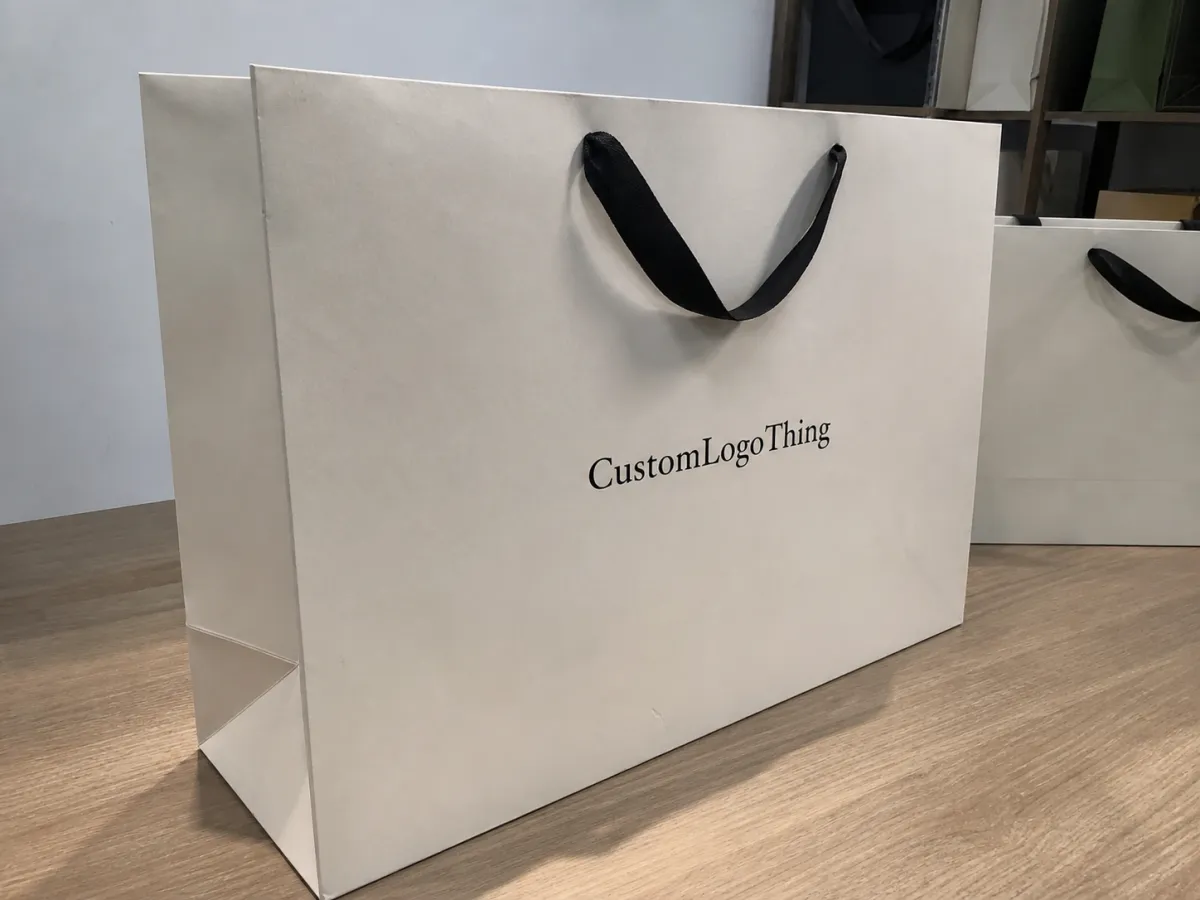
A well-sized large boutique bag makes the transaction feel smoother. The product sits upright, the handle doesn’t pull awkwardly, and the customer does not need to pinch the opening to keep a rigid box from tipping. That matters more than people admit. Retail packaging is part of the handoff, and the handoff is part of the sale.
With larger formats, the bag becomes a visible signal of price point. A thin stock, narrow handle, or off-center logo can make a premium item look discounted. The reverse is also true. A properly proportioned bag can make a mid-priced product feel more elevated than the item alone would suggest. That does not require luxury embellishment. Often it is enough to get the board weight, print density, and handle balance right.
Practical issues sit underneath the visual ones. The wrong bag size means more crushed corners, more handle strain, and more repacking at the counter. A bag that is too tall wastes material and freight volume. A bag that is too shallow risks bulging at the gusset and distorting the front panel. For larger programs, those small errors show up in returns, store complaints, or a pile of samples that never quite made it into production.
Buyers who sort product dimensions, retail setting, and branding expectations early usually get cleaner pricing on printed large Boutique Paper Bags with logo quote requests. The supplier can then price a real bag rather than trying to reverse-engineer one from a logo file and a short email. The difference is material. The quote is more accurate, and the production path is easier to manage.
Paper Stock, Finish, and Handle Choices
Paper stock is the first place to make or lose money. Natural kraft is popular because it carries a sturdy, tactile look and can support recycled or FSC-certified positioning. It also hides minor scuffs better than many coated options. Coated art paper, by contrast, gives sharper artwork reproduction and cleaner solids, which helps when the logo has fine type, gradients, or a multi-color mark that needs precision.
For large boutique bags, paper weight usually lands somewhere in the 170-250 gsm range, though the exact recommendation depends on construction and contents. Lighter papers may work for apparel or gift items. Heavier boxes, stacked sets, or retail programs with repeated customer handling usually need more board strength and sometimes reinforcement at the mouth or base. A supplier who quotes a very light stock for a heavy load is not saving money. They are shifting the cost into failures later.
Finish changes the feel more than some buyers expect. Matte finish reduces glare and tends to age better under handling. Gloss can make colors punchier, but it also highlights fingerprints and edge wear. Soft-touch has a premium hand-feel, yet it can be more sensitive to rub marks and pressure points during packing. For large bags, that sensitivity matters because flat-packed cartons are stacked, moved, and sometimes compressed before they ever reach a store.
Handles deserve a proper review instead of being treated as a decorative afterthought. Rope handles are usually the strongest all-around option for boutique formats. Paper twist handles are economical and sit well with natural branding, especially on kraft bags. Ribbon handles can read as more refined, but they are not always the best answer for heavier goods. Die-cut handles work on certain flat, lighter bags, though they are less forgiving when the contents have real weight.
| Spec Choice | Typical Use | Cost Impact | Practical Tradeoff |
|---|---|---|---|
| Natural kraft + paper twist handle | Gift shops, apparel, eco-forward brands | Lowest to moderate | Good strength, less premium sheen |
| Coated art paper + rope handle | Boutique retail, cosmetics, luxury promos | Moderate | Cleaner print, stronger shelf appeal |
| Soft-touch lamination + ribbon handle | Premium gifting and high-end retail | Higher | Better tactile feel, more scuff-sensitive |
| Heavy board reinforcement + die-cut or rope | Large, heavier boxed products | Highest | Best load support, more setup and material |
Reinforcement is not optional once the contents gain real weight. Look for glued bases, reinforced tops, and handle patches where the pull stress lands. If the bags are carrying footwear boxes, stacked gift sets, or dense product bundles, ask for the load rating and the test method. “Boutique” is a style description, not a strength guarantee.
Sizing and Print Specs That Affect the Quote
Bag dimensions drive the quote more than most people expect. Width, gusset, and height all affect sheet usage, cutting layout, carton count, and how efficiently the press can impose the artwork. A small change in gusset depth can have a surprisingly large effect on yield. On oversized bags, that effect is amplified because the dieline uses more material and wastes more space if the proportions are not efficient.
Before asking for pricing, lock the internal logic of the bag. What size product is going inside? Does it need to sit upright? Does the customer need to carry it comfortably at arm’s length? Will it move through a crowded sales floor or mostly travel from counter to car? These are not abstract questions. They determine whether the bag should be tall and narrow, wide and stable, or designed with extra gusset room for a boxy item.
Print coverage changes the number quickly. One-color logo print on a single panel is the simplest route. Full-bleed coverage, heavy background color, repeated pattern work, foil stamping, embossing, debossing, or spot UV all add setup, time, and waste risk. They can look excellent, but only if the artwork is prepared carefully and the paper stock can support the finish. A dense solid on a soft or porous stock may print differently than the render suggests.
Vector files matter. AI, EPS, or a properly prepared PDF gives the printer the control needed for line quality and placement. Screenshots do not. Neither do low-resolution images that look acceptable on a laptop and then fall apart at bag size. Thin type, small icons, and intricate marks need special attention because the larger the bag, the more obvious registration flaws become. A logo that is slightly off on a 20 cm bag becomes visibly off on a 45 cm bag.
For printed large Boutique Paper Bags with logo quote requests, the most useful instruction is often the simplest one: tell the supplier exactly where the mark should sit and how much blank space should remain around it. That reduces proof revisions and avoids the common situation where a logo is technically centered but visually awkward once the handles, gusset, and fold lines are taken into account.
It also helps to specify whether the print is intended for a quiet luxury look or a more promotional retail style. Those two briefs can use the same logo and still need very different ink density, spacing, and finish choices. The quote changes because the production method changes, not because the bag suddenly became “better” or “worse.”
Pricing, MOQ, and Quote Drivers
Pricing usually comes down to five variables: paper grade, print coverage, handle construction, finishing, and order quantity. Once those are fixed, the rest is mostly execution. MOQ exists because setup costs are real. The printer has to prepare the plates or screens, set the press, cut the die, and check registration. Those costs do not disappear just because the first order is small.
As a planning guide, a simple large kraft bag with a single-color logo might land around $0.35-$0.75 per unit at 5,000 pieces, depending on size and handle type. A coated paper bag with a rope handle and one or two print colors often sits around $0.65-$1.40 per unit at the same volume. If you add lamination, foil, embossing, or soft-touch finish, a premium oversized bag can move into the $1.10-$2.40 range or higher. Those are directional ranges, not promises. Freight, location, and paper market swings can push them around.
Quantity changes the curve. At 10,000 pieces, the fixed setup cost spreads out and unit pricing usually drops. At 1,000 or 2,000 pieces, the unit cost rises fast because the press setup is being amortized over a smaller run. That is why first orders often look expensive relative to the repeat order. The economics are not unfair; they are simply front-loaded.
Comparing quotes only works if the specs match. A 200 gsm coated bag with a double-twist rope handle is not comparable to a 170 gsm kraft bag with paper twist handles, even if both are described as “large boutique paper bags.” Ask for the exact size, stock weight, handle type, and print coverage in every quote. If one supplier includes export-grade cartons and another quotes loose-packed bags, the lower number is incomplete rather than cheaper.
Watch for hidden variables as well. Sampling, pre-production proofs, custom insert cards, special inner printing, and split shipments can alter the final cost. A transparent quote should separate the bag, the print, the finishing, the sample charge, and freight. That format makes it much easier to see where savings are possible without changing the bag’s core quality.
Production Steps, Lead Time, and Shipping Milestones
A reliable order moves through a familiar chain: quote, artwork review, proof approval, production, packing, and freight booking. The chain is simple enough. The delays happen when one step is treated casually. Proof approval is the most common weak point. Once the proof is signed off, the production team uses that file and those measurements. If the logo is too high, the handle holes are too close to the top fold, or the color reference is vague, the problem becomes expensive instead of theoretical.
For straightforward printed bags, production often runs about 12-15 business days after proof approval. More complex jobs can stretch into the 18-30 business day range, especially if they include foil, embossing, multi-step lamination, or hand assembly. Lead time should be separated from shipping time. That distinction sounds basic, yet it causes avoidable frustration every season because buyers quote the factory schedule as if it includes transit.
Rush production is possible in some cases, but it narrows the margin for error. Artwork needs to be final, the shipping destination needs to be ready, and the receiving window cannot be vague. If the bags are headed to a warehouse with strict appointment scheduling, build in extra time. If they are going through more than one distribution point, the packaging spec should include enough strength to survive handling changes and carton stacking.
For shipments that need to endure long transit chains, it is reasonable to ask whether the cartons are packed with stack resistance in mind. Large flat-packed bags can deform if cartons are too loose, too heavy, or poorly sealed. If export handling is involved, shipment testing references from ISTA are useful for thinking about compression and rough handling. The goal is not to overcomplicate a simple product. The goal is to keep a flat bag from arriving bent, wavy, or marked before it ever reaches the sales floor.
Ask for a schedule that separates manufacturing milestones from freight milestones. That one document prevents a lot of confusion later.
Repeat Order Consistency for Retail Rollouts
The first order gets attention. The second order proves whether the spec was actually controlled. For retail rollouts, pop-ups, and seasonal replenishment, consistency matters more than novelty. If the approved bag used a certain paper weight, handle length, or gloss level, those details need to stay fixed. Small shifts make a bag feel different in the hand, even when the printed artwork is unchanged.
Good operators keep the approved dieline, Pantone references, carton counts, and packing method on file. They do not rely on memory or old email threads. That may sound dull, but it saves time and protects the brand. A 170 gsm bag and a 210 gsm bag can appear nearly identical in a photograph while behaving very differently under load. The same problem shows up with handle thickness. One millimeter of rope diameter can change the feel of the bag more than a buyer expects.
Quality control should happen before shipment, not after complaints. Check print registration, handle pull strength, base adhesion, and the alignment of the folded top edge. On large programs, ask for first-off samples or an in-line inspection if the quantities justify it. A run that looks fine from a distance can still hide problems like uneven lamination, slightly crooked logo placement, or weak glue lines at the base corners.
For chain retail, matching presentation across locations matters as much as the design itself. Customers notice when one store hands over a crisp, well-made bag and another store gives them a thinner version with a dull finish and looser handles. The discrepancy suggests inconsistency upstream, which is rarely a good look for a brand that wants to feel organized.
Shipping, Storage, and Damage Prevention
Large boutique bags usually ship flat. That keeps freight efficient, but it also means the cartons have to be packed with enough discipline to survive stacking and handling. If the bag has lamination, foil, or a soft-touch surface, edge wear can show up before the bags are even opened. Ask how many bags go into each carton, whether cartons are reinforced, and how the supplier prevents compression at the corners.
Moisture is a real problem. Paper absorbs humidity, adhesives weaken, and edges warp if cartons are stored badly. Warehouses that are too warm, too damp, or too close to loading doors cause avoidable damage. This sounds elementary because it is elementary. Yet it still happens, especially during seasonal rushes when cartons are stacked wherever space exists.
Receiving details matter too. If the bags are going to multiple stores, confirm pallet labels, carton counts, and receiving windows before dispatch. Mislabelled freight slows down launch dates and increases the odds of accidental damage. If the rollout date is fixed, build a buffer for customs checks, carrier delays, and the usual last-mile surprises. That buffer is not wasted time. It is the difference between a controlled launch and a hurried one.
For recycled or FSC-certified stock, keep the paper claim, purchase order, and shipping paperwork together. That makes it easier to confirm what was ordered if a store manager, auditor, or internal buyer asks later. Claims are only as good as the documents behind them.
Printed Large Boutique Paper Bags With Logo Quote: What to Send
An accurate quote starts with a complete spec sheet. The faster the supplier can see the real requirements, the faster the price becomes useful. Half the delays in bag sourcing come from missing dimensions or vague artwork notes. The other half come from buyers assuming the supplier can guess what “large” means in context.
Include these details in one message:
- Exact size: width, gusset, and height in millimeters or inches.
- Quantity: total run and any likely repeat order volume.
- Paper stock: kraft, coated art paper, recycled stock, or another grade.
- Handle style: rope, ribbon, paper twist, or die-cut.
- Print specs: number of colors, Pantone references, foil, embossing, or inside print.
- Finish: matte, gloss, soft-touch, or unlaminated.
- Destination: delivery address, pallet needs, and required arrival date.
It also helps to include the logo file, a placement note, and any non-negotiable construction detail such as reinforced top edge, extra base board, or handle length. If a sample is needed, say whether you want a plain stock sample, a printed proof, or a pre-production sample. Those are different objects with different lead times and different uses.
A small amount of clarity at the start saves a large amount of rework later. That is especially true for printed large boutique paper bags with logo quote requests, where the final result depends on the fit between brand image and packaging structure as much as it does on the artwork itself.
What should I include in a printed large boutique paper bags with logo quote?
Send the exact bag size, quantity, paper stock, handle style, print colors, finish, and delivery destination so the supplier can price the actual build. Add artwork files and logo placement notes as well, because those affect both setup and proofing.
Which paper stock works best for large boutique paper bags with logos?
Kraft works well for a natural, sturdy look and is often easier to position as recycled or FSC-certified. Coated paper is better for crisp artwork and more polished color. The right answer depends on load, finish, and how premium the bag should feel in hand.
How does MOQ affect the price per bag?
Higher MOQ usually lowers unit cost because press setup, cutting, and finishing are spread over more bags. Small runs tend to carry a higher per-unit price, so the first order may look expensive compared with repeat replenishment.
How long does production usually take for large boutique bags?
Simple runs often take about 12-15 business days after proof approval. More complex jobs with foil, embossing, or hand assembly can take longer. Freight time is separate, so ask for both manufacturing and transit estimates before setting launch dates.
Can I see a sample before I place the order?
Yes, and it is usually the smartest move. A sample shows paper feel, handle strength, and how the logo reads at full size. Make sure the sample type is clear, since a plain sample, a printed proof, and a pre-production sample each serve a different purpose.

