Boutique Paper Bag Handles: Compare Options Before You Order
The Boutique Paper Bags handle options comparison often tells a more useful story than the paper stock itself. A 157 gsm art paper bag with a well-made rope handle can feel more premium than a heavier bag with a weak die-cut slot, because shoppers touch the handle first, judge the grip instantly, and remember the carry experience long after checkout.
That matters because boutique buyers are not buying a container. They are buying comfort, presentation, and a small but powerful signal that the brand paid attention to details. Twisted paper, flat paper, rope, ribbon, die-cut, cotton, and laminated options all create different expectations, and the tradeoffs rarely line up neatly. Strength pulls one way, appearance another, and cost usually drags behind both.
If you are choosing between styles, compare four things first: load, appearance, sustainability, and price. Those factors move together, but not at the same speed. The best choice is not the fanciest handle on paper. It is the one that fits the product, the customer journey, and the order quantity you can actually support.
Boutique paper bags handle options comparison: what shoppers notice first
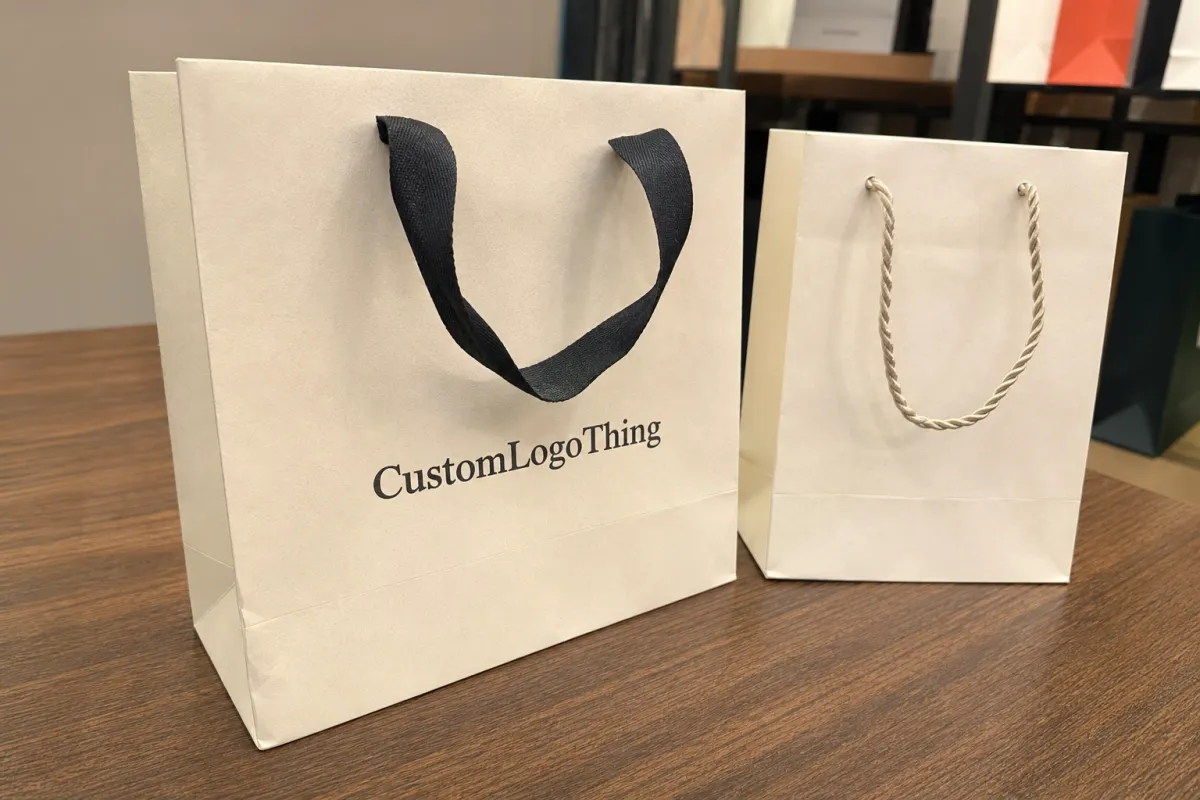
Open a boutique bag and the handle usually gets noticed before the board grade, the coating, or the print finish. That is not a theory. It is simple hand logic. People reach for the point of tension. If the handle feels balanced and secure, the bag earns a premium impression. If it digs into fingers, twists awkwardly, or pulls unevenly, the whole package feels cheaper even when the print is flawless.
That is why a Boutique Paper Bags handle options comparison should begin with the shopper’s first touch. Twisted paper handles usually communicate practical value and recyclability. Flat paper handles feel tidy and familiar. Rope handles give the bag more substance and a gift-like feel. Ribbon handles lean decorative and high-end, though they are better suited to lighter loads. Die-cut handles are clean and economical, but they depend heavily on board strength and top reinforcement. Cotton and laminated handles sit further up the premium ladder, yet they also raise cost and production complexity.
Most buyers forgive simple print before they forgive a weak handle. That is especially true in gift retail, beauty packaging, apparel, and specialty food bags.
Reuse matters too. A handle that feels sturdy enough for a second trip extends brand exposure. A handle that frays, tears, or stretches badly does the opposite. The decision is not only about carrying one purchase home. It also affects the unboxing moment, checkout photos, gifting, and whether the bag survives one more use.
Seen that way, the handle is not a small detail. It is the part of the bag that turns packaging into an object people notice.
How handle styles work on custom paper bags
Handle construction changes how the bag behaves from the top edge down. A twisted paper handle is usually attached through reinforced eyelets or glued anchor points inside the bag. Flat paper handles use similar attachment logic, but their broader shape spreads pressure differently in the hand. Rope and cotton handles often rely on knots, ferrules, or reinforcement tabs, which add strength and a more finished appearance. Die-cut handles skip a separate component entirely, but they depend heavily on paperboard strength and clean top reinforcement.
That attachment method matters because it affects folding, load transfer, and print area. A glued anchor may be fast to assemble, yet it can pull the mouth of the bag inward if the internal reinforcement is weak. A rope handle can support a heavier fill, but if the top board is too light, the bag may deform before the rope fails. In practice, the handle and the top edge should be designed as one system, not two separate parts.
Comfort is just as important. A narrow handle concentrates pressure, especially if the bag swings while walking. A wider handle spreads force better and feels less sharp during longer carries. For a customer walking from counter to car, that may not matter much. For someone carrying a heavier apparel order across a mall or through transit, it matters a lot.
Typical paper bag builds also vary by stock. A 120-157 gsm bag can work for lighter retail use, while 200+ gsm or reinforced board constructions are more suitable when the contents are dense or the bag needs to look structured. Coated or laminated finishes improve appearance and stiffness, but they can also affect recyclability and folding behavior. Those tradeoffs should be checked before the artwork is approved, not after bulk production starts.
Here is a practical Boutique Paper Bags handle options comparison across common styles:
| Handle type | Typical feel | Load behavior | Typical add-on cost | Best use case | Main caution |
|---|---|---|---|---|---|
| Twisted paper | Practical, tidy | Good for light to medium loads | $0.03-$0.06/unit | Gift, apparel, general retail | Can feel basic if finishing is poor |
| Flat paper | Clean, familiar | Often comfortable in hand, but reinforcement matters | $0.03-$0.07/unit | Boutique retail, takeaway bags | Needs strong anchoring to avoid tearing |
| Rope | Premium, substantial | Strong for medium to heavier loads | $0.05-$0.12/unit | Luxury retail, cosmetics, apparel | Raises material and assembly cost |
| Ribbon | Elegant, gift-oriented | Best for lighter contents | $0.06-$0.15/unit | Special events, beauty, gifting | Not ideal for dense or awkward products |
| Die-cut | Minimal, modern | Depends on board strength and hole reinforcement | $0.00-$0.04/unit | Light boutique items, promo packs | Finger comfort drops as weight rises |
| Cotton | Soft, high-touch | Good comfort and dependable carry | $0.07-$0.16/unit | Premium retail, reusable bags | Higher cost and more material weight |
| Laminated or wrapped handle | Glossy, polished | Varies by build quality | $0.06-$0.14/unit | Luxury presentation bags | Can complicate recyclability |
Those numbers are not universal, but they are realistic enough to frame a buying conversation. The real question is not which handle looks best in isolation. It is which handle works with the same bag size, paper weight, print coverage, and internal reinforcement without creating weak points or an awkward top fold.
Cost, pricing, and MOQ tradeoffs
Handle choice can move unit cost more than many buyers expect. A rope handle usually needs more material, more assembly steps, and sometimes more reinforcement than a twisted paper handle. Ribbon can look delicate on the finished bag, but the manufacturing side is not always delicate at all. If the handle requires separate cutting, threading, tying, or color matching, labor starts to matter quickly.
For a 5,000-piece order, the price spread between a plain die-cut handle and a premium rope or cotton build can be meaningful. In many programs, the handle alone can shift the bag by several cents per unit, and that adds up faster than many buyers plan for. A difference of $0.05 on 10,000 bags is $500. That is real money in a packaging budget, especially when the bag is only one line item in a larger launch.
MOQ changes the picture again. At low volumes, setup cost is spread across fewer units, so a premium handle can look expensive very quickly. At higher volumes, the same handle may become easier to justify because the setup is diluted. This is why suppliers should quote the same bag size, the same paper stock, and the same print coverage across multiple handle styles. Otherwise, the comparison is noisy.
Ask for line-item clarity on these costs:
- Handle material such as paper cord, cotton, ribbon, or wrapped rope
- Reinforcement like internal pads, top cards, or extra adhesive
- Assembly labor including threading, gluing, and inspection
- Freight weight because heavier handle builds can raise shipping cost
- Reject allowance since ornate handles can create more waste if tolerances are tight
If a supplier cannot explain where the price difference comes from, the quote is not useful enough yet. Good buyers compare like for like. Good suppliers should be able to separate handle cost from the rest of the bag spec so the premium is visible instead of buried inside a bundled price.
Process, timeline, and lead time expectations
Handle selection affects lead time because it changes both sourcing and assembly. A stock twisted paper handle can usually move through production with minimal disruption. A custom-colored rope or specialty ribbon may require material confirmation, color approval, or a different assembly workflow. Those steps do not sound dramatic, but they are where schedules slip.
The cleanest production path usually looks like this: quote confirmation, dieline review, sample approval, bulk manufacturing, quality inspection, and shipping. Each step is small on its own. Together they determine whether the order lands on time. If the handle is unusual, the sample stage becomes especially important. That is where glue strength, board crease behavior, and top-edge symmetry show up before bulk production locks them in.
Typical timing varies by supplier and season, but many custom paper bag orders land in the 12-18 business day range after proof approval when stock materials are used. If handle materials need sourcing or testing, add time. A fully custom handle build can push the project into the 3-4 week range or more, especially if the order also needs specialty finishes or heavier reinforcement.
For logistics-minded buyers, it helps to use the same discipline packaging engineers use in transport testing. The International Safe Transit Association publishes methods for distribution testing that are useful when you want to pressure-test a bag concept before committing to volume: ISTA. That does not mean every boutique bag needs formal lab testing, but it does mean the concept should be checked against realistic handling, stacking, and drop conditions before approval.
Rush orders often fail at the sample stage, not the print stage. The artwork may be fine. The handle may be the reason the project slips, because it is easier to overlook than a logo color or a panel layout. That is exactly why lead time should be confirmed in writing, with one line that says whether the timeline assumes stock materials or a custom handle build.
What matters most beyond style alone
A handle should start with the product, not the mood board. A light jewelry pouch, a rigid candle box, and a folded apparel set all place stress in different places. A handle that looks elegant can still be wrong if the fill height is too tall, the contents are dense, or the top edge needs extra support. The safest order of thinking is simple: product weight first, then bag geometry, then style.
Branding goals matter too. Some boutiques want a soft luxury cue, where the bag feels giftable but not flashy. Others need a rugged, reusable carry option that suggests practicality and substance. The handle should support that position. Rope and cotton usually read as more premium and reusable. Twisted paper can feel understated and contemporary. Die-cut handles make sense when minimalism is part of the brand language.
Sustainability is best treated as a materials question, not a slogan. Recyclability depends on the mix of fibers, adhesives, coatings, and added components. A paper bag with paper handles and water-based inks is usually easier to explain than one with mixed plastics and heavy lamination. For buyers who need a sourcing reference point, the Forest Stewardship Council is a useful checkpoint for paper fibers: FSC.
Warehouse efficiency matters too, even if it is less glamorous. Some handles pack flatter. Some stand taller in cartons. Some create snag risk during packing. Those details affect cube utilization, freight cost, and the time it takes to fill cases without damaging the bag mouth. The best-looking option is not always the easiest one to store, ship, and receive.
That is why a smart boutique paper bags handle options comparison includes the back-of-house story, not just the customer-facing one.
Step-by-step comparison checklist for buyers
The fastest way to make a good decision is to compare options using the same baseline. Otherwise every sample carries a slightly different paper weight, different print area, and different reinforcement, which makes the comparison messy. Keep the variables controlled and the result gets clearer.
- Define the use case. Gift bag, apparel bag, cosmetics bag, food takeaway, or event giveaway each points to a different handle profile.
- Lock the size first. Bag width, gusset, and height change how much load the handle actually carries.
- Choose two or three handle families. Do not compare six styles at once unless the order is large enough to justify the time.
- Request like-for-like samples. Same size, same paper stock, same print coverage, different handle only.
- Test with real product weight. Use the exact contents you plan to ship, not a lighter stand-in.
- Score four categories. Comfort, appearance, cost, and lead time should be rated side by side.
- Approve one final spec line. Write the handle type, color, attachment method, reinforcement, and target weight range into the PO.
That last step sounds boring. It is also where errors stop. Procurement, design, and production should all read the same handle spec before the order starts. If one team assumes twisted paper and another assumes rope, the project loses time and money fast.
A simple comparison sheet often tells the whole story. A premium handle may score highest on appearance, but if it pushes lead time out by a week and raises cost by 12 percent, the value case needs to be strong. Conversely, a die-cut handle may look modest yet win because it packs well, ships cheaply, and handles the actual product weight without trouble.
Common mistakes and expert tips
The most common mistake is choosing a handle for looks alone. That is understandable; the bag is a brand object, and visuals matter. Still, visual cues do not guarantee grip strength. A ribbon handle can read as elegant and still be a poor fit for a dense product. A die-cut handle can look minimal and modern, yet punish the hand if the bag gets too heavy.
Another mistake is treating all boutique bags as if they share one stress profile. They do not. A small fragrance bag and a folded denim bag create very different pull forces. The handle, the board, and the reinforcement should match the heaviest plausible fill, not the lightest sample that happened to be on the desk during approval.
Watch for sample drift, too. A buyer may approve one paper weight, one lamination, and one handle configuration, then place the order on a slightly different spec because of cost pressure. That is where surprises happen. If the approved sample and the ordered version are not identical, the result is not the same product.
Two practical checks usually save the most trouble:
- Ask for a weight test and a drop test if the contents are dense, irregular, or likely to shift during carry.
- Standardize one or two handle families across your SKU set if you want simpler purchasing, faster reorders, and more consistent brand presentation.
In practice, the strongest programs are often the least complicated ones. They do not chase novelty in every bag size. They use a narrow set of proven constructions and spend their energy on finish quality, color consistency, and clean assembly.
Frequently asked questions
Which handle works best for boutique paper bags carrying heavier items?
Choose a reinforced rope, flat paper, or well-anchored twisted paper handle when load matters most. Test the bag with the actual product weight, not a sample fill, because capacity can change after printing and finishing.
How do boutique paper bags handle options change the unit price?
Premium materials, extra reinforcement, and more manual assembly usually raise unit cost. Ask suppliers to quote the same bag size and print spec across multiple handle styles so you can see the real difference.
What handle type looks most premium without feeling impractical?
Ribbon and rope handles often read as higher-end, but the best choice depends on the product and expected carry time. For a more understated luxury look, many buyers prefer a clean twisted paper or die-cut option with strong finishing.
How much extra time does a custom handle usually add?
If the handle uses stock materials, the timeline impact may be small. If it requires color matching, reinforcement testing, or a new assembly method, lead time can increase quickly.
Should I use the same handle style across all my boutique paper bags?
Use one handle family when it supports your brand and simplifies procurement, but do not force it on every bag size. Separate lightweight gift bags from heavier retail bags when the product load or customer experience calls for a different build.