Buyer Fit Snapshot
| Best fit | Printed Packaging Stickers with Logo projects where brand print, material claims, artwork control, MOQ, and repeat-order consistency need to be specified before quoting. |
|---|---|
| Quote inputs | Share finished size, material target, print colors, finish, packing count, annual reorder estimate, ship-to region, and any compliance wording. |
| Proofing check | Approve dieline scale, logo placement, barcode or warning zones, color tolerance, closure strength, and carton packing before bulk production. |
| Main risk | Vague material claims, crowded artwork, missing packing details, or unclear freight terms can make a low unit price expensive after revisions. |
Fast answer: Printed Packaging Stickers with Logo: Material, Adhesive, Artwork, and MOQ should be specified like a repeatable production item. The safest quote records material, print method, finish, artwork proof, packing count, and reorder notes in one written spec.
Production checks before approval
Compare the actual filled-product size with the drawing, then confirm tolerance on folds, seals, hang holes, label areas, and retail display edges. Reserve space for logos, QR codes, warning copy, and material claims before decorative graphics fill the panel.
Quote comparison points
Review material grade, print process, finish, sampling route, tooling charges, carton quantity, and freight assumptions side by side. A quote is only useful when the supplier can repeat the same color, closure quality, and packing count on the next order.
Printed Packaging Stickers with Logo: Smart Buying Guide starts with a simple truth that many brands overlook: the sticker is often the first branded surface a customer actually touches, especially on mailers, jars, shipping cartons, and retail boxes. A well-made sticker does more than decorate. It seals, identifies, informs, and quietly shapes the way people judge the rest of the package.
For any brand that cares about package presentation, printed packaging Stickers with Logo are one of the most adaptable tools available. They can lift plain cartons, support seasonal campaigns, and create a cleaner unboxing moment without forcing a full redesign of the product packaging. That flexibility keeps them in demand for both small test runs and larger production orders.
What makes them effective is not just the logo itself, but the way shape, finish, and placement work together. A round seal on tissue paper sends a different signal than a matte die-cut sticker on a corrugated mailer, and a glossy label on a bottle does a different job than a paper seal on a folding carton. If you are comparing printed packaging stickers with logo against ordinary labels or generic seals, the real difference is that branding purpose is built into every choice.
From a packaging buyer's point of view, the best decisions usually come down to a handful of practical questions: what print method fits the quantity, what face stock survives the environment, which adhesive will actually hold, and how the finish will look under store lighting or camera flash. Those are the details that separate a sticker that merely exists from printed packaging stickers with logo that earn their keep.
For broader packaging planning, it helps to connect sticker decisions to the rest of your system. The finish on a carton, the coating on a pouch, and the texture of a mailer all affect how the sticker reads visually. If you are also shopping for Custom Packaging Products or comparing them with Custom Labels & Tags, it pays to think about the entire package as one coordinated surface rather than a pile of separate parts.
Printed Packaging Stickers with Logo: What They Are and Why They Stand Out
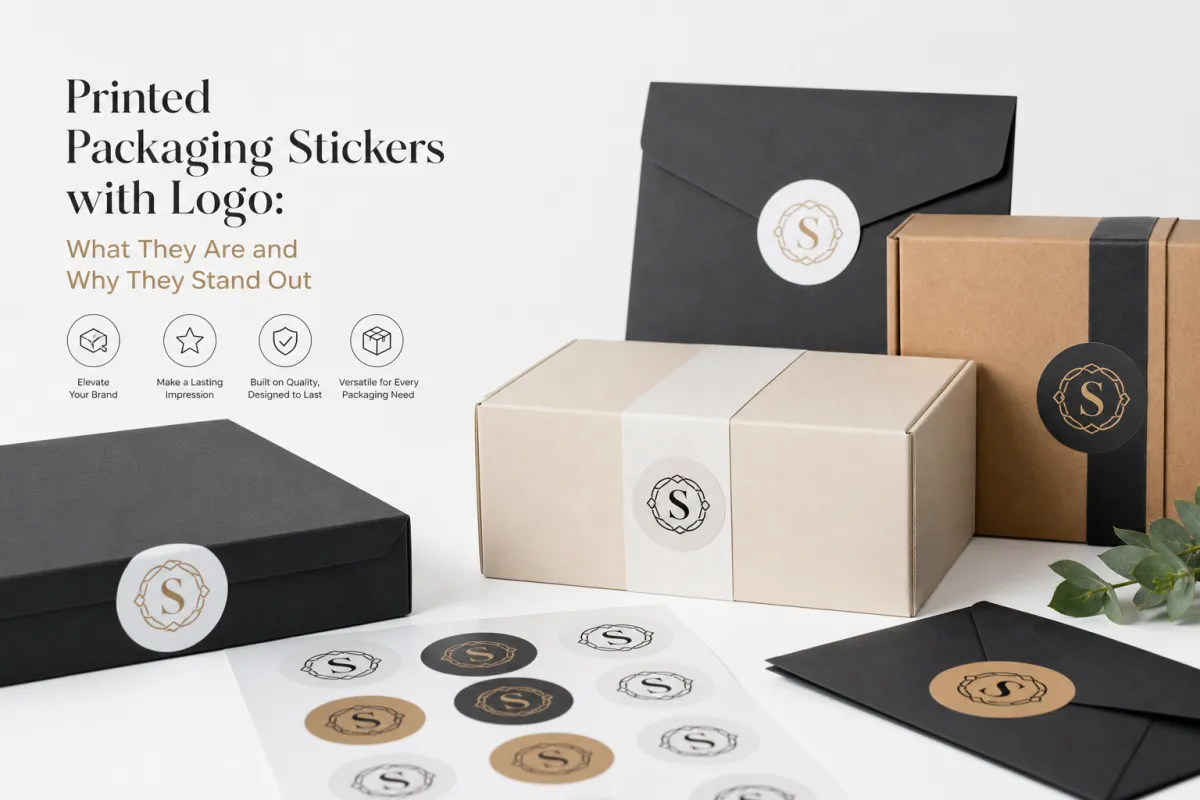
Printed packaging stickers with logo are branded adhesive pieces designed to do more than identify a product; they act as a visible layer of package branding that can seal flaps, decorate the outer carton, mark a batch, or reinforce a customer-facing message. In practice, they show up everywhere from subscription mailers to deli tubs to high-end rigid boxes because they are easy to apply and surprisingly strong in how they shape first impressions.
The reason they stand out is not magic. It is the mix of visibility and touch. A customer may glance at a carton, but they often handle the sticker directly while opening the package. That small moment matters. A crisp, well-aligned sticker suggests care, and care is something people notice fast in retail packaging and ecommerce alike. Printed packaging stickers with logo can make even a simple brown box feel intentional.
There is also a practical side. A brand can change a campaign, seasonal message, or product variant without redesigning structural packaging. That is useful for small businesses that do not want to commit to large runs of custom printed boxes, and it is just as useful for larger teams managing multiple SKUs. Printed packaging stickers with logo give you a branding layer that is faster to update than cartons, sleeves, or molded components.
Here is the part buyers sometimes miss: the sticker is not just a logo carrier. It is part of the packaging design system. A square sticker with a heavy border feels different from a soft die-cut shape that follows the logo outline. Matte paper sends a more understated message than gloss film. A centered seal on the front panel feels formal, while a corner placement can look relaxed and modern. Those choices quietly tell the customer what kind of brand they are dealing with.
From a production standpoint, printed packaging stickers with logo sit at the intersection of function and presentation. They may need to close a mailer, keep a carton tamper-evident, or simply keep the package visually tidy. The best programs treat them as a repeatable part of the system, not an afterthought. That is why brands that use them well usually have a clear spec for size, finish, and placement instead of asking for a generic sticker and hoping the result feels premium.
"A sticker is small, but it travels everywhere the product travels. If it looks off by a millimeter or peels in transit, the customer notices immediately."
That is why printed packaging stickers with logo deserve the same level of planning you would give to cartons, inserts, or shipping tape. In strong branded packaging, small surfaces often do more visual work than the big ones.
How Printed Packaging Stickers with Logo Are Made
The production path for printed packaging stickers with logo starts with artwork and ends with trim, but the middle matters just as much. A logo that looks sharp on a screen can shift once it moves onto paper, film, or a coated stock, and that shift comes from how ink sits on the surface, how the artwork is separated, and what finishing steps happen after printing.
Most jobs begin with prepress review. That means checking file resolution, bleed, safe area, and color setup before anything goes to press. Vector artwork is preferred because it keeps edges clean at any size, while raster logos can soften if the file is too small. If the design includes fine type or thin lines, those details need extra care, because printed packaging stickers with logo are often judged at arm's length, not from across a room.
Print methods and why they matter
Digital printing is a common choice for shorter runs and mixed artwork because it avoids plate costs and can move quickly once the file is approved. Flexographic printing is often a better fit for larger runs, especially when the same design repeats across thousands of pieces and the setup cost can be spread out. There are also specialty production paths for metallic effects, heavy coatings, and niche materials, but the core question stays the same: how many pieces do you need, and how consistent does the color need to be?
Printed packaging stickers with logo produced digitally usually give buyers more flexibility on quantity and version changes. Flexo tends to make more sense when the order is stable, the artwork will not change often, and the unit economics matter more than absolute flexibility. A good supplier should explain the tradeoff without pretending one process is always better. That is not how print works, and anyone who has managed production knows that the material and quantity usually decide the method before the logo does.
For buyers comparing print methods, the most useful question is not "which one is best?" It is "which one fits this run, this surface, and this budget?" That is especially true for printed packaging stickers with logo used across multiple SKUs, because a method that works beautifully on a 2,000-piece test may not be the smartest choice for a 20,000-piece reorder.
Cutting, format, and finishing
After printing, the stickers are cut into their final shape. Kiss-cutting leaves the backing intact while cutting only the sticker layer, which is helpful for sheets and peel-off application. Die-cutting trims the shape fully around the edge, creating a custom silhouette that can follow the logo or a specific outline. Roll format is common for faster application, while sheets often work better for hand packing, small runs, or storage on busy packing tables.
That finishing choice has real operational impact. Printed packaging stickers with logo on rolls can speed up manual application and fit better into semi-automated workflows. Sheet format can be easier for teams that pack a few hundred boxes a day and need stackable material that stays tidy in the warehouse. If the sticker is being applied by hand to retail packaging, the format can matter almost as much as the print quality.
Coatings and laminates are another layer of protection. A clear varnish, gloss laminate, matte laminate, or soft-touch film can help reduce scuffing, protect color density, and improve handling during shipping. If the packaging will be stored in humid conditions, placed in coolers, or touched frequently, finishing is not cosmetic fluff; it is part of durability. Printed packaging stickers with logo often need that extra protection to hold up through transit and display.
Proofing closes the loop. A digital mockup can catch layout problems quickly, but for color-sensitive work, a physical sample or press proof gives a far better read on how the final sticker will behave. This is where small errors get expensive if they are missed: a font too small, a border too close to the edge, or a contrast issue that makes the logo disappear against a reflective surface. In the packaging trade, catching that early is always cheaper than correcting it later.
For brands that want a wider view of structural and decorative options, it helps to compare the sticker job with other branded packaging components. A sticker may be the most flexible item in the mix, but it still has to work with the box, pouch, or bottle around it. That is the real production picture behind printed packaging stickers with logo.
Materials, Adhesives, and Finish Choices That Change Performance
The material choice behind printed packaging stickers with logo is where many buying decisions are won or lost. A sticker can look great on a sample sheet and still fail on a frosted bottle, a textured mailer, or a cold carton pulled from storage. That is why a practical material spec matters. It helps the sticker survive the surface, the environment, and the handling routine it will actually face.
For face stock, coated paper is a common, cost-effective option for dry environments and short-term use. It prints cleanly and often has a nice feel for general retail packaging. BOPP, which is a polypropylene film, is a better fit for moisture resistance, abrasion, and stronger handling. Other film stocks can be selected for specialty jobs, especially when the packaging will encounter refrigeration, oils, or repeated contact. Printed packaging stickers with logo do not need the most expensive material, but they do need the right one.
Adhesive selection is just as important. Permanent adhesive is the usual choice for most branding and sealing applications because it is designed to stay put. Removable adhesive is helpful if the sticker must come off cleanly, though it is not always reliable on rough or curved surfaces. Freezer-safe or high-tack adhesives matter for cold-chain conditions, chilled display, or packaging that sees condensation. Temperature swings can change performance fast, which is why printed packaging stickers with logo for food packaging, cosmetics, or beverage packaging need a real use-case check rather than guesswork.
Finish and visual tone
Gloss finish gives stronger shine and more visual pop, especially under bright retail lights. Matte finish reduces glare and can make typography easier to read at close range. Satin sits between the two, with a softer reflection that often feels balanced. Soft-touch lamination adds a velvety feel that can elevate Premium Product Packaging, but it should be used with care because fingerprints, scuffing, and color shifts can still show up depending on the artwork.
The finish also changes how printed packaging stickers with logo read from a distance. High contrast matters more on matte than on gloss, because reflections can wash out tiny details. If the sticker includes a QR code, ingredients, a short campaign message, or a small logo lockup, the finish needs to support legibility rather than fight it. That is especially true in retail packaging, where lighting is rarely neutral and shelf viewing is rarely ideal.
Shape, size, and application surface
Shape is not decoration alone. A complex die-cut can look memorable, but every extra curve creates more trimming complexity and often more waste. Tiny text inside an irregular shape can become hard to read, and very intricate outlines may lift at the edges faster if the sticker is applied to a curved or flexible surface. For printed packaging stickers with logo, the smartest shape is usually the one that balances brand character with easy application.
Surface type matters just as much. Smooth cartons, coated mailers, glass, PET, and metal each behave differently. Texture can reduce adhesive contact. Curved bottles can stress the edges. Powder-coated tins and recycled kraft board can both challenge adhesion in their own way. That is why a sticker spec that works for shipping boxes may not be the right one for jars or pouches. Printed packaging stickers with logo should always be tested on the actual package substrate, not just on a desk sample.
For a broader material benchmark, many buyers also review guidance from organizations like the International Safe Transit Association when packaging needs to survive shipping abuse, or the Forest Stewardship Council when paper sourcing and certification matter to the brand story. Those references do not replace supplier testing, and they definitely do not guarantee sticker adhesion, but they do help anchor decisions in real standards rather than assumptions.
In short, printed packaging stickers with logo perform best when the face stock, adhesive, and finish all match the environment. That is the difference between something that merely sticks and something that keeps the package looking right from packing table to customer doorstep.
Printed Packaging Stickers with Logo Pricing, MOQ, and Quote Basics
Pricing for printed packaging stickers with logo is shaped by a few predictable factors: material choice, quantity, size, shape complexity, print method, and finish. The fastest way to compare quotes is to understand those inputs before asking for numbers, because a small gloss paper seal and a waterproof die-cut film label are not competing on the same cost structure at all.
Quantity usually has the biggest effect on unit price. Setup and tooling are real costs, and they get spread across the run. That is why a 5,000-piece order may have a significantly higher per-unit cost than a 25,000-piece order, even if the larger order costs more overall. For printed packaging stickers with logo, the economics reward volume, but only if the branding need actually justifies the larger inventory.
MOQ exists for a reason. Press setup, color calibration, cutting dies, and material waste all have to be absorbed somewhere, and a very small run can be expensive to produce responsibly. That does not mean small orders are a bad idea. It means buyers should think about whether they are testing a new product line, launching a seasonal campaign, or committing to a long-term packaging system. Printed packaging stickers with logo are often ideal for test runs because they let you validate design and placement before locking in larger purchasing.
A solid quote should be transparent. It should show the sticker size, material, adhesive, finish, quantity, proofing process, shipping estimate, and any extra charges tied to a custom die or specialty ink. If the supplier only gives a lump sum without clarifying those details, you do not really have a comparison yet. You have a guess.
| Print option | Typical fit | Setup cost | Typical unit cost trend | Notes |
|---|---|---|---|---|
| Digital print | Short runs, multiple versions, faster proof cycles | Low to moderate | Higher at small quantities, steadier for shorter jobs | Good for printed packaging stickers with logo that may change by campaign or SKU |
| Flexographic print | Large stable runs, repeat orders, tighter long-run economics | Moderate to higher | Often drops more sharply as volume rises | Best when artwork is locked and the same sticker repeats across a lot of units |
| Specialty finish jobs | Premium branding, unusual coatings, texture or metallic effects | Higher | Usually the highest of the three | Used when package branding needs strong visual distinction |
As a rough market reality, small branded runs can land in a wide range depending on the spec, but buyers often see better economics once quantity climbs past the point where setup costs are diluted. A simple paper sticker in a standard shape may be a fraction of the cost of a waterproof film sticker with custom die-cut edges and lamination. Printed packaging stickers with logo are rarely priced fairly by unit alone; the total package of size, finish, and durability matters more.
It also helps to compare test-run economics against long-run purchasing. A short run is useful if you are validating packaging design, checking application speed, or launching a limited campaign. A larger run makes sense if the artwork and structure are stable and the packaging will stay in use for several months. That decision is especially important for brands managing ecommerce fulfillment or retail packaging across multiple locations.
If you are gathering quotes, ask for the same spec across all vendors. One supplier may quote a paper label with basic adhesive while another quotes a waterproof laminate with freezer-safe adhesive, and the numbers will not mean the same thing. Printed packaging stickers with logo are easy to compare only when the spec is consistent.
Process, Timeline, and Turnaround: From File to Finished Order
Good turnaround starts before production begins. The usual path for printed packaging stickers with logo looks like this: request a quote, submit artwork, review proof, approve sample, print, finish, pack, and ship. Each step is simple on paper, but every handoff can add time if the file needs changes or the buyer needs to rethink dimensions after seeing the proof.
Artwork is where delays often begin. A logo that arrives as a low-resolution image, a font that has not been outlined, or a layout that lacks bleed can all force prepress corrections. Color matching can also take time if the brand is trying to hold a very specific tone across packaging design, a carton print, and sticker branding. Printed packaging stickers with logo move faster when the art is clean before it reaches the press team.
Lead times vary, but a straightforward run may move through production in around 7-12 business days after approval, while more specialized jobs often need 12-15 business days or longer, especially if the order includes a custom die, specialty finish, or a harder-to-source film stock. That range can stretch during peak production periods. Printed packaging stickers with logo are not difficult to make, but they are still print products, and print capacity is finite.
Planning backward from launch day helps a lot. If the stickers are tied to product photography, a trade event, or a retail rollout, build in a cushion for reproofing and freight time. I have seen projects go tight because the buyer approved artwork late on a Friday and expected cartons to be packed by Monday. That sort of schedule only works if the order is very small and the supplier already has the right stock ready. Otherwise, printed packaging stickers with logo need a realistic buffer.
What buyers can do to protect the timeline
Fast approvals matter more than many people think. A shop can only move as quickly as the latest unresolved question. If the proof is sitting on a desk waiting for wording changes, new dimensions, or a revised color, the timeline slips even if the press schedule is open. That is why printed packaging stickers with logo should be ordered with clear sign-off responsibilities from the start.
One practical trick is to give the supplier a short spec sheet before quoting. Include size, shape, material preference, adhesive notes, quantity, placement, and target date. If you have sample packaging, send a photo or measured drawing of the surface. This reduces back-and-forth and makes it easier to judge whether the sticker is being used as a seal, a branding accent, or both. Printed packaging stickers with logo benefit from that clarity because the file can be built around the real package rather than a guess.
Another detail is packaging format. Roll-applied stickers often fit better in high-volume packing lines, while sheeted stickers can be easier for manual assembly. If your team is hand-applying on a table, ask whether the roll core size, unwind direction, and spacing make sense for your workflow. A small format choice can save minutes on every batch, and those minutes add up fast in product packaging operations.
For more complex branded packaging programs, it is smart to compare the sticker schedule with the rest of the launch calendar. If your printed cartons, inserts, and stickers are all arriving separately, the final assembly window can get squeezed. That is a logistics issue, not just a print issue, and printed packaging stickers with logo should be scheduled as part of the whole packaging plan.
Common Mistakes to Avoid with Printed Packaging Stickers with Logo
The biggest mistake is buying on price alone. Cheap material can be a false bargain if the stickers peel in a refrigerated case, curl on a textured mailer, or scuff before they reach the customer. Printed packaging stickers with logo should be judged by performance in the real environment, not just by the lowest quote line. A sticker that fails creates more cost through rework, damage, and brand erosion than a slightly better spec ever will.
Artwork mistakes cause another kind of trouble. Low-resolution images, unconverted fonts, and colors designed for screens instead of print can all lead to disappointing results. Tiny text is especially risky, because the eye forgives less on adhesive products than it does on a website mockup. If the logo needs to sit beside a QR code, ingredient note, or compliance line, the layout has to leave enough breathing room. Printed packaging stickers with logo should feel crisp, not crowded.
Wrong adhesive selection is the most practical failure point. I have seen stickers lift at the corners, leave residue, or fall away completely because the surface was too rough, too cold, or too coated for the adhesive that was chosen. That problem is rarely visible on the proof. It shows up in transit or on the shelf. Printed packaging stickers with logo need surface testing because packaging materials are not all equal, and texture matters more than many buyers expect.
Shape can also work against the design if it gets too elaborate. A highly detailed outline may look clever in a mockup, but if it makes the sticker harder to peel, harder to place, or harder to keep aligned, the customer experience suffers. The same goes for very small cutouts or thin tails around the logo. A cleaner shape often wins in real production. The best package branding usually looks easy because it was engineered carefully.
Test the sticker on the actual box, bottle, pouch, or mailer before approving a full run. A paper sample on a desk does not behave like a textured or coated package surface.
That last point is easy to ignore and hard to recover from. A sticker that works on a smooth sample sheet may fail on recycled board or on a curved jar. That is why printed packaging stickers with logo should always be checked against the actual product packaging, especially if the order is meant to hold for several weeks in warehouse, retail, or shipping conditions.
Finally, do not forget to think about the whole branding surface. If the logo sticker is fighting with a busy carton print, too many colors, or a reflective laminate, the result can feel cluttered. Good packaging design leaves each element enough room to do its job. That is true for printed packaging stickers with logo, and it is just as true for every other branded surface in the system.
Expert Tips and Next Steps for Printed Packaging Stickers with Logo
Start with the package itself, not the artwork. Measure the panel, note the curve, and take a photo of the surface under normal lighting. That tells you far more than a vague request for a sticker size ever will. Printed packaging stickers with logo work best when the layout is built around the real object, because the object controls the application space, the viewing angle, and the adhesion challenge.
It also helps to create one master file and a short version list. Keep the core logo, dimensions, and brand colors fixed, then build variants for seasonal campaigns, product lines, or special promotions. That approach saves time on reorders and reduces the chance that one batch drifts away from the rest of the package branding. Printed packaging stickers with logo should feel consistent even when the campaign changes.
If finish or surface performance matters, request a sample or short proof before approving the full run. That is especially useful for premium products, moisture-prone environments, and any packaging that will be handled a lot. A small proof can reveal more than a dozen emails about "maybe gloss, maybe matte" because it shows the actual feel, contrast, and edge behavior. Printed packaging stickers with logo are too visible to guess at.
Build a simple spec sheet before you ask for pricing. Include dimensions, shape, quantity, material preference, adhesive type, finish, artwork file type, placement notes, and deadline. That document gives the supplier enough information to quote accurately and helps your own team avoid last-minute changes. If you are also reviewing broader branded packaging or comparing with custom printed boxes, having a single source of truth keeps the project organized.
A few operational notes are worth repeating. If the order will be applied by hand, think about sheet size and peel speed. If it will be packed with other materials, think about storage space and dust. If it has to survive cold or humidity, specify that up front. If the logo is small, protect it with enough contrast and enough quiet space around it. Printed packaging stickers with logo succeed when the real-world use case is clear from day one.
The best buying decisions are rarely dramatic. They are usually careful. A buyer who matches material to surface, adhesive to environment, and finish to brand tone ends up with printed packaging stickers with logo that do their job quietly and well. That is the goal: a sticker that looks right, applies cleanly, and keeps the package looking intentional from the packing bench to the customer's hands.
So before you place the order, measure the package, decide where the sticker will live, compare a few material options, and ask for a proof if the environment is tricky. Do that, and printed packaging stickers with logo become a dependable part of the packaging system rather than a guess. That is the practical path to cleaner presentation, steadier production, and fewer surprises.
FAQ
How are printed packaging stickers with logo different from standard product labels?
Stickers are often chosen for branding, sealing, or decorative impact, while labels may be designed more narrowly for product information and compliance. Printed packaging stickers with logo can be cut to custom shapes, finished for a premium look, and used across boxes, mailers, jars, and pouches. The best choice depends on whether the goal is presentation, function, or both.
What file type should I use for printed packaging stickers with logo artwork?
Vector files such as AI, EPS, or PDF are usually best because they preserve logo sharpness at any size. Fonts should be outlined or included, and images should be high resolution so the final print stays crisp. A print-ready file should also include bleed, safe area, and any spot-color notes if color matching matters.
What affects the cost of printed packaging stickers with logo the most?
Quantity, size, material, print method, and finish are usually the biggest pricing factors. Custom die shapes, specialty adhesives, and multiple artwork versions can add setup or tooling costs. Unit cost typically drops as quantity goes up, even though the total order value rises.
How long does production usually take for printed packaging stickers with logo?
Production time depends on proof approval, quantity, material, finish, and current shop workload. Simple orders can move quickly, while specialty materials or custom cutting usually take longer. The fastest way to keep turnaround on track is to approve artwork promptly and avoid mid-order changes.
Should printed packaging stickers with logo come on rolls or sheets?
Rolls are usually better for faster hand application, semi-automated application, and larger runs. Sheets can be easier for small batches, manual packing tables, or storage in tight spaces. The best format depends on how the stickers will be applied and how many packages are being prepared each day.

