If you need a Printed Woven Labels Quote for apparel, the number alone is not the real story. A label can look clean in a mockup, then price very differently once size, weave density, fold style, edge finishing, and quantity are fixed. That is usually where the first surprise shows up, especially for brands comparing several suppliers at once.
For apparel buyers, the quote is the document that reveals whether a label is actually suitable for the garment, not just attractive on screen. A sample may show color and layout, but the quote tells you what the factory has really committed to producing. If that document is vague, you are not comparing real offers.
Printed Woven Labels are used across neck labels, hem tags, care labels, and small branding tabs because they can carry fine detail while still feeling soft against fabric. They are not always the cheapest option, but they are often the right one when the design includes tiny text, narrow lines, or a brand mark that needs to stay legible after sewing and washing. The useful question is not simply “what does it cost,” but “what exactly is included at that price.”
Why the quote tells you more than the sample
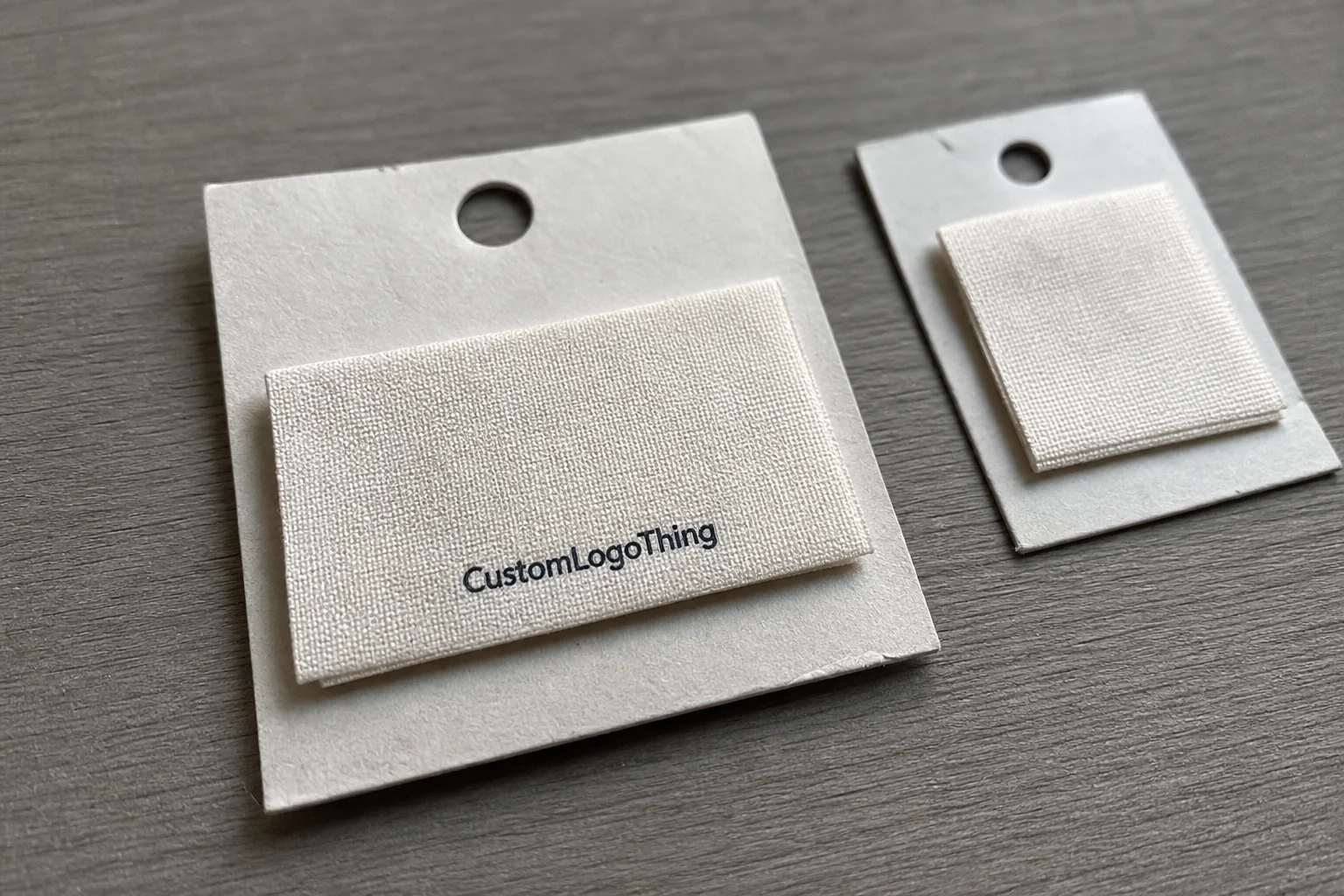
A sample can be polished and still be misleading. It may be made on a different weave, a different finish, or a different production path than the final order. That happens more often than buyers expect, and it is one of the main reasons a quoted price changes after the first conversation.
The quote shows the variables that actually drive cost:
- Label size — a narrow size tab and a large back-neck label use different amounts of material and machine time.
- Weave density — a tighter weave handles small text better, but it usually costs more.
- Color count — additional thread colors add complexity and can change setup time.
- Fold style — center fold, end fold, loop fold, and straight cut all require different finishing.
- Edge treatment — heat cut, ultrasonic cut, or sewn-in finishing can change both look and durability.
If the sample is made from a generic construction but the production quote is based on a denser, softer, or more durable build, the price will rise for a valid reason. The problem is not the higher price itself. The problem is discovering that difference after approval, when the garment line already depends on the label spec. That is where production friction starts.
“A quote that only gives unit price is incomplete. Ask for the full spec set, or you are comparing versions of the same label that may not actually be the same.”
For apparel, the final application matters as much as the artwork. A label sewn into a ribbed collar needs a different structure than one placed on a denim waistband or an outerwear lining. Softness, seam behavior, and fold choice all affect how the label sits once it is attached. If those details are not reflected in the quote, it is too early to trust the price.
Printed woven label styles, materials, and finish options
Printed woven labels are often chosen when a brand wants the softness and durability of woven construction without giving up the clarity of printed detail. In practice, the exact construction depends on the garment, the artwork, and how much abrasion the label will see over time.
Common label constructions
- Damask — a tight weave with strong detail retention, often the best balance of softness and clarity for apparel branding.
- Satin — smooth to the touch and often used for neck labels or premium-feel garments, though very fine detail may need careful review.
- Taffeta — economical and widely used, but usually stiffer than damask or satin.
- Printed woven blends — useful when the brand wants woven structure with printed graphic flexibility in the same label.
Material choice affects three things right away: how the label feels against skin, how well it resists fraying, and how clearly the artwork holds up. If the label is inside a T-shirt or activewear top, softness often matters more than a heavily textured finish. If it is being used on outerwear, bags, or denim, edge durability may matter more. Tiny type and narrow logos almost always push the spec toward a tighter weave.
Fold style is not decorative. It determines how the label can be sewn and how much visible surface remains after application. A center fold is common for neck labels because it hides the raw edge inside the seam. An end fold works well for side-seam branding and exterior tags. A loop fold may be used where the label needs to hang or display on the outside. Straight cut is typically selected when the label will be sewn on all sides, and mitre fold can create a cleaner premium look for certain applications.
Edge finishing deserves as much attention as the artwork. Heat cutting can help reduce fray on some constructions, while ultrasonic cutting can leave a cleaner edge when the material supports it. A sew-in label remains the most common format for repeat apparel production because it is predictable, durable, and easy for sewing teams to handle.
Typical uses are straightforward. Neck labels carry branding and size information. Hem labels give a subtle exterior mark. Care labels handle compliance and washing instructions. Small exterior tabs and ID labels are used when the brand wants visible identity without committing to a large patch. Printed woven labels are particularly useful when the design needs to stay sharp without feeling coarse on the garment.
Specifications that affect your apparel label quote
If you want an accurate printed woven labels Quote for Apparel, send exact specifications before asking for pricing. Otherwise the supplier has to guess, and guesswork usually becomes an estimate that needs revision later. The more complete the brief, the cleaner the quote.
The essentials are simple, but they need to be precise:
- Width and height
- Fold type
- Color count
- Attachment method
- Artwork file
- Quantity
Artwork complexity affects pricing more than many first-time buyers expect. A clean logo with one or two colors is usually easier to produce than a dense design with micro type, thin outlines, gradients, or layered elements. Fine lines can force a tighter weave or a more careful print process, which raises the cost. If your label has tiny legal text or care instructions, readability should be checked at production scale, not only on a screen.
Placement matters too. A label that will be sewn into a neckline has different constraints than one used as a side-seam marker or outer branding tag. Children’s wear, knitwear, denim, activewear, and outerwear each handle labels differently because the fabric structure changes how the label lies, flexes, and rubs against the wearer. One spec does not suit every garment, and that is normal.
Color matching is another area where buyers should ask direct questions. Some suppliers match to Pantone references, some match visually, and some rely on thread libraries with close approximations. Those are not the same commitment. If the brand depends on a specific shade, confirm the tolerance before the quote is approved. Small variation is part of woven production, but there should still be a clear standard for acceptable match quality.
It also helps to ask whether the quote includes a digital proof, a physical sample, or both. A digital proof confirms layout, spelling, and spacing. A physical sample checks softness, fold behavior, and how the label behaves on fabric. Those are different checkpoints, and for apparel they solve different problems.
| Spec | Why it affects price | Buyer risk if unclear |
|---|---|---|
| Label size | Larger labels use more material and more machine time | Wrong fit in garment seam or neckline |
| Weave density | Finer detail requires tighter construction and slower production | Small text becomes blurry or unreadable |
| Color count | More colors add setup complexity and handling time | Quoted price does not match the artwork |
| Fold style | Different folds require different cutting and finishing | Label sits awkwardly or needs rework |
| Application method | Sew-in, heat seal, or patch format changes labor and prep | Label does not attach the way the garment needs |
Cost, pricing, MOQ, and how to compare quotes without guessing
This is where good sourcing habits pay off. A reliable Printed Woven Labels Quote for apparel should separate unit price, setup cost, sample cost, and shipping so you can see the real landed cost. If all of that is bundled into one vague number, you cannot compare vendors accurately.
Pricing depends heavily on order size and construction. For simple woven label jobs, higher-volume pricing may fall roughly around $0.08 to $0.20 per piece, while smaller runs often move into the $0.18 to $0.45 per piece range or higher when the artwork is detailed or the order is limited. Those are broad working ranges, not guarantees, and they change with label size, finish, and production country. A low price only means something if the specs are truly the same.
Minimum order quantity, or MOQ, can be useful or annoying depending on the stage of the brand. Smaller MOQs help with launch tests, seasonal drops, and sample assortments. They also usually come with a higher unit cost because the setup effort is spread across fewer pieces. Larger orders usually bring the price down, but only if the design is finalized and repeatable.
Compare quotes only after confirming that each supplier is pricing the same item. That means the same size, same fold, same color count, same finish, same attachment method, and the same shipping terms.
- Same size.
- Same fold.
- Same color count.
- Same finishing method.
- Same shipping terms.
If one quote is dramatically lower, check whether something was quietly changed. The cheaper offer may use a looser weave, fewer colors, simpler finishing, or a different spec entirely. It may also leave out setup or sample charges. That is not necessarily wrong, but it is not directly comparable.
Repeat orders often improve pricing once the art file and production parameters are already approved. For buyers building a long-term trim program, the first order is usually about establishing the correct construction, while later orders are about consistency and lead-time control. That is the more realistic way to think about labeling costs.
Rush timing also affects the landed price. Expedited production is often available, but there is usually a premium because it interrupts scheduling and compresses finishing. The same applies to freight. Air shipping can be useful for launch deadlines, while ocean freight may make more sense for larger replenishment orders where timing is less urgent.
For buyers who want a broader procurement reference, the Packaging Machinery Manufacturers Institute is a useful industry source for packaging and sourcing basics. It will not quote your labels, but it can help you think more clearly about materials, process, and supply-chain tradeoffs.
Process and timeline from artwork approval to delivery
The standard workflow is straightforward, but it slows down fast if the brief is incomplete or the artwork needs repeated correction.
- Inquiry and specification collection
- Artwork review
- Digital proof or mockup
- Sample approval if needed
- Production
- Finishing and packing
- Shipment
Most delays come from missing measurements, unclear color references, file problems, late revisions, and slow approvals. A label order can look small on paper and still take time if the artwork is technical or the garment line needs exact matching. One unresolved detail can hold up the whole schedule.
Lead time varies by quantity and design complexity. A simple label with standard finishing may move faster than a dense logo with multiple colors and a special fold. If a sample is required, add that into the schedule instead of assuming production starts immediately. Physical samples are useful, but they do extend the timeline.
It helps to ask for milestones in writing. For example: proof by one date, sample by another, production start after approval, and shipment after finishing. That gives planning teams something concrete to work with and reduces confusion later. It also makes it easier to spot where the project is actually sitting.
Choose the shipping method with the launch date in mind. Air is faster and usually more expensive. Ocean is slower and generally cheaper. If a new collection depends on the labels arriving before sewing starts, the freight choice matters almost as much as the production date. That is especially true for brands working on tight seasonal windows.
For sustainability and shipping-related material considerations, the EPA sustainable materials management guidance is a useful reference point. It will not solve label pricing, but it can help keep procurement decisions grounded in material efficiency rather than habit.
How to request an accurate quote and avoid rework
The cleanest way to request a quote is to send one complete spec sheet instead of starting with a loose description. The more the supplier has to infer, the more likely the quote will change later.
Include the basics in one package:
- Label size
- Fold style
- Quantity
- Artwork file
- Color count
- Garment type
- Shipping destination
Ask the supplier to break out unit price, setup cost, sample cost, and shipping. That makes comparisons much easier and prevents surprises when the first invoice arrives. If the quote only gives a single number, you do not yet have enough information to approve production.
Request proofing details in writing so spelling, size, and color expectations are confirmed before any production run begins. If the label is for a launch or a restock date, ask for the timeline in the same conversation. That helps you spot bottlenecks early, especially if artwork corrections or sample approval are still pending.
Before mass production, compare at least two quotes using identical specs. Then check the sample for three things that matter in real apparel use: legibility, softness, and how the label sits once sewn onto fabric. If a label scratches, curls, or loses clarity at actual size, it is not ready for production even if the proof looks fine on a monitor.
The point of the quote stage is not just to get a price. It is to catch avoidable mistakes before they become a batch of labels that cannot be used. A good Printed Woven Labels Quote for apparel should confirm the construction, the finish, the application method, and the delivery timeline in enough detail that sewing can begin without second-guessing. That is what keeps the trim order practical instead of expensive.
How do I get a printed woven labels quote for apparel with accurate pricing?
Send the exact size, fold style, quantity, color count, artwork file, garment type, and shipping destination. Ask whether setup, samples, and shipping are included or billed separately. Use the same specs for every supplier so the quotes are actually comparable.
What MOQ is typical for printed woven labels for apparel?
MOQ varies by supplier and label complexity, but smaller runs usually cost more per piece. Standard sizes and simpler artwork are easier to price at lower quantities. If you expect repeat orders, ask for tiered pricing so you can see where the unit cost improves.
What details change the unit cost the most?
Label size, weave density, and number of colors are major drivers. Fold style and finishing can also affect price, and rush timing or shipping method can change the landed cost more than buyers expect.
How long does production usually take after I approve the artwork?
Timing depends on quantity, design complexity, and whether a sample is required. Clear files and quick approval shorten the schedule. Ask for a timeline that separates proofing, production, finishing, and shipping so you can plan the garment run properly.
Can I order a sample before placing a full apparel label order?
Yes, and that is often the right move if the label will be sewn into finished garments. Confirm whether the sample is digital, physical, or pre-production. Check readability, softness, and size on fabric before approving mass production.


