The Small Label That Makes Cheap Jewelry Packaging Look Expensive
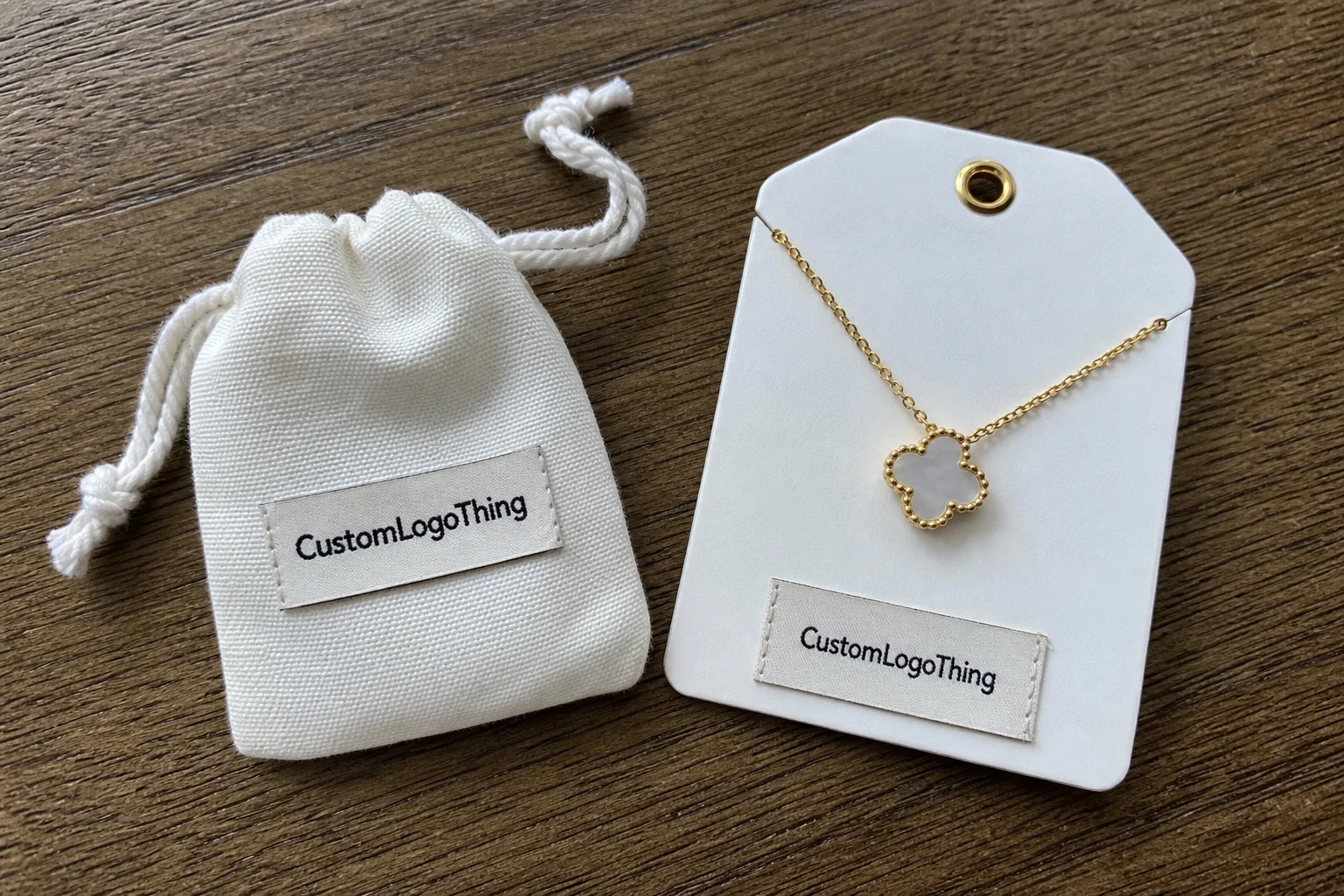
A $40 bracelet in a plain pouch can feel unfinished. Add a crisp woven logo label to that same pouch, box insert, ribbon, or display card, and the packaging suddenly feels more deliberate, more giftable, and less like a stock supply item. Most buyers asking for a Printed Woven Labels Quote for jewelry are not just shopping for a decoration; they are trying to raise perceived value without committing to fully Custom Rigid Boxes or complicated packaging systems.
That is a practical move. Jewelry packaging has to protect a small product, photograph well, carry the brand name clearly, and still feel pleasant in the buyer’s hand. A woven label helps because it adds texture rather than another flat printed surface. It can sit on a drawstring pouch, velvet sleeve, satin bag, tissue wrap, display card, ribbon band, or the inside lid of a small jewelry box.
Buyers remember touch. A smooth paper box is fine, but a soft pouch with a clean damask label feels more considered. The label may only cover one or two square inches, yet it can change how a necklace, ring, charm, or pair of earrings is perceived before the product is even worn.
Terminology can get messy. Woven labels build the artwork with thread. Printed fabric labels place ink on satin, cotton, polyester, or another textile base. Many jewelry sellers call both “printed labels” because they are focused on the logo result rather than the production method. The distinction matters, though, because thread and ink behave very differently at small sizes.
For jewelry brands, woven labels are useful because they are compact, tactile, and flexible across packaging types. They can make a standard pouch feel custom. They can keep a kraft box from looking generic. They can give a handmade brand a cleaner retail presentation without forcing a large custom box order before the brand is ready.
Custom Logo Things helps turn that idea into a workable specification: actual sizes, material options, fold styles, backing choices, minimums, and quote details that make sense before production starts. If you already know you need branding on a pouch, sleeve, card, gift box, or ribbon, start with our Custom Labels & Tags options and build the order from there.
What Changes a Printed Woven Labels Quote for Jewelry Boxes
A Printed Woven Labels Quote for jewelry depends on more than size. Small labels are not automatically simple labels. Setup, thread density, artwork conversion, cutting, folding, backing, packing, and quality checks all take production time, even if the finished label is smaller than a postage stamp.
The main quote drivers are usually clear:
- Label size: Jewelry labels often range from 0.5 x 1 inch side tabs to 1.5 x 2 inch labels for box inserts or pouch fronts.
- Fold style: Straight cut, end fold, center fold, loop fold, and miter fold each require different finishing.
- Thread density: Higher-density damask labels hold smaller type and cleaner curves better than basic woven options.
- Color count: Two-thread labels usually cost less than labels with four, five, or metallic thread colors.
- Backing: Sew-on, adhesive, iron-on, and no backing affect both production cost and application method.
- Quantity: Unit cost usually drops sharply at 500, 1,000, 2,500, and 5,000 pieces.
- Shipping destination: Domestic delivery, international shipping, and split shipments can change the final landed cost.
Logo complexity deserves extra attention. Thin lines, gradients, tiny serif type, delicate script, and miniature icons may need simplification before weaving. Thread is not a laser printer. A 2 mm hairline can look elegant on a website and turn into visual fuzz on a 0.75-inch label.
Most jewelry packaging labels fall into three useful size groups. A 0.5 x 1 inch center-fold side tab works for small pouches or sleeve seams. A 1 x 1.5 inch label suits drawstring bags, velvet pouches, and fabric envelopes. A 1.5 x 2 inch or larger label fits box inserts, branded cards, ribbon wraps, and larger gift packaging.
To receive a useful quote, send the logo file, finished size, order quantity, label placement, material preference, backing preference, fold style, packaging material, target delivery date, and shipping country. Photos of the pouch, card, or box help more than many buyers expect. Guessing label proportions from a logo file alone is how a brand ends up with a badge that looks either timid or strangely oversized.
Label Materials, Folds, and Finishes That Work for Jewelry
Jewelry labels need refinement at small scale. The label cannot overpower a ring box, soft pouch, or narrow display card. It has to sit flat, read clearly, and survive handling during packing, shipping, unboxing, and storage.
| Label Type | Best Use | Buyer Notes |
|---|---|---|
| Damask woven label | Premium pouches, box inserts, bridal jewelry packaging | Best choice for small logo detail, smooth texture, and a polished retail look. |
| Satin woven label | Soft pouches, ribbons, delicate packaging | Shiny finish and elegant feel, though small type needs careful review. |
| Cotton-look label | Handmade, organic, artisan, or minimalist jewelry brands | Warmer texture, less gloss, and a natural look for simple marks. |
| Printed satin label | Gradient logos, watercolor marks, fine illustrations | Better for artwork that cannot be woven cleanly at tiny dimensions. |
| Heat-cut fabric label | Straight-edge labels for inserts, cards, or boxes | Clean edge on synthetic materials, with feel and durability depending on the base fabric. |
For premium jewelry pouches and boxes, Damask Woven Labels are often the safest choice. They hold detail better than lower-density woven labels, feel smoother, and avoid the rough souvenir-patch effect that cheap weaving can create. Not every logo requires damask, but fine lettering, compact icons, and luxury-leaning layouts usually benefit from the cleaner weave.
Fold style matters because the label has to attach cleanly. A straight cut label works for box inserts, cards, adhesive applications, and flat display pieces. An end fold hides raw ends when sewing the label onto a pouch. A center fold creates a side tab, often used along seams. A loop fold gives a hanging detail for ribbon, bags, or product tags. A miter fold creates angled ends for a more tailored finish.
Backing is not a small detail. Sew-on labels are secure for fabric pouches. Adhesive backing can work well on smooth rigid boxes, coated paperboard, and flat inserts. It may fail on fuzzy velvet, textured linen, dusty kraft paper, or loose-fiber surfaces, so testing matters before the full order is applied.
Iron-on backing can help with certain fabric applications, but heat sensitivity has to be considered. Velvet can crush. Satin can shine or warp. Coated paper can blister. A label that looks right in isolation still has to behave on the actual packaging material.
Color choice also affects the final result. Metallic threads can add shine, but they often cost more and may not render tiny details as cleanly as standard thread. Neutral grounds such as ivory, taupe, black, charcoal, warm white, and soft gray are common for luxury positioning. High-contrast logos read better at one inch wide. Soft palettes can suit bridal, heirloom, and handmade jewelry, but they still need enough contrast to remain legible under normal room lighting.
Practical rule: if a buyer has to squint to read the label from 12 inches away, the artwork is too delicate, the contrast is too low, or the label is too small.
Specifications to Confirm Before You Ask for Pricing
A reliable Printed Woven Labels Quote for jewelry starts with clean specifications. Vague requests produce vague numbers, then the order gets revised after someone realizes “about an inch” does not say whether the folded ends are included.
Confirm the core details before requesting pricing:
- Width and height: Use inches or millimeters, and state whether the size includes folded areas.
- Fold type: Choose straight cut, end fold, center fold, loop fold, or miter fold.
- Material: Specify damask woven, satin woven, cotton-look, printed satin, or another base.
- Thread colors: Include Pantone references if color accuracy is important.
- Logo file: Vector AI, EPS, SVG, or clean PDF is preferred.
- Backing: Choose sew-on, adhesive, iron-on, or no backing.
- Edge finish: Confirm heat cut, woven edge, folded edge, or sewn edge depending on use.
- Quantity: Ask for price tiers rather than one isolated number.
- Use case: Identify whether the label goes on a pouch, sleeve, display card, box insert, ribbon, tissue wrap, or gift box.
File quality affects quote accuracy and production results. Vector files such as AI, EPS, SVG, or clean PDF are best because the artwork can be scaled and adjusted without losing clarity. A high-resolution PNG may work for a simple mark. A blurry screenshot from a social profile is not enough for clean label production.
Legibility has physical limits. For woven labels, avoid lettering under roughly 5-6 mm tall unless the design is tested. Keep linework bold. Simplify detailed jewelry illustrations, tiny gemstones, thin chain graphics, and ornate serif type. If the artwork depends on a soft gradient, shadow, or watercolor effect, printed satin may be a better option than woven thread.
Manufacturing tolerance is normal. Woven labels can have small variations in size, color, fold placement, and alignment, especially at tiny dimensions. A 1 mm shift on a large apparel label may be hard to notice. On a 0.5-inch jewelry tab, it can look more obvious, so tight layouts need more breathing room.
For broader packaging expectations, standards from groups such as ISTA can help brands think about transit testing, handling, and packaging performance. A label is small, but it still lives inside a larger packaging system that has to survive storage, fulfillment, shipping, and customer handling.
Use this short checklist before requesting pricing:
- Choose the label placement on the pouch, box, card, insert, ribbon, or wrap.
- Measure the available area, not only the logo artwork.
- Decide whether labels will be sewn, adhered, heat-applied, or inserted loose.
- Request quantity tiers such as 100, 300, 500, 1,000, 2,500, and 5,000.
- Note the launch date, wholesale deadline, event date, or reorder window.
Cost, MOQ, and Unit Pricing Without the Sales Fog
Woven label pricing usually improves as quantity increases because setup costs are spread across more pieces. That is why 1,000 labels may make more sense than 100 if the brand already expects repeat pouch orders, subscription kits, pop-up inventory, or wholesale packaging.
A typical quote may include setup, artwork preparation, sampling, unit cost, fold finishing, backing, packing, and shipping. Some suppliers bundle those charges. Others list them line by line. Neither format is automatically better. What matters is whether the buyer can compare actual landed cost and see what is included.
MOQ depends on material, label size, customization level, and finishing. A lower MOQ helps a new jewelry brand test packaging before tying up cash. A higher MOQ lowers unit cost and keeps packaging consistent across product drops. Consistency matters because a retail display with three slightly different logo labels can feel less premium even if each label is acceptable on its own.
Ask for multiple quantity tiers in one request. Useful tiers include 100, 300, 500, 1,000, 2,500, and 5,000 pieces. That range shows the real price break and helps with reorder planning. A single quote for 200 labels may answer the immediate question, but it does not reveal whether the next tier would be far better value.
| Quantity Tier | Best For | Pricing Behavior |
|---|---|---|
| 100 pieces | Testing size, placement, or a small launch | Highest unit cost because setup is spread over few labels. |
| 300 pieces | Small batch jewelry drops or market inventory | Better than 100, though still not the strongest value tier. |
| 500 pieces | Starter retail packaging and pouch branding | Often a practical balance between cash flow and unit price. |
| 1,000 pieces | Brands with repeat sales, wholesale, or subscriptions | Unit cost usually improves enough to justify ordering ahead. |
| 2,500-5,000 pieces | Established sellers, multi-SKU packaging, larger campaigns | Best unit cost, but requires confidence in artwork and usage. |
Several choices can raise pricing: metallic thread, multiple thread colors, very small detail, special folds, adhesive backing, rush production, tighter inspection requirements, individual packing, and split shipments. None of these choices are wrong. They simply need to serve the brand presentation or application method well enough to justify the added cost.
The cheapest label is not always the best value. If it puckers, frays, sheds, lifts from the surface, or makes a $70 necklace look like it came from a bargain bin, the savings are working against the product. Saving a few cents per label does not help if the packaging loses the gift moment.
If sustainability claims matter to your customers, ask about recycled content, paper components, and responsible sourcing where relevant. For packaging materials beyond the fabric label itself, references such as FSC can help buyers understand chain-of-custody claims for paperboard, inserts, and tags. Avoid broad “eco” claims unless the material claim can be supported.
Production Steps, Lead Time, and Approval Timeline
The ordering process is manageable when the specifications are ready. Submit the details, receive the quote, approve the artwork, confirm the proof or sample, begin production, complete quality checks, pack the labels, and ship them to the brand, fulfillment partner, or pouch sewing vendor.
Lead time depends on artwork readiness, sampling requirements, order quantity, finishing method, and shipping method. Rush production may be possible, but it can add cost and reduce time for revisions. If the labels will be sewn onto pouches after delivery, that sewing or application time belongs in the schedule too.
Sampling usually falls into three categories. A digital proof is fastest and useful for checking layout, size, fold direction, and general color references. A physical sample gives better confidence in texture, weight, and actual appearance. A pre-production sample is the safest option when a brand needs exact color, fold, backing, and placement approval before the full run.
Quotes can be prepared faster when the buyer sends complete information at the start. Artwork revisions, unclear sizing, missing logo files, and open-ended requests for something “premium” slow the process. Premium is a result, not a production measurement.
Quality control for jewelry labels should check several points:
- Logo clarity: Small text and icons should read cleanly at the final size.
- Thread color: Colors should match the approved reference as closely as the material allows.
- Fold accuracy: End folds, center folds, and loop folds should align with the approved spec.
- Edge finish: Edges should resist fraying and sit cleanly on the packaging.
- Backing performance: Adhesive or iron-on backing should suit the actual pouch or box material.
- Count and packing: Labels should arrive clean, counted, and protected from moisture or crushing.
Launch schedules need buffer time. Holiday drops, influencer mailers, retail buyer presentations, and wholesale shipments leave little room for unclear specs or late artwork changes. Freight delays and proof revisions are ordinary production risks, not rare exceptions.
Brands evaluating packaging beyond appearance can also review general resources from the EPA Sustainable Materials Management program, especially if they are looking at material reduction, reuse, or packaging waste claims. A label is small, but the total packaging system still affects cost, disposal, and customer perception.
How to Order the Right Label the First Time
Ordering the right label starts before the quote request. Gather the logo file, quantity range, dimensions, application method, packaging photos, deadline, and delivery location. If the size is uncertain, send the packaging dimensions and a photo with the intended placement marked. A quick marked-up photo can prevent an expensive production mistake.
Scale matters. A 1.5-inch label may look balanced on a medium drawstring pouch and oversized on a ring pouch. A side tab can look refined on a linen sleeve but awkward on a rigid box insert. The same logo may need different proportions for a pouch front, ribbon wrap, display card, and interior box lid.
Use a simple decision path:
- Choose damask woven labels for premium texture, small logo detail, and elevated pouch branding.
- Choose printed satin labels for gradients, tiny illustrations, watercolor marks, or complex artwork.
- Choose adhesive backing for smooth rigid boxes, coated inserts, and flat paperboard surfaces.
- Choose sew-on labels for velvet, linen, cotton, satin, or microfiber pouches.
- Choose end fold when raw edges need to be hidden during sewing.
- Choose center fold for side tabs on pouches, sleeves, or small fabric bags.
If you are comparing options, request several quantity tiers in one quote. That single step gives a clearer view of whether 500, 1,000, or 2,500 pieces makes more sense for your cash flow, packaging calendar, and reorder plan.
Custom Logo Things can help narrow the choices when the practical details are included. Photos help. Measurements help. A clean vector logo helps even more. If the packaging is still undecided, specify whether the label will go on a pouch, box, insert, ribbon, tissue wrap, or display card so the recommendation is grounded in the way the label will actually be used.
For accurate pricing, send the size, quantity tiers, material preference, backing, fold style, deadline, delivery country, and any packaging photos through Contact Us. A printed woven labels quote for jewelry should give enough detail to compare material, quantity, timeline, and cost before production begins.
FAQs
What details do I need for a printed woven labels quote for jewelry packaging?
Send your logo file, label size, quantity tiers, fold style, backing type, packaging material, delivery country, and deadline. Add photos of the pouch, box, insert, ribbon, or display card where the label will be used. If you are unsure about size, send the packaging dimensions so label proportions can be recommended.
Are woven labels or printed fabric labels better for jewelry pouches?
Woven labels are better for a premium textured look and durable brand detail. Printed fabric labels are better for gradients, tiny artwork, watercolor effects, or complex illustrations. For many jewelry pouches, Damask Woven Labels are the safest premium option because they balance detail, texture, and durability.
What is the usual MOQ for custom woven labels for jewelry brands?
MOQ depends on material, size, finish, and customization level. Small starter runs may be possible, but unit pricing usually improves at 500, 1,000, and higher quantities. Ask for several quantity tiers so you can compare the real price break before committing.
How long does production take after I approve the jewelry label design?
Lead time depends on artwork approval, sampling, quantity, finishing, and shipping method. A clean logo file and confirmed specifications speed up quoting and production. If labels are needed for a launch, wholesale order, or holiday drop, allow time for proofing, production, shipping, and any sewing or application after delivery.
Can adhesive woven labels be used on jewelry boxes?
Yes, adhesive backing can work well on smooth paperboard, rigid boxes, coated inserts, and flat packaging surfaces. It may not bond reliably to velvet, linen, textured paper, or dusty surfaces without testing. For fabric pouches, sew-on labels are usually more secure than adhesive.