Why cosmetics brands ask for a woven-label quote before sampling
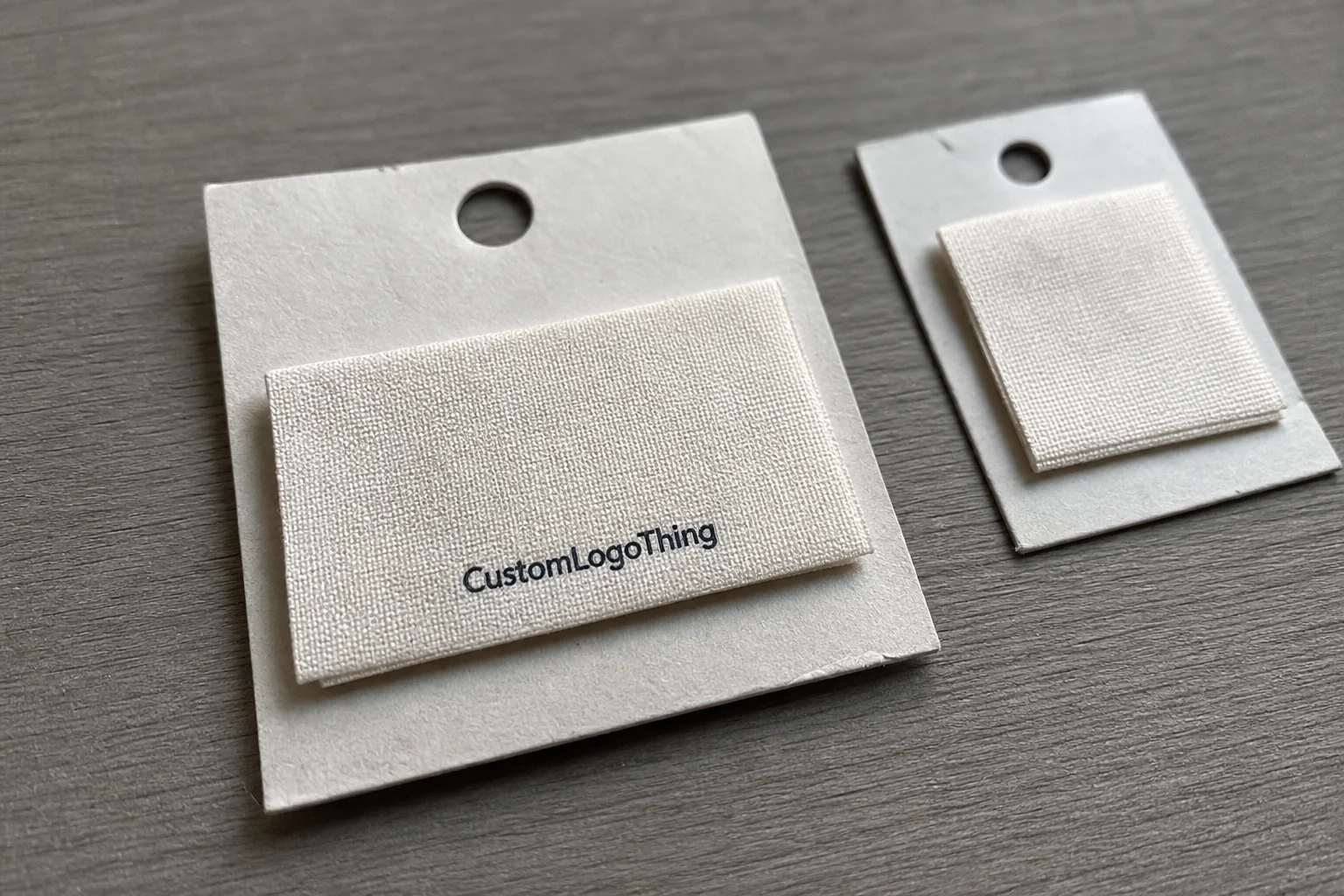
A Printed Woven Labels Quote for cosmetics usually starts before sampling because the label is often the first tactile detail a customer notices on a pouch, gift set, or accessory kit. If the weave feels rough, the edges fray, or the logo loses clarity under bright retail lighting, the package can read as lower value than the product inside.
For packaging buyers, asking for a quote early is less about chasing the cheapest number and more about fixing the construction before artwork approval creates expensive rework. Once a buyer signs off on size, fold, thread count, and color count, changing any one of those later can mean a new setup, another proof cycle, and a longer lead time.
Cosmetic brands also need to separate decorative branding labels from regulatory labels. A decorative label on a makeup pouch or travel kit can focus on logo placement, texture, and presentation. A regulatory label on a primary cosmetic pack may need space for ingredients, net contents, country of origin, or care instructions, which changes the layout and sometimes the material choice. On secondary packaging, like gift boxes and refill kits, the woven label may serve both as branding and as an identifier, so the quote should reflect that dual role.
Woven labels work especially well on soft goods tied to cosmetics: zipper pouches, satin wraps, applicator cases, reusable bags, and promotional kits. They bring a more finished feel than a plain printed paper insert, and they usually tolerate repeated handling better than a basic adhesive label.
Good quoting is about production variables, not just size and quantity. Yarn count, finish, fold type, cut style, and color count can change the cost meaningfully, even when the label dimensions stay the same.
If you need a fast starting point, a clear Contact Us request with specs usually gets a cleaner answer than a vague “price please” message. A detailed Printed Woven Labels Quote for cosmetics only becomes useful when it matches the real construction you plan to order.
Printed woven label options for cosmetic packaging and soft goods
Printed woven labels sit between a fully woven satin label and a printed fabric tag. In practical terms, that means the branding is applied in a way that preserves sharper detail and easier readability, while still giving you the textile feel many buyers expect on premium cosmetic packaging accessories. For brands that need small text, a clean logo edge, or a softer hand than a rigid film label, this is often the right lane.
They are a strong fit for makeup bags, skincare pouches, product sleeves, travel kits, gift packaging, and reusable accessory items such as brush holders or vanity cases. If the product will be pulled in and out of a drawer, moved through a retail display, or folded into a seasonal set, a woven label tends to keep its appearance longer than a basic adhesive label.
Common construction choices include end fold, center fold, loop fold, straight cut, and heat-cut edges. The attachment method drives that decision. A center fold is often useful when sewing a label into a seam. End folds are good when the ends need to tuck in cleanly. Straight cut labels work when the item is stitched flat or when the brand wants a tag that hangs freely. Heat-cut edges can reduce fraying, but they must be matched to the material and the intended use.
Material choice matters too. Polyester yarns are common because they resist wear and hold detail well through repeated handling. A satin finish can give the label a subtle sheen that reads as more premium, especially on darker cosmetic packaging. Damask-style weave structures can carry finer detail than a basic plain weave, which is why many buyers prefer them for small logos or thin type.
Designing for cosmetics is a little different from designing for apparel. Bright lighting on retail shelves can make pale thread colors look washed out, and very thin logo lines may disappear once the label is woven or printed on textile substrate. Clean spacing, moderate font weight, and simple icon work usually deliver a better result than a crowded composition.
For brands comparing options, it helps to think in terms of end use rather than label type alone. A boutique skincare set may benefit from a soft satin label with a center fold, while a travel pouch that gets heavy handling may need a tighter weave and stronger edge finish. If you already stock other components, the team handling your Custom Labels & Tags can often advise whether the woven label should match or contrast with the rest of the packaging system.
| Label option | Best use | Typical visual effect | Relative cost |
|---|---|---|---|
| Damask woven | Fine logos, small text, premium cosmetic accessories | Sharp detail, smooth hand | Medium to higher |
| Satin woven | Gift sets, fashion-forward beauty packaging, soft sheen branding | Glossy face, elegant presentation | Medium |
| Printed fabric label | Simple branding, larger copy, shorter-run decorative use | Clear print, less texture | Lower to medium |
| Heat-cut straight label | Flat application, internal branding, sewn-in identifiers | Clean edge, minimal bulk | Lower to medium |
Specifications that affect print quality, durability, and brand appearance
The quote gets more accurate when the specification sheet is complete. At minimum, buyers should confirm width, height, fold type, background color, thread count or print detail level, and attachment method. If those details are vague, the supplier has to assume a default construction, and that almost always creates a mismatch later.
Small text and thin lines deserve special attention. Woven structures cannot reproduce tiny artwork the same way a coated paper label or a high-resolution film label can. If a logo has hairline strokes, condensed type, or a detailed symbol, the artwork may need cleanup before production. In practice, a slightly simplified logo often looks better on a woven cosmetic label than an overcomplicated one that turns muddy at small sizes.
Color matching is another place where expectations should be set clearly. If your brand guidelines call for a specific Pantone reference, give it up front and ask how closely the supplier can match it in woven production. Thread sheen changes how color is perceived, and the same shade can appear lighter or darker depending on lighting and substrate. A good supplier will explain acceptable variation instead of pretending woven labels behave exactly like offset print.
Durability matters even on cosmetic items, because many of them are handled far more than buyers expect. Makeup pouches get stuffed into handbags, travel kits get zipped and unzipped, and gift items are often unpacked, repacked, and displayed again. A woven or printed woven label should tolerate abrasion, light moisture, and repeated folding without losing readability or shedding its edge finish too quickly.
There is also a compliance side. If the label must carry care symbols, fiber content, origin information, or brand identifiers, the available space gets tight fast. That affects not only size but also how much detail can sit on one line. A cosmetic accessory label is not the same as a generic merchandising tag; if the content has to serve a regulatory purpose, the layout needs to be planned around that requirement from the start.
When buyers ask for a Printed Woven Labels Quote for cosmetics, the most useful attachment to send is a clean spec sheet with a vector file, fold sketch, and any color references. That gives the factory enough information to quote the actual job rather than a guess.
printed woven labels quote for cosmetics: cost, MOQ, and unit pricing factors
Price is driven by more than quantity. The main cost factors are size, weave complexity, number of colors, folded construction, cut style, and order quantity. A small one-color label with a straight cut is a different job from a multi-color, finely detailed cosmetic brand label with end folds and individual bagging.
MOQ, or minimum order quantity, matters because setup cost is spread across fewer units on smaller orders. Loom programming, print preparation, color setup, trimming, and inspection all take time whether you order 1,000 pieces or 10,000. That is why a lower-MOQ order usually costs more per label. For a launch or seasonal beauty kit, that may still make sense if you are testing packaging response before scaling.
Here is a practical pricing lens buyers can use when reviewing a Printed Woven Labels Quote for cosmetics:
| Order profile | Typical unit price behavior | What usually drives the number | Buyer takeaway |
|---|---|---|---|
| Small launch run | Higher unit price | Setup spread over fewer pieces | Good for testing new SKUs |
| Mid-size replenishment | Moderate unit price | Balanced setup and production volume | Often the best value zone |
| Large recurring order | Lower unit price | Production efficiency and volume absorption | Best for stable, proven packaging |
Buyers should also check whether folding, cutting, and finishing are included or billed separately. A quote that looks lower at first glance can become more expensive once you add post-production work. The same goes for rush production, mixed SKUs, specialty packing, or labels delivered sorted by variant. For a cosmetic brand managing multiple shades, seasonal sets, or travel sizes, those details can change the final landed cost more than a small difference in base unit price.
One common mistake is comparing total quote numbers without checking what each supplier included. One supplier may quote a bare label, another may include folding and polybagging, and a third may have a higher line item but a shorter lead time because the production process is more controlled. A clean quote should give line-item clarity so you can compare like for like instead of trying to decode the fine print later.
For practical planning, many cosmetic buyers see rough unit pricing fall into a few bands depending on complexity: a very simple woven tag in a large run may land near the low cents per piece, while a detailed damask label with multiple colors, special folding, and smaller order volume can move into the higher cents range or above. Exact pricing shifts with width, length, and finishing, so the useful question is not only “What does it cost?” but also “What is included in that number?”
Production steps and lead time from artwork to finished labels
The normal workflow is straightforward: artwork review, spec confirmation, proofing, sampling if needed, production, finishing, inspection, and shipping. Each step looks simple on paper, but delays tend to appear when the artwork is incomplete or the buyer has not finalized fold instructions.
Missing vector files are a common slowdown. So are logos delivered in low-resolution formats, unclear crop marks, or color references that are not tied to a standard like Pantone. If the supplier has to rebuild artwork or guess the placement of an emblem on a narrow label, the proofing cycle becomes longer. It is usually faster to finalize the spec before the quote is approved than to revise the quote after the proof is already underway.
A realistic timing expectation for custom cosmetic woven labels is often around 12 to 15 business days from proof approval, though that depends on quantity, finishing, and factory load. Very simple orders can move faster, and complex orders can take longer. Sampling, if requested, usually adds time but is worth it when the label includes small text or exact color requirements. For premium cosmetics packaging, a pre-production check is often cheaper than redoing a full run because the type weight or fold direction was wrong.
Approvals usually happen in two stages. First comes the digital proof, which confirms spelling, layout, and dimensions. If the label is high-risk because of detail density or presentation sensitivity, a physical sample or pre-production sample gives a better read on hand feel, edge finish, and color behavior. That extra step is especially useful for beauty brands trying to match a textile label to rigid cartons, pouch fabrics, or ribbon finishes.
Packaging coordination matters too. Labels may ship loose, on rolls, folded, or bagged by style. The right format depends on whether the labels will be sewn in by hand, attached during final assembly, or inserted into kits. If you do not specify the pack-out format, you may get a technically correct order that is awkward for your finishing team to use.
If your brand follows quality protocols, it is fair to ask about inspection standards, carton packing, and any third-party test references. For transport testing of packaged goods, many teams refer to ISTA packaging testing standards, and for broader material or sustainability questions, the EPA is a useful reference point for environmental claims and waste reduction context. Those references do not replace supplier QC, but they help keep the discussion grounded.
What to look for in a supplier for cosmetic label orders
The best supplier for a cosmetic label order is the one that can keep the details straight. You want manufacturing consistency, clear communication, and the ability to confirm technical points before production starts. A supplier should be able to explain whether the label construction suits your application, whether the artwork needs simplification, and what the likely tradeoff is between appearance, durability, and cost.
Technical advice matters more than polished sales language. If a supplier can tell you that a certain fold type will bunch up on a narrow pouch seam, or that your lettering needs to be slightly larger to remain legible after weaving, that is useful. If all you get is a generic promise, the project is carrying too much risk.
Quality control checkpoints should include color review, edge finishing, cut consistency, and carton packing so the labels do not arrive creased or mixed by style. On cosmetic orders, where packaging presentation is closely tied to brand perception, those small issues become visible quickly. A slightly crushed label on a sample pouch can make an entire set feel underfinished.
Responsiveness matters too because packaging projects shift. A fragrance set becomes a skincare bundle. A holiday kit becomes a travel promo. A SKU count grows from three variants to eight. The supplier that can revise a quote cleanly, without confusion over quantities or construction, saves a surprising amount of time.
Transparent quoting is the real sign of a good partner. You want a clean breakdown that shows what is included, what is optional, and what could change if the artwork changes. If a supplier can give that level of clarity, they are usually easier to work with once production starts.
How to request the right quote and move to production
If you want the quote to be accurate, send the basics in one message: label dimensions, artwork file, quantity, fold style, desired finish, and any special packing requirements. That gives the supplier enough information to build the estimate around the real job instead of a placeholder version of it.
It also helps to explain the cosmetic use case. A label for a sewn-in pouch brand panel is different from a tag that will be inserted into a gift set or tied onto a promotional accessory. The application tells the supplier whether they should prioritize softness, edge finish, readability, or presentation from the front of the package.
If the artwork changes, ask for a revised quote. Do not assume a small adjustment will not affect price or lead time. A one-color change may be minor, but a revised logo layout, new fold type, or added care text can shift the job enough to require new setup. That is normal, not a problem, as long as the communication is clear.
Before authorizing full production, confirm proof approval, target ship date, and whether a sample is required. For a premium beauty launch, the safest sequence is usually quote, proof, sample if needed, then production. That is the cleanest way to avoid avoidable delays and protect your packaging schedule.
If you are collecting multiple packaging components at once, it can help to bundle the label conversation with the rest of your order planning. That way the woven label, carton, pouch, and insert all move on a similar timeline. If you need another price point or want to compare label constructions, start with a clear request through Contact Us, then verify the sample or proof before moving ahead. For many buyers, the best Printed Woven Labels Quote for cosmetics is the one that balances appearance, lead time, and finish quality without hidden assumptions.
FAQ
What do I need to request a printed woven labels quote for cosmetics?
Provide label size, quantity, fold style, artwork file, color references, and the intended cosmetic application. Include whether the label will be sewn, inserted, or attached to packaging so the supplier can suggest the right construction.
How does MOQ affect printed woven label pricing for cosmetic brands?
Higher quantities usually reduce unit cost because setup and production overhead are spread over more pieces. Lower MOQ orders can be useful for launches or seasonal kits, but the price per label is usually higher.
Can printed woven labels hold fine logo details and small text?
Yes, but readability depends on label size, thread count, and artwork complexity. Very thin fonts or tight spacing may need simplification to print cleanly on a woven structure.
What is the typical turnaround for custom cosmetic woven labels?
Turnaround depends on proof approval, material availability, quantity, and finishing requirements. Orders move faster when artwork is final and specs are confirmed before production begins.
Should I request a sample before placing a full order?
Yes, especially if the label has small text, exact color needs, or will appear on a premium cosmetic package. A sample helps confirm size, readability, fold, and overall brand presentation before full production.


