For a private label apparel program, packaging is not a side detail. The bag that holds a folded tee, hoodie, or multi-piece set influences how the garment looks in a carton, on a hook, and on a shelf. That is why the Private Label Buyer apparel poly bags material spec guide has to be treated like a working spec, not a generic purchasing note.
A good poly bag does several jobs at once. It protects against dust and abrasion, keeps folds intact, carries the barcode or warning copy, and supports a retail-ready presentation across reorder cycles. The wrong film or closure can make a clean garment look tired before it reaches the floor.
Buyers usually feel the difference in three places: shelf appeal, damage rate, and consistency. A clear, well-sealed bag helps a product look controlled and premium. A cloudy, wrinkled, or oversized bag can make the same product look lower grade, even if the apparel itself is sound.
Why apparel poly bag material choice affects shelf appeal and returns
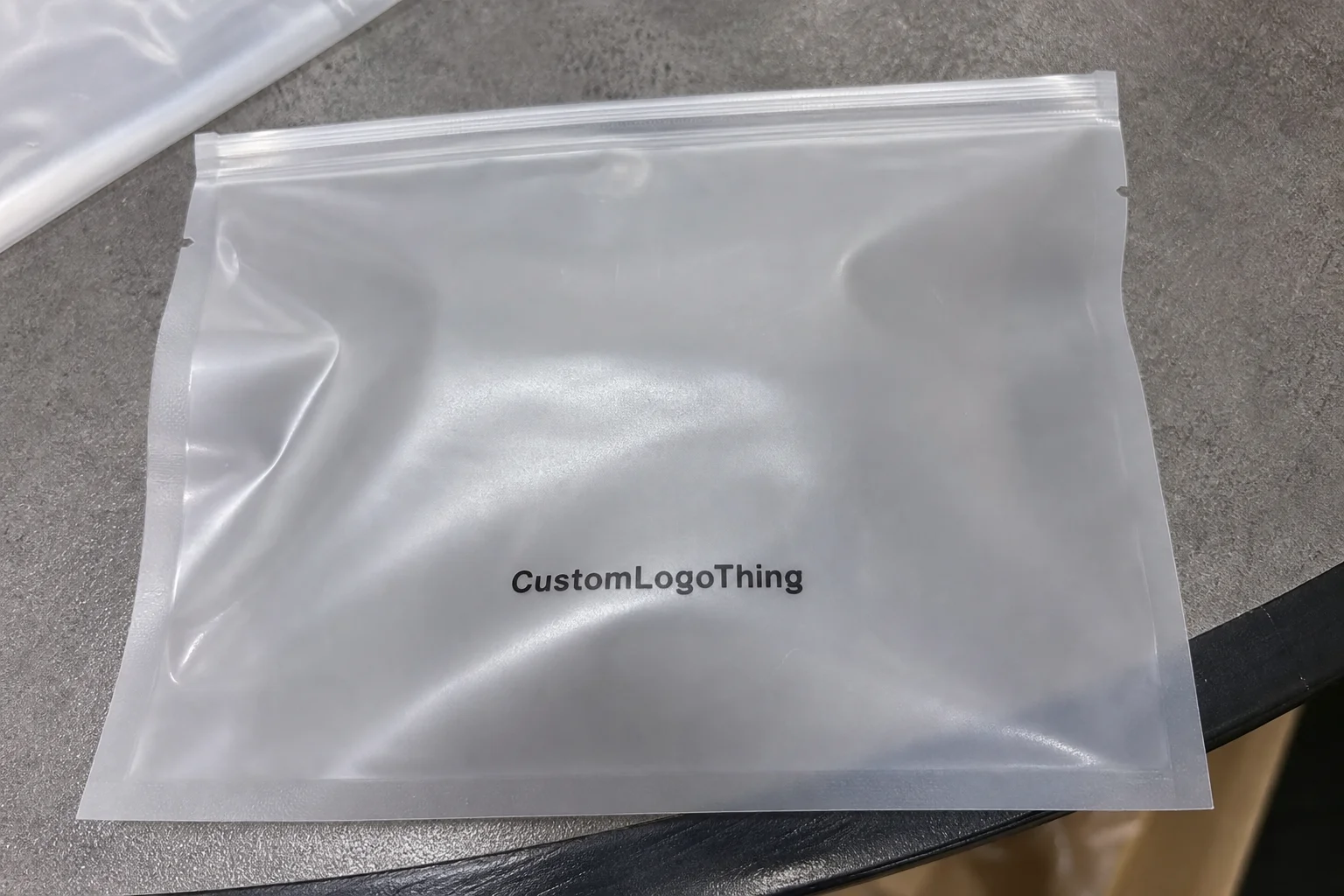
Material choice affects more than appearance. It changes puncture resistance, clarity, static behavior, and how the bag holds a fold during transport. Those differences matter because apparel packaging often passes through several hands: pack-out, carton loading, warehouse handling, store backroom storage, and finally retail display.
Film clarity is the first thing most buyers notice. High clarity helps a brand color, size mark, or folded silhouette stand out. Haze can be acceptable in some lower-cost programs, but too much haze makes the bag look cloudy and can dull the product inside. The same garment inside a flat, crisp film will look more deliberate than one in a wrinkled bag with distorted edges.
Returns are not driven by packaging alone, but packaging can contribute to avoidable problems. Thin film around zippers, snaps, rivets, or decorated trims may split during handling. Once the bag opens or tears, dust, compression marks, and fold disturbance become more likely. That is a small failure with a visible cost attached.
The tradeoff is straightforward. Light film lowers cost, but it may reduce protection. Heavier film improves durability, but if the gauge is too high for the item, the package can feel stiff, bulky, and harder to pack. The right answer depends on garment weight, trim type, packing method, and where the product sits in the supply chain.
“The best bag spec is rarely the thickest one. It is the one that matches the garment, the packing line, and the way the item is handled after packing.”
Buyers who manage private label programs usually learn this the hard way. A spec that looks fine on paper can create problems later if it ignores actual carton conditions, line speed, or the way stores open and rehandle packed goods. The bag should be designed for use, not just for quote comparison.
Apparel poly bag formats, closures, and print-ready options
Apparel Poly Bags are not one standard product. The format should follow the garment and the packing process. Flat bags are common for tees, underwear, socks, and other low-profile items. They are usually the simplest and lowest-cost option. Gusseted bags are better for thicker folds, bulkier knits, hoodies, and sets that need more room without overstressing the seams.
Wicketed bags are often used where speed matters. They make hand packing easier on faster lines because the bags are held together in a stack. Resealable styles serve a different purpose: they help when the consumer may open and close the package more than once, or when the retailer wants controlled reclosure after inspection.
Closure style should be settled early. A self-seal flap is common for retail apparel, but some programs need heat seal, adhesive closure, or an open-top presentation with a hang hole. If a suffocation warning is required, the warning panel should be positioned before artwork is finalized. Moving it later can force a re-layout of the barcode, size callout, or brand panel.
Print options also deserve early attention. Common elements include size marks, warning copy, barcodes, brand marks, and lot or SKU identifiers. Some buyers prefer a clear film with minimal print. Others need a tinted or opaque look to segment product lines or limit visibility for premium packaging strategies. The wrong print contrast can create compliance risk, especially under bright retail lighting.
The format should match the garment, not just the budget. A flat bag that works for a lightweight tee may be a poor fit for a heavyweight sweatshirt. A gusset that protects a sweater may be unnecessary overhead for basics. That sounds obvious until reorder season starts and buyers are forced to reconcile presentation with cost.
- Flat poly bags: efficient for simple folded apparel and lower-cost programs.
- Gusseted bags: better for bulkier garments and thicker fold profiles.
- Resealable bags: useful for premium retail and repeated opening.
- Wicketed bags: suited to faster packing lines and higher throughput.
- Printed warnings and size marks: support compliance, sorting, and shelf clarity.
Material and gauge specifications buyers should lock in
The most common materials for apparel poly bags are LDPE and LLDPE, along with blends that combine flexibility, clarity, and puncture resistance. LDPE is soft and seals well, which makes it a dependable choice for many apparel applications. LLDPE is tougher and resists tear propagation better, which helps when contents have sharper edges or when distribution is rougher than expected.
Do not approve a bag based only on a generic description like “clear poly bag.” Ask for the actual film specification. A proper spec should identify resin type, thickness, dimensions, width and length tolerances, seal style, print placement, carton pack count, and any special features such as vent holes or tear notches. Those details are not paperwork decoration; they determine whether the bag performs on the line and in transit.
Film thickness is usually described in mil. For light folded apparel, many programs operate around 1.5 to 2 mil. That range can work for tees and basic knits if the handling environment is controlled. For heavier garments, outerwear, or items with zippers, snaps, studs, or decorative hardware, buyers often move into the 2.5 to 4 mil range. It is not a universal formula, but it is a practical starting point.
Other performance terms matter too. Haze affects how clear the bag appears. Gloss affects how polished the surface looks. Seal strength tells you whether the seam is likely to hold during packing and distribution. Coefficient of friction influences how easily bags stack, feed, or slide in a production setting. Buyers do not need to become materials scientists, but they should know enough to ask the right questions.
Functional add-ons can solve real problems. Anti-static treatment helps in dry rooms where cling slows packing. Vent holes reduce trapped air and help garments fold flatter. Tear notches make opening easier for store associates and consumers. Embossed finishes can improve grip when smooth film is too slippery for consistent handling.
There is a sustainability angle too, but it should be handled carefully. Recycled content can be useful when the end use tolerates a little more variation in clarity or appearance. Biodegradable claims are a separate matter and should not be attached to a bag that does not actually meet the relevant standard. If a program is trying to reduce material use, the honest route is to specify the lightest film that still protects the garment, rather than inflating claims the packaging cannot support.
Many buyers also coordinate poly bags with other packaging elements, such as tags, labels, inserts, or outer cartons, so the entire package feels planned rather than assembled late in the process. If your program includes broader packaging changes, it helps to review nearby components such as Custom Packaging Products and related formats that affect packing efficiency and shelf presentation.
For transport testing and packaging guidance, industry references such as ISTA and the EPA are useful starting points. They will not tell you the exact bag thickness to buy, but they do help frame handling expectations, material claims, and shipping performance. If your apparel program includes paper inserts or FSC-certified components, those can support a mixed-material package without forcing the poly bag to carry a sustainability story it does not own.
| Typical apparel bag option | Common spec range | Best use | Relative cost |
|---|---|---|---|
| Flat clear LDPE bag | 1.5-2.0 mil | T-shirts, basics, light fold packs | Lower |
| Gusseted LDPE/LLDPE blend | 2.0-3.0 mil | Sweatshirts, sweaters, boxed sets | Medium |
| Printed wicketed bag | 2.0-3.5 mil | Higher-volume pack lines | Medium to higher |
| Resealable apparel bag | 2.5-4.0 mil | Premium retail or repeat-open items | Higher |
Cost, pricing, MOQ, and quote factors that change your unit cost
Unit price is driven by more than size. Resin cost, gauge, bag dimensions, print colors, closure type, and order quantity all move the number. If two quotes look far apart, check whether the suppliers are really quoting the same product. A lower price sometimes hides a lighter gauge, smaller dimensions, or a different carton pack count.
MOQ tends to rise when the bag is custom printed, uses unusual dimensions, or includes special features like a zipper closure, venting, or a hang-hole placement that requires extra setup. Standard clear bags usually allow lower minimums. Fully custom printed programs often need more volume because print setup, proofing, and tooling have to be spread over a larger run.
Price also changes when the specification changes. That sounds basic, but it gets missed often. A reorder that adds one color, widens the bag by a quarter inch, or switches from LDPE to a tougher blend is not the same buy. Volume helps, but only when the specification stays stable across runs.
Freight and packing configuration can alter landed cost more than buyers expect. Carton size, pack count, pallet pattern, and shipment terms matter. A piece price that looks competitive can become expensive if the cartons do not fit the warehouse workflow or if the supplier’s pack count creates unnecessary receiving labor.
Sampling and artwork charges should also be included in the comparison. Some suppliers absorb them; others do not. Rush fees are another quiet cost. If the launch date is tight, faster service often means a higher price or a more limited material choice.
For brands balancing cost and environmental goals, recycled content may be worth the premium if the bag still looks acceptable and performs consistently. But a material change should be evaluated against optical clarity, seal consistency, and dimensional stability, not just against the sustainability headline. A lower-cost film that causes rework or damage is not actually cheaper.
The cleanest way to compare quotes is to put every variable side by side: resin type, thickness, dimensions, print method, carton count, tolerance, shipment terms, and the expected approval timeline. Anything less invites apples-to-oranges pricing, and that is where many private label packaging decisions go off track.
Production process and timeline from spec approval to delivery
The usual workflow is simple: inquiry, spec review, quote, artwork confirmation, sample approval, production, inspection, and shipment. The process only feels simple until one detail is missing. A barcode file in the wrong format, an unclear print placement note, or a late change to the fold direction can add days or even a full cycle of revisions.
Stock-style clear bags usually move faster than fully custom printed bags. A straightforward order may ship in roughly 10 to 15 business days after proof approval, while more complex programs can take longer depending on tooling, print setup, resin availability, and order size. Buyers should treat that range as a planning estimate, not a promise. The real schedule depends on how clean the spec is and how quickly approvals come back.
There are a few ways to keep a program on time. Send final artwork early. Confirm the size chart, barcode placement, and warning language before the order is released. Approve the written spec, not just a verbal summary. Those steps sound minor, but they reduce the kind of back-and-forth that stalls production at the worst time.
Quality control belongs at every stage. The run should be checked for dimensional accuracy, seal integrity, print alignment, and count accuracy. The finished bag should match the approved sample closely enough to avoid pack-out surprises. A bag that is slightly off in width or seal placement can still create issues once garments are folded, bagged, and stacked in cartons.
For more demanding distribution networks, buyers may also ask whether packaging can be aligned with transport-testing expectations such as ISTA methods. That does not always mean the poly bag itself needs special testing, but it does mean the bag should be considered alongside the carton, insert, and shipping environment instead of being approved in isolation.
How to qualify a supplier for private label apparel programs
Capability comes first. A supplier should be able to hold tolerances, repeat print registration, and maintain film consistency across reorders. That sounds ordinary, but it is the difference between a packaging partner that can support a private label calendar and one that only handles spot buys well.
Documentation is equally important. Ask for the spec sheet, material declaration, compliance statements, and an approval record for the final sample. If the packaging needs a suffocation warning, barcode consistency, or size marking, the supplier should explain how those elements are controlled in production. Clean paperwork makes reorders faster and reduces disputes when a new batch arrives.
Sampling tells you a lot about how the supplier works. A useful supplier will explain tradeoffs instead of pushing the most expensive option. They should be able to describe the difference between clarity and puncture resistance in plain language, then provide samples that reflect real production conditions rather than idealized versions that never get used.
Ask specific quality-control questions. How is seal strength checked? How is contamination controlled? How is print adhesion verified? Is batch traceability maintained? If the answer is vague, the risk usually shows up later in the form of inconsistent bags, delayed replacements, or unexplained variation between runs.
Communication matters more than buyers sometimes expect. Private label programs often run on reorder discipline, launch dates, and predictable replenishment. A supplier that answers quickly, records changes accurately, and flags risks early is more valuable than one that offers a slightly lower unit price but creates confusion during every release.
Many apparel brands coordinate packaging, labels, and inserts together so the presentation feels intentional across the whole unit. If that applies to your program, it may be useful to align the bag specification with Custom Labels & Tags so the visual system and the pack-out system stay consistent.
Next steps to finalize your apparel poly bag spec and order
Start with the garment, not the bag. Confirm the item type, folded dimensions, closure style, print requirements, and how the product will be packed. A tee, a hoodie, and a multi-piece set do not share the same packaging needs, even if they are all apparel.
Then gather the working details in one place: artwork files, barcode requirements, warning text, carton pack count, and any tolerance limits that matter to receiving or retail inspection. The more complete the brief, the fewer quote revisions you will need. That alone can save time and reduce avoidable errors.
If the item is new or the shelf presentation is strict, ask for a sample or proof before approving production. Sampling costs less than correcting a large run. It also exposes weak points early, such as poor contrast, awkward fold fit, or a closure that does not hold the garment as intended.
For budget-sensitive programs, compare two or three viable specs rather than forcing one bag to cover every use case. A lighter inner bag may work better than an overbuilt all-purpose option. In some cases, a stronger outer carton or shipper can reduce the need to overspec the poly bag itself.
The most reliable buying process is the least dramatic one: write the spec clearly, compare quotes on identical terms, approve a real sample, then release production. That is the practical core of the Private Label Buyer apparel poly bags material spec guide. Good packaging is rarely flashy. It is consistent, readable, and built to survive the trip from packing table to shelf.
What should a private label buyer include in an apparel poly bag material spec?
Include bag dimensions, film type, thickness, closure style, print requirements, carton pack count, tolerance limits, and any compliance wording. It also helps to note the garment type and packing method so the supplier can recommend the right format and strength.
How do I choose the right thickness for apparel poly bags?
Match thickness to garment weight, trim type, and shipping conditions rather than choosing the thickest film available. Lightweight basics often use thinner film, while heavier or hardware-heavy items need stronger gauge and better puncture resistance.
What affects MOQ for custom apparel poly bags?
MOQ depends on bag size, print colors, special closures, and whether the order uses a standard or fully custom specification. More complex packaging usually requires a higher minimum because setup and production change with each unique run.
How long does production usually take for private label apparel poly bags?
Timeline depends on artwork approval, sample signoff, material availability, and the complexity of the bag spec. Clear specifications and quick approvals usually shorten turnaround and reduce avoidable delays.
What is the best way to compare quotes from different suppliers?
Compare the exact same film type, thickness, dimensions, print method, carton pack count, and shipment terms. A lower quote is not a better quote if the supplier quietly changes the material or reduces the gauge.


