If you need Apparel Poly Bags low moq custom order options, the real question is not how cheap the bag can be. It is how to get a polished package without tying up cash in cartons of packaging that may never move. That distinction matters more than most brands admit, especially when styles change quickly, drops sell unevenly, or a product line is still being tested.
For packaging buyers, low minimums are not a consolation prize. They are a control tool. Smaller orders reduce dead stock, protect cash flow, and keep branded packaging aligned with current product rather than last season’s assumptions. That is the practical case for Apparel Poly Bags with a low MOQ: lower risk, better fit, less waste.
The phrase sounds straightforward, but the buying decision is not. A low-MOQ run can cost more per bag, yet still be the smarter purchase if the product is new, the SKU mix is changing, or the brand is testing presentation before scaling. The important part is matching packaging volume to real demand, not hoped-for demand.
Practical rule: buy the smallest quantity that still gives you enough room to test sales, verify fit, and keep presentation consistent. Cheap inventory that never moves is not cheap.
Why low-MOQ apparel poly bags make sense for lean brands
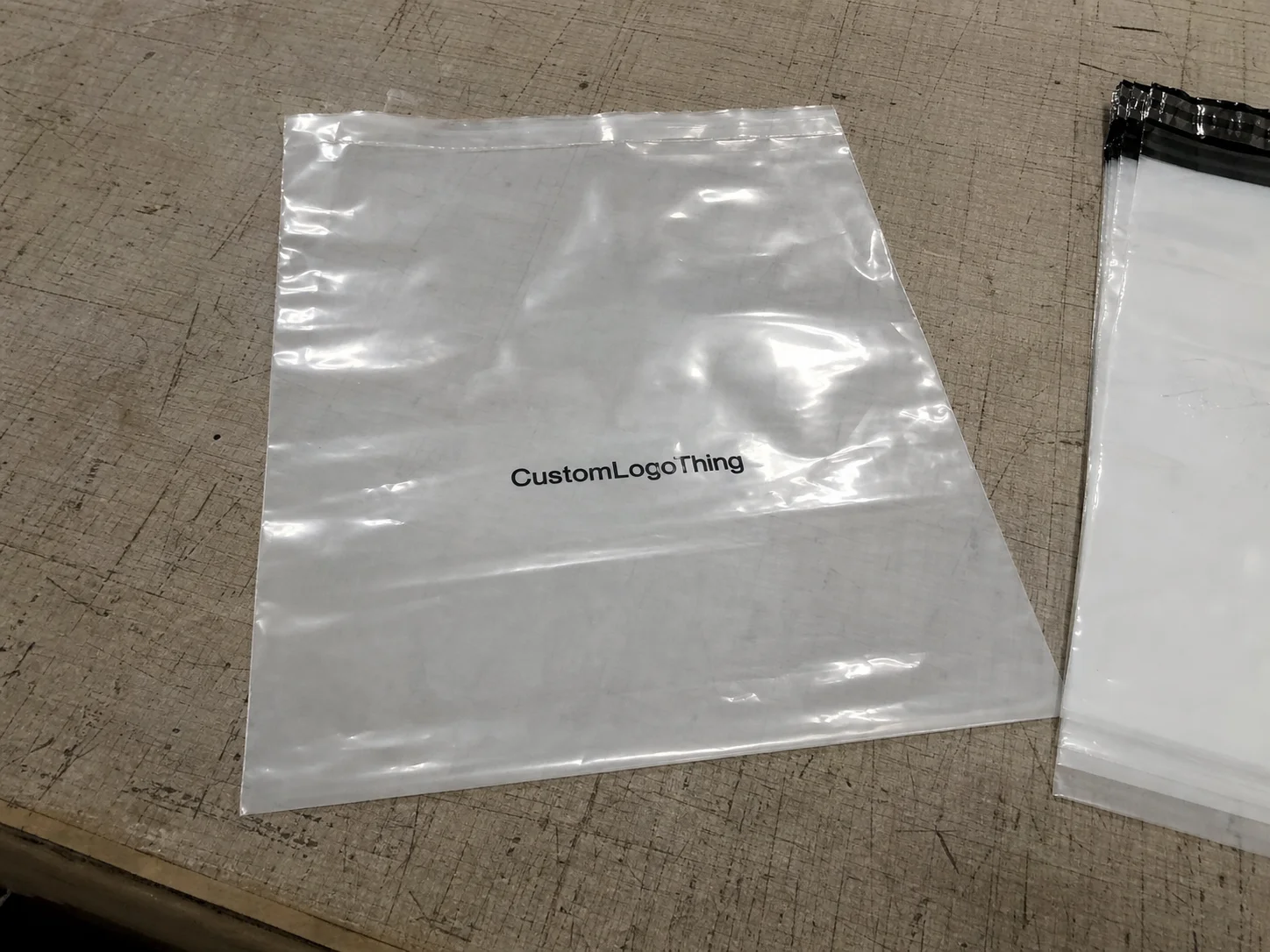
Most brands do not need 20,000 bags to launch a tee, test a hoodie, or replace a generic sleeve that makes a premium product look oddly ordinary. A lower MOQ lets you buy packaging for the order you actually have, not the order you hope will happen six months from now. That sounds obvious. It rarely is in practice.
Startups, seasonal collections, subscription apparel, and short-run DTC drops tend to benefit most from smaller Custom Packaging Orders. You get a cleaner presentation without locking up too much capital in packaging. You also avoid the irritation of changing graphics after a logo refresh, label update, or product repositioning. Packaging should support the product, not trap it in old artwork.
There is a tradeoff. Lower minimums almost always cost more per unit than bulk production. That is normal manufacturing math, not a supplier trick. But a smaller run can still be the better buy if the product is unproven, demand is volatile, or your warehouse cannot absorb surplus packaging. A two-cent savings is irrelevant if the cartons sit for a year.
Low-MOQ Apparel Poly Bags also help operations. Clear, correctly sized bags reduce rework, simplify sorting, and make it easier to keep fulfillment consistent across multiple SKUs. For teams that pack by hand, the difference between a well-sized sleeve and an awkward one shows up in labor time, not just appearance.
One more point gets overlooked: packaging is part of the product experience, but only if it fits the business model. A brand selling 300 units a month does not need the same procurement strategy as a brand selling 30,000. The buyer who treats them the same usually ends up with excess inventory and a spreadsheet full of excuses.
Product details: film types, closures, and print options that matter
Apparel poly bags are not interchangeable. The film, closure, and print method all affect how the bag looks, how it handles, and how it survives packing and shipping. If the goal is a clean presentation with predictable performance, these details matter more than glossy sales language.
Film types
LDPE is the most common choice for apparel packaging because it is flexible, soft, and clear enough to show the garment. It resists cracking better than many stiff films and works well for folding, sealing, and stacking. CPP offers a crisper feel and better clarity, so it often fits premium presentation needs. Recycled-content film can be a sensible option for brands trying to reduce virgin plastic use, though clarity and consistency can vary by blend and supplier spec.
Most apparel runs land somewhere between 1.5 mil and 3 mil. Lighter retail sleeves sit at the low end. Heavier garments or bags that will take more handling push toward thicker film. A thin bag might look fine on a sample table, then start splitting during packing or transit. That is not a cosmetic issue. It is a labor problem and a customer service problem.
Closures and handling features
An adhesive flap is common for apparel storage and e-commerce presentation. It keeps the item contained and is simple for fulfillment teams. A zipper closure gives a more reusable feel, which can make sense for premium basics or archival-style packing. Hanging holes belong on retail items that will actually hang. Add them only when the merchandising plan calls for it; otherwise, they add cost and complexity without improving the packaging.
Some bags need a suffocation warning printed in a specific location or style, especially for retail and warehouse safety expectations. That is not decorative copy. It is a packaging requirement that should be confirmed before production starts. If your order crosses retail and e-commerce use cases, confirm where the warning must appear so the layout does not have to be reworked later.
For general background on flexible packaging materials and formats, the Flexible Packaging Association provides useful industry reference material.
Print options
Single-color flexographic printing is usually the best fit for lower quantities and simple branding. It keeps setup manageable and avoids turning a basic bag into an expensive art project. Multi-color print works when the logo or packaging graphics are part of the brand’s retail story, but it increases setup, cost, and the chance of scuffing during transit.
For apparel, a clean logo on clear film often performs better than full coverage artwork. Buyers usually think they need more ink. In practice, they often need better placement, stronger contrast, and the right film clarity. A restrained layout can look more expensive than a crowded one.
| Option | Best for | Typical tradeoff |
|---|---|---|
| Clear LDPE with single-color print | Basics, tees, test runs | Lowest setup complexity, limited visual impact |
| CPP with multi-color print | Premium retail packaging | Better clarity, higher unit cost |
| Recycled-content film | Sustainability-focused brands | Material consistency can vary by spec |
| Thicker film with zipper closure | Reusable or heavier garments | More durable, usually more expensive |
Brands comparing Custom Poly Mailers with apparel bags should separate the use cases. Mailers protect shipments. Apparel poly bags protect presentation, bundle integrity, and shelf appeal. The same material family can serve both, but the specs are not the same.
Specifications buyers should lock before requesting a quote
If you want an accurate quote, do not send “medium size” and hope the rest gets sorted out later. That is how projects drift. The core specs should be fixed before pricing starts: bag width, length, gusset, film thickness, closure type, print area, and whether the bag is a simple sleeve, a header bag, or a fully custom format.
Size should be driven by the folded product, not by guesswork. A slim tee, oversized hoodie, sock bundle, and multi-piece set all behave differently in packaging. A tee may fit comfortably in a compact sleeve, while a hoodie often needs more width and a little extra sealing margin. Set bundles need even more room so the packer is not fighting the film.
Thickness should be matched to the product’s weight and handling requirements. Lighter retail sleeves often sit in the 1.5–2 mil range. Heavier garments or more durable storage applications can move to 2.5–3 mil. That is not a fixed rule. It depends on how the bag will be used, whether it will be hand-packed or machine-handled, and how much abuse it needs to survive before reaching the customer.
What to send with your quote request
- Garment dimensions in folded form
- Target quantity and a backup quantity option
- Logo artwork in vector format
- Preferred closure style
- Any barcode, warning text, or hanger hole requirement
- Shipping deadline or launch date
That list is not busywork. It keeps the order from turning into a round of “we assumed you meant…” which is how buyers end up with a bag that fits in theory and fails in production. If the product is already packed, sending a sample is even better. A packed sample tells the truth faster than a spec sheet.
Compliance details should be settled early too. If the bag needs suffocation warnings, barcode placement, or hanger hole positioning for retail, those requirements should be in the initial request. If sustainability claims are part of the pitch, check the actual material documentation rather than relying on a green label on a sales sheet. For environmental and recycling background, the EPA’s materials resources are a useful reference: EPA recycling and materials guidance.
For brands that need repeat ordering across multiple SKUs, Wholesale Programs can simplify replenishment once the packaging spec has been proven.
Cost, pricing, and MOQ: what changes the unit price
The unit price changes for two reasons: setup gets spread across fewer bags, and some specifications cost more to manufacture. That is the whole story, even if quotes sometimes dress it up. MOQ is simply the floor at which production still makes economic sense.
The main pricing drivers are film type, thickness, bag size, print colors, closure style, and total quantity. A small single-color order on clear LDPE will usually price lower than a multi-color CPP bag with zipper closure and warning text. Larger bags use more material, so size matters more than many first-time buyers expect.
For planning purposes, low-MOQ custom runs often carry a higher unit price than bulk production, but they can still be the better spend. A small run may fall in a range like $0.18–$0.45 per unit depending on the spec, while larger quantities can move below that. That is not a promise; it is a common market pattern. Printing complexity, resin cost, freight, and current supply conditions can move the number quickly.
Watch the hidden costs. Plate charges for flexographic printing, artwork prep, proof corrections, freight, and rush fees can make a small order feel more expensive than the bag line alone suggests. Buyers are often surprised because they compare the bag price and ignore the rest of the ticket.
If you are deciding between two quantities, compare both the unit cost and the total cash commitment. Sometimes 3,000 bags at a better unit price is still the wrong move if sell-through is uncertain. Better to protect margin than to save two cents and sit on dead packaging for nine months. That is not smart buying. That is warehouse clutter with a purchase order attached.
One more reality check: low MOQ does not mean unlimited flexibility. Once artwork is approved, changes can trigger reproofing, new plates, or delay. Buyers who expect to revise the print three times during production usually pay for the privilege.
Process, timeline, and production steps from artwork to delivery
The workflow is straightforward when the buyer is prepared. First, specs and artwork come in. Then the bag size and print layout are reviewed. After that comes proof approval, production, packing, and shipment. The delays usually happen when the artwork is incomplete or the dimensions are still uncertain.
Artwork should be in vector format whenever possible. PDF, AI, or EPS files are the safest starting point. Low-resolution logos create fuzzy print edges, and that problem never improves on press. If color matching matters, send Pantone references or an approved color standard. Guessing from a phone screen is a quick way to end up disappointed.
Lead time depends on a few real variables: sample approval, print complexity, material availability, and whether the order uses a stock bag format or a fully custom size. A straightforward stock-size print job may move faster, often around 12–15 business days from proof approval. Custom sizing, extra colors, or special closures can add time. If the job needs a new tooling setup, expect additional lead time. That is normal production math, not delay for sport.
Rush production is possible, but every shortcut increases the chance of error and may cost extra. If your launch date is fixed, build in buffer time for proof review and freight. Packaging does not care about the marketing calendar.
Good rule: the earlier you lock artwork and dimensions, the cheaper and faster the order tends to be. Surprises are expensive in packaging.
Quality control should happen at more than one stage. Buyers should ask how print registration is checked, whether film thickness is sampled, and how seal integrity is verified before shipment. On larger or more sensitive runs, a simple pre-production sample can prevent the most common failure: a bag that looks right on paper but feels wrong in hand.
How brands avoid the usual packaging mistakes
The most common mistake is buying on unit price alone. A bag can be cheap and still be wrong. Wrong size, weak seal, poor clarity, graphics too close to the edge, or film that scuffs when stacked. None of that is a bargain.
Small brands also tend to over-specify. They ask for thicker film, more print coverage, extra closure features, and additional warning copy, then wonder why the quote jumps. Every added feature affects cost and usually complexity. If the product is a simple tee, it does not need the packaging equivalent of armor plating.
What helps most is a practical spec review. The garment, use case, presentation goal, and quantity should all point toward the same bag. If the requested structure is off, it is better to correct it early than to produce packaging that fits badly or looks sloppy on arrival. A bag that looks good but tears in fulfillment is not a win. It is a reprint waiting to happen.
Consistency matters too. Clean folds, repeatable sizing, and clear print placement across SKUs make a brand look organized. That matters in retail packaging and in e-commerce packing as well. If you are also managing custom printed boxes, the bag should match the same visual language. Otherwise the brand looks like three different companies arguing in a warehouse.
There is also a sustainability angle that gets oversold. Recycled-content or lighter-gauge film can reduce material use, but only if the bag still performs its job. A failed bag that needs replacement is not the greener choice. Material efficiency should be measured against actual performance, not against a marketing claim.
Good packaging buyers tend to think in totals, not just in line items. They look at fit, labor time, shelf appearance, shipping behavior, and reorder flexibility together. That is a better way to buy than chasing the lowest quote.
For more general support around packaging formats and order planning, our FAQ covers common pre-order questions.
Next steps to place a low-MOQ apparel poly bag order
If you want to move quickly, gather the basics first: garment size, target quantity, artwork files, closure preference, and shipping timeline. Then request a quote with two quantity options so you can compare unit cost against total cash commitment. That comparison usually makes the decision obvious.
Ask for a proof if print placement or color accuracy matters. If the bag is new, or if the SKU mix is still changing, start with the smallest viable test run. That gives you real feedback before you scale. It also keeps the warehouse from becoming a graveyard of almost-right packaging.
If you are ready to place an apparel poly Bags Low MOQ Custom Order, send the specs, confirm the MOQ, approve the proof, and move into production. No guesswork, no unnecessary revisions, and no cartons of unused bags sitting in storage because the order was sized for ambition instead of demand.
FAQs
What is the usual MOQ for apparel poly bags low MOQ custom order?
MOQ depends on size, film type, and print complexity, but low-MOQ custom runs are usually much smaller than standard bulk jobs. Single-color printed orders often allow lower quantities than multi-color or fully custom film jobs. The real answer depends on the exact spec sheet, not a broad promise.
Can I order custom apparel poly bags for just one product style?
Yes. Single-style orders are common for launches, seasonal items, and small DTC brands. One style is often easier to price because size and print placement stay consistent. If you plan multiple sizes later, ask for a spec that can scale across the line.
How do I know what size apparel bag to choose?
Start with the folded garment dimensions, then add room for thickness and sealing margin. Different items need different allowances: a tee, hoodie, and bundle will not fit the same way. Sending a packed sample is the fastest way to avoid a sizing mistake.
What affects custom apparel poly bag pricing the most?
The biggest drivers are quantity, bag size, material thickness, print colors, and closure style. Extra features like warning text, reinforced seals, or special finishes will raise the unit cost. Shipping and setup charges can matter just as much as the bag itself on small orders.
How long does a custom order usually take from proof to delivery?
Lead time depends on proof approval, print method, and whether the bag is stock-sized or fully custom. Simple jobs move faster; custom sizing and heavier print coverage usually take longer. Approve artwork quickly if you want the shortest possible turnaround.


