Private Label Caps minimum order quantity matters, but only when the rest of the spec is clear. A small first run can be the right move if the brand is still testing fit, decoration, or demand before committing to deeper inventory.
The common mistake is treating MOQ as a stand-alone target. A cap quote needs the style, fabric, closure, decoration method, color standard, packing plan, and shipping destination. Without those inputs, the price is only a placeholder. With them, the supplier can calculate setup, labor, material use, and freight more accurately.
That is why focused launch briefs work best. A six-panel cotton twill cap with one embroidery location is a very different job from a 5-panel build with a woven patch, custom underbill, and retail packaging. The first usually moves faster and with fewer revisions. The second can still be worth doing, but the buyer should expect a higher unit cost and more lead time.
A cap program gets expensive in small increments: a better patch, heavier fabric, a custom closure, a retail insert. Each change looks minor until it hits the quote.
Why Low-MOQ Private Label Caps Move Faster Than You Think
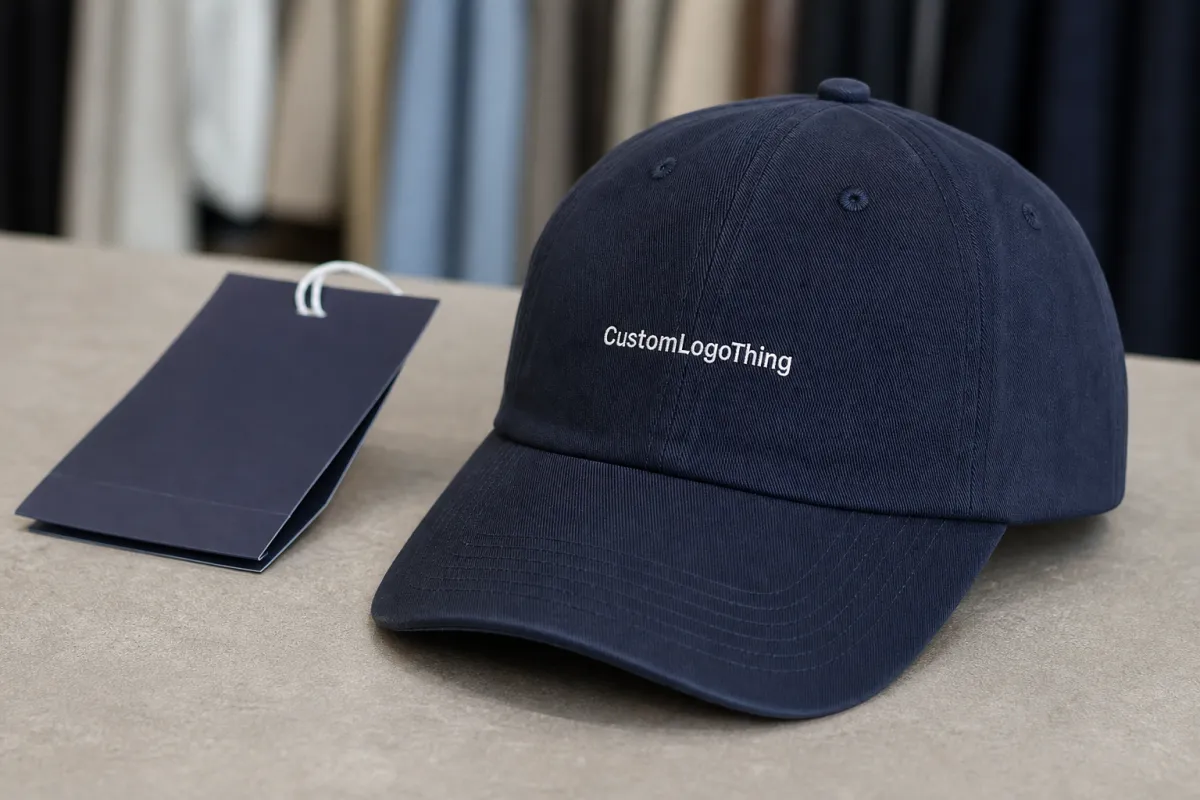
Small test orders usually move quickly because there are fewer variables to approve. One fabric, one crown profile, one decoration proof. That simplicity matters when a retailer or brand team needs to review options without dragging the project across several decision cycles.
Low MOQ is also a cash-flow decision. A first run of 300 to 500 caps lets a brand test demand before inventory starts sitting. In a category where silhouettes and colors can shift quickly, that early read is often more useful than a polished forecast. It is easier to correct a 400-piece miss than a 4,000-piece one.
The cap style also affects how quickly decisions get made. An embroidered logo may read best on a structured front panel, while a woven patch can look cleaner on a lower-profile crown. A trucker cap may fit a value-led promotion, while a performance cap is better for golf or activewear. The sample answers those questions faster than a spec sheet does.
Buyers should also think about packing and shipping early. Bulk cartons are simple, but retail-ready labeling or carton sorting can change the project. If the cap order needs to fit into a broader branded system, align the labeling approach with Custom Labels & Tags instead of treating each item as a separate one-off.
Cap Styles That Work Best for Private Label Launches
The right style depends on channel, budget, and how the cap will be worn. A structured dad cap works well for lifestyle brands because it sits low and looks polished without feeling too formal. A 5-panel cap gives a flatter front, which helps when the logo or graphic is the hero. Trucker caps still work well for promo and outdoor programs because the mesh back keeps cost under control. Performance caps fit sports and active categories where moisture management matters. Flat-bill styles remain useful for streetwear and youth-oriented lines.
Style choice affects MOQ because every extra construction detail adds labor and handling. A simple six-panel cotton twill cap is easier to quote than one with contrast stitching, custom taping, patch layering, or specialty closures. More pieces mean more opportunities for delay, and that is usually a production issue rather than a supplier issue.
- Structured dad caps - Good for retail basics, premium embroidery, and broad audience appeal.
- 5-panel caps - Better for graphic-heavy branding and cleaner front-panel decoration.
- Trucker caps - Useful for value-led programs, events, and outdoor merchandising.
- Performance caps - Better for sport, sun protection, and moisture-managed wear.
- Flat-bill caps - Fit streetwear collections and trend-driven drops.
The main mistake is picking the trendiest shape instead of the one that supports the margin. A cap can look strong in a mockup and still become awkward once premium trims are added. If the goal is to hit a competitive shelf price, style discipline matters more than decorative ambition.
Materials, Construction, and Decoration Specs Buyers Should Lock In
The quote gets sharper when the spec gets tighter. Buyers should confirm fabric weight, panel count, crown height, bill shape, closure type, and decoration method before comparing suppliers. A 100% cotton twill dad cap behaves differently from a polyester performance cap. A curved bill changes the silhouette and often the production steps. Even small changes can shift cost enough to affect the launch.
Decoration choice matters just as much. Embroidery is durable and familiar, but not always the best fit. Woven patches support finer detail. Leather patches create a premium read, though they often raise setup time and minimums. Screen print works for simpler art, while heat transfer may suit artwork with more color variation or a smaller placement area. Stitch count matters too; dense embroidery adds both labor and machine time.
The unglamorous details often save the order. Send vector artwork. Tie colors to Pantone references or approved physical samples. State patch dimensions and placement clearly. Ask for seam tolerances and label positioning in writing. Those steps reduce back-and-forth and lower the risk of a sample that looks close but not quite right.
- Fabric weight - Affects hand feel, durability, and price.
- Crown height - Changes fit and the way the cap sits on head.
- Bill shape - Curved, pre-curved, or flat.
- Closure type - Snapback, strapback, buckle, Velcro, or fitted.
- Panel count - Usually five or six, though custom builds are possible.
If the brand also cares about packaging materials, the broader system matters. FSC-certified paper inserts or retail cards can support that story, and resources like FSC help frame that choice. The goal is not to document everything. It is to document the parts that change cost, lead time, or the final product.
Private Label Caps Minimum Order Quantity and Pricing
This is where the tradeoff becomes visible. Private Label Caps minimum order quantity affects unit price because setup and sampling costs are spread across fewer pieces on a small run. A 300-piece order almost always carries a higher per-unit price than a 1,000-piece order with the same decoration. That does not automatically make the larger order smarter. It just means the buyer should compare tiers before choosing a quantity.
For a basic cotton twill cap with simple embroidery, some markets may see first-run pricing in the rough range of $3.50 to $6.00 per unit before freight and import costs. Add woven patches, custom labels, individual polybags, hang tags, or more involved stitching, and pricing can move into the $6.00 to $10.00-plus range. Those are broad market estimates, not a promise, but they show how quickly accessories stack costs.
A clean quote request should include target quantity, cap style, color count, decoration method, packaging level, and destination. If the buyer needs barcode stickers, retail hang tags, or exact carton counts, those details belong in the first message. Packaging often changes landed cost more than expected, especially if the order needs sorting by size, color, or channel.
| Order Level | Typical Unit Cost Pattern | Best For | Notes |
|---|---|---|---|
| Lower MOQ run | Higher per unit | Testing, first launches, seasonal trials | Useful when speed and inventory control matter more than scale |
| Mid-size run | Balanced pricing | Retail reorders, focused brand drops | Often the sweet spot for MOQ planning |
| Larger run | Lower per unit | Established programs and volume retail | Better pricing, but more stock risk if demand is uncertain |
Setup fees deserve attention too. Embroidery digitizing, tooling for custom patches, and sample development can all add costs that are easy to miss in a quick comparison. Those fees may be reasonable on a small launch if the brand is testing demand. The real question is whether the quantity tier lowers the landed cost enough to justify more inventory.
A practical approach is to ask for three quantity levels. If the price drops only a little, stay smaller. If the middle tier materially improves the per-unit number without creating excess stock, that is often the most sensible choice. For recurring programs, Wholesale Programs can make those breaks easier to compare across repeat orders.
Sampling, Proofing, and Production Steps
The best orders follow a clear sequence: quote, artwork review, mockup confirmation, material sign-off, sample approval, then bulk production. If the artwork changes late, the schedule moves. That is one reason small, focused orders often feel faster: fewer variables are drifting at the same time.
After approval, the order moves into cutting, sewing or assembly, decoration, inspection, and packing. A strong supplier should say what is being checked at each stage. Embroidery should match thread color and placement. Patch edges should be clean. Labels should sit consistently instead of landing somewhere random on the cap. These details are easy to overlook until a box arrives with inconsistent branding.
MOQ can influence sample speed, but only to a point. Lower-MOQ projects sometimes move faster because they sit in a simpler queue. The real time sink is usually buyer response. If proof comments take days, the order slows. If files are final and feedback is clear, the process moves much faster.
- Use one decision-maker for artwork and sample approval.
- Send final vector files instead of screenshots or social exports.
- Confirm packaging details before signing off on the sample.
Some suppliers are better at quoting than producing, and the reverse is also true. Ask for a sample that reflects the exact bulk spec. If the proof and bulk order differ, the project can drift. The FAQ page is a useful place to frame those questions before the first order is placed.
Lead Time, Packing, and Shipment Milestones
Lead time is not one number. It is a chain of milestones. Sampling may take several days, then bulk production starts after approval. For a simple cap program, a typical post-approval timeline might fall around 12 to 20 business days, but style complexity, decoration method, and factory workload can move that window.
Packing choices also shape the schedule. Bulk cartons are faster. Individual polybags, barcode stickers, retail inserts, and hang tags all add labor. Carton configuration matters if the order needs e-commerce sorting or retail compliance. The more customized the packing, the more counting and checking happens before shipment.
Shipping adds another layer. Air freight is faster and more expensive. Ocean freight is slower and better suited to larger, less urgent orders. Customs timing, destination, and seasonal congestion can change arrival dates. If the order supports a trade show, store reset, or promotional event, freight planning should happen before final approval, not after.
It helps to build in time for artwork revisions and freight booking. That buffer is cheaper than a missed launch. Buyers who treat Private Label Caps minimum order quantity as part of a full production calendar tend to get fewer surprises and fewer rushed fees.
How to Vet a Supplier Before You Commit
Price matters, but it should not be the first filter. The better supplier is usually the one that replies clearly, quotes consistently, and keeps the order moving without confusion. Ask how they handle revisions. Ask whether the sample you approve is the exact spec that runs in bulk. Ask what changes trigger a new quote. Those questions reveal more than a polished sales deck.
Request proof of previous cap work, production photos, and material options. A reliable supplier should be able to show stitching quality, patch finishing, and packaging examples without hesitation. If the quote changes every time you clarify a detail, that is a warning sign. So is a supplier that cannot separate setup fees from unit pricing.
Consistency matters on repeat orders. A first run that looks great but cannot be matched later is not a stable program. Crown shape, thread color, label placement, and closure quality should stay within a tight band from one production cycle to the next. That is what makes a private label cap line look intentional.
The hidden cost of a weak supplier rarely appears on the invoice. It shows up in revisions, missed deadlines, and slight brand drift from one box to the next. That is why experienced buyers ask direct questions early. If the supplier also handles broader accessory programs, it helps to see how cap work fits with Custom Labels & Tags and other branded components rather than treating each item as a one-off order.
Next Steps for a Faster Quote and Cleaner First Run
The fastest way to improve a quote is to send a tight brief: logo files, target quantity, cap style, color references, decoration method, packaging requirements, and destination. Add whether the order needs retail-ready packing or simple bulk cartons. That one message can remove several days of back-and-forth.
Then sequence the decisions in the right order: confirm style, lock decoration, verify private label caps minimum order quantity, approve the sample, then confirm production and shipping timing. Buyers often reverse that order and end up paying for rework. The cleaner path is simple, but it requires discipline at the start.
That discipline pays off in three ways: the quote becomes easier to compare, the first run is less likely to stall, and the cap order turns into a repeatable product plan rather than a one-off experiment. For brands building a private label accessory line, that difference is usually the whole point.
What is the usual private label caps minimum order quantity for a first run?
MOQ varies by style, decoration, and supplier capacity. Simple embroidered caps often support lower runs than multi-part custom builds. Ask whether the minimum applies per color, per design, or per size range before comparing offers.
How does MOQ affect unit cost on private label caps?
Lower quantities usually carry a higher unit cost because setup, sampling, and decoration are spread across fewer pieces. A slightly larger run may reduce price enough to change the economics, but only if the extra inventory fits the plan. Request tiered pricing to see the breakpoints clearly.
Can I mix cap colors or styles within one private label order?
Some suppliers allow mixed colors within one style, but many still tie MOQ to each colorway. Mixing styles usually raises complexity and can split the job into separate production runs. Confirm whether the artwork, labels, and packaging stay the same across variants.
How long does production usually take after sample approval?
Timelines depend on decoration method, packing requirements, and current factory load. A simple order can move in a couple of weeks after approval, while more customized builds take longer. Ask for a milestone schedule instead of a single flat estimate.
What information should I send to get an accurate private label caps quote?
Send the target quantity, cap style, artwork files, decoration method, color references, and packaging requirements. Include any special labeling or retail packing needs, since those affect price and lead time. Clear inputs make it easier to compare MOQ, cost, and turnaround across suppliers.

