A private label Slider Lock Clothing Bags supplier affects more than packaging appearance. The bag changes how a folded garment fits, how it handles in transit, and how the product looks when a buyer opens the carton or sees it on shelf. If the film is cloudy, the closure feels weak, or the dimensions are off, the packaging starts working against the product.
That is why buyers should treat the bag as a spec, not a generic accessory. Stock options can vary by lot, but branded runs should stay consistent across reorders. The useful question is not whether a bag can be printed, but whether it can be repeated with the same clarity, fit, and closure performance.
What a private label slider lock clothing bags supplier actually delivers
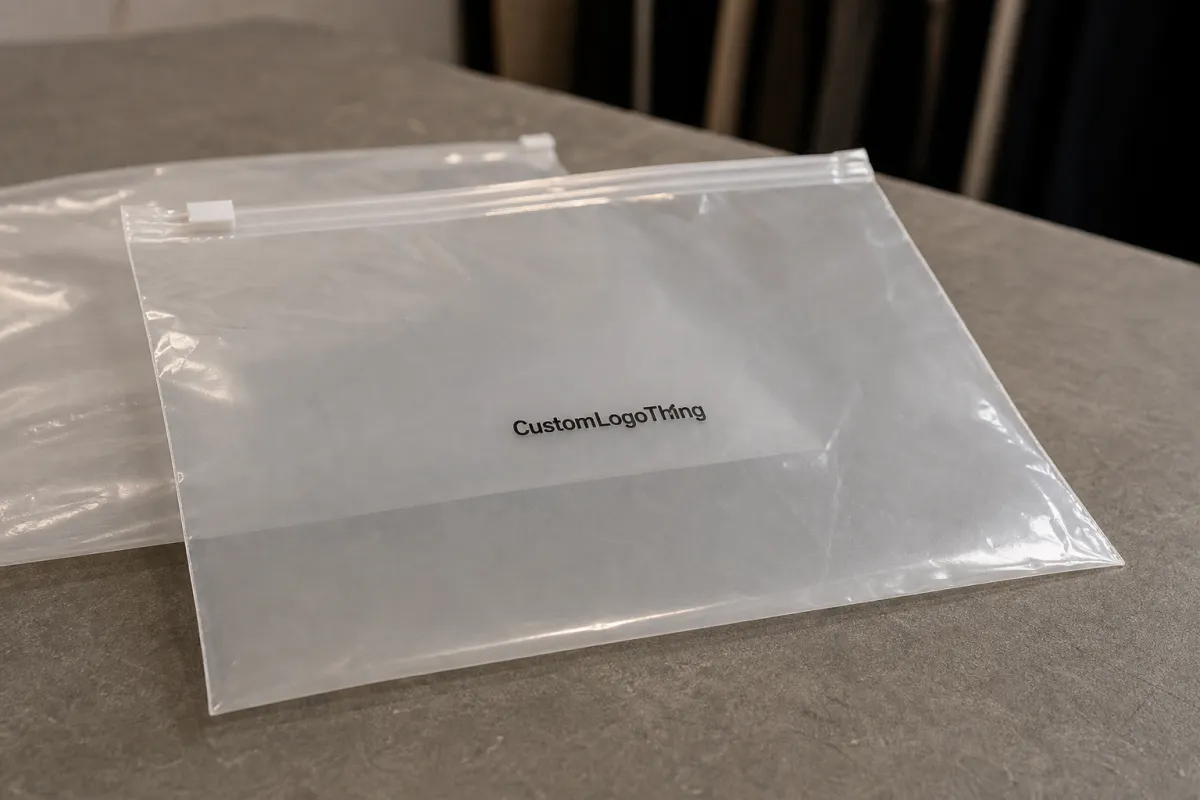
A good supplier delivers a repeatable packaging spec: exact dimensions, material, thickness, closure style, print layout, and packing method. For a folded tee, that means a bag that holds shape without excess bulk. For socks, babywear, or undergarments, it means a closure that opens and reseals cleanly without damaging the film.
Private label work usually means the package is built around your brand rules instead of a stock bag. That can include clear film with a one-color logo, frosted or matte film with fuller artwork, or a layout that leaves room for hang tags, barcodes, or size stickers. Buyers often overlook small details such as slider color, hang-hole placement, and seal width until production starts.
Consistency is the main value. A retailer does not want one lot to feel softer, the next to look slightly blue, and the third to close differently. A stable spec reduces that drift and gives you something that can survive reorder cycles, seasonal changes, and different fulfillment partners.
- Garment fit: The bag should match folded width and height with enough clearance to insert and reseal the product.
- Visual control: Print placement should avoid the closure track and areas likely to crease in handling.
- Reorder repeatability: The supplier should be able to match the same material and dimensions without redesigning the package.
If you already use Custom Labels & Tags, the bag should feel like part of the same identity system. The bag, care label, hang tag, and carton inserts should look planned together rather than sourced as separate afterthoughts.
How slider lock clothing bags work for apparel packaging
The main advantage is simple: the slider makes the bag easier to close and reopen than a basic press seal. That matters in retail, e-commerce returns, and any workflow where the garment may be handled more than once. It also feels more intentional than a thin zip edge that loses shape after a few openings.
For apparel, the bag earns its keep by making the product easier to live with. Customers can inspect a shirt, refold it, and put it back. Retail staff can open and reseal it. Warehouse teams can pack it without fighting a weak closure. That convenience depends on both the closure hardware and the film quality.
Slider lock bags suit folded shirts, leggings, socks, underwear, babywear, and light-to-medium accessories. They also work for kit assembly when multiple pieces need to stay organized before final packing. In premium programs, the closure becomes part of perceived quality: a smooth slider suggests care, while a rough one does the opposite.
There are limits. Heavy knits can strain light film. Sharp trims can nick the bag. Overfilled packaging can twist the track and make closure alignment worse. If the product is bulky fleece, structured outerwear, or anything with hard edges, a thicker film or another closure style may be a better fit.
Practical rule: if the bag looks fine when empty but wrinkles badly once the garment is inserted, the size or thickness is probably wrong.
For transit checks, some buyers borrow the thinking behind ISTA testing: compression, vibration, drop handling, and how the package behaves after repeated movement. A real garment sample packed the real way tells you far more than a clean sample on a desk.
Pricing, MOQ, and quote drivers
Pricing usually depends on five variables: size, film thickness, print coverage, closure style, and quantity. A plain clear bag with a standard slider is one price band. A heavier-gauge printed bag with matte finish and custom artwork is another. They are different products even if both are described as “custom bags.”
For planning, simple private label runs often land around $0.10-$0.20 per unit at lower volumes. Custom-printed bags commonly move into the $0.18-$0.40 per unit range, with premium finishes, thicker film, or specialty features pushing higher. Freight, duty, inner packing, and cartons can add materially to the landed cost.
| Bag option | Typical MOQ | Indicative unit cost | What changes the price |
|---|---|---|---|
| Plain clear slider lock bag | 1,000-3,000 pcs | $0.10-$0.20 | Size, film thickness, and closure quality |
| Custom printed private label bag | 3,000-10,000 pcs | $0.18-$0.40 | Print coverage, color count, and setup work |
| Premium heavy-gauge branded bag | 5,000+ pcs | $0.28-$0.55 | Thicker film, matte finish, and specialty features |
MOQ rises with tooling, print setup, and the cost of running the line efficiently. Lower minimums exist, but they usually come with a higher unit price because the supplier still has to prepare files, run the equipment, and pack the goods. If you are launching or testing a style, that tradeoff may be fine. If the bag will reorder regularly, a higher MOQ can lower total cost over time.
Compare quotes only after the spec is fixed. Finished size, material type, thickness in microns or mil, print method, number of colors, closure style, and freight terms all need to match. If one quote is FOB and another is landed, the spreadsheet is not comparing the same thing.
For adjacent packaging needs such as paper inserts, hang tags, or cartons with sourcing claims, references like FSC can help align the wider packaging program.
Ordering process and timeline: sample to shipment
Most orders move through the same sequence: inquiry, spec confirmation, artwork review, sampling, approval, production, inspection, packing, and shipment. The names vary. The flow usually does not. Understanding the sequence helps you spot weak communication early.
Sampling deserves real attention. Ask for the exact film, slider style, and approximate gauge you plan to order, not a substitute. Then test that sample with the actual garment fold. A sample can look polished on a table and still fail once a sweater or multi-piece set goes in.
Lead times vary with artwork readiness and revision count. A straightforward stock-based private label run may ship in about 10-15 business days after proof approval. A fully custom printed order with new artwork, adjusted dimensions, or material changes may take 15-25 business days or longer. Shipping time is separate.
In practice, the timeline usually falls into three bands:
- Fastest: Existing size, simple logo, no structural changes.
- Middle: Custom size or thickness with standard print layout.
- Slowest: New artwork, multiple proof rounds, or specialty finishes.
Ask for sample lead time and production lead time separately. Also ask what happens if the approved sample is based on one file and the final artwork changes later. That mismatch causes avoidable delays and usually becomes an inventory problem.
Key specs that decide performance and shelf appeal
Material choice sets the baseline. Clear PE film is common because it offers decent transparency and a soft hand feel. CPP can feel crisper. Recycled-content film can support sustainability goals, though clarity, odor, and surface finish may shift depending on the resin blend.
Thickness affects both durability and appearance. Thin film is cheaper and lighter, but it wrinkles more easily and can look flimsy. Heavier film gives the package more structure and improves shelf presentation, but it can also make the bag feel bulkier and raise freight cost. The right point depends on garment weight and reuse expectations.
Print choices matter just as much. A centered one-color logo on clear film can look cleaner than full-coverage art if the garment carries the visual story. A matte finish or frosted film can make a private label bag feel more deliberate, especially for premium basics. If the bag is supposed to disappear, keep the graphics restrained.
Details that affect performance include the following:
- Thickness: Too light and the bag creases or tears easily; too heavy and the package looks bulky.
- Closure quality: The slider should move smoothly, seat fully, and close evenly across the track.
- Transparency: High clarity shows the garment well, but it also reveals fold imperfections.
- Open-and-close cycles: Retail handling demands more durability than a one-time ship-to-customer use case.
- Brand alignment: Logo size, ink density, and placement should match the rest of the packaging stack.
QC is where suppliers separate quietly. Useful checks include seal width consistency, track alignment, zipper engagement force, print registration, color shift from proof to production, and bag dimensions after sealing. Ask whether the supplier checks samples during the run or only at the end.
Storage matters too. Bags stored poorly can pick up dust, surface distortion, or bend marks before they are filled. That is usually a handling issue, but the customer sees the result either way.
Common mistakes buyers make when sourcing slider lock bags
The first mistake is buying on price alone. Cheap is easy to find. Cheap with stable closure performance, clean print, and repeatable sizing is harder. Thin film, sloppy seals, or weak sliders create returns and a package that looks chosen from a thumbnail.
The second mistake is sending vague specs. If the request says only “clear bag with logo,” the supplier will fill in the blanks, and every supplier may fill them differently. Use exact dimensions, target thickness, closure style, print area, quantity, and shipping terms.
The third mistake is skipping real-garment testing. A sample that fits a flat tee may fail on a sweatshirt. A bag that looks ideal in a photo can distort once folded edges and bulk are inside it. Test the actual item, with the actual fold method, under the actual packing flow.
Simple truth: if the sample looks weak, the production run will not rescue it.
Another miss is ignoring reorder control. Some suppliers look fine on the first order and drift on the second. Ask how they store artwork files, how they match material lots, and whether they can reproduce the same closure and print placement without re-approval from scratch. A reliable Private Label Slider Lock Clothing bags supplier should make reorders predictable.
Expert tips and next steps for comparing suppliers
Start with a one-page spec sheet. Keep it direct: finished size, film type, thickness, closure style, print method, artwork placement, quantity, packing method, and destination. That single page improves quote quality more than a dozen messages that say “something like this, but better.”
Then request samples that match the exact film and closure you are considering. If the supplier cannot send a representative sample, that is useful information. Compare the bag with the garment inside it, not just against a neutral background. Light, transparency, and print visibility change once the product is packed.
Use a simple comparison set:
- Spec accuracy: Does the quote match the size, thickness, and print coverage you asked for?
- Sample quality: Does the slider close evenly and does the bag hold shape with product inside?
- Communication speed: How fast do they answer proof questions and fix inconsistencies?
- Reorder discipline: Can they reproduce the same bag without changing hidden details?
- Tradeoff clarity: Do they explain why one option costs more, or just drop a number?
If your private label program includes labels, tags, and mailers, keep the bag aligned with those pieces rather than treating it as a separate purchase. That is where Custom Labels & Tags and apparel bags should reinforce each other. Consistency usually sells better than novelty.
The strongest packaging partners are usually not the loudest. They quote cleanly, show the limits of the spec, and explain tradeoffs before you spend money on a bad run. That is the standard worth using for any private label Slider Lock Clothing Bags supplier handling apparel that needs to look sharp, stay organized, and survive more than one touch.
What should I ask a private label slider lock clothing bags supplier before ordering?
Ask for the exact material, thickness, closure style, print method, MOQ, and freight terms so the quote can be compared fairly. Request physical samples or detailed sample photos and confirm both sampling and production lead times before approval.
How do I compare pricing from slider lock clothing bag suppliers?
Compare quotes only after the size, film thickness, print coverage, and shipping terms are the same. Also check whether the price includes setup, tooling, packing, and sampling, because those costs can change the real landed number.
What MOQ is normal for private label slider lock clothing bags?
MOQ depends on bag size, print complexity, and whether the order uses stock material or a custom run. Lower MOQs are possible, but the unit cost usually rises because the supplier still has to cover setup and line time.
How long does production usually take for custom slider lock clothing bags?
Simple orders can move in about 10-15 business days after proof approval, while more customized runs may take 15-25 business days or longer. Add shipping time separately and do not assume sample timing matches mass production timing.
What makes slider lock bags look low-end on retail shelves?
Thin film, poor print placement, cloudy material, and weak closure alignment are the usual culprits. A bag that is too large for the garment can also create a loose, unfinished look even if the print is clean.


