custom Slider Lock Clothing Bags bulk order decisions usually begin with a practical question, not a branding one: will the bag move garments through packing faster, or will it create another step the team has to work around? For folded tees, socks, sleepwear, and multi-piece apparel sets, the slider closure can save time because staff can open, inspect, and reseal the package without reaching for tape or heat equipment.
That speed adds up. If a line saves even three seconds per unit on 10,000 pieces, that is more than eight hours of labor recovered across the run. The bag itself may not look like a big operational decision, but in bulk apparel packing, small differences in closure feel, film stiffness, and bag fit show up in labor, waste, and product presentation.
For buyers comparing suppliers, the real work is in the spec sheet: dimensions, film, closure action, print coverage, carton pack, and the way the package behaves after repeated handling. The wholesale and product pages are useful starting points, and the FAQ covers the order questions that usually come up first. If the bag is hard to open or hard to close, the print rarely redeems it.
"A closure that saves ten seconds on the sample table is a closure that saves money on the floor."
Why slider-lock bags speed up apparel packing
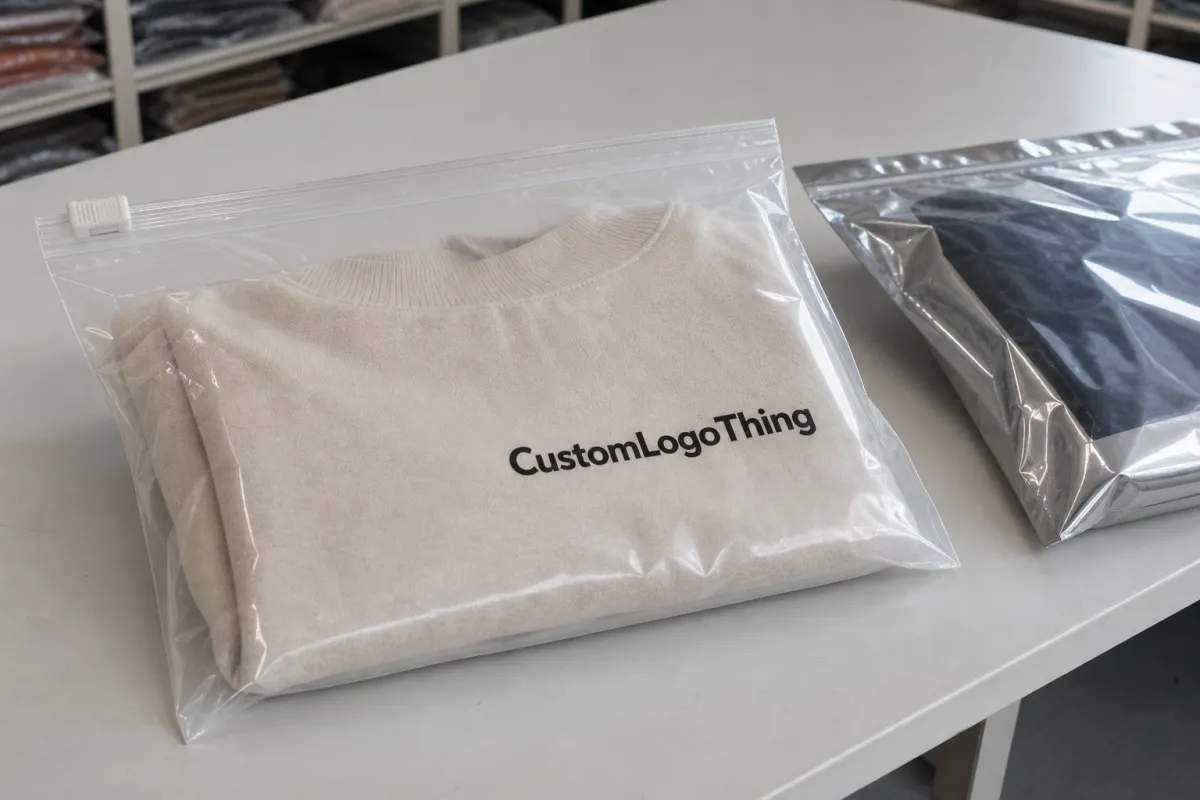
A slider-lock bag solves a common packing problem: how to inspect a folded garment without destroying the package. Apparel teams need to confirm size, style, and fold quality, then return the item to a clean presentation. A slider makes that possible with less handling than tape, staples, or a heat-sealed pouch that has to be cut open and reworked.
The benefit is clearest on basic programs like tees and socks, but it becomes more obvious on sleepwear, gift sets, and multipacks where more than one item has to be checked. A good slider should move smoothly and guide the operator back into the track without fighting the film. If the closure feels stiff, the labor savings disappear quickly.
There is also a presentation angle. Clear slider-lock bags make it easy to see color, print placement, size marking, and fold quality at a glance. That reduces mis-picks in storage and makes returns handling less chaotic. Compared with a plain poly bag, the slider gives the package a more controlled feel without forcing a more expensive retail carton.
That said, slider-lock bags are not the right answer for every program. If the package must be tamper-evident, a resealable closure may not be enough on its own. If the garment is bulky or irregular, a straight bag can look overfilled. In practice, a custom Slider Lock Clothing Bags bulk order works best when the closure, film, and finished size are chosen around the packing process, not around a catalog description.
Materials, closure styles, and garment-fit choices
Most apparel slider bags are made from polyethylene film, but the exact blend matters. Clear LDPE is common because it gives good visibility and a familiar finish. LLDPE blends feel softer and stretch a little more, which helps when folded items vary in thickness. Frosted film is usually chosen for a cleaner retail look, especially when the package needs to feel more elevated than warehouse-only packaging.
For apparel, thickness usually sits somewhere in the 1.5 to 3 mil range, though the right choice depends on the garment weight and how often the package will be handled. Light tees and socks can often use thinner film. Hoodies, sweat sets, and dense folded items tend to benefit from a heavier gauge because the bag keeps its shape better and resists scuffing during transit.
The slider hardware matters more than many first-time buyers expect. The track, the slider body, and the seal quality all affect how the bag performs after repeated use. A weak track can snag. A stiff slider can slow the line. A poorly formed seal can make each bag feel slightly different, which is exactly the sort of inconsistency that triggers complaints from packing teams.
Fit is the other major decision, and flat width alone is not enough. The bag has to match the folded depth of the garment, not just the measurement printed on the quote. If the fit is too tight, the film can look stretched and cheap. If it is too loose, the garment shifts around and the package looks sloppy. Some programs need a small gusset for bulkier knits. Others stay cleaner with a flat bag that stacks neatly in cartons.
Useful features depend on the end use. A euro slot makes sense if the bag will hang in a display. A hang hole helps for club-store formats. Header space can hold a logo band, size marking, barcode area, or a short care panel. For retail packaging, those details should be treated as part of the package design, not as extras added at the last minute.
On the sustainability side, material selection matters as much as the artwork. Teams that track resin use or recycling claims usually check the spec against local guidance and recognized references such as EPA recycling guidance. That does not replace a formal policy review, but it keeps the conversation anchored in actual material choices instead of marketing language.
Size, thickness, and print specs to lock down
The easiest way to avoid a bad quote is to define the spec before pricing starts. Buyers should confirm width, height, closure placement, film thickness in mil, print coverage, and carton pack count. Those are not minor details. They decide whether the run arrives usable, overbuilt, or too expensive for the SKU margin.
Thickness deserves more attention than it usually gets. Thinner film can look cleaner and cost less, but thicker film tends to stay flat better through repeated handling. For a lightweight tee, a thinner gauge may be enough. For fleece or coordinated sets, a heavier gauge often prevents the sagging and wrinkling that make a package look tired before it reaches the shelf.
Print spec matters just as much. Many apparel programs only need a single-color logo, a size code, or a barcode area. Others need a more complete front panel with brand mark, size callout, and care text. My bias here is toward restraint. Strong package branding does not require a crowded panel; it needs clean contrast, enough unprinted space, and print registration that does not drift across the run.
| Film option | Best use | Typical feel | Practical notes |
|---|---|---|---|
| Clear LDPE | Everyday apparel packing | Smooth, familiar, good clarity | Often the simplest choice for standard product packaging. |
| LLDPE blend | Items that need a little more give | Softer and more flexible | Useful when folded garments vary slightly in thickness. |
| Frosted finish | Retail-facing presentations | Muted, premium look | Good when the package should feel more refined than warehouse-only packaging. |
Before approving a run, test the bag with a real folded sample. That sounds basic, but it is the step that catches most spec mistakes. A sample test shows whether the garment sits too high, whether the slider reaches comfortably, and whether the print remains visible once the product is inserted. It also reveals whether the bag looks tidy in the carton or awkwardly loose.
For teams that also manage custom printed boxes or broader packaging systems, the same rule applies: lock the spec early and compare it against the physical product, not just a drawing. A small change in width or thickness can improve the package more than a new graphic ever will.
Cost, MOQ, and unit-price drivers
Pricing for a custom slider lock clothing Bags Bulk Order is driven by a handful of variables buyers can actually control. Bag dimensions matter. Film gauge matters. Slider hardware matters. Print colors matter. Carton configuration matters. Freight destination matters. If any one of those changes, the landed cost changes too, which is why the cleanest quote request is the one that includes the full spec up front.
MOQ usually reflects setup economics. Printed bags and custom sizes often require a higher starting quantity than stock packaging because the run has to cover film setup, print preparation, and hardware configuration. Simpler unprinted runs may allow lower quantities, but once artwork and special sizing enter the picture, the minimum usually rises. That is not a red flag; it is just how production math works.
There is a real difference between quoted unit price and landed cost. A bag that looks cheap on paper can become expensive once cartons, palletization, and freight are included. The opposite is true as well: a slightly higher unit price can be easier to live with if it reduces damage, speeds packing, or allows a more efficient carton count. Buyers who only compare the bag price often miss the part of the budget that shows up later.
| Order size | Typical use | Indicative unit price | What usually drives the price |
|---|---|---|---|
| 5,000 pieces | Launches, seasonal drops, pilot programs | $0.22-$0.42 each | Setup cost is spread over fewer units, so artwork and hardware have more impact. |
| 10,000 pieces | Core SKU programs | $0.16-$0.30 each | Better balance between setup and volume, especially for repeat orders. |
| 20,000+ pieces | National distribution or multi-warehouse runs | $0.12-$0.24 each | Higher volume often lowers the film and print cost per unit. |
Those ranges are starting points, not promises. A one-color logo on clear film will usually cost less than a design with larger coverage, more colors, or special hardware requirements. One-time setup charges may also appear on the first run, especially if the bag needs custom sizing or print tooling. Repeat orders often skip part of that expense because the spec already exists.
There are practical ways to lower cost without weakening the package. Standardize bag sizes across similar SKUs where possible. Keep artwork simple. Combine seasonal demand into one production run instead of splitting volume into several smaller orders. If the same closure style can work across tees, socks, and light knits, the program becomes easier to source and easier to reorder.
Production steps, proofing, and lead time
A clean run follows a fairly predictable sequence. First comes the RFQ and spec review. Then the artwork check. After that, the proof goes out for approval, followed by a sample or preproduction review if the program calls for it. Manufacturing comes next, then quality inspection, then shipment. Delays usually happen because one of those steps is rushed or described too loosely.
The slowdowns are familiar. Missing dielines create artwork confusion. Low-resolution logos make print approval harder. Unclear color targets lead to back-and-forth on proofs. Late buyer responses stall the schedule. If the bags need to arrive before a launch, share that date early and work backward from it. A factory can plan around a real deadline; it cannot plan around a guess.
Lead time depends more on quantity, print complexity, and factory load than on a single calendar number. For a straightforward order, buyers often see something like 12-15 business days after proof approval. Larger quantities, special finishes, or more complex print coverage can push that longer. The honest answer is that the timeline should be quoted after the spec is locked, not before.
Quality control matters a great deal with slider-Lock Apparel Bags because the closure is part of the user experience. Good checkpoints include slider action, seal integrity, print registration, bag dimensions, and carton counts before freight release. For orders that will travel through rougher distribution channels, some teams also reference testing methods from ISTA so the packaging can be judged against shipping stress rather than just a bench sample.
Repeat orders usually move faster because the original spec sheet, proof, and carton details already exist. If the second run uses the same size and artwork, the buyer avoids the longest approval loops. That matters for seasonal apparel, where the product date is fixed but the packaging still has to stay consistent across replenishment cycles.
What to send for a custom slider lock clothing bags bulk order
For the cleanest quote, send the garment size, folded dimensions, target bag size, quantity by SKU, print file, closure preference, and shipping destination. That gives the estimator enough information to judge fit, calculate print setup, and separate unit cost from freight. If the order includes multiple styles, list each one clearly. Bundling everything into a single line item usually creates avoidable confusion.
Photos help more than many buyers expect. A picture of the current package, or better yet a folded sample next to a ruler, gives the spec team a better sense of depth and closure placement. That often prevents an overstuffed bag, wasted film, or a package that looks visually heavy once the garment is inside. It also helps if you are deciding between retail presentation and warehouse-only packing.
After the quote is approved, the next steps are straightforward:
- Request a sample against the actual folded garment.
- Review the proof carefully, including size marks and barcode areas.
- Confirm carton labels, pallet needs, and shipping terms.
- Set the reorder point before inventory gets tight.
If the apparel line is seasonal, mention the production window right away. A custom slider lock clothing Bags Bulk Order should be built around the real launch date, not a generic target. That is the simplest way to avoid rushed freight, partial deliveries, or a packaging change that lands after the product has already gone live.
What is the minimum order for custom slider lock clothing bags?
Minimum order depends on bag size, print complexity, and whether the run needs custom tooling or printed artwork. Unprinted or standard-spec runs may allow lower quantities than full custom printed programs. For the fastest answer, send the garment size, target quantity, and whether the order is one-time or repeat.
Can custom slider lock clothing bags be printed on both sides?
Yes, both-side printing is possible when the film width and artwork layout allow it. Two-sided print usually increases setup complexity and can raise the unit price, especially on smaller runs. Keep the design simple if the main goal is branding plus a clear front view of the garment.
What thickness works best for slider lock apparel bags?
The best thickness depends on garment weight, handling frequency, and whether the bag must hold shape on a display or packing line. Lighter tees and socks can use thinner film, while hoodies, sets, or heavy folded items often benefit from a thicker gauge. Ask for a sample against the actual folded garment before confirming final thickness.
How long does a bulk order take after proof approval?
Lead time depends on print setup, order size, and current production schedule, so proof approval should happen as early as possible. Simple orders move faster than heavily printed or highly customized programs. If the order is tied to a launch date, share that date up front so the timeline can be planned around it.
Can I reorder the same custom slider lock clothing bags without starting over?
Yes, repeat orders are usually faster when the size, artwork, and material spec stay unchanged. Keep the original spec sheet, proof, and carton details so the reorder matches the first run. A reorder is also the right time to adjust quantity if demand has changed, since larger runs often lower unit cost.

