Private label Slider Lock Clothing Bags supplier quotes look simple until the packaging line, the freight bill, and the rework pile start disagreeing with each other. The garment is rarely the only problem. More often, the issue is a shirt that arrives wrinkled, dusty, or impossible to reseal without slowing the pack-out team. That is why the bag matters: it has to protect the SKU, carry the brand, and keep reorder math predictable.
A good slider-lock bag does more than hold fabric. It keeps the item visible, reduces handling damage, and gives the brand a surface for logos, size marks, barcodes, care notes, and product information. The best supplier is not just selling plastic. It is solving a workflow problem that shows up in receiving, packing, retail presentation, and returns handling.
That may sound like a small detail. It is not. In apparel, a few cents saved on the wrong package can easily turn into labor, damage, or presentation losses later. The math is rarely dramatic on one order. Over a season, it gets attention fast.
What a private label slider lock clothing bags supplier actually solves
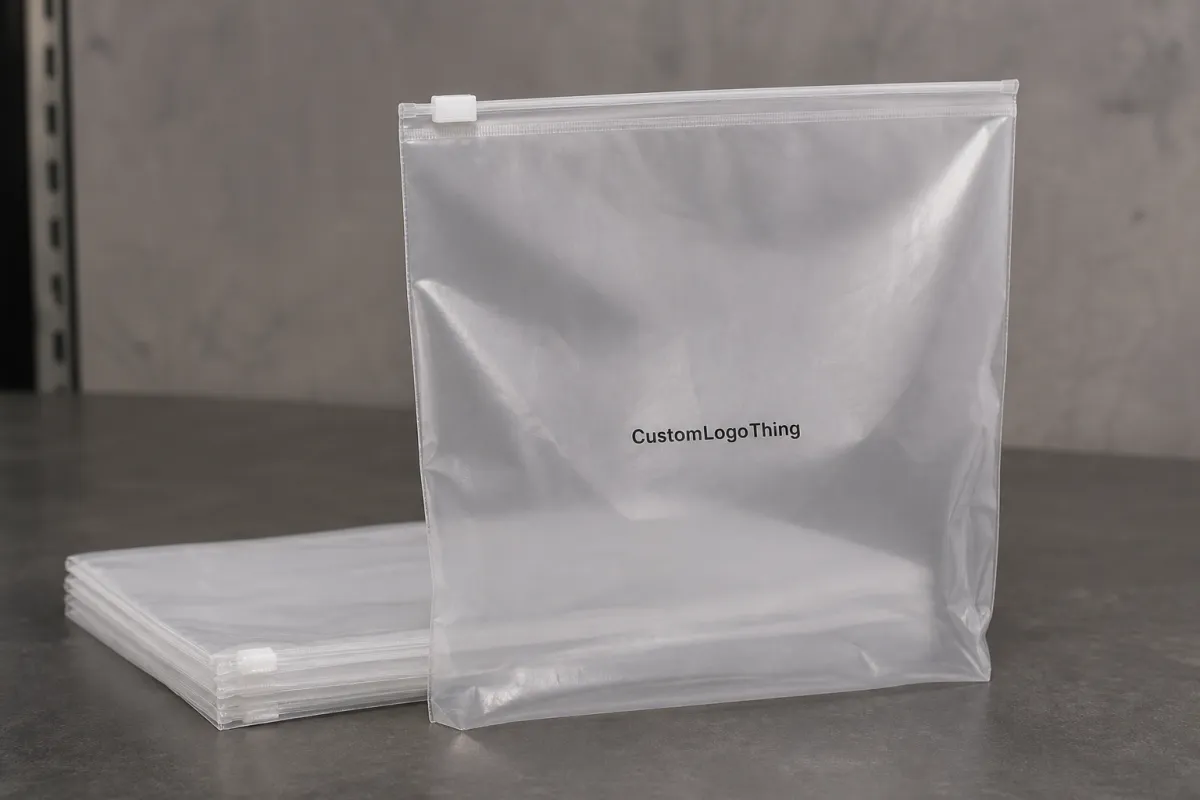
Most packaging headaches show up before anyone blames the garment itself. Dust, fold marks, loose stickers, poor shelf presentation, and repeated repacking are the usual offenders. A private label Slider Lock Clothing Bags supplier gives buyers a resealable clothing bag with a closure that feels more finished than a basic sleeve, while still leaving room for branding and SKU information.
That private-label layer matters because it turns the bag into part of the merchandising system. Logos, size callouts, color codes, barcodes, QR codes, and care instructions can sit on the package instead of being added later as separate labels. Fewer loose components usually means fewer mistakes at packing tables. It also keeps returns processing cleaner, which matters more than many teams expect once orders start coming back open, checked, and rebagged.
These bags are common for fashion basics, socks, loungewear, uniforms, subscription apparel, and accessories that need to look orderly while staying protected. They also work well for SKUs that are opened and closed often, such as exchange items or warehouse-checked goods. For brands that want the packaging system to stay consistent across categories, pairing the bag with Custom Labels & Tags can keep the visual language aligned without crowding the film.
The practical test is simple: does the bag reduce friction? If it speeds packing, improves presentation, and lowers the chance of a damaged or messy arrival, it earns its place. If it only looks good in a mockup, the quote is missing the real cost.
How slider-lock closures work for apparel packaging
The mechanism is straightforward. A slider-lock bag uses a track at the opening and a movable slider that presses the two sides of the track together as it travels. That creates a closure that can be reopened and resealed repeatedly without tearing the lip the way some one-time seals do.
For apparel, that matters for three reasons. First, the product stays visible, which helps on retail shelves and in warehouse checks. Second, the bag keeps dust and handling marks off the fabric. Third, the resealable format makes picking, packing, and exchanges easier because staff do not need fresh tape or a replacement sleeve every time the bag is opened.
Compared with a plain poly sleeve, the slider adds cost. It usually adds value too. A careful private label Slider Lock Clothing Bags supplier should be able to explain the closure grade, how smoothly the slider travels, and whether the track is meant for repeated use or just a single pack-out cycle. That difference shows up quickly on the line. A bag that hangs up on a thick knit is not premium. It is a bottleneck.
"If the bag looks good in a PDF but the slider catches on a sweatshirt, the package is not finished. It is only approved on paper."
That is why closure testing should use the actual garment, not a flat sample in an oversized bag. A light tee, a folded hoodie, and a textured knit behave differently. They should be judged differently too. The best sample is the one that reveals the problem before production starts, not after a carton has shipped.
Pricing, MOQ, and quote factors that change your unit cost
The unit price is shaped by more than bag size. Film thickness, dimensions, print coverage, slider style, and whether the job needs custom tooling all change the number. A Private Label Slider Lock Clothing Bags Supplier should separate those variables instead of burying them inside one vague line item.
For a 5,000-piece run, a plain clear bag with a one-color logo might land around $0.18 to $0.32 per unit, depending on size and hardware. Add heavier film, two-sided print, or a custom size and the number can move toward $0.28 to $0.55. Smaller runs under 2,000 pieces often cost more per unit because setup, inspection, and packing labor are spread across fewer bags. That is normal. It is not a red flag by itself.
| Quote factor | What changes | Typical effect |
|---|---|---|
| Film thickness | Clarity, tear resistance, and feel | Heavier film usually adds cost, but it can reduce damage and wrinkling |
| Bag dimensions | Material use and pack-out efficiency | Oversized bags waste film and freight space |
| Print coverage | Ink usage and setup complexity | A one-color logo is cheaper than multi-panel branding |
| MOQ | How setup costs are spread | Lower MOQ usually raises the per-unit price |
| Freight and carton pack-out | Total landed cost | Bulky cartons and inefficient palletization can erase savings from a low unit quote |
There are also quote variables that buyers miss because they are not printed in the headline price: sample fees, rush charges, revision costs, overrun tolerance, carton strength, and freight assumptions. Ask whether the supplier is quoting by finished bag count or by a quantity that allows for spoilage and setup loss. Those details affect the real cost far more than a small difference in the unit line.
A cleaner comparison starts with identical inputs. Send every supplier the same artwork, the same dimensions, the same closure style, and the same quantity break. Then compare landed cost, not just factory price. A lower quote can still become the expensive one if the bags arrive too thin, too large, or too awkward to pack.
For very small launches, expect the per-unit number to feel less efficient. That is the tradeoff for lower risk. Once artwork, dimensions, and closure style are locked, the numbers usually settle down on repeat orders, especially if the supplier can keep the same tooling and print setup in rotation.
Production process and lead time from artwork to delivery
A reliable quote only matters if the production path is clear. A private label Slider Lock Clothing Bags supplier should be able to map the job from briefing to shipment without hand-waving. The usual flow is straightforward: artwork review, proof approval, sample check, production, quality control, packing, and transit.
- Briefing: confirm dimensions, film thickness, print area, slider color, and quantity.
- Artwork review: check logo placement, barcode readability, and any size or care information.
- Proof approval: sign off on a digital mockup or physical sample before production starts.
- Production: print, form, cut, and install the slider hardware.
- Quality control: verify closure action, print alignment, bag count, and carton strength.
- Shipment: confirm carton counts, palletization, and transit method.
Most delays come from the same few places. Artwork files are incomplete. Bag dimensions are described loosely. A proof gets revised after someone notices that the barcode is too small or the logo sits too close to the track. Seasonal demand adds pressure. None of those issues is unusual, but together they can turn a 12-business-day window into something longer.
For transit testing, ask whether the packaging should be checked against a distribution profile such as ISTA 3A or an equivalent carton-handling standard. That does not solve every shipping problem, but it does force the supplier to think beyond the first carton leaving the factory. It also exposes weak carton construction before a pallet reaches receiving.
For many apparel orders, a workable timeline is 12 to 18 business days after proof approval, plus freight. Simple runs move faster. Jobs with unusual dimensions, heavier print coverage, or specialty hardware usually take longer. It is better to ask for separate milestones in writing than to rely on one vague "ready soon" promise that leaves planning up to guesswork.
One more point from experience: the fastest job is rarely the one with the cheapest quote. Clear specifications save more time than aggressive price shopping. A supplier can only build fast if the buyer removes ambiguity early.
Sizing, film, and finish choices that make the bag work
The best sizing decision starts with the folded garment, not the hanger size on the style sheet. A hoodie that looks manageable on paper can become bulky once it is folded to fit warehouse rules or a retail insert card. That is why a private label slider lock clothing bags supplier should quote against packed dimensions, not just garment size.
As a rough guide, light tees often fit well in bags with a bit of extra clearance, while heavier knits and sweatshirts need more headroom and a wider opening so the slider does not fight the bulk. Many buyers land in roughly the 50 to 100 micron range, depending on the weight of the garment and how much stiffness they want on shelf. Thin film can be fine for soft, lightweight items. Thicker film tends to improve tear resistance, stackability, and the overall feel of the package.
Finish choices change the impression more than people expect. Gloss reads sharper and makes artwork pop. Matte feels softer and often photographs better under store lighting. Transparent film is useful when the garment itself should drive the sale. Frosted or tinted film can hide minor fold marks while still showing enough of the product for retail. None of those choices is universally better. Each one solves a different presentation problem.
Think about the details that get ignored until the order is already moving: hang-hole features, tamper-evident tear lines, barcode windows, writable panels, and the amount of seal strength needed around the slider track. If the bag also needs an insert card or size sticker, a partner like Custom Labels & Tags can keep the package system cleaner than trying to force every detail onto the film. For paper inserts or hang cards, ask for FSC-certified stock if sustainability claims matter to the brand.
Material choice matters too. Most apparel bags use PE-based film because it flexes rather than cracking under folding and shipping pressure. If the product requires anti-static behavior, a matte finish, or another special property, confirm that the additive or coating is compatible with printing and disposal requirements. Clear film is not automatically recyclable in every market, and mixed-material features can complicate collection.
The right combination of size, film, and finish does something practical: it lowers repacking, reduces presentation complaints, and avoids the most common mistake in apparel packaging, which is buying a bag that looks premium in isolation but feels too large or too flimsy once the garment is inside it.
Common mistakes buyers make when sourcing custom slider-lock bags
A private label slider lock clothing bags supplier can only quote cleanly if the buyer gives clean inputs. The most common mistake is ordering by garment size alone instead of measuring the folded item that actually has to fit inside the bag. A large tee and a dense sweatshirt may sit in the same style family, but they do not share the same packed footprint.
Another frequent miss is weak proofing. Logos can sit too close to the slider track, barcodes can lose readability, and low-contrast print can disappear on frosted film. What looks acceptable on a screen can fail once the bag is filled, handled, and stacked. That is not a design problem. It is a verification problem.
Freight is another quiet trap. Buyers sometimes celebrate a low unit price, then discover the cartons are bulkier than expected or the pallet count is higher than planned. A cheap factory quote can become expensive after transport, receiving labor, and storage are added. The product still looks inexpensive on paper, but the warehouse says otherwise.
Sampling also gets rushed. Many teams approve a nice-looking sample and never test it with the thickest SKU in the range. Then the closure drags, the bag bows, or the print becomes hard to read once the item is inserted. A better habit is to test real garments, multiple openings, and the actual pack-out style used in the warehouse.
A bag that passes a visual check but fails on the line is not a win. It is avoidable rework.
Repeatability deserves as much attention as the first sample. Print alignment over a full run, carton consistency, and the way the closure performs after repeated opening all matter more than a perfect hero sample. If the run cannot hold that consistency, the supplier is selling a demonstration, not a packaging solution.
There is one more mistake that comes up often: assuming a clear bag is automatically recyclable. It is not that simple. Recycling depends on the resin structure, local collection rules, and whether the bag includes mixed materials or hardware that complicates recovery. If sustainability is part of the brief, ask for resin details early, not after the order is on the water.
Next steps to sample, test, and launch a private-label order
Start with two or three samples that match your garment type, size range, and branding needs. If the supplier only offers one generic sample, that is not enough. A private label slider lock clothing bags supplier should be able to show variation by thickness, closure style, and print level so the tradeoffs are visible before you commit.
- Test the bag with the thickest SKU in the line, not just the easiest one.
- Open and reseal it several times to check slider action and track wear.
- Read the logo, barcode, and size mark under warehouse lighting and retail lighting.
- Ask for a written quote with MOQ, unit price breaks, freight assumptions, and lead time.
- Confirm carton counts, storage needs, and reorder rules before production starts.
A useful test is simple: can the bag handle packing, opening, resealing, and shelf display without making the garment look cheap? If yes, the package is doing real work. If not, the quote is missing a hidden cost.
The right supplier should make packaging easier to buy, easier to pack, and easier to present. If the quote is confusing, the closure feels awkward, or the specs keep changing, the supplier is adding friction instead of removing it. That is usually the clearest signal a buyer gets.
Packaging often looks like a cost center until it starts preventing returns, reducing repack time, or protecting premium presentation at the shelf. Then it becomes a control point. The brands that treat it that way tend to choose better dimensions, ask better questions, and avoid expensive surprises later.
What should I ask a private label slider lock clothing bags supplier before quoting?
Ask for exact bag dimensions, film thickness, closure type, print method, and MOQ before comparing prices. Request sample photos or physical samples so you can verify clarity, sealing, and logo placement. Confirm whether freight, tooling, and proof revisions are included in the quote.
How do I know which size slider-lock clothing bag to order?
Measure the garment after folding or flat packing, not just its retail size on the hanger. Leave room for the slider hardware and any insert card, barcode, or size label you want inside the bag. Test a sample with the thickest SKU in your range before placing the full order.
Can a private label slider lock clothing bags supplier print logos and product details?
Yes, most custom suppliers can add logos, size marks, care notes, barcodes, and brand messaging. Ask how many print colors are included so you can compare quotes fairly. Check that the print stays readable after handling, stacking, and shipping.
What lead time should I expect for custom slider-lock apparel bags?
Lead time usually depends on artwork approval, sample sign-off, MOQ, and print complexity. Simple runs move faster than jobs that need new tooling or multiple revisions. Ask the supplier to separate proof time, production time, and transit time in writing.
Are slider lock clothing bags reusable or recyclable?
Many are reusable because the slider closure is designed for repeated opening and resealing. Recyclability depends on the film structure, local collection rules, and whether the bag uses mixed materials. If sustainability matters, ask the supplier for resin details and disposal guidance before you order.


