A Washed Cotton Caps private label order can look straightforward until the sample arrives. The cap may feel relaxed and retail-ready, but the result still depends on fabric weight, wash level, fit, decoration, labeling, and pack-out decisions that need to be set before bulk production starts.
The biggest risk is treating a washed style as if it needs less specification because the finish is casual. It actually needs more clarity. Once the wash, trim, and artwork details are fixed in writing, the order becomes easier to quote, approve, and repeat.
Why washed cotton caps work for private label programs
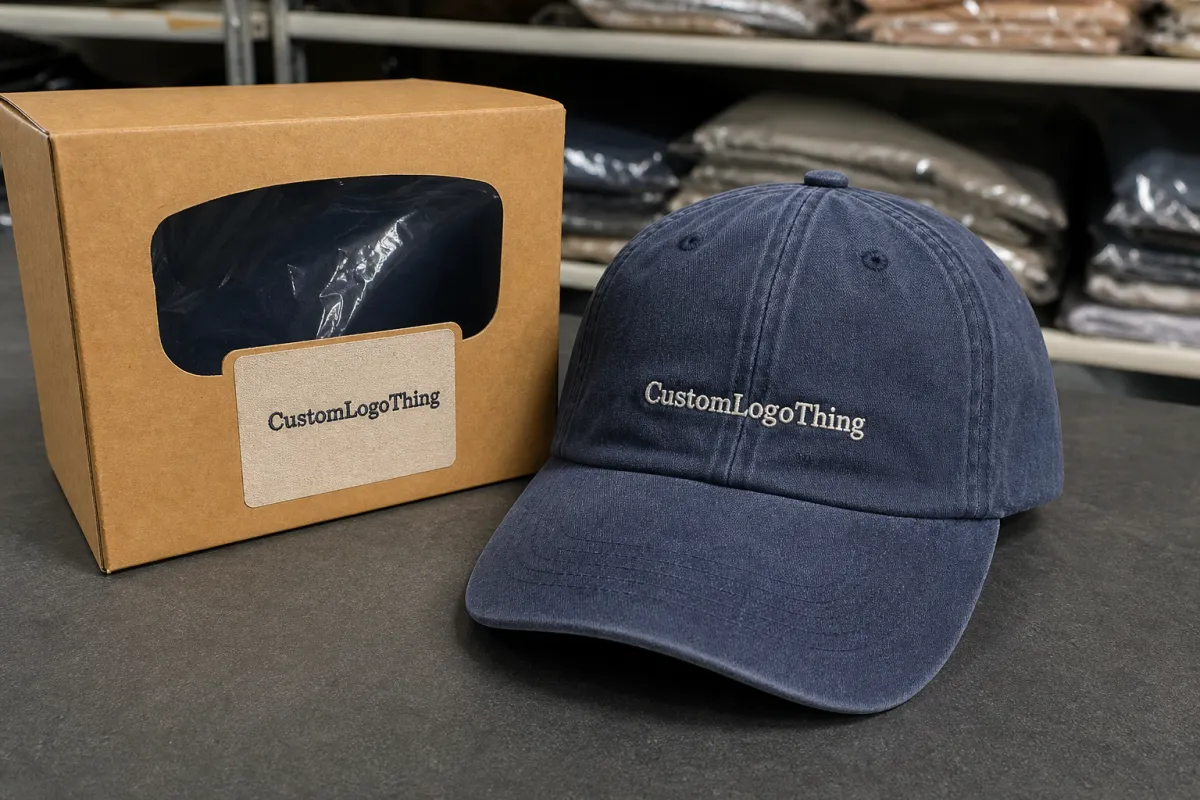
Washed cotton has a built-in advantage for private label use: it already feels broken-in and shelf-ready. The softer handfeel, less rigid crown, and muted surface finish suit lifestyle brands, streetwear labels, outdoor assortments, and retail programs that want something less promotional than a standard cap.
The style also works well as a repeat item. Once the silhouette and wash tone are locked, the cap can be reordered without redesigning the product every season. That matters for brands that want a core accessory with consistent fit and presentation.
A washed cap looks simple, which is why buyers under-spec it. The less engineered the product appears, the more important the written spec becomes.
There is also a practical packaging benefit. Washed Cotton Caps usually ship cleanly, do not need fragile assembly, and hold up well in cartons when the brim and crown are packed correctly. That makes receiving and replenishment easier than with more delicate accessory builds.
Fabric, wash level, and fit specs to confirm early
Start with the base fabric. Washed cotton twill gives a softer drape and more casual look, while heavier cotton canvas adds structure and feels more substantial. The right choice depends on whether the cap should read relaxed, rugged, or slightly elevated.
Fabric weight has a direct effect on handfeel and durability. A practical range for many programs is 260-340 gsm. Lower weights wear lighter and are often better for warm-weather comfort. Higher weights hold shape better and usually support decoration more cleanly. Too light, and the cap can lose body after washing. Too heavy, and the wash effect may look forced.
The wash process should be named clearly. Garment wash, enzyme wash, and pigment wash all behave differently. Garment wash gives a natural broken-in feel, enzyme wash softens without making the cap look heavily processed, and pigment wash can create a faded vintage tone but usually brings more shade variation. That variation is normal; the issue is whether it is within the brand's tolerance.
Fit should be approved early, not left for the end. Low-profile, unstructured crowns work for casual ranges. Mid-profile shapes are safer for broader retail because they sit cleaner on display and fit more wearers without collapsing. Brim length is commonly around 7.0-7.5 cm, but a reference sample is better than a guess. Adjustable closures should match the brand position and the intended price point.
- Fabric weight: 260-340 gsm is a practical range for washed cotton cap programs.
- Crown shape: low profile for lifestyle and streetwear, mid-profile for broader retail appeal.
- Brim length: around 7.0-7.5 cm is common, but verify with the reference sample.
- Closures: metal buckle, fabric strap, or snapback, depending on the brand story.
Color direction needs hard references. “Washed black” or “vintage blue” are not specs by themselves. Use Pantone references, physical swatches, or approved photos. If the cap should look faded but not chalky, say that. If the stitching should stay visible against the wash, say that too.
Decoration and labeling details that affect approval
Lock the structure before discussing embellishment. Panel count, crown height, brim length, stitch density, closure type, and wash target should be fixed before final pricing. If those details are still moving, the quote is not really final.
For decoration, flat embroidery is the safest repeatable option. It gives a clean retail look and usually holds up well through production. Woven patches and badges add texture and often suit washed caps better because they match the softer, worn-in handfeel. A small side hit or rear mark can add value without crowding the front panel.
Inside labeling matters too. Sweatband prints, woven labels, care tags, size loops, hangtags, barcode stickers, and taping all affect how finished the cap feels. A product that looks polished outside but random inside often signals a rushed order, and retail buyers notice that quickly.
Use one spec document instead of scattered messages. Include the reference photo, artwork file, Pantone callout, stitch count, placement measurements, and tolerance notes in the same file. If there are multiple logo locations, label each one clearly so the supplier does not have to interpret the layout from chat history.
If you need paper hangtags or insert cards, ask for FSC-certified stock. For shipping cartons, focus on compression resistance, outer label accuracy, and count control. A crushed carton or bad SKU label can create a receiving problem even when the product itself is fine.
Cost, MOQ, and pricing drivers buyers should watch
Pricing for a washed cotton caps private label order moves with fabric grade, wash process, decoration count, labeling, pack-out, and freight. The factory quote is only part of the landed cost. Sample fees, tooling, carton work, and shipping can shift the real cost enough to affect margin.
Starter MOQs often begin around 300 to 500 units for a basic build with simple decoration and standard packaging. Better pricing usually starts around 1,000 units because setup costs spread more efficiently. At 3,000 units and above, buyers usually get more room on price and a steadier repeat run.
The wash process can also affect cost. More controlled garment washing may require tighter batch handling. Pigment-dyed looks can bring extra shade approval. Heavier fabric, structured shapes, and metal closures add sewing or sourcing time. More decoration always adds labor, and labor shows up in the unit price.
| Build option | Typical unit cost at 1,000 pcs | What you get | Tradeoff |
|---|---|---|---|
| Washed cotton twill, flat embroidery | $2.20-$3.10 | Clean retail look, easy repeatability | Less distinctive if the brand wants more texture |
| Garment-washed twill, woven patch, custom label | $3.10-$4.60 | More premium handfeel and stronger private label presence | Higher setup and slightly more approval time |
| Heavy cotton canvas, mixed decoration, special pack-out | $4.80-$6.50 | Heavier feel, stronger shelf impact, better for elevated retail | Higher MOQ pressure and more cost sensitivity |
Sample cost is easy to underestimate because it looks small next to the bulk order. It is not always small if revisions are needed. Freight matters too: air shipping helps with launch timing, while ocean freight is usually better for replenishment. Compare landed cost, not just factory price.
Production workflow, lead time, and delivery checkpoints
The usual workflow is artwork review, sample development, revision, bulk production, inspection, packing, and dispatch. The sequence is simple; the risk comes from skipping a step because the launch date is tight.
A sample commonly takes 7 to 10 working days after artwork is confirmed. Bulk production is often 20 to 30 days after sample approval, depending on quantity, wash complexity, and decoration type. Transit time sits on top of that. If a supplier is promising an unusually fast schedule, ask which part of the process has been compressed.
Approval should cover color, stitch quality, wash effect, logo placement, and packaging before bulk cutting begins. Do not sign off from one front-facing photo alone. The side profile, crown shape, and brim curve matter just as much as the front view.
Pack-out should be agreed before the line starts. Individual polybags, inner tissue, master carton labels, SKU stickers, and carton counts protect the warehouse team from avoidable mistakes. A cap can be perfectly made and still create problems if the cartons are mislabeled or packed inconsistently.
Quality control checks that should not be skipped
Washed caps need a different kind of QC than a crisp structured cap. The finish is softer, which is the point, but softness can hide problems. Loose threads disappear into the texture, and small asymmetries can look intentional until they show up across multiple cartons.
Before bulk starts, ask for a pre-production sample using the final fabric, wash, thread color, and labels. Check it under daylight and indoor light because pigment-dyed colors can shift by environment. If the goal is a vintage feel, the target should be controlled variation, not random aging.
Measure crown height, panel symmetry, brim curve, and closure placement. Inspect embroidery or patch work for puckering, skipped stitches, thread tension, and backing marks. On washed cotton, small defects often become more visible after handling, so a photo approval alone is not enough.
Ask for carton pulls from different parts of the production run, not just the first few units. If you use AQL inspection, keep the defect categories simple: color, fit, stitching, labeling, and pack-out. The goal is not a formal report. The goal is to catch drift before shipment.
What a reliable private label supplier should prove
A reliable supplier treats the order as a repeatability problem, not a one-off sample exercise. The real question is whether the same wash tone, crown shape, and stitch quality can be held on the next run without a fresh round of guesswork.
Ask how the factory documents approval. A good partner should have a clear spec pack, sample reference, and production sign-off path. If they cannot show where the approved version lives, reorder consistency will be weak.
Packaging capability is another useful test. A supplier that can manage polybags, carton labels, barcode placement, and count accuracy is easier to work with because fewer handoffs are left to chance. It also helps to ask whether the wash treatment is done in-house or subcontracted, since that affects control over shade and batch consistency.
The best suppliers do not promise perfection. They explain tolerance, approval steps, and what changes are realistic between sample and bulk. That honesty is usually worth more than a polished sales pitch.
Common ordering mistakes that raise cost or delay shipment
The biggest mistake is skipping the sample to save time. That usually costs more later when the wash tone, logo size, or fit is off and the run needs correction. Fast is useful. Blind is not.
Second mistake: vague color direction. “Vintage blue” means almost nothing by itself. Use Pantone, a physical reference, or both. If the cap should look faded but still premium, say so. If the wash should be soft without looking dirty, say that too.
Third mistake: overloading the cap with decoration. Extra patches, mixed materials, multiple embroidery hits, and complicated inner branding can move a simple cap into a more expensive range quickly. Every added detail needs approval, and every approval adds time.
Fourth mistake: leaving packaging decisions until the end. Carton counts, inserts, hangtags, and barcode placement are easiest to confirm before bulk production begins. Late changes cause rework and delay.
Fifth mistake: not documenting the reorder spec. Keep the approved sample tied to a written spec sheet, and record thread colors, measurements, wash target, and pack-out instructions in one place. That is how a private label cap line stays repeatable instead of drifting every season.
Final checklist before you place the order
Send a brief with target quantity, preferred wash look, closure type, decoration method, delivery country, and the date you need stock in hand. A clean brief gets a cleaner quote.
Attach reference images and mark the non-negotiables: logo size, label placement, thread color, carton pack-out, and retail packaging requirements. If the cap sits alongside a broader assortment, keep the color story and logo scale consistent with the rest of the line.
Ask for a line-item quote that separates sample cost, unit cost at more than one quantity, any tooling, and estimated lead time. That makes supplier comparison possible and exposes whether the vendor actually priced the order or just tossed out a number.
Before approval, lock the spec sheet and archive it. The next reorder should be a controlled repeat, not a fresh debate about wash tone or fit. That is the practical value of a well-managed washed cotton caps Private Label Order: fewer surprises, cleaner replenishment, and a product that stays on brand.
What MOQ should I expect for a washed cotton caps private label order?
Starter runs often begin around 300 to 500 pieces, depending on decoration and packaging. Better unit pricing usually starts around 1,000 pieces because setup costs spread more cleanly. If you add custom labels, special washes, or complex embroidery, expect the MOQ to rise.
Can I add custom embroidery to washed cotton caps for private label use?
Yes. Flat embroidery is the most common choice and usually the easiest to repeat. 3D puff can work on some styles, but washed caps often look better with cleaner, flatter decoration. If you want a softer vintage feel, a patch, badge, or woven label may be the better call.
How long does a washed cotton caps private label order usually take?
Samples commonly take 7 to 10 working days after artwork is confirmed. Bulk production is often 20 to 30 days after sample approval, depending on quantity and complexity. Shipping time adds on top, so confirm the route before you set launch dates.
What should I send to get an accurate private label cap quote?
Send quantity, cap style, closure type, decoration method, and the target wash look. Add artwork files, reference images, and any packaging or labeling requirements. Include your delivery country or port so freight and landed cost are clear from the start.
How do I keep the wash and fit consistent on repeat orders?
Approve one master sample and keep it tied to the spec sheet. Record color references, stitch details, and packaging instructions in writing. Ask for pre-production and final QC photos before every bulk run ships so the reorder does not drift.


