pvc zipper garment Bags Small Batch Custom Order requests usually start with a practical mismatch. The stock cover is too short for a coat, too loose for a dress, too flimsy for repeated handling, or too generic for a line that already has branding, hang tags, and packaging standards. That mismatch is easy to ignore in a sample room. It becomes obvious when 300 pieces are sitting on a rack or packed into cartons.
The reason brands keep coming back to custom runs is control. A small batch lets a buyer set the dimensions around the actual garment, choose the film thickness that fits the use case, and decide whether the bag should look invisible or deliberately branded. The order is small, but the consequences are not. A bag that wrinkles the hem, fogs under store lighting, or snags at the zipper can make a well-made garment look like a bargain-bin item.
The useful way to think about this category is not as a generic accessory. It is a protective package with a display job. That changes the buying logic. You are not just purchasing a cover. You are deciding how the garment will sit in storage, how it will be seen on the rack, and how often staff will open and reclose it before the product sells.
PVC zipper garment bags small batch custom order: when stock fails
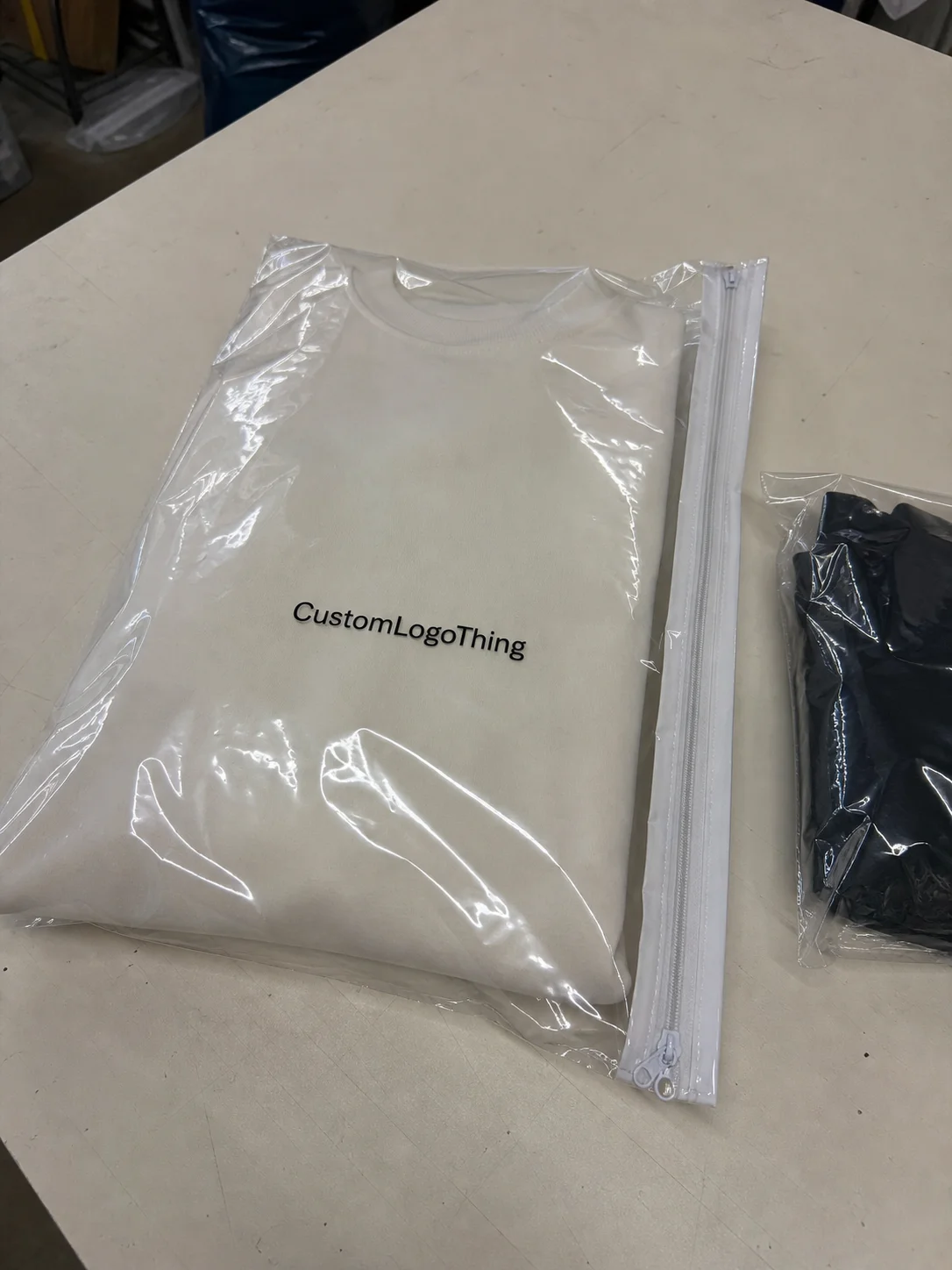
Stock garment bags work only when the product range is predictable and the presentation standards are forgiving. Once the assortment changes, the compromises show up fast. A seasonal coat launch needs more depth than a shirt bag. A bridal sample room needs clearer visibility and smoother zipper action than a warehouse cover. Uniform programs often need durability first, then appearance. One standard size rarely serves all three well.
That is where PVC Zipper Garment Bags Small Batch Custom order work earns its keep. It reduces the hidden cost of bad fit. When a bag is too tight, seams strain and the zipper track gets stressed. When it is too long, the garment shifts and looks untidy. When it is too wide, the bag takes more shelf space and creates a looser, less premium presentation. Those are not cosmetic issues. They affect handling time, storage density, and perceived value.
There is also a timing angle that gets overlooked. Small-batch ordering is useful when the buyer is testing a collection, filling a short reorder gap, or supporting a limited retail window. No one wants to commit to a full year of inventory on a bag design that may only be needed for one season. A smaller run gives the brand room to correct sizing, update logos, or change film finish after the first sell-through.
From a buyer's perspective, the order makes sense when three conditions are true:
- The garment size is not standard: long coats, dresses, uniforms, or layered pieces need tailored dimensions.
- The bag will be seen by customers: clarity, zipper alignment, and surface finish affect how the item reads on the rack.
- The brand needs a controlled quantity: launch drops, showroom use, and limited programs do not justify oversized inventory.
The best suppliers do not sell this as a novelty. They treat it like a spec-driven packaging job. That means asking how the bag will be used, how often it will be handled, and what kind of garment it must protect. If those questions are not asked early, the quote usually misses the real cost drivers.
A low unit price is not a win if the bag fails at the hanger slot, the zipper, or the first store reset. Rework is where small-batch orders quietly become expensive.
For teams that already manage other packaging formats, it often makes sense to review garment bags alongside matching Custom Packaging Products or the broader ordering structure on Wholesale Programs. The point is not to bundle everything for its own sake. It is to keep sizing, graphics, and packing standards aligned across the full line.
Fit, clarity, and closure details that change daily use
PVC is simple on paper and less simple in practice. The clarity level, surface finish, and stiffness all affect how the bag behaves in the store and in transit. Clear film shows the garment with no visual filter, which is useful for retail display and sample viewing. Frosted film reduces glare and hides fingerprints better, which matters when staff handle the bag repeatedly or when the visual language of the brand leans more refined than sterile. Neither is universally better. The right choice depends on what the customer should notice first.
The zipper is equally important. Many buyers focus on the film and treat the closure as a standard component. That is a mistake. A single zipper is usually fine for storage or occasional use. A double-pull zipper is better when the bag will be opened often, because it spreads wear and makes the motion feel more controlled. Reinforced stops, clean zipper tape, and consistent track alignment are worth paying for on garments that move between showroom, warehouse, and retail floor.
Hanger access is another detail that causes preventable failures. If the opening is too tight, staff have to force the hook through the top and distort the film. If it is too wide, the bag slides and the garment sits off-center. For longer pieces, the top opening also has to work around collars and shoulder width without making the garment look cramped. This sounds minor until a whole run is hanging on display. Then the inconsistency becomes the first thing anyone notices.
A good buyer usually checks these four points before approving the design:
- Visibility: clear film maximizes product visibility, while frosted film cuts glare and reduces visible handling marks.
- Access: the zipper should open and close without snagging, especially if the bag will be reused.
- Hanging method: the slot or opening must match the actual hanger style, not a generic hook assumption.
- Structural behavior: the bag should keep its shape when loaded, not collapse into folds that make the garment look neglected.
If the program also needs printed inserts, sleeves, or outer cartons, the packaging system should be considered as a whole. A transparent garment bag can carry the display role, while other custom printed boxes handle storage or gift presentation. Trying to make one package solve every packaging problem usually produces a weak result in all of them.
Specs: thickness, dimensions, print, and hardware
The fastest way to get a useful quote is to send a complete spec sheet. If the dimensions are vague, the factory will pad the number. If the artwork is incomplete, the proof cycle stretches. If the zipper and hanger requirements are not clear, the supplier has to guess at conversion cost. Guessing is expensive on both sides.
For this product category, the core technical fields are straightforward: width, height, gusset depth if needed, film thickness, zipper style, hanger opening size, and print area. The garment itself should drive the measurements, not the label size on a retailer's system. A medium jacket, a formal dress, and a uniform cover may all be called "one size" internally, but they need different cut dimensions in production.
Film thickness matters more than many buyers expect. A common practical range is 0.12 mm to 0.25 mm. Thinner film usually works for lighter garments, samples, or short-term display. Thicker film is better for coats, uniforms, and orders that will be handled often. It also tends to hold shape better, which matters when the bag is part of the retail presentation rather than just a storage sleeve.
For cut tolerances, buyers should ask what the factory can actually hold. A plus or minus 3 mm tolerance is a useful starting point for many runs, but it depends on the construction method and the complexity of the piece. Large-format bags, reinforced openings, and printed registration can widen the tolerance band. The important thing is to confirm the number before the order is approved, not after the first cartons arrive.
Print is where a small run can either look polished or look improvised. One-color logo printing is usually the most efficient choice for modest quantities. Multi-color branding can work, but every additional color adds setup, registration risk, and the chance of visible variation between cartons. On transparent or frosted film, a restrained print often performs better than a crowded one. The garment should remain the main visual object.
Hardware should never be treated as filler. Zipper color, pull-tab style, end-stop construction, and hanger-slot reinforcement all affect how the bag feels in use. A cheap-looking pull tab can drag down the whole package even if the film is excellent. That is why experienced buyers ask to see the hardware choices before they approve the proof.
Send the supplier this information up front:
- Artwork files: vector files are preferred for logos and line art.
- Color control: provide Pantone references if brand color matters.
- Use case: retail display, storage, transit, or a mix of all three.
- Packing method: carton count, inner bundle requirements, and whether palletizing is needed.
- Compliance needs: ask for material declarations if the bags will be sold into regulated markets or exported through strict channels.
For shipping durability, it helps to ask whether the packed cartons have been considered for transit testing. Distribution stress is not theoretical. Compression, vibration, and drop handling can distort zipper lines and crease the film. The International Safe Transit Association documents common test methods at ISTA. Broader packaging industry context is available through Packaging.org.
Cost, MOQ, and what actually moves the quote
The quote is shaped by a small set of variables, and most of them are predictable. Material thickness, finished dimensions, zipper type, print complexity, total quantity, and packing format do most of the work. PVC itself is only one part of the bill. A large bag with reinforced edges and custom print takes more cutting and assembly time than a simple clear sleeve, even if the material cost difference seems small on paper.
MOQ is not a single fixed number across the market. It changes with standardization. A standard clear bag with no print will usually support a lower minimum than a custom dimension, heavy film, or multi-color logo. For simple builds, a realistic low-MOQ zone often sits around 200 to 500 pieces. More customized orders commonly move into the 500 to 1,000 piece range. Once the design includes heavier film, special zipper work, or tighter print control, the run may need to be larger before the price settles.
Here is a practical comparison of common options.
| Option | Typical MOQ | Indicative Unit Price | Best Use | Main Cost Driver |
|---|---|---|---|---|
| Clear 0.12-0.15 mm PVC, single zipper, no print | 200-500 pcs | $0.75-$1.20 | Simple storage and short-run showroom use | Low setup, basic conversion |
| Clear or frosted 0.18-0.20 mm PVC, logo print | 500-1,000 pcs | $1.05-$1.75 | Branded retail packaging and sample runs | Print setup, size variation, color control |
| Heavy 0.22-0.25 mm PVC, reinforced zipper, hanger slot | 1,000 pcs+ | $1.40-$2.40 | Coats, uniforms, repeated handling | Material weight, tighter construction, more labor |
Those numbers are directional, not universal. Freight, duties, carton count, and rush production can move the landed cost as much as the factory quote itself. A buyer who compares only unit price is missing the larger picture. The cleaner approach is to ask for a split quote that shows the unit cost, setup fee, sample cost, and shipping separately. That makes comparison possible.
There is also a small but important difference between cheap and economical. A supplier with a slightly higher quote but faster proofing, fewer revisions, and more consistent output can be the lower-cost option overall. That tends to be true when the bags are tied to a launch date, a showroom refresh, or a uniform delivery schedule that cannot slip.
Proofing, production, and lead time
A clean process saves more money than an urgent message. The usual sequence is simple: inquiry, spec confirmation, artwork review, proof approval, production, quality inspection, packing, and shipment. Delays usually happen when one of those steps is skipped or compressed too aggressively. If dimensions are not confirmed, the proof cannot be trusted. If the artwork is incomplete, the sample tells you little. If the packing method is unclear, freight becomes a last-minute scramble.
Lead time depends on stock availability, print method, and how quickly approvals move. For standard builds with clear specifications, a digital proof can often be turned around in 24 to 48 hours. Physical samples commonly take 7 to 12 business days. Production after approval often runs in the 10 to 15 business day range for a modest order, though that can stretch if the film has to be sourced to spec or if the print requires extra setup. Shipping time is separate and should be treated that way from the beginning.
That separation matters more than many buyers admit. A factory can finish production on time and still miss the retail date because freight was not booked early enough. International shipments add customs clearance, port delays, and consolidation time. If the order has a fixed launch, build the schedule backward from the arrival date, not from the day the quote lands in your inbox.
A workable planning framework looks like this:
- Day 1-2: send garment dimensions, quantity, logo files, and zipper preference.
- Day 2-4: confirm quote, MOQ, and proof method.
- Day 5-12: review sample or digital proof, then complete one revision cycle if needed.
- Day 13-25: production, inspection, packing, and freight booking.
If a supplier says every step can be rushed without consequence, ask which step is being shortened. In most cases it is the proof cycle or the inspection window. Those are the two places where shortcuts create expensive mistakes. A day spent correcting an outline, print position, or zipper alignment is cheaper than replacing a full run.
For buyers managing several packaging lines, the bag order can be organized alongside other Custom Packaging Products or folded into a broader procurement cycle through FAQ guidance and standard ordering rules. That reduces duplicate proofing and keeps the packaging language consistent across categories.
How to spot a reliable small-batch supplier
The lowest price is rarely the best signal. The stronger signal is whether the supplier can explain the price clearly. A good factory will tell you why the cost changes when the size changes, why one zipper style is more expensive than another, and how print setup affects the run. That level of transparency is more useful than a fast quote with no detail.
Reliable suppliers usually show discipline in three places: communication, specification handling, and repeatability. Communication speed matters because small-batch work has little room for drift. If a supplier takes several days to answer a basic sizing question, the whole project slows. Spec handling matters because garment bags fail at the margins. A hanger slot that is off by a few millimeters or a zipper stop that shifts can make an entire carton look inconsistent. Repeatability matters because the second carton should match the first one.
There are a few quality-control checks that are worth asking about directly:
- Seam consistency: heat lines should be even, with no wavering edges or weak corners.
- Zipper alignment: the track should close cleanly without snagging or drifting.
- Film uniformity: clouding, scratches, and thickness variation should be minimal.
- Print stability: logo color and placement should hold from the first carton to the last.
A serious supplier will also tolerate minor design adjustments without turning every change into a new project. Sometimes the logo needs to move a little because the zipper line changed. Sometimes the hanger opening needs to widen. Sometimes the film finish needs to be adjusted because the store lighting makes the first proof too glossy. Those are normal production corrections, not signs of a bad brief.
On larger apparel programs, the bag is part of a wider packaging system. Retailers often compare the garment bag with inserts, cartons, and shipping protection, then decide where presentation should live and where transit protection should take over. That is a practical decision, not a branding exercise. The smartest packaging choices usually come from that kind of comparison rather than from a generic design rule.
Trust in packaging is operational. If the supplier catches errors early, keeps the proof close to the production run, and communicates tradeoffs plainly, the order is more likely to arrive usable.
That matters more in a small batch than in a large one. A bulk order can absorb a little waste. A small run has less room to hide mistakes, so the supplier's process matters as much as the product itself.
Placing the order without losing time
Start with what cannot be guessed: garment dimensions, quantity, intended use, zipper style, print files, and ship date. If any of those are missing, the quote will be broader than it should be and the proof path will stretch. The cleanest orders are the ones where the buyer has already made the hard decisions.
Ask for pricing that separates unit cost from setup, samples, and freight. That is the only way to compare suppliers honestly. A single all-in number looks neat, but it hides the details that usually determine whether the order works for retail packaging, storage, or transit. If one supplier is slower but better at proofing, or another is slightly more expensive but more consistent, you should be able to see that clearly in the quote.
If the bag style, zipper placement, or print area is still unsettled, request a digital proof or sample before production. That is not wasted time. It is cheaper to correct a proof than a full run. For brands using the bag as part of a wider packaging family, keep the visual language consistent so the garment, carton, and shipment all feel like part of the same system rather than separate decisions made in different weeks.
The practical end of the process is simple. Confirm the spec, approve the proof in writing, and release production with enough margin for inspection and freight. That sequence protects both quality and schedule. For a small-batch garment bag order, those two things are usually the only ones that matter.
If the goal is a PVC Zipper Garment Bags small batch custom order that actually fits the garments and the timeline, the useful move is not more discussion. It is a complete spec sheet, a clear proof, and a production schedule that respects the shipping window.
What is the usual MOQ for pvc zipper garment bags small batch custom order?
MOQ depends on dimensions, thickness, zipper style, and print complexity. Standard clear bags with minimal setup can support lower quantities than fully custom sizes or printed runs. Many suppliers will quote lower minimums for repeat orders or simpler builds, but the exact number should be confirmed against the actual spec sheet.
Can a small batch include logo printing?
Yes. Most small runs can include one-color or multi-color branding if the artwork is prepared correctly. The print method, placement, and film finish all affect the result, so the logo should be reviewed alongside the zipper line and hanger opening before approval. A clean one-color print is usually the most efficient option for modest quantities.
How thick should the PVC be for retail use?
A practical range is often 0.12 mm to 0.25 mm. Thinner film is suitable for lighter garments or short-term use. Thicker film is better when the bag needs to hold shape, survive repeated handling, or support heavier items such as coats and uniforms. The right choice depends on garment weight and how often the bag will be reused.
How long does production usually take after artwork approval?
For straightforward orders, production often takes 10 to 15 business days after approval, with sample or digital proof time added before that. Complex printing, custom dimensions, or material sourcing can extend the schedule. Freight time should be planned separately because shipping delays do not change the factory's production calendar.
What details should I prepare before requesting a quote?
Prepare garment dimensions, expected quantity, intended use, zipper preference, logo file, and target ship date. Include any special requirements such as hanger openings, gussets, print placement, or retail-ready packing. The more specific the brief, the more reliable the MOQ, Pricing, and Lead-time estimate will be.


