For fitness brands, packaging has to do more than hold a garment together. It needs to protect the item in transit, present it cleanly on a shelf or in an unboxing video, and fit a purchase plan that does not trap too much cash in slow-moving stock. That is why PVC Zipper Garment Bags moq for fitness brands comes up so often during sourcing. The bag itself may look simple, but the decision behind it touches product fit, retail presentation, warehouse handling, print setup, and the amount of inventory a brand can realistically carry.
In activewear, those details matter more than many buyers expect. A pair of leggings folded into a flimsy sleeve can arrive wrinkled and hard to display, while a hoodie packed in a bag that is too small may bulge at the seams and make the product look careless before a customer ever touches it. A proper zipper garment bag helps the line look finished. It also gives the warehouse team a repeatable way to package sets, separate sizes, and keep returns or re-stocking cleaner.
Why fitness brands choose zipper garment bags over basic poly sleeves
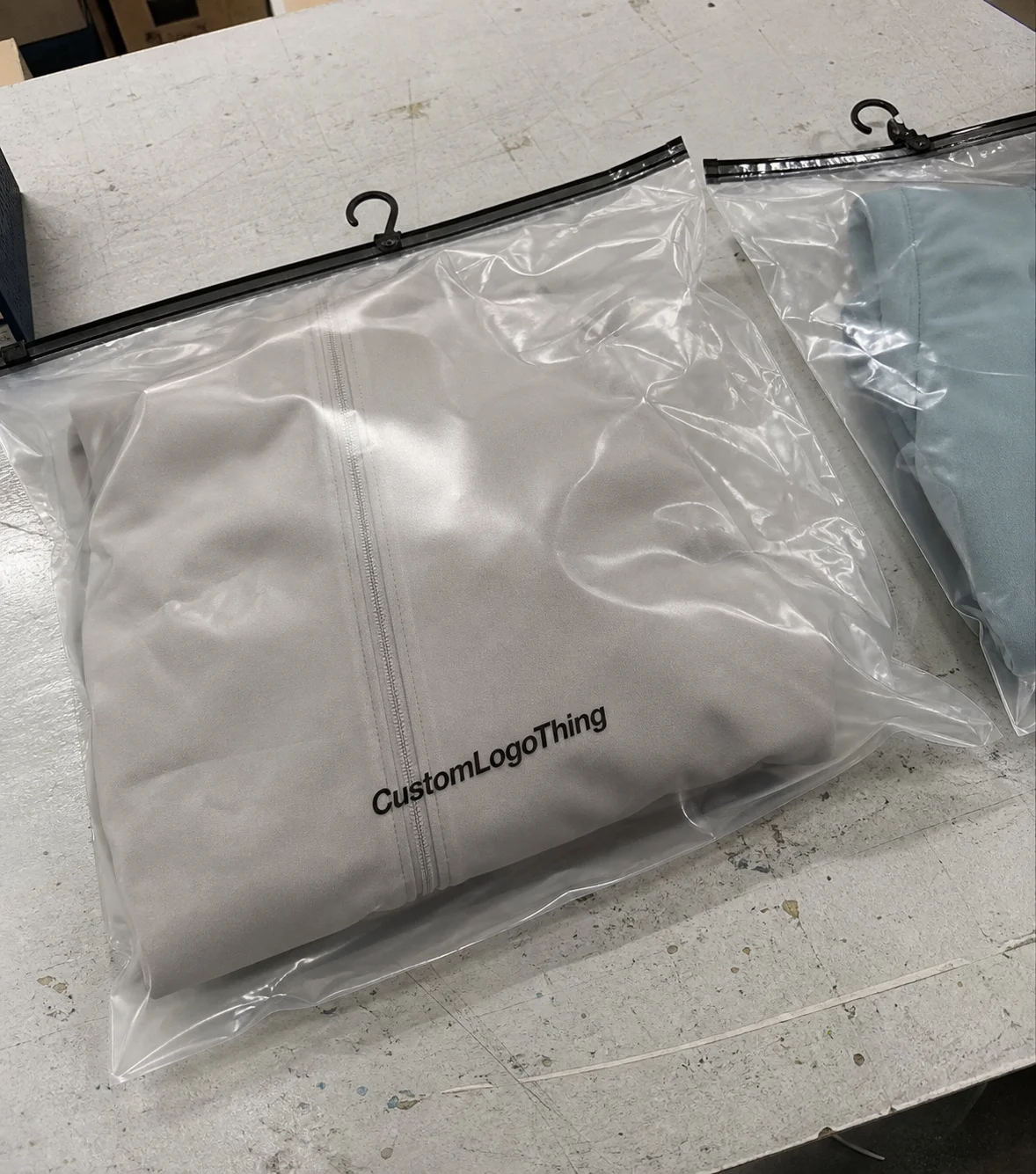
Thin poly sleeves still have a role, especially for basic warehouse packing or low-cost bulk distribution, but they often fall short once a brand starts caring about display quality and repeated handling. A zipper garment bag creates a more deliberate presentation, protects against dust and lint better than an open sleeve, and keeps folded apparel from slipping out during shipping or merchandising. For gymwear, team apparel, and coordinated sets, that extra structure can make the product feel much closer to retail-ready.
The zipper also changes how the packaging is used after delivery. Customers can open and reclose it without tearing the bag apart, which makes it useful for travel, storage, returns, or keeping matching pieces together. That reuse factor is not just a marketing point; it reduces the chance that a garment gets stuffed loosely into a drawer or bag after first use. Transparent or frosted PVC lets the customer see the color, fabric, and garment count without opening the package, which is especially helpful for bundles and multi-piece sets.
Fitness brands commonly use Zipper Garment Bags for:
- Influencer kits and press packages
- Retail-ready folded leggings, tops, and hoodies
- Event giveaways and membership rewards
- Training apparel bundles and travel kits
- Merchandise that needs a cleaner shelf presentation
Compared with woven tote-style packaging, PVC zipper bags are usually lighter, more compact, and easier to inspect. Compared with simple PE bags, they feel more structured and more intentional, which is useful when the goal is not just transport but presentation. They also allow more control over visibility. A clear finish shows everything, while a frosted finish softens glare under store lighting and can make the package feel a little more premium.
There is a practical tradeoff, though. PVC is not the best choice for every brand story, and some buyers prefer to avoid plastic-heavy packaging on principle or for regulatory reasons. That is why the bag should be selected with the product and sales channel in mind, not just because it looks good in a sample photo. If the line is built around value pricing and high-turn warehouse fulfillment, a simpler sleeve may still be the right answer. If the brand depends on premium presentation, repeated handling, and a more retail-ready feel, the zipper bag usually wins.
PVC zipper bag construction: materials, closures, and print options
The base material is usually clear PVC or frosted PVC, and the choice affects both the look and the handling. Clear PVC gives the strongest visibility, which works well for collections built around color variety and matching sets. Frosted PVC reduces glare and fingerprints and tends to look less harsh under bright lighting. Thickness commonly ranges from about 0.12 mm to 0.30 mm, although a project may call for something lighter or heavier depending on size, intended reuse, and shipping conditions.
Material stiffness matters more than many spec sheets suggest. A stiffer film holds a flat, retail-style fold better and resists buckling when cartons are stacked. A softer film is easier to fold and handle, but it may wrinkle more and feel less structured in hand. Neither is automatically better. A bag used once for influencer seeding does not need the same body as a reusable retail garment organizer, and a heavyweight fleece set deserves a different spec from a slim sports bra and leggings bundle.
Closure options usually include standard track zippers, color-matched zipper tape, pull tabs, and reinforced seam edges where repeated opening is expected. A smooth zipper is not a luxury detail; it is one of the first things a buyer notices when a bag is opened. If the track snags, gaps, or feels uneven, the package immediately reads as lower quality even if the garment inside is excellent. For brands that want a cleaner visual identity, the zipper can be kept neutral so the logo and product stay at center stage, or it can be color-matched to the collection.
Printing is usually simple, but it still needs planning. Most fitness brands use:
- Silk screen printing for one-color logos or short branding lines
- Size labels such as S, M, L, XL, or numbered size systems
- Barcode or SKU zones for warehouse scanning
- Warning text or care instructions where required
Useful structural features can include carry handles, hang holes, gussets, or an insert-card pocket. A hang hole works well for retail display and sorting on warehouse racks. Gussets help when the garment is thicker or folded with accessories. Insert pockets are helpful when a brand wants to keep branding separate from the print face of the bag or add a promotional card without cluttering the design. For storage, keep PVC clean and dry, and avoid placing it near strong inks, solvents, or odor-heavy materials. PVC can absorb unwanted smells if it sits in the wrong environment for too long.
“A bag that looks clean in a sample but awkward in production usually failed at the spec stage, not the printing stage.”
For broader material and end-of-life context, buyers often compare packaging guidance from the Flexible Packaging Association with environmental information from the EPA. Those references do not decide the spec for you, but they help frame the tradeoffs more clearly, especially when a brand is balancing product protection, retail presentation, and sustainability messaging.
What sizes and specs fit leggings, hoodies, and sets
Size selection is one of the most practical parts of ordering zipper garment bags, and it is also one of the easiest places to make a costly mistake. A folded pair of leggings takes very little room, while a thick hoodie, jogger set, or multi-piece outfit can need much more depth and width than a buyer expects from a catalog photo. The right size depends on the folded dimensions, the weight of the fabric, and whether the package needs to hold tags, inserts, or accessories such as socks or a headband.
As a working reference, many buyers start with something in the range of 12 x 15 inches for leggings or slim tops, 14 x 18 inches for standard hoodies, and 16 x 20 inches or larger for bulkier sets. That is a starting point, not a rule. A tight retail fold can reduce the footprint significantly, while a fleece hoodie with a brushed interior may need more room than a smooth woven item of the same apparent size. Fold style changes the package more than many first-time buyers realize.
When reviewing a spec, these points deserve close attention:
- Film thickness and whether it matches the intended reuse level
- Seam strength at the corners and edges
- Zipper width and how smoothly it opens and closes
- Transparency level for clear, frosted, or semi-frosted finishes
- Dimensional tolerance so the bag stays consistent across production
One common sourcing mistake is trying to make a single size work for every SKU. That can be fine if the assortment is narrow, but activewear catalogs usually mix slim leggings, padded tops, oversized hoodies, and coordinated sets with different packing profiles. In that case, separate packaging sizes can reduce wasted material and make packing faster. On the other hand, if the warehouse process values simplicity above all else, a single universal size may still be worth using even if it is not perfect for every item.
Ask for samples or dieline mockups before production starts. A sample tells you whether the zipper sits correctly, whether the fold lands naturally inside the bag, and whether the logo is visible when the package is closed. It also reveals simple problems that are easy to miss on paper: a bag that is technically large enough but too narrow at the zipper line, a print area that clashes with the fold, or a hang hole that lands in the wrong spot. Those are the mistakes that tend to surface only after a few cartons have already shipped.
PVC zipper garment bags MOQ, cost, and unit pricing explained
This is the part most buyers want clarified early: how MOQ interacts with real cost, not just the headline unit price. MOQ, or minimum order quantity, changes with bag size, thickness, print complexity, zipper style, and the amount of customization involved. A plain clear bag with standard dimensions and no print usually allows a lower starting quantity than a frosted bag with custom logo printing, a matched zipper color, and a pocket or hang-hole feature.
Pricing drivers are usually straightforward: material thickness, dimensions, print coverage, zipper hardware, and total quantity. Setup charges can also appear if the project needs a new print plate, a special cutting layout, or color matching for zipper tape. Those charges matter because they change the true cost per piece, especially on smaller runs where setup is spread across fewer units.
Here is a practical way to think about typical pricing tiers:
| Option | Typical MOQ | Unit Cost Range | Notes |
|---|---|---|---|
| Plain clear PVC zipper bag | 500-1,000 pcs | $0.18-$0.32 | Lower setup, minimal print, useful for testing a new line |
| Custom printed frosted PVC bag | 1,000-3,000 pcs | $0.28-$0.55 | More branding, stronger shelf presence, moderate setup charges |
| Heavier-gauge premium bag with extras | 3,000+ pcs | $0.45-$0.90 | Handles, pockets, multiple print areas, and higher material cost |
Those numbers are directional, not universal. A small one-color logo is less expensive than full-face printing, and a larger order often lowers unit price enough to justify more branding or a stronger film. But the cheapest per-piece option is not always the smartest business decision. A brand that does not need 20,000 bags sitting in storage may be better off paying slightly more per unit and keeping inventory risk under control.
It also helps to separate sample cost, production cost, and freight. Samples usually cost more per unit because they involve short-run setup and more manual handling. Freight is its own expense, especially if you are comparing domestic delivery with overseas shipment. A quote that looks attractive on paper can shift once carton counts, packing method, and shipping mode are added in.
For brands launching a new collection, a staged order is often the lowest-risk path. Start with the most important SKUs, review sell-through and packing performance, then scale the bag size and print layout that proved itself. That approach keeps inventory under control while still giving the line a polished presentation. It also gives the team real data on whether the bag size is oversized, too tight, or exactly right once the garments are folded at production speed rather than sample-room speed.
Production steps and lead time from approval to shipment
The production path is usually predictable once the specifications are clear. First comes inquiry and spec confirmation, then artwork review, sample approval, mass production, inspection, and final packing. Delays usually start when the brief is incomplete: artwork files arrive in the wrong format, the size changes after sample approval, or the print placement is still under discussion after the job has already been scheduled. A clear spec sheet is not just convenient; it protects the lead time.
A realistic lead time for standard orders is often 12 to 20 business days after proof approval, depending on quantity and factory load. More customized work, especially if it includes new hardware, special zipper colors, or multiple print positions, can take longer. Peak production periods can extend that window further, so packaging should be planned ahead of the product launch rather than added at the last minute.
Quality checks should happen at multiple points, not only at the end. Good production control usually includes:
- Dimensional checks on width and height
- Seal inspection for clean edges and no weak corners
- Zipper function tests for smooth opening and closing
- Print alignment checks so logos sit straight and centered
- Random carton inspection before shipment
Shipping also deserves early planning, especially if the launch has to hit a fixed date across retail stores, fulfillment centers, and influencer kits. Domestic delivery shortens transit time, while overseas production may improve bulk pricing but needs more buffer for freight and customs. If the product launch date is fixed, build in margin. A packaging delay can stall the launch even when the apparel itself is already finished.
For transit performance, packaging teams sometimes review guidance from the ISTA organization when they want a better sense of how packed goods handle distribution stress. That kind of thinking is useful for activewear, where the package may be handled several times before it reaches the customer and where a crushed or misaligned bag can make even a strong product look less prepared.
Why our packaging approach works for activewear brands
What buyers usually want from a packaging partner is not polished language; they want consistency. Film thickness should stay consistent from sample to production. Zippers should fit the same way across cartons. Print placement should not drift. When a line has multiple sizes or multiple colorways, small variations become obvious quickly, and that kind of inconsistency creates rework, delays, and uneven shelf presentation.
The best approach is to match the spec to the product instead of pushing a single package type across every SKU. Oversized bags can waste material and make the product feel loose inside the package. Undersized bags crease the garment and create pressure on the zipper seam. A good spec balances those two problems with enough room for the fold, enough structure for handling, and enough clarity for the product to still be seen.
Practical retail details matter too: clean logo placement, room for a barcode, hang holes where needed, and enough transparency to show the garment without opening the bag. Those small decisions add up. They are the difference between packaging that looks like an afterthought and packaging that feels built for the line. If a brand also needs paper components, such as inserts or carton labels, those should be considered together so the visual system stays coherent.
Technical honesty matters more than a long sales pitch. A partner who tells you a lighter gauge will do the job, or that a certain size will be too tight for a fleece hoodie, saves money and reduces production risk. That kind of guidance is useful because packaging is not separate from the product; it is part of how the product is stored, shipped, displayed, and remembered.
If a brand is comparing packaging formats, a quick review of internal product photos, fold dimensions, and sell-through patterns usually reveals more than a long round of general discussion. The bag choice should follow what the garments actually need, not what happens to look attractive in a mockup.
How to request a quote, confirm specs, and place the right order
If you are pricing PVC Zipper Garment Bags moq for fitness brands, send a spec sheet that is complete enough to remove guesswork. Start with garment dimensions, target quantity, print file, zipper preference, and any retail display requirement such as a hang hole or barcode zone. If the size is still undecided, send the folded garment measurements along with a short description of the fabric weight, because a light mesh set and a heavyweight fleece hoodie do not behave the same way in packaging.
Ask for pricing at several quantities so you can compare MOQ against bulk pricing. That gives you a real picture of where the unit cost drops and whether the savings justify the extra inventory. Samples or digital proofs are worth requesting before approval, especially if the bags are tied to a new activewear launch or a branded kit going to retailers or creators.
Before approving production, confirm these points:
- Material type: clear PVC, frosted PVC, or a softer blend
- Thickness: enough for handling without being unnecessarily heavy
- Closure style: standard zipper, colored tape, or reinforced pull tab
- Artwork placement: logo, size label, barcode area, and print color
- Packaging method: bulk packed, carton count, and any insert requirements
- Delivery address: warehouse, fulfillment center, or store distribution point
For some programs, paper components such as FSC-certified inserts or cartons may also matter if the brand is trying to align packaging choices with broader sustainability goals. Those materials should be discussed early so they do not get added after the quote is already set. If you need a precise estimate, the fastest path is to send the garment measurements and artwork together. That makes the pricing more accurate and reduces the chance that the final bag arrives slightly too small, too loose, or visually off-center.
What is the typical MOQ for PVC zipper garment bags for fitness brands?
MOQ depends on size, thickness, printing, and zipper style. Simpler bags usually start lower than fully customized versions, while extras such as pockets, handles, or special zipper colors can push the requirement higher.
How much do PVC zipper garment bags cost per unit?
Unit cost is driven by material thickness, dimensions, print coverage, and total quantity. Higher order volumes usually lower the per-bag price, while samples, setup, and freight are priced separately.
Can you print logos and size labels on zipper garment bags?
Yes. Common options include one-color logo printing, size markings, and barcode areas. Artwork should be placed with the zipper track and fold lines in mind so the finished package stays clean and readable.
What bag size should I order for leggings, hoodies, or matching sets?
The right size depends on the folded garment dimensions, thickness, and whether inserts or accessories are included. Samples are the best way to confirm fit before committing to production.
How long does production usually take after artwork approval?
Standard orders often take 12 to 20 business days after proof approval, depending on quantity and customization level. More complex projects can take longer, especially during busy production periods.
For fitness brands, the smartest packaging decision is usually the one that balances fit, presentation, and buying risk instead of chasing the lowest number on a quote. That is what makes PVC zipper garment bags moq for fitness brands a practical sourcing question rather than a purely price-driven one: the right bag protects the garment, supports the brand image, and keeps the order size in a range the business can actually use.


