Buyer Fit Snapshot
| Best fit | Recycled Carton Packaging for Retail projects where brand print, material claims, artwork control, MOQ, and repeat-order consistency need to be specified before quoting. |
|---|---|
| Quote inputs | Share finished size, material target, print colors, finish, packing count, annual reorder estimate, ship-to region, and any compliance wording. |
| Proofing check | Approve dieline scale, logo placement, barcode or warning zones, color tolerance, closure strength, and carton packing before bulk production. |
| Main risk | Vague material claims, crowded artwork, missing packing details, or unclear freight terms can make a low unit price expensive after revisions. |
Fast answer: Recycled Carton Packaging for Retail: What Matters Most should be specified like a repeatable production item. The safest quote records material, print method, finish, artwork proof, packing count, and reorder notes in one written spec.
Production checks before approval
Compare the actual filled-product size with the drawing, then confirm tolerance on folds, seals, hang holes, label areas, and retail display edges. Reserve space for logos, QR codes, warning copy, and material claims before decorative graphics fill the panel.
Quote comparison points
Review material grade, print process, finish, sampling route, tooling charges, carton quantity, and freight assumptions side by side. A quote is only useful when the supplier can repeat the same color, closure quality, and packing count on the next order.
Recycled carton packaging for retail can look cleaner, sharper, and more expensive than glossy carton board when the structure is right. That often surprises people, since recycled still gets treated like shorthand for rough, dull, or cheap, and that assumption leads to a lot of weak specs getting approved. The reality is much more practical: recycled carton packaging for retail usually performs best when the design stays disciplined, the board grade is chosen with care, and the print plan works with the material instead of fighting its natural character.
From a packaging buyer's point of view, that matters because retail packaging has to do three jobs at once. It has to protect the product, sell the product, and stay out of the operations team's way later on. Recycled carton packaging for retail can handle cosmetics, apparel accessories, supplements, candles, and small electronics very well, as long as the carton structure, recycled content, and finish match the actual use case. Guessing gets expensive fast, and the carton has a way of reminding you where the spec was loose.
If you are planning custom printed boxes or branded packaging for a shelf-facing launch, the carton spec should be treated like a business decision, not a decorative choice. A carton with the wrong stiffness, the wrong coating, or the wrong print coverage can turn a solid concept into a weak retail package in a hurry. The good news is that recycled carton packaging for retail is flexible enough to fit most mainstream product categories without drifting into waste.
What recycled carton packaging for retail really is
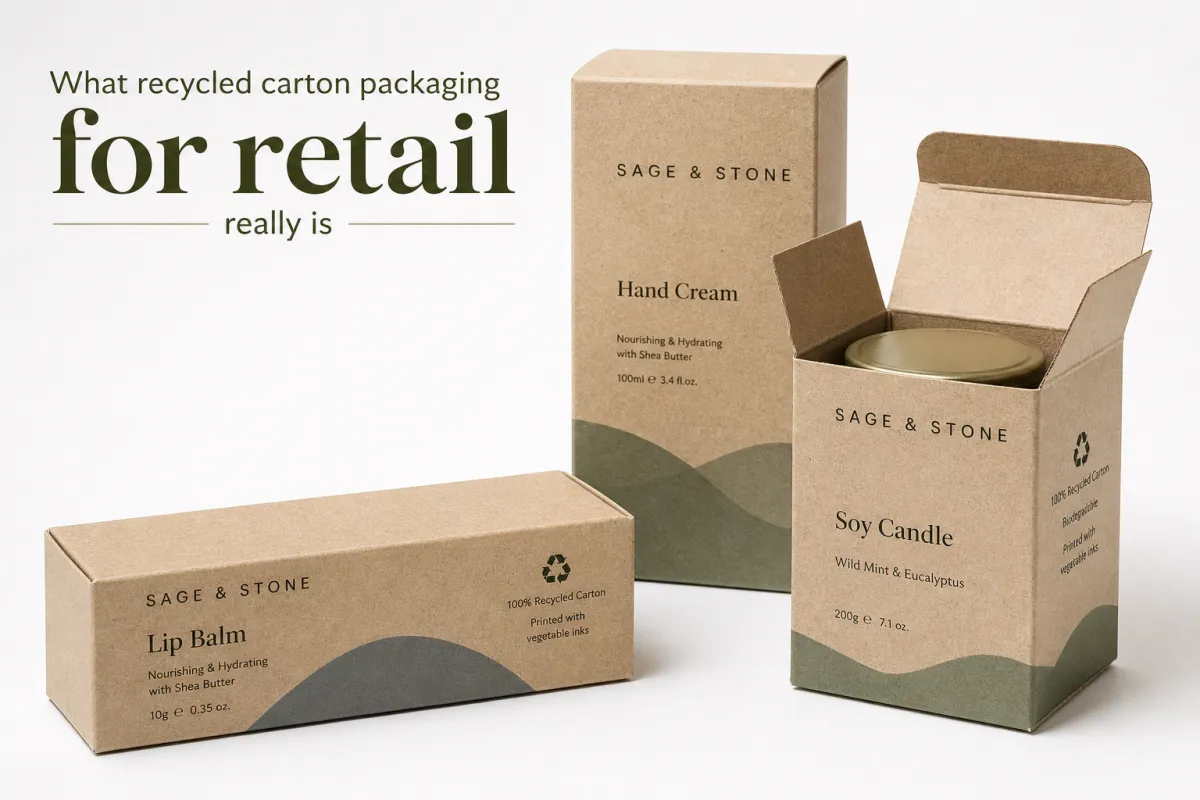
Recycled carton packaging for retail starts with fiber that has already been used once, but that phrase covers more than one material story. Recycled content means some portion of the board comes from recovered paper fiber. Post-consumer fiber comes from paper that consumers or businesses already used and collected. Pre-consumer fiber comes from manufacturing scrap before a product reaches the market. Those distinctions matter because two cartons can both be described as recycled and still carry different environmental profiles, different paper performance, and different documentation.
A lot of recycled carton packaging for retail looks stronger when the structure is simple. A clean straight tuck, a proportioned sleeve, or a narrow footprint with crisp print can feel more premium than a carton loaded with extra folds and surface tricks. I have seen brands pour budget into noisy decoration to compensate for weak packaging design, only to end up with a box that felt overworked the moment it came off the press. Simplicity gives recycled board room to look intentional.
Retail packaging usually relies on folding carton stock or paperboard in the 250-450 gsm range, though some products need heavier board or a reinforced insert. Cosmetics and supplements often sit comfortably in the middle of that range. Apparel accessories can go lighter if the product is delicate and the carton mainly serves as presentation. Small electronics, candles, and heavier bottle formats often need tighter tolerances and stronger caliper. Recycled carton packaging for retail is not flimsy by default; flimsy is usually a spec problem, not a fiber problem.
Brands choose recycled carton packaging for retail for a few direct reasons. Shelf appeal matters. Sustainability messaging matters. Unboxing matters. A carton made from recycled fiber can support all three when the structure, finish, and message are handled honestly. The carton can also cut down the visual clutter that comes with overdesigned product packaging. Cleaner package branding often performs better because customers can understand it in two seconds, which is about all retail gives you before the decision is made.
One practical point gets overlooked too often: recycled carton packaging for retail needs a realistic finish plan. Natural recycled fiber tends to show a little more texture, which can be attractive, but that texture changes how saturated inks appear. That does not mean the carton will print badly. It means the board grade, coating choice, and color expectations should be set before the artwork is finalized. A deep solid black and a soft recycled feel can coexist, though not on just any stock pulled from a sample shelf.
For sustainability claims, accuracy matters more than marketing sparkle. If you are saying a carton is recycled, know whether you mean recycled content, FSC-certified fiber, or a mix of both. The FSC certification system is one of the clearer references buyers can use when they need chain-of-custody documentation. Recycled carton packaging for retail is strongest when the claim is specific enough to survive supplier questions and a skeptical retail buyer.
"A carton does not need to shout to look premium. It needs to look controlled." That is especially true with recycled carton packaging for retail, where texture and structure do some of the work that heavy finishes usually try to fake.
How recycled carton packaging for retail is made
The manufacturing path for recycled carton packaging for retail starts with recovered paper being sorted, cleaned, and pulped. In plain language, the fiber is broken back down into slurry, screened to remove contaminants, and refined so it can be formed into new board. After that, the pulp is pressed, dried, and calendered to reach the target thickness, stiffness, and surface smoothness. That is the part most buyers never see, yet it is what determines whether the carton feels crisp in the hand or tired before it even reaches the shelf.
The recycled fiber blend is where a lot of performance decisions happen. More post-consumer fiber can improve sustainability messaging, but too much can affect brightness, smoothness, or print clarity if the mill does not balance the recipe correctly. Mills often combine recycled fiber with virgin fiber or treated fillers to reach the right combination of stiffness, opacity, and surface performance. Recycled carton packaging for retail is usually a controlled blend, not a purity contest.
Once the board is made, coatings and liners can be added. Aqueous varnishes are common because they add basic scuff resistance without making the carton feel plastic-heavy. Water-based coatings can also help with moisture resistance and ink holdout, which matters if the retail packaging sits in humid environments or gets handled a lot on the way to shelf. Soft-touch lamination looks premium, but it can complicate recyclability, so I would only use it when the brand benefit clearly outweighs the tradeoff.
The next stage is print, and print quality depends on both ink system and board surface. Offset lithography is common for custom printed boxes because it produces sharp text and controlled color. Digital print can work for shorter runs and test launches, though the cost per unit may rise. Flexographic printing is used in some packaging formats, but the board and finish need to be matched carefully. Recycled carton packaging for retail can look excellent in any of these methods if the prepress files, trapping, and color targets are set correctly.
Then the sheet is die cut, scored, and glued into finished cartons. That sounds routine because it is routine, but the details matter. Poor scoring can cause cracking on a recycled board surface. Weak glue zones can create loose seams during pack-out. Bad die cutting can leave a rough edge that ruins the feel of an otherwise good carton. A simple recycled carton packaging for retail design often wins because fewer folds mean fewer places for production to go sideways.
If the carton needs extra resistance to moisture or abrasion, you can ask for a water-based coating, a protective varnish, or a stronger liner board. If the product ships in parcels rather than sitting on retail shelves only, packaging testing matters too. Standards such as EPA recycling guidance and test methods from organizations like ISTA help set practical expectations. For parcel transit, ISTA 3A-style testing or a comparable drop-and-vibration test is a smart move. Recycled carton packaging for retail can be fully appropriate for shipping, but only after the product is tested like a real product, not a presentation mockup.
Key factors that shape performance, print, and shelf appeal
The four levers that shape recycled carton packaging for retail are board weight, recycled content ratio, finish, and structural design. Miss one of them and the carton starts making tradeoffs you did not budget for. A lightweight board can save money but crush under stack pressure. A high recycled content ratio can help with sustainability goals but may need a smarter print strategy. A premium finish can lift shelf appeal, but it can also hide the very texture that makes recycled carton packaging for retail feel authentic.
Board weight affects feel and durability first. For lighter products, a carton in the 300-350 gsm range may be enough. For medium-weight goods, 350-400 gsm often gives a better balance. Heavier items may need 400 gsm and up, or even a structural insert. The right answer depends on product weight, distribution method, and how much stacking pressure the carton will face on a shelf or in a display tray.
Finish controls how much the carton reads like a natural fiber board versus a polished retail package. Uncoated recycled surfaces can look honest and modern, especially for wellness or eco-led brands. Aqueous coating gives a cleaner, more durable surface. Matte varnish can soften the look without killing recyclability. If the brand wants a premium effect, a restrained print palette often works better than flooding the surface with heavy color. Recycled carton packaging for retail usually looks expensive when the graphics stop trying so hard.
Structural design is where many teams overcomplicate things. A smart tuck-end carton, a sleeve with a snug insert, or a straightforward two-piece box can support strong package branding without wasting material. If the product moves around inside, add a paperboard insert or adjust the dieline. If the product is fragile, test closures and corners before approving the run. A pretty carton that rattles is still a bad carton.
Retail lighting can also change how the carton reads on shelf. Glossy surfaces grab reflections fast. Matte surfaces reduce glare and can make copy easier to read. Natural fiber texture can work beautifully under bright retail lights if the typography is bold and the contrast is managed. Recycled carton packaging for retail does not need to mimic plastic-coated luxury packaging to feel premium. It needs to look deliberate from two feet away.
Compliance is another filter. If you are using sustainability claims, keep the wording precise and documentable. If the carton carries product claims, legal copy, or barcode panels, the layout should leave enough quiet space to avoid clutter. A polished retail package often comes from subtraction, not addition. That is true for branded packaging as much as it is for recycled carton packaging for retail.
Here is a quick comparison of three common spec directions I see in retail projects:
| Option | Typical Spec | Best For | Indicative Unit Cost | Main Tradeoff |
|---|---|---|---|---|
| Value build | 300-350 gsm recycled board, 1-2 colors, aqueous coating | Apparel accessories, sample kits, light cosmetics | $0.18-$0.32 at 5,000 units | Limited visual depth and less rigidity |
| Balanced build | 350-400 gsm board, full-color print, matte or aqueous finish | Supplements, candles, mid-weight retail product packaging | $0.28-$0.48 at 5,000 units | Moderate setup and finish costs |
| Premium build | 400-450 gsm board, specialty coating, precise die cuts, insert | Prestige cosmetics, small electronics, gift-led retail packaging | $0.45-$0.90 at 5,000 units | Higher cost and more finishing complexity |
If you need a broader packaging mix, the Custom Packaging Products catalog is a useful place to compare formats before locking the carton spec. The key is not to choose the fanciest option. Choose the option that gives recycled carton packaging for retail the best mix of shelf appeal, cost control, and production reliability.
Recycled carton packaging for retail: cost and pricing factors
Price is driven less by the word recycled and more by the actual spec. Recycled carton packaging for retail can be very cost-effective, but only if the structure, print, and finishing stay in a sane range. Material cost is only one slice of the bill. You also pay for tooling, prepress, print setup, finishing, assembly, and freight. People love to focus on board price because it is visible. The invisible parts are usually where the budget gets stretched.
For a typical 5,000-piece retail run, a simple recycled carton packaging for retail order might land around $0.18-$0.32 per unit for a clean one- or two-color print with an aqueous coat. A mid-tier full-color carton with moderate finishing often sits around $0.28-$0.48 per unit. A premium carton with specialty coating, insert work, tighter tolerances, or heavier board can move into the $0.45-$0.90 range. Those are practical planning numbers, not promises, because product size and artwork complexity change everything.
Higher recycled content can sometimes lower raw material cost, especially if the board spec is straightforward and the mill is working with a common recycled paperboard grade. The savings can disappear fast if the design asks for tight registration, special finish work, or multiple sample rounds. Recycled carton packaging for retail is not expensive because it is recycled. It becomes expensive when the creative brief pretends that production has no rules.
Volume changes the equation. Small runs carry a higher unit price because setup costs are spread across fewer cartons. Once you get into larger runs, often 10,000 units or more, the unit cost usually drops because the die, print setup, and QC costs are amortized better. That does not mean you should over-order just to chase a lower price. Storage, obsolescence, and artwork updates can eat the savings later. A retailer who has ever had to scrap a warehouse of obsolete cartons already knows that lesson the expensive way.
Here are the cost buckets you should expect to see in a real quote for recycled carton packaging for retail:
- Board and substrate - the paperboard itself, including recycled content and caliper.
- Prepress - dieline cleanup, artwork prep, proofing, and color correction.
- Tooling - die cutting, scoring, and any custom knife work.
- Printing - number of colors, coverage, and pass count.
- Finishing - varnish, coating, foil, embossing, or lamination.
- Assembly - gluing, window insertion, and carton packing.
- Freight - domestic shipping, ocean transit, or expedited delivery.
Hidden costs show up when artwork is not final. Extra sample rounds are common if the product dimensions are fuzzy or the marketing team keeps changing copy. Rush fees also happen when the schedule is unrealistic. Rework charges show up if the carton arrives with fit issues because nobody checked the internal dimensions properly. Recycled carton packaging for retail is usually affordable when the team locks the spec early and stops treating proofing like a vague suggestion.
My blunt take: if a supplier gives you a quote that looks suspiciously low, ask what is missing. Is the coating included? Are proofs included? Is assembly included? Are freight and carton master packs included? A cheap-looking price on recycled carton packaging for retail often becomes a less cheap reality after the add-ons appear. The quote should tell the truth the first time.
Step-by-step process and timeline for a retail launch
Every clean retail launch starts with a product brief that is more specific than "we need a nice box." For recycled carton packaging for retail, the brief should include product dimensions, product weight, shipping conditions, shelf goals, and any sustainability target the brand wants to hit. If the carton will be used for display, shelf storage, e-commerce fulfillment, or all three, say that up front. One size does not magically handle every channel.
The next step is dieline and structure work. This is where a packaging designer or supplier maps the physical carton around the product. A good dieline accounts for product height, insert space, closure style, and the amount of board needed for safe folding. If you are moving from mockup to production, sample construction is the stage that prevents ugly surprises. Most delays happen here, not on the pressroom floor. Recycled carton packaging for retail rewards teams that approve the structure before they fall in love with the artwork.
A realistic timeline for a moderate custom job often looks like this:
- Brief and sizing - 2 to 4 business days if the product data is ready.
- Dieline and structure - 3 to 7 business days, depending on complexity.
- Sampling - 5 to 10 business days for a physical proof or prototype.
- Artwork approval - 2 to 5 business days if the stakeholders respond quickly.
- Production - often 10 to 20 business days after approval.
- Shipping - 2 to 7 business days domestically, longer if imported.
That puts many projects in the 3 to 6 week range from clean spec to delivery, and longer if there are revisions or transit delays. If the carton needs unusual coating, structural inserts, or certification checks, build extra time into the schedule. Recycled carton packaging for retail almost never fails because the board itself is bad. It fails because the timeline was fantasy-based.
Before production, run a quick prelaunch test. Fit the product. Close the carton. Shake it. Check for movement. Stack a few units and see whether the top panels crush or bow. Rub the surface lightly to check for scuffing. Put the carton under retail-like light and see if the typography still reads cleanly. If the carton is for shelf display, mock it up on a shelf and stand back three feet. That is usually the distance that tells the truth.
Coordination matters too. The printer needs final artwork. The fulfillment team needs carton counts and master pack details. The brand team needs proof approval. The retailer may need barcodes, case pack info, or sustainability documentation. Recycled carton packaging for retail turns into a launch headache when each team assumes someone else handled the boring stuff. Spoiler: nobody else handled it.
If you are comparing carton formats alongside other packaging design options, keep the launch goal in view. A carton that looks beautiful but arrives late is a bad launch tool. A carton that is structurally sound but visually weak may protect the product while missing the shelf. Recycled carton packaging for retail works best when the schedule, artwork, and supply chain are planned together from the beginning.
Common mistakes retailers make with recycled cartons
The most common mistake is choosing the lowest-cost board and acting surprised when the carton folds badly, crushes in transit, or prints with a muddy finish. Recycled carton packaging for retail can be economical, but not if the spec is cut so hard that the carton is compromised. The better approach is to choose the cheapest spec that still passes the actual use case. That sounds obvious because it is obvious, yet it gets ignored constantly.
Another mistake is overdesign. Too much ink coverage, too much lamination, too much foil, too much everything. That kind of carton may look busy on a screen and expensive in a quote, but it rarely behaves well in real production. Heavy decoration can also make recyclability harder, which undercuts the point of choosing recycled carton packaging for retail in the first place. If the material is doing a good job, let it show a little.
Vague sustainability claims create legal and brand risk. Saying a carton is "eco-friendly" is weak. Saying it contains 80% recycled fiber and is FSC-certified is much stronger, provided you can document it. If you cannot document the claim, do not print it. Recycled carton packaging for retail should be honest enough to survive both a retailer audit and a customer who knows the difference between marketing language and a real spec sheet.
Late artwork approval is another classic. A team spends weeks talking about brand color, then waits until the last minute to finalize copy, barcodes, and panel layout. The result is rushed prepress, rushed proofs, and a tighter production window. A launch schedule is not a wish list. If recycled carton packaging for retail needs to land on time, artwork needs to settle early.
Sizing errors are brutal because they are so avoidable. A carton that is even a few millimeters off can let a product rattle, snag, or collapse the front panel when stacked. Too much empty space also wastes board and makes the product feel smaller than it is. Product packaging should fit the item cleanly without making the operator fight the carton at pack-out. If the team cannot close fifty units in a row without cursing, the dieline is not done.
There is also a shelf mistake that gets missed: the carton may test well in a sample room but disappear under retail lighting. If the typography is too light, the contrast too soft, or the texture too busy, the carton becomes a beige blur from three feet away. Recycled carton packaging for retail should not rely on the customer leaning in to appreciate it. Retail gives you no such luxury.
The rule is simple. Do not ask recycled carton packaging for retail to compensate for weak planning. A good carton does a lot, but it cannot rescue a late launch, a bad dieline, or a vague claim. The material is not the problem nearly as often as the decision-making around it.
Expert tips and next steps for a smarter rollout
Start with a spec matrix before the design team gets attached to a look. For recycled carton packaging for retail, that matrix should compare recycled content, board weight, finish, print method, estimated unit cost, and launch risk. Once those variables are visible side by side, the conversation gets less emotional and more useful. That is usually a relief for everyone involved.
Ask suppliers for three sample paths: value, balanced, and premium. The value path should keep the carton basic but reliable. The balanced path should improve shelf appeal without blowing up cost. The premium path should show what is possible if the brand wants a stronger tactile feel or more refined package branding. This is a faster way to choose recycled carton packaging for retail than arguing over one abstract concept for two weeks.
Design for the carton you can actually manufacture at scale. A concept that works in a single mockup can fail once the line is running and packers are opening hundreds of units an hour. That is not a design failure; it is a manufacturing reality check. Use structural choices that suit the production method, the carton board, and the actual retail packaging workflow. If the team wants an especially refined look, simplify the structure and let the print do the talking.
Here is a practical launch checklist that keeps recycled carton packaging for retail on track:
- Confirm product dimensions, weight, and closure behavior.
- Choose the target recycled content and ask for documentation.
- Decide whether the carton needs shelf-only, ship-ready, or dual-purpose performance.
- Approve the dieline before final artwork.
- Request a physical sample and test fit, scuff resistance, and stack performance.
- Lock artwork early so production is not squeezed by revisions.
- Check barcodes, claims, and retail copy one last time before sign-off.
If you are building a new retail line, recycled carton packaging for retail should be treated as part of the product, not a finishing touch. That mindset saves money and usually produces better branding too. The carton is one of the first things a customer touches, and the first touch says a lot about whether the brand is organized or just optimistic.
The clearest takeaway is simple: lock the board grade, structural fit, and claim language before you approve artwork, then test a physical sample under real shelf and transit conditions. If those three pieces hold together, recycled carton packaging for retail can look premium, ship safely, and stay honest about what it is. Skip that order of operations, and the carton is gonna remind you pretty quickly.
Is recycled carton packaging for retail strong enough for heavier products?
Yes, if the board weight, paperboard grade, and carton structure match the product weight. Heavier items usually need tighter scoring, better inserts, and more careful testing before launch. Do not judge recycled carton packaging for retail by recycled content alone; design and caliper matter more.
How much does recycled carton packaging for retail usually cost?
Cost depends on quantity, board grade, print complexity, coatings, and whether you need custom tooling. Small runs carry higher unit pricing because setup costs are spread across fewer cartons. Simple recycled carton packaging for retail with standard print and modest finishing is usually the most cost-efficient starting point.
What recycled content should I ask for in retail cartons?
Ask for the exact percentage and whether it is post-consumer or pre-consumer fiber. If the carton is customer-facing, balance recycled content with print quality and strength requirements. Recycled carton packaging for retail should come with documentation so your sustainability claims stay accurate.
Can recycled carton packaging for retail still look premium?
Yes, especially with clean typography, disciplined color use, and a well-structured carton. Natural texture can actually improve the premium feel if the branding is intentional. Recycled carton packaging for retail often looks better with smarter material choices than with heavy decoration.
How long does a recycled carton packaging for retail order take?
Typical timelines depend on sampling, artwork approval, production capacity, and shipping distance. Fast projects move when the dieline, copy, and artwork are approved early and there are fewer revisions. Build in extra time for sample rounds if the carton must pass fit, drop, or retail display checks, because recycled carton packaging for retail usually rewards patience more than panic.
Related packaging resources
Use these related guides to compare specs, costs, quality checks, and buyer decisions before making the final call.


