Buyer Fit Snapshot
| Best fit | Recycled Counter Display Boxes with Logo projects where brand print, material claims, artwork control, MOQ, and repeat-order consistency need to be specified before quoting. |
|---|---|
| Quote inputs | Share finished size, material target, print colors, finish, packing count, annual reorder estimate, ship-to region, and any compliance wording. |
| Proofing check | Approve dieline scale, logo placement, barcode or warning zones, color tolerance, closure strength, and carton packing before bulk production. |
| Main risk | Vague material claims, crowded artwork, missing packing details, or unclear freight terms can make a low unit price expensive after revisions. |
Fast answer: Recycled Counter Display Boxes with Logo: Board, Finish, Dieline, and Unit Cost should be specified like a repeatable production item. The safest quote records material, print method, finish, artwork proof, packing count, and reorder notes in one written spec.
Production checks before approval
Compare the actual filled-product size with the drawing, then confirm tolerance on folds, seals, hang holes, label areas, and retail display edges. Reserve space for logos, QR codes, warning copy, and material claims before decorative graphics fill the panel.
Quote comparison points
Review material grade, print process, finish, sampling route, tooling charges, carton quantity, and freight assumptions side by side. A quote is only useful when the supplier can repeat the same color, closure quality, and packing count on the next order.
A small product on a counter can disappear in a few seconds. Put it inside recycled counter display Boxes With Logo, and the same item starts to read as deliberate, branded, and worth a pause. That is the quiet strength of this format: it does more than hold product, it gives the product a reason to be noticed.
From a packaging buyer's point of view, recycled counter display Boxes with Logo sit in a useful middle ground. They are smaller than a floor display, easier on budget than a full custom retail shipper, and far more visible than a plain carton tucked behind the register. Used well, they help a product earn its place without turning the counter into a shouting match.
I have seen plenty of counter displays that looked fine in a PDF and then went sideways once they were actually filled, moved, and restocked by busy staff. The fixes were rarely dramatic. Usually it was a stronger board, a cleaner logo placement, or just a better sense of how people reach for the product in real life. That is why the structural details matter so much here.
If you are comparing options, start with structure before you get lost in artwork details. You can browse Custom Packaging Products for a wider sense of what is possible, but the better decisions usually come from matching the box to the product, the counter space, and the refill routine. Recycled board, print method, and logo placement matter more than most teams expect once the boxes are on an actual counter and not just on a screen.
Recycled Counter Display Boxes with Logo: Why They Sell
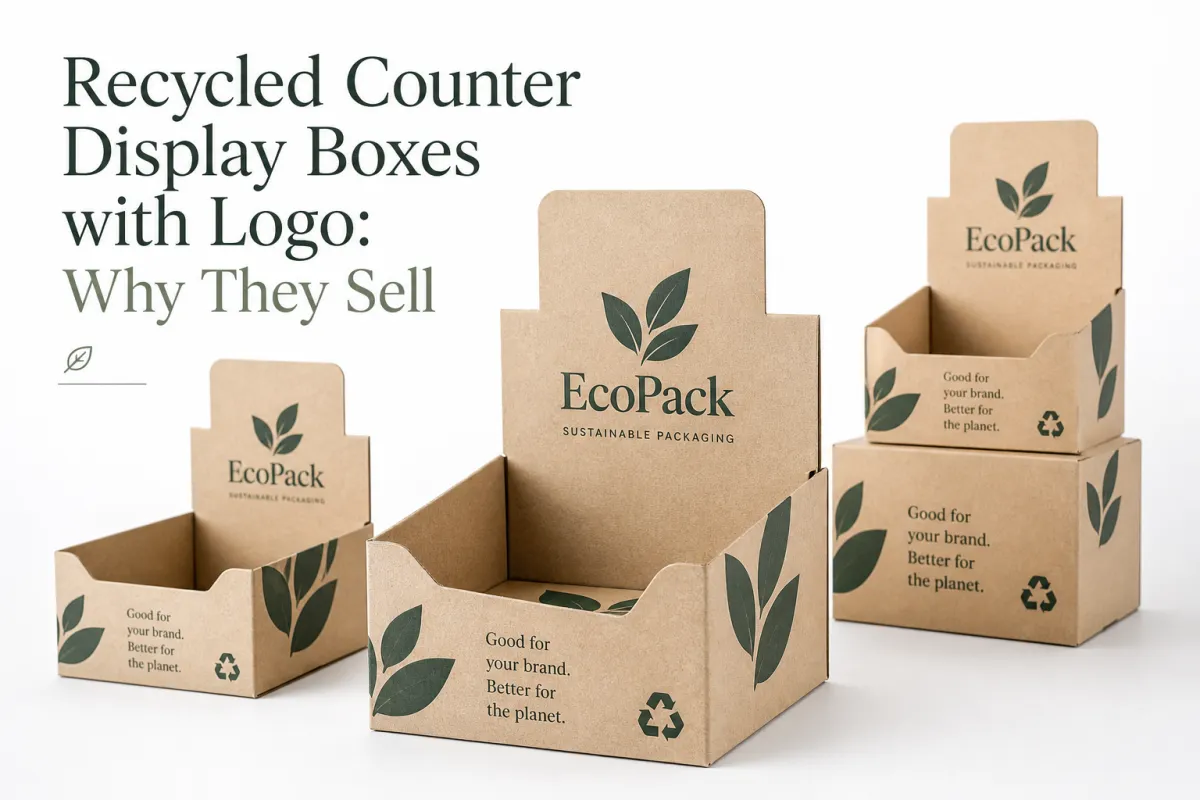
Walk into a convenience store, beauty counter, or specialty shop and watch what happens near checkout. Small items get passed over unless something gives them a bit of stage presence. recycled counter display boxes with logo do exactly that. They pull a product up to eye level, keep it arranged neatly, and create a quick visual stop that can turn a passing glance into a sale.
The format is usually straightforward: a compact countertop carton, tray, or open-face display made from recycled board and designed to sit near the point of sale or demo station. Simple does not mean bland. recycled counter display boxes with logo are doing three jobs at once. They present the product, carry the brand, and help the retailer keep the counter from looking like a pile of loose stock next to the cash drawer.
That is why material choice matters more than people tend to think. A recycled board display can still look sharp, print cleanly, and feel appropriate for a serious retail setting. It just needs the right structure. If the board is too soft, the box bows. If the print is too busy, the product disappears. If the logo sits in the wrong place, the whole piece turns into expensive clutter.
There is also a sustainability angle here that does not need extra gloss. Buyers are wary of green claims that sound polished but do not hold up in the hand. recycled counter display boxes with logo can support a cleaner brand story when the board really is recycled, the print is controlled, and the build avoids unnecessary plastic extras. The EPA's recycled materials guidance is a useful reference for keeping those claims honest, and FSC certification is worth checking if you need chain-of-custody documentation: EPA recycled materials guidance and FSC certification information.
The appeal is plain enough. People respond to order, visibility, and a clear brand signal. recycled counter display boxes with logo deliver all three, which is why they show up so often for launches, promotions, travel-size products, sachets, test units, and anything else that benefits from impulse-friendly placement.
They also work well in categories where the shopper is deciding quickly. I am thinking of lip balms, sample packs, vitamins, packeted snacks, small electronics accessories, and trial-size personal care items. In those spaces, the packaging has to do a little selling before anyone even picks up the product.
How Recycled Counter Display Boxes with Logo Work
The mechanics are simple. The display keeps the product upright, makes the front edge visible, and places the logo where eyes naturally land. That sounds basic because it is. recycled counter display boxes with logo work best when they reduce effort for the shopper: less searching, less bending, less confusion about what the item actually is.
Front lips, angled backs, open-face trays, and insert-supported styles all change how the product behaves on the counter. A shallow lip can help keep items from sliding forward. An angled back panel can improve visibility from a standing position. A divided insert can keep tubes, boxes, or sachets from leaning like they are tired of retail altogether. In practice, those small structural choices decide whether recycled counter display boxes with logo feel polished or look rushed.
Logo placement is where many projects drift off course. The logo should sit where a customer actually looks, not where the designer had spare space. On a counter display, that often means the front panel, the header, or the upper face of the tray. If the logo sits too low, it gets blocked by stock. If it sits too high, the customer reads it after they have already reached past the product. recycled counter display boxes with logo only earn their keep when the brand mark is visible at a glance.
The retail benefit reaches beyond appearance. These displays can support launches, limited offers, seasonal rotations, and product education. A small item that might otherwise look lonely becomes a deliberate offer. That matters in tight retail spaces, where every square inch has to work. recycled counter display boxes with logo help a retailer organize small goods without adding another fixture or asking staff to hand-stack product every hour.
That last part sounds minor until you are standing at a checkout lane and the display has been bumped three times before lunch. A thoughtful counter unit saves staff time, and that is one reason buyers keep coming back to this format. It does not need to be fancy. It needs to stay upright and readable.
"A good counter display is boring in the right way: it stands straight, keeps the product visible, and makes the brand easy to read from arm's length."
That is the standard. If a display needs a five-minute explanation, it is probably overdesigned. If it lets the customer understand the product in one glance, recycled counter display boxes with logo are doing their job.
Key Factors for Recycled Counter Display Boxes with Logo
Start with board choice, because the board is the backbone of the whole thing. Recycled kraft, recycled SBS, and corrugated each behave differently. Kraft has a natural, practical look and often suits brands that want to signal low-waste packaging. Recycled SBS gives you a smoother print surface and a more polished finish. Corrugated adds stiffness, which helps if the unit will carry heavier items or survive more handling. For recycled counter display boxes with logo, the board should match the product weight, not the mood board.
Print is the next big decision. A one-color logo on recycled kraft can feel clean and confident. Full-color art can look excellent too, but only if the file prep is disciplined and the board surface supports detail. Fine type, tiny icons, and muddy gradients expose weak print planning fast. If you want recycled counter display boxes with logo to look premium, avoid crowding them with copy just because the artwork file has room.
Sizing deserves more respect than it usually gets. The footprint has to fit the product, the counter, and the refill plan. Too small, and the staff will overstuff the box until it tears. Too large, and the display looks empty even when stocked. The best recycled counter display boxes with logo account for pack quantity, product height, shelf edge clearance, and how a hand actually reaches in to take one unit. That last part matters more than the CAD drawing suggests.
There is also a sustainability tradeoff people like to gloss over. Recycled content helps, but glue choice, lamination, coatings, and mixed-material add-ons affect how recyclable the final display really is. If you do not need a heavy gloss film, skip it. If you can use water-based adhesive instead of a more complicated build, do that. Buyers notice whether recycled counter display boxes with logo feel genuinely thought through or just green in the copy deck.
One practical test helps a lot: ask whether the display can survive a few real-world insults. Will it hold shape if a cashier moves it twice a day? Will the front panel survive restocking? Will the logo remain visible after a week of traffic? If the answer is shaky, the structure needs work Before You Print 10,000 of them. That is the difference between packaging strategy and expensive optimism.
For transit and handling, it is smart to think about ISTA-style testing if the displays will ship pre-filled or travel through rough distribution. The International Safe Transit Association has useful guidance on package testing standards: ISTA testing resources. Not every project needs a full lab routine, but a few drop and vibration checks can save a lot of embarrassment.
There is one more thing I always check: the hand-feel of the stock. Some recycled boards print beautifully but crack on sharp folds if the score is not set correctly. Others stay sturdy yet show fiber pull on rich dark colors. That is the kind of detail that separates a display that looks decent on camera from one that still looks good after a week on a counter.
Cost, Pricing, and MOQ for Recycled Counter Display Boxes with Logo
Pricing usually comes down to five things: size, board grade, print complexity, finish, and order quantity. The shape matters less than people expect. A simple tray can cost more than a clever carton if it uses heavier board, more die-cutting, or more labor in assembly. For recycled counter display boxes with logo, the cost conversation should start with structure and quantity, not just the logo artwork.
Here is a practical range, assuming standard custom production and normal retail use. At around 5,000 units, a simple recycled kraft tray with one-color print might fall around $0.18-$0.35 per unit. A more structured recycled SBS display with better print coverage may land around $0.28-$0.60 per unit. A corrugated version with inserts or a more complex build can move into the $0.32-$0.75 per unit range. Those are not promises. They are normal buying ranges, and they move with quantity, board pricing, and finishing choices.
MOQ is where smaller brands feel the pressure first. Lower quantities are possible, but the unit cost usually climbs because setup costs get spread across fewer pieces. Larger quantities reduce the per-unit price, yet they also raise inventory risk if the product changes or the promotion misses. That is why many buyers start with a test run of recycled counter display boxes with logo, then scale after they see how the box performs in real retail conditions.
If you are asking for quotes, ask for more than a unit price. You want the board specification, the print method, whether the sample is structural or final, what setup fees are involved, and whether the shipment is flat-packed or pre-assembled. Shipping can swing the total more than people expect, especially if the display is bulky. A $0.30 box does not stay $0.30 once freight, assembly, and spoilage enter the picture. That is why landed cost matters more than a shiny per-unit number.
| Option | Typical Use | Relative Cost | Notes |
|---|---|---|---|
| Recycled kraft tray | Light items, sample packs, small impulse goods | Low | Natural look, good for simple branding, fewer finishes |
| Recycled SBS display | Premium small goods, colorful graphics, cleaner retail presentation | Medium | Smoother print surface, better for detailed logos and artwork |
| Recycled corrugated display | Heavier products, refill-heavy counters, more structural support | Medium to higher | More rigid, often a better choice for durability and load stability |
For brands comparing formats, it can help to look at Custom Packaging Products as a reference point for structure, finishing, and quantity planning. The cheapest unit is not always the smartest buy. A display that collapses, ships badly, or looks empty loses more money than it saves.
Also, if your run is small, be honest about the tradeoff. Short runs are handy for launches and market tests, but they are rarely the lowest cost path per piece. That is not a flaw in the process; it is just how setup math works in packaging. A clean quote will show you that plainly.
Production Steps, Timeline, and Lead Time
The production flow is usually the same, even if the artwork changes. Brief, dieline, artwork, proof, sample, production, packing, freight. That is the path. Most delays happen between artwork and sample approval, not during the actual manufacturing run. If you need recycled counter display boxes with logo ready for a launch window, the schedule lives or dies on how quickly decisions get made.
Artwork approval often moves faster than sample approval because digital files are easy to review and physical boxes are not. A proof can be checked in an afternoon. A sample needs folding, handling, fit checks, and sometimes a second round of corrections. That is normal. I would rather see a buyer spend three extra days on the sample than discover a bad logo placement after production has already started. With recycled counter display boxes with logo, a cheap mistake at the sample stage is still cheap. A cheap mistake after print is just expensive.
Most standard projects run on something like this: 1-3 business days for dieline and quoting, 2-4 business days for artwork prep and proof review, 5-10 business days for a physical sample if one is needed, and 10-18 business days for production after approval. Freight is its own line item. Domestic shipping can be quick; freight for larger or bulkier runs can add several days or more, depending on method and destination. If the project includes inserts, special coatings, or multiple approval rounds, stretch the timeline. recycled counter display boxes with logo are not a same-day item, and pretending otherwise causes bad launches.
If the display is simple, the lead time can stay friendly. If it includes custom cavities, dual-language copy, spot varnish, or a layered header, expect more back-and-forth. None of that is a problem if it is planned early. The real mistake is assuming the box is minor because the footprint is small. Counter displays are small in size, not necessarily small in complexity. That distinction saves a lot of trouble.
I also like to leave one buffer step in the schedule just for the messy reality of packaging work. Files get revised. Retail teams change their minds. Someone notices a legal line needs to move. That is normal. A little slack in the timeline keeps the whole order from getting squeezed, and it keeps everybody calmer, which helps.
"The fastest project is the one that does not have to be rescued later."
That sounds obvious, but it is amazing how often teams ignore it. Build in buffer time for proofing, sample review, and freight. If the promotion has a hard launch date, plan backward from that date instead of forward from the quote.
Common Mistakes with Recycled Counter Display Boxes with Logo
The first mistake is overdesign. Too much copy, too many colors, and too many claims turn a display into a crowded poster with a product attached. On a countertop, people are scanning quickly. They want the product, the brand, and maybe one useful cue. That is enough. recycled counter display boxes with logo perform better when the message is disciplined and the hierarchy is clear.
The second mistake is using board that is too light for a heavy fill item. It sounds obvious, which is why it keeps happening. A lightweight display might look fine on a sample table, then sag once it is filled with glass bottles, metal tins, or thicker cartons. Sagging is not only cosmetic. It makes the box harder to shop from and makes the brand look careless. If the product has weight, give recycled counter display boxes with logo enough board strength to hold shape after repeated handling.
Logo placement is another easy way to waste money. If the logo sits behind the product, under the lip, or where a hand covers it during pickup, the branding work is mostly gone. On a real retail counter, customers do not admire packaging from a safe distance. They reach, grab, and move on. That means recycled counter display boxes with logo need logo placement that survives motion and human hands, not only a static mockup.
The sustainability theater problem deserves a mention too. A display can be called recycled content all day long, but if it uses unnecessary plastic windows, heavy plastic lamination, or mixed components that complicate disposal, buyers will notice the contradiction. The market is not naive. It may not inspect every detail, but it does notice when the packaging story and the physical package do not match. If the claim is recycled, the build should respect that claim.
Another common error is forgetting how refills happen. A display that looks neat when first packed can become a mess when staff restock it under pressure. If units have to be force-fit, they will get bent. If the front opening is too tight, the display will look good for a day and then fall apart by the weekend. Good recycled counter display boxes with logo are designed around the messier second half of the display life, not just the clean first hour.
Finally, watch for design that is too generic. If the display could carry any brand name with a quick file swap, it probably does not say enough about your product. The best recycled counter display boxes with logo signal category, price level, and use case at a glance. That can be done without shouting. In fact, the quieter versions often look more premium.
Expert Tips and Next Steps for Recycled Counter Display Boxes with Logo
Start with the product, not the art. Measure the unit, check the fill weight, and think through how a shopper will pull one out without mangling the rest. That order matters. The structure should solve the retail problem first, then the design should make it look better. For recycled counter display boxes with logo, a smart structure is worth more than an overworked graphic.
Order a physical sample before you commit to a full run. A sample tells you whether the box stands straight, whether the logo reads from arm's length, whether the front opening is wide enough, and whether the display survives handling without collapsing at the corners. It also exposes dull problems that look minor on screen but are annoying in real life. A lot of recycled counter display boxes with logo fail because nobody touched the sample with a real hand and real impatience.
Keep the brief tight. One logo. One message. One callout. One action. That is usually enough. If you need a sustainability cue, a product benefit, and a price message, make sure they do not all compete for the same front panel. The cleanest recycled counter display boxes with logo are rarely the most crowded ones. They are the ones that let the product breathe while still telling the shopper what they need to know.
For brands that want a cleaner ordering path, it helps to compare display styles inside a broader packaging order rather than making the counter unit a one-off emergency. Pairing the project with other print or structural items from Custom Packaging Products can make setup more efficient, especially if you are already planning cartons, sleeves, or inserts. That does not magically lower every cost, because nothing does that, but it can keep the whole project better organized.
Here is the practical launch plan I would use: measure the counter space, confirm the retail quantity, finalize artwork, approve a structural sample, lock the schedule, and order enough buffer for spoilage or late-stage edits. If you do that, recycled counter display boxes with logo can do exactly what they should do: hold product, sell product, and keep the counter looking like somebody actually thought about it.
And yes, if you keep the build simple and the branding honest, recycled counter display boxes with logo can still look premium. Recycled does not have to mean rough. It usually just means you stopped wasting money on decoration that never helped sell the item anyway. That is the part a lot of teams miss, kinda to their own surprise.
The takeaway is straightforward: choose a recycled board that matches the product weight, put the logo where a shopper will actually see it, and approve a physical sample before you spend on volume. If those three pieces line up, the display has a real shot at doing its job on a busy counter instead of just looking good in a render.
Are recycled counter display boxes with a logo strong enough for heavy products?
Yes, if the board grade and structure match the product weight. Heavier items usually need thicker board, reinforced folds, or an insert instead of a basic tray. A sample is the fastest way to check sagging before you place a full order for recycled counter display boxes with logo.
What is the typical MOQ for recycled counter display boxes with logo?
MOQ depends on size, print method, and how customized the structure is. Small runs are possible, but unit cost usually drops as quantity goes up. Ask for tiered pricing so you can compare test orders against a full rollout of recycled counter display boxes with logo.
How much do recycled counter display boxes with logo usually cost?
Simple designs are cheaper; complex structures and premium print raise the price fast. Board type, finishing, and quantity are the biggest drivers of unit cost. Always compare landed cost, not just the box price, because freight and assembly can change the total for recycled counter display boxes with logo.
How long does production take for recycled counter display boxes with logo?
The timeline usually includes design, proofing, sampling, production, and shipping. Artwork approval is often quick; samples and revisions are what stretch the schedule. If you need a launch date, build in buffer time for approval delays and freight for recycled counter display boxes with logo.
Can recycled counter display boxes with logo still look premium?
Yes, recycled does not have to look rough or cheap. Clean typography, good structure, and disciplined color choices can make the display look sharp. A matte or natural finish often improves the premium feel without weakening the sustainable message of recycled counter display boxes with logo.


