Buyer Fit Snapshot
| Best fit | Recycled Product Boxes Wholesale for Sustainable Packaging projects where brand print, material claims, artwork control, MOQ, and repeat-order consistency need to be specified before quoting. |
|---|---|
| Quote inputs | Share finished size, material target, print colors, finish, packing count, annual reorder estimate, ship-to region, and any compliance wording. |
| Proofing check | Approve dieline scale, logo placement, barcode or warning zones, color tolerance, closure strength, and carton packing before bulk production. |
| Main risk | Vague material claims, crowded artwork, missing packing details, or unclear freight terms can make a low unit price expensive after revisions. |
Fast answer: Recycled Product Boxes Wholesale for Sustainable Packaging should be specified like a repeatable production item. The safest quote records material, print method, finish, artwork proof, packing count, and reorder notes in one written spec.
Production checks before approval
Compare the actual filled-product size with the drawing, then confirm tolerance on folds, seals, hang holes, label areas, and retail display edges. Reserve space for logos, QR codes, warning copy, and material claims before decorative graphics fill the panel.
Quote comparison points
Review material grade, print process, finish, sampling route, tooling charges, carton quantity, and freight assumptions side by side. A quote is only useful when the supplier can repeat the same color, closure quality, and packing count on the next order.
Recycled Product Boxes Wholesale for Sustainable Packaging
Recycled product boxes wholesale sound like a simple buying decision, but the better programs usually solve more than one problem at once: product protection, freight efficiency, shelf consistency, and packaging waste. I have seen plenty of brands spend extra on glossy cartons that look great in a mockup and then fall apart the minute they hit a busy packing table. If you need packaging that ships cleanly, stacks neatly, and keeps your margin from getting eaten alive, recycled product boxes wholesale deserve a serious look.
Packaging buyers know the smartest box is rarely the one that gets the biggest reaction in a presentation. It is the one that hits the right unit cost, survives transit, and does not send the operations team back to the drawing board every few weeks. That is why recycled product boxes wholesale keep showing up in practical packaging plans for e-commerce, retail, and subscription brands. They are not a trend. They are a working answer to a real set of constraints.
Custom Logo Things supports buyers who need packaging that feels intentional without wasting material. If you are comparing recycled product boxes wholesale options for a new launch or a packaging refresh, the details below should help you sort out what is genuinely useful from what just looks polished on a sales sheet.
Why Recycled Product Boxes Wholesale Make Sense
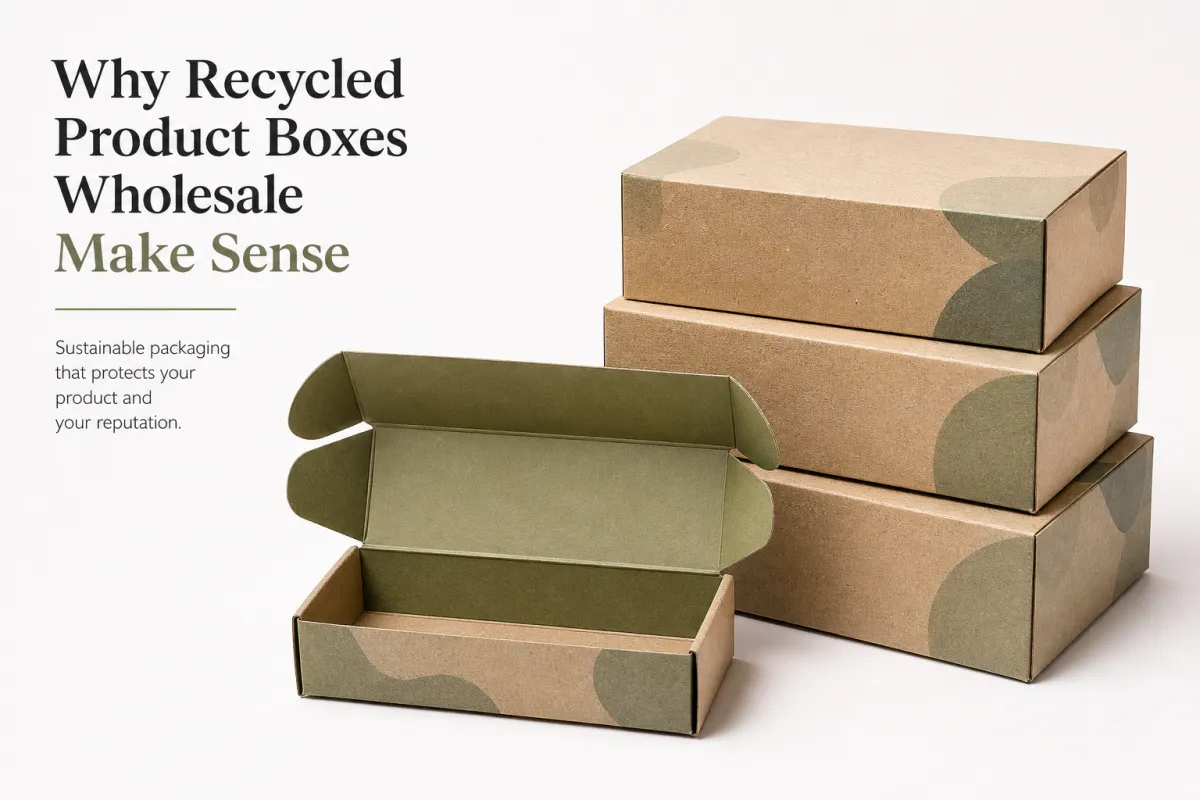
Brands often overspend on packaging because they focus on the customer-facing moment and ignore the back-of-house math. A box that appears inexpensive on paper can turn costly once damage rates, storage space, packing labor, and freight waste are added in. That is the first reason recycled product boxes wholesale make sense. They usually provide enough structure for the job without the extra weight, coating, or unnecessary build cost that quietly chips away at every shipment.
A lighter packaging build is not automatically a weaker build. A well-made recycled corrugated mailer or kraft paperboard carton can protect a product just as well as a fancier print-heavy box if the dimensions are right and the board grade is matched to the item weight. That is the real value of recycled product boxes wholesale. Better fit. Better stackability. Better control over cost. A box that does the job cleanly is worth more than one that merely photographs well.
Wholesale buying changes the economics too. Larger quantities usually open cleaner pricing tiers, steadier production slots, and more control over inventory. Instead of scrambling for small repeat orders, you can plan around quarterly or seasonal usage. For growing brands, that matters more than a shiny finish. It keeps the packaging line from becoming a constant fire drill. And, frankly, it saves people from those annoying last-minute scrambles that always seem to happen on a Friday afternoon.
There is also the credibility piece. Sustainability claims get shaky fast if the packaging story sounds vague. Recycled product boxes wholesale let you say something concrete: the box uses recycled board, the print stays within a minimal ink system, and the structure was chosen to reduce waste without sacrificing shipping performance. That message carries more weight than generic green language. Buyers, retailers, and consumers can tell the difference, even if they do not say it out loud.
A box that saves 4 cents in paper cost but adds 20 cents in damage and replacement is not a bargain. It is a bill with better branding.
For brands buying at scale, recycled product boxes wholesale are not about hype. They are about unit economics, stock consistency, and packaging that does its job without asking for applause. If your product line spans several SKUs, wholesale packaging also makes it easier to standardize sizes and reduce the number of box formats sitting in storage. Fewer SKUs. Fewer mistakes. Less dead inventory.
That is the practical value of recycled product boxes wholesale: the packaging supports operations instead of fighting them. There is still room for a clean printed logo and a premium feel. It just means the design starts with the real problem, not the mood board.
Recycled Product Boxes Wholesale: Material and Build Options
Material choice decides almost everything. Recycled product boxes wholesale can be built from recycled corrugated board, kraft recycled paperboard, or recycled rigid board, and each one solves a different problem. Corrugated recycled board is the workhorse for shipping because the fluted structure adds crush resistance and helps protect against transit damage. Kraft recycled paperboard is lighter and works well for presentation-style cartons, cosmetics, accessories, and retail display. Recycled rigid board brings a heavier, more premium feel, but it costs more and usually suits gift sets, high-end subscription kits, or products where the unboxing experience carries real weight.
Board strength matters more than many buyers realize. For corrugated, flute type changes performance. E-flute is thinner and prints well, which makes it a common choice for mailer-style boxes. B-flute gives more crush resistance and works better when stacking or heavier products are involved. Caliper also matters on paperboard and rigid stock. A box can look similar on a spec sheet and still behave very differently in storage or transit because one material flexes too much and another holds shape cleanly. That kind of mismatch is exactly where packaging budgets start leaking.
For sustainable packaging, the finish should stay honest. Uncoated kraft, water-based inks, and soy inks are common choices because they keep the recycling stream cleaner and avoid unnecessary coating layers. A minimal laminate approach can still make sense if scuff resistance is needed, but the question should always be whether the extra finish is doing real work. Too often it exists because someone liked the mockup. That is not a packaging strategy, no matter how good the render looked.
The right structure depends on the product. Lightweight cosmetics often do well in recycled paperboard tuck boxes with an insert. Apparel usually ships well in recycled mailer boxes. Accessories and small consumer goods often need die-cut inserts to stop movement. Fragile items may need stronger corrugated walls, tighter internal fit, or corner support. Recycled product boxes wholesale should be matched to the load, not to a loose idea of “premium.”
From a buyer’s angle, the tradeoff is straightforward. Better print quality can raise cost. Stronger board can raise cost. Stronger recycled board can also reduce damage, which saves money elsewhere. That is the balancing act. You are not just buying a box. You are buying a packaging system that has to survive warehousing, packing, transport, and opening without falling apart at the seams.
For brands that want a clearer baseline on recycled content and responsible sourcing, the FSC site is useful for understanding chain-of-custody and recycled claims. It is not glamorous reading. Packaging rarely is. But it helps when you need documentation that can stand up to retailer questions or internal compliance checks.
The best recycled product boxes wholesale programs usually balance three things: enough board strength, enough print quality, and not one gram more material than necessary. That balance is where the savings live.
Size, Print, and Structural Specifications
Size is where good packaging plans get made or broken. Recycled product boxes wholesale should be sized around the actual product, the insert, and the void space you can tolerate. Too much empty room means shifting, scuffing, and higher damage risk. Too little room means difficult packing, crushed corners, and product stress. The goal is not just a box that fits. The goal is a box that fits with some discipline built in.
Start with usable product dimensions, not the fantasy number from the website. Measure the longest, widest, and tallest points, then account for insert thickness and any closure clearance. For a mailer, even 1/8 inch can matter. For rigid boxes or premium paperboard cartons, the tolerance needs to be tighter because the build feels less forgiving. Recycled product boxes wholesale work best when the spec is clean enough that every supplier quotes the same thing. Otherwise, you end up comparing apples to oranges and wondering why the quotes do not line up.
Structural style changes the user experience too. Mailer boxes are popular for e-commerce because they ship flat, assemble quickly, and hold up well in courier networks. Tuck end boxes are common for cosmetics, supplements, and small retail items. Two-piece rigid boxes serve premium sets and gift packaging. Die-cut structures can be customized around odd shapes, which is useful for accessories or product bundles. If the item is fragile, a plain box is rarely enough; inserts, partitions, or a tighter cavity usually make the difference between a clean arrival and a return.
Print specs should be decided early. One-color kraft printing is cost-effective and often looks better than buyers expect because the natural board does some of the visual work. Full-color exterior printing adds brand presence but also adds setup and coverage cost. Interior print can create a stronger unboxing impression, though it should be used with intent rather than because the design team wants every surface to shout. If a design uses a dark image on kraft, ask whether a white underbase is required. That small detail can affect both price and color consistency.
Functional details are easy to overlook. Do you need a tear strip for easy opening? A self-locking closure for pack-out speed? A friction-fit lid? A shipping label panel? Stackable sides for warehouse handling? These are not minor points. They are the difference between a box that gets approved once and a box that gets used every day without complaints from fulfillment staff. I have watched entire programs get smoother just because someone finally specified a label panel in the right spot.
For teams comparing bids, I recommend a spec sheet that includes internal dimensions, board type, flute or caliper, print count, finish, insert requirements, closure style, and target quantity. That makes recycled product boxes wholesale quotes much easier to compare because the suppliers are pricing the same thing. Without that sheet, every quote becomes a different argument.
The other reason to be precise is testing. If the product is going through parcel delivery, ask whether the structure should be checked against ISTA transit test methods or related packaging performance standards. For heavier programs, ASTM-based performance testing may also be relevant. A box does not need to survive a laboratory just to be good, but testing helps you avoid expensive guesses and a few headaches you really do not need.
In practice, the cleanest recycled product boxes wholesale projects are built from a tight spec, a realistic print plan, and a structure that fits the product instead of fighting it.
Pricing for Recycled Product Boxes Wholesale
Pricing for recycled product boxes wholesale comes down to a handful of variables, and there is no magic trick here. Material grade, box style, print coverage, size, insert count, finishing, and quantity all push the number up or down. If you know those levers, quote comparisons stop feeling random.
Simple kraft mailers or basic recycled corrugated boxes can land in a wide range depending on volume. At around 5,000 units, a straightforward Printed Corrugated Mailer might fall roughly in the $0.35-$0.85 range per unit, while a more complex carton with insert and multi-color print may move into the $0.75-$1.50 range. Recycled rigid boxes are a different lane altogether; they often sit around $1.50-$4.00+ per unit depending on size, wrap, finish, and insert requirements. Those are not fixed prices. They are practical ranges, and the real quote depends on the exact spec.
The annoying truth is that volume changes everything. A run of 10,000 often gives a much better unit cost than 3,000, and sometimes the per-unit savings more than offset the extra inventory. That is especially true if the box is a standard shape that you can use across more than one SKU. Recycled product boxes wholesale reward planning. Small panic orders do not.
MOQ expectations are also tied to structure. Basic recycled mailers may allow lower minimums, sometimes 250 to 500 pieces for simpler setups. Custom Printed Corrugated or rigid packaging often starts closer to 1,000 pieces, and some factories want 3,000 or more before pricing becomes truly useful. Ask for the real minimum, not the polite marketing version. There is usually a difference.
| Box Type | Typical Use | Common MOQ Range | Relative Cost | Notes |
|---|---|---|---|---|
| Recycled corrugated mailer | E-commerce shipping, apparel, kits | 250-1,000 | Low to mid | Good protection, fast pack-out, strong value |
| Kraft recycled paperboard carton | Cosmetics, accessories, retail shelves | 500-2,000 | Mid | Cleaner presentation, lighter structure |
| Recycled rigid box | Gift sets, premium kits, specialty retail | 1,000-3,000+ | Mid to high | Premium feel, more material, more labor |
| Die-cut recycled box with insert | Fragile products, bundles, samples | 1,000-5,000 | Mid to high | More tooling, better product control |
One useful buying move is to request two or three quote scenarios. For example, compare a standard recycled board build, a stronger recycled board option, and a version with a simplified print plan. Then look at the landed cost, not just the factory price. Freight, duties, sampling, and tooling can move the total far more than the first quote suggests. Recycled product boxes wholesale look cheaper when buyers stop at the first number. That is usually a mistake.
Another detail people forget is that a slightly larger run can sometimes lower the total cost enough to justify the extra inventory. If the same die, same print, and same setup can cover multiple campaigns, the extra pallet is often worth it. Not always. But often enough that it deserves a spreadsheet instead of a gut feeling.
For more information on sustainability and material recovery language, the EPA Sustainable Materials Management resources are a solid reference point. Buyers do not need to become policy experts, but they should know the terms behind the claims. That keeps recycled product boxes wholesale decisions grounded in something better than vague environmental branding.
Order Process and Timeline for Recycled Product Boxes Wholesale
The order process for recycled product boxes wholesale is straightforward if the brief is good. If the brief is messy, everything slows down. The standard path is quote, dieline, artwork, sample, approval, production, and shipping. Simple. Not easy, but simple.
Quote stage should start with the product dimensions, target quantity, print method, board preference, finish, and destination. If any of those pieces are missing, the quote will be soft and usually not very helpful. A buyer should also specify whether the boxes are for shipping or display, because that affects board strength and structure. Recycled product boxes wholesale are only efficient when the supplier is pricing the same use case you actually need.
Dielines come next. If the box is standard, the supplier may already have a template. If it is custom, the dieline should be reviewed before artwork starts, not after. This is where a lot of jobs get delayed. A logo placed too close to a fold line or a barcode dropped into a glue flap turns into avoidable rework. The best time to catch that problem is before plates, tooling, or print setup are locked.
Samples matter, especially on first orders. A plain structural sample may arrive in a few days to a week, while a printed proof or sample can take longer depending on setup and revision count. If the box is unusual, if the contents are fragile, or if retail shelf fit matters, do not skip this step. A sample is cheaper than a pallet of packaging that does the wrong job. I have seen a simple sample save a team from reworking an entire launch timeline, and that kind of save is hard to beat.
For timing, first orders often land in the 12-20 business day range after proof approval for simpler recycled product boxes wholesale jobs, and complex rigid or insert-heavy projects can stretch to 20-35 business days. Repeat orders move faster once the design is locked, often 8-15 business days if materials are available and the schedule is clear. Shipping time sits on top of that. Too many buyers forget shipping and then act surprised when the boxes are not sitting in the warehouse the next morning.
What slows a project down? Late artwork, color changes, fuzzy specs, approvals that sit idle for a week, and last-minute structure edits. That is the full list more often than not. The actual press time is rarely the biggest problem. The delay usually lives in decision-making.
My advice is simple: build a planning buffer for retail rollouts, seasonal launches, and subscription restocks. If the packaging is late, the launch is late. Recycled product boxes wholesale should be the easiest part of the rollout, not the reason the team is refreshing tracking numbers all afternoon.
Recycled product boxes wholesale work best when everyone knows the timeline, the sampling path, and the point at which the order truly becomes real.
Why Choose Us for Recycled Product Boxes Wholesale
Buyers do not need more packaging jargon. They need a supplier who can quote clearly, build accurately, and tell the truth when a design needs adjustment. That is the real value of a packaging partner for recycled product boxes wholesale. Clear communication saves more money than fancy sales language ever will.
Custom Logo Things is built around practical packaging decisions: consistent print quality, usable dielines, recycled material options that match the brief, and support that does not disappear once the quote is sent. If the spec is too heavy for the use case, that should be said. If the structure can be simplified without hurting performance, that should be said too. A good supplier protects the buyer from overbuilding and underbuilding. Both are expensive.
For recycled product boxes wholesale, service matters in ways that are easy to measure. Faster quoting means the team can move. Sample support means the product can be checked before production. Material guidance means fewer mismatched quotes. Honest feedback means fewer surprises when the order lands. That is not a luxury list. That is the baseline for wholesale packaging that needs to work across multiple SKUs and order cycles.
We also help buyers think in systems, not just boxes. If you need a shipping mailer for one line and a retail carton for another, our Custom Packaging Products page shows the range of structures that can be built from recycled board, while our Wholesale Programs page is a better fit for teams planning repeat buying across several products. That matters because recycled product boxes wholesale usually work best when the packaging strategy supports the whole catalog, not a single isolated box.
Another point worth saying plainly: the right partner should reduce risk. That means catching dieline errors, confirming material availability, checking print limits, and asking the annoying questions before production starts. The supplier that never challenges a bad spec is not “easy to work with.” They are expensive in a quieter way.
Look for proof points that you can actually verify: production capability, quality control checks, finishing options, recycled board sourcing, and experience with both e-commerce and retail packaging. Those are the details that matter. Not slogans. Not vague claims. Recycled product boxes wholesale should feel easier to buy once the supplier knows what they are doing.
Honestly, that is the job: make the packaging decision clearer, lower the risk, and keep the order moving without drama.
Next Steps Before You Order Recycled Product Boxes Wholesale
Before you request quotes, gather the basics. Product dimensions. Quantity. Print count. Insert needs. Shipping destination. Target launch date. If you have those pieces ready, recycled product boxes wholesale becomes a normal buying process instead of a long back-and-forth about missing information.
Then ask for two versions of the quote. One can use the standard recycled board option. The other can step up to a stronger board or a more premium finish. That makes the tradeoff visible. Sometimes the better option only adds a small amount per unit. Sometimes it does not. Either way, you will know before the order is placed.
If the box has unusual dimensions, fragile contents, or shelf-facing retail requirements, ask for a sample or a dieline before production. Do not skip that just to save a few days. The fastest way to waste money is to approve a box that looked fine in a PDF and failed in real use. Recycled product boxes wholesale are only smart if they fit the real product and the real workflow.
Also confirm the actual MOQ, lead time, freight method, and artwork format. If the supplier says the MOQ is 1,000, ask whether that applies to one color or full color, one box style or another, and whether inserts change the minimum. If the lead time sounds short, check whether that includes proofing or only production. If freight is not included, ask what shipping method they recommend. Small questions. Big consequences.
Here is the practical order of operations:
- Define the product size and weight.
- Choose the box style and recycled board type.
- Set the print method and finish level.
- Confirm inserts, closures, or special features.
- Review the dieline and proof.
- Approve production only after the sample or proof is right.
That sequence keeps recycled product boxes wholesale from turning into a guessing game. It also helps your supplier give you cleaner pricing and a more reliable timeline. The better the brief, the fewer corrections later.
Once the specs are locked, recycled product boxes wholesale should be a straightforward order, not a gamble. That is the bar. If a supplier cannot get you there, keep looking.
Recycled product boxes wholesale make sense because they protect the product, support the brand, and keep the numbers sane. That combination is rare enough to matter.
FAQ
What is the typical MOQ for recycled product boxes wholesale?
MOQ depends on box style, print complexity, and material grade. Simple kraft mailers usually allow lower minimums than fully Custom Rigid Boxes. Higher MOQs usually bring a better unit price, so compare total spend, not just the minimum. For recycled product boxes wholesale, the real number can range from a few hundred pieces on simple structures to several thousand on premium builds.
Are recycled product boxes wholesale strong enough for shipping?
Yes, if the board grade and structure match the product weight. Corrugated recycled boxes are common for shipping because they protect better than thin paperboard. Fragile products may also need inserts, corner support, or a tighter fit to prevent movement. Recycled product boxes wholesale are not automatically weak; the board choice just has to match the job.
How do I compare recycled box pricing from different suppliers?
Compare the same dimensions, board type, print coverage, finish, and insert requirements. Ask for landed cost, not just factory price, so freight and duties do not surprise you. Check whether the quote includes sampling, plates, tooling, and artwork support. Recycled product boxes wholesale are easy to compare only when every quote is built from the same spec.
Can recycled product boxes wholesale still look premium?
Yes, premium does not require wasteful materials. A clean structure, sharp print, and smart finishing choices can look high-end on recycled stock. Minimalist designs often perform better on kraft and recycled board than overcomplicated graphics. Recycled product boxes wholesale can absolutely carry a premium brand; they just need better design discipline.
How long does it take to produce recycled product boxes wholesale?
First orders take longer because dielines, artwork, and sampling need approval. Repeat orders move faster once specs are finalized. The biggest delays usually come from artwork changes and slow sign-off, not the actual box production. For recycled product boxes wholesale, a realistic timeline is usually faster once the packaging spec stops changing.
If you are ready to move from comparison mode to ordering mode, recycled product boxes wholesale are a practical place to start. Gather the product dimensions, Choose the Right board, confirm the print plan, and ask for a proof before production. That is the cleanest way to get packaging that works in the warehouse, holds up in transit, and still looks like it belongs to your brand.