For a skincare brand, a beanie does more than cover a head. It carries the same job as a sleeve label, a carton insert, or a wash bag: it tells people whether the brand pays attention to feel, finish, and restraint. The skincare embroidered beanies material sample guide exists because digital mockups can make almost any knit look refined. Physical samples reveal the things that actually decide whether the piece belongs in a premium assortment: stretch recovery, stitch pull, surface softness, and whether the logo still looks intentional once embroidery tightens the fabric.
That distinction matters. A knit can look plush in a flat lay and feel dry against the forehead after ten minutes of wear. A color can read rich on a screen and shift under fluorescent light. An embroidery that seems subtle in a render can become bulky, scratchy, or oddly raised once the backing is added. In practice, the sample is not a formality. It is the first real test of whether the product can support the brand promise without overperforming in a photo and underperforming in hand.
The useful question is not whether the sample resembles the concept. It is whether the final piece would still feel right after a full day of wear, a quick wash, and a second look under bad lighting.
Packaging belongs in the evaluation too. If the sample arrives folded in kraft paper, protected by corrugated cardboard, and labeled clearly with style number and material content, the buyer gets a fairer read on presentation and transit resilience. For skincare programs that care about a clean, low-friction unboxing, that can matter almost as much as the beanie itself. If paper components are meant to support a sustainability story, FSC certification or recycled content can be documented at the sample stage rather than argued later, when the order is already moving.
Skincare Embroidered Beanies Material Sample Guide: What to Test First
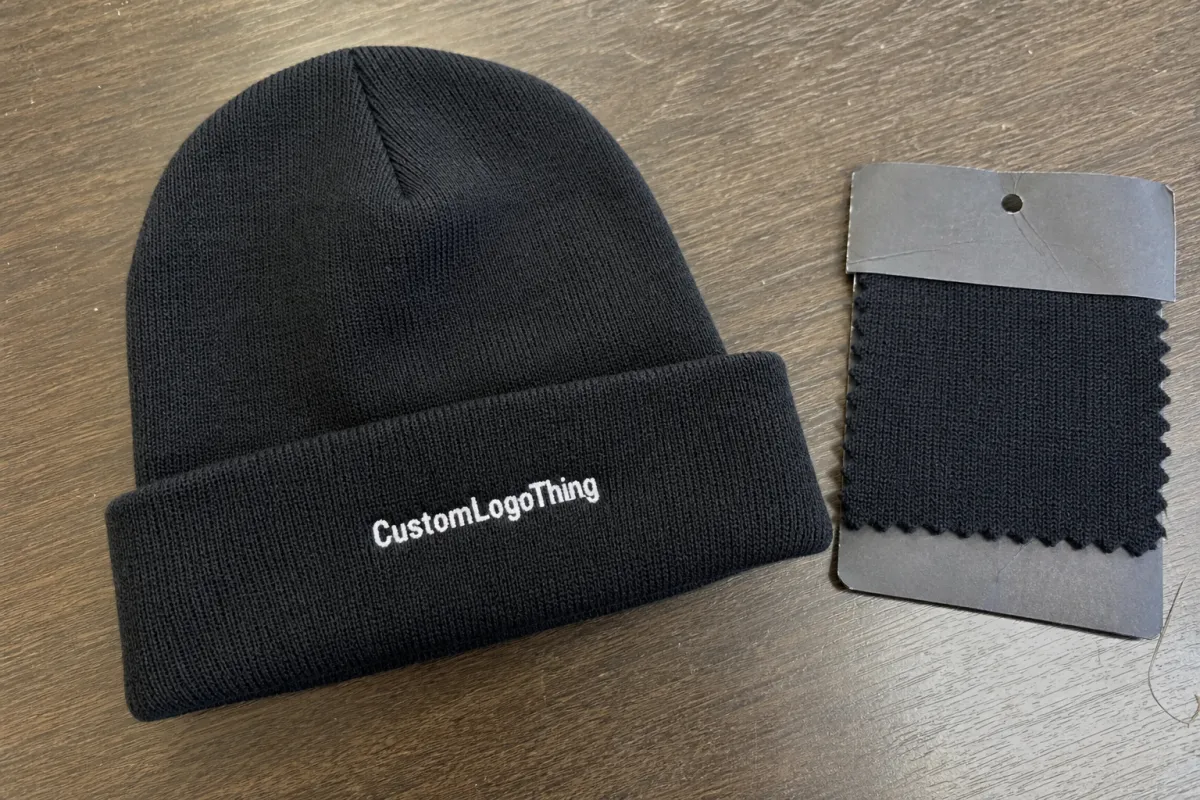
Start with a simple trio: a raw swatch, a washed swatch, and the same fabric after embroidery. That sequence shows more than a pretty sample ever will. A knit that feels soft before decoration can tighten once the needle path and stabilizer are introduced. A yarn that looks smooth in the roll may reveal fuzz, pilling, or sheen after handling. The first pass should answer a basic question: does the material still behave like a premium accessory once embroidery is added?
For skincare brands, the beanie usually sits in a specific role. It is often bundled with product launches, holiday kits, loyalty gifts, or seasonal campaigns. It is expected to feel calm, wearable, and polished without drifting into loud merch territory. Buyers usually notice four things first: the shape of the crown, the cuff recovery, the feel against the skin, and whether the logo has enough breathing room. If any one of those feels off, the piece can look less like a branded accessory and more like a leftover promo item.
That is why the skincare embroidered Beanies Material Sample guide should be used as a risk filter, not a mood board. Ask practical questions. Does the cuff bounce back after stretching? Does the embroidery leave a ridge inside the cap? Does the color remain consistent under daylight, office light, and phone flash? Does the beanie still feel comfortable after the thread density goes up? These are not cosmetic checks. They are the difference between a reorderable product and a one-off sample that only looked good on the first pass.
- Test softness: compare the embroidered sample directly against skin, not over another layer.
- Test recovery: stretch the cuff and crown, then watch how quickly the knit settles back.
- Test finish: inspect the inside for backing roughness, loose ends, and seam bulk.
The most useful sample notes are precise. “Cuff height 7 cm, embroidery centered 1.5 cm above fold, thread tone slightly warmer than approved Pantone” is better than “looks a bit off.” The more exact the comment, the faster the revision. That matters because headwear sampling is often limited by machine time, yarn availability, and the supplier’s queue. Vague feedback burns a day; specific feedback usually saves one.
How Fabric Choice Changes Embroidery Results
Fabric choice affects more than warmth. It determines how the logo stitches out, how the beanie drapes, how much the fabric pulls under tension, and how much inside bulk the wearer feels. Acrylic, cotton blends, recycled polyester, and wool blends all behave differently, and none is automatically best. The right answer depends on budget, finish target, and how structured the design needs to be.
Acrylic is usually the easiest route for cost control and warmth. It can hold color well, and it tends to work for larger orders, but quality varies sharply by yarn grade. Lower-grade acrylic may feel dry or slightly plastic. Cotton blends often feel softer and more natural at first touch, which helps when the product is meant to read as a premium gift, though heavy embroidery can distort the knit if the structure is too loose. Recycled polyester can work well for sustainability-led programs if the supplier can document the content and the knit is balanced enough to keep shape after stitching. Wool blends usually feel the most elevated, but they also bring higher cost, more careful care instructions, and a greater chance that the sample will scratch if the fiber blend is not well chosen.
The knit structure matters just as much as the fiber. A tighter rib gives the needle a steadier base, which usually means cleaner edges and less distortion around the logo. Looser knits look relaxed, but they can show pull marks or small waves if the embroidery is dense. Two samples can use the same thread and the same artwork and still look unrelated because the base fabric reacts differently to the stitch count. Buyers often blame thread first. Sometimes the knit is simply too open for the design being asked of it.
Inside comfort is the part many teams under-evaluate until a sample is worn for real. Stabilizer, backing, and seam construction all affect the feel against the forehead and ears. A beanie can look polished from the outside and still fail because the inside has scratch points or a stiff patch where the embroidery sits. That is especially noticeable in skincare programs, where the product is often treated as a gift and the expectation is gentleness, not just decoration.
| Fabric Type | Embroidery Behavior | Typical Sample Signal | Common Use Case |
|---|---|---|---|
| Acrylic | Stable with moderate stitch density | Good value, but quality can vary a lot | Entry price programs and larger runs |
| Cotton blend | Soft handfeel, can pull under dense logos | Natural and wearable | Premium lifestyle or skincare gifts |
| Recycled polyester | Good shape retention if the knit is balanced | Useful for sustainability messaging | Brands prioritizing recycled materials |
| Wool blend | Strong structure, often pricier | Elevated handfeel when sourced well | Higher-end retail or seasonal capsules |
Packaging should be judged with the same discipline as the fabric. A sample shipped in kraft paper inside corrugated cardboard feels considered, while a loose or crushed shipment can distort the crown and make a good beanie look less refined than it is. If packaging claims matter to the brand, ask for documentation on FSC certified paper or recycled components at the sample stage. It is easier to align product and packaging early than to retrofit the story later.
Process, Timeline, and Lead Time for Sample Approval
A strong sample process begins with a usable spec sheet. List fabric type, knit style, logo size, thread colors, target handfeel, packaging preference, and any non-negotiables. If the supplier knows the beanie should feel soft on the forehead, hold moderate stretch, and use low-sheen thread, the first sample is more likely to be useful. If the brief is loose, the supplier fills in the gaps, and that usually shows up as avoidable revision.
The sample path generally moves in stages. First comes the yarn or fabric match. Then comes the stitched strike-off, which shows how the artwork behaves on the actual knit. If that result is close but not correct, a second revision typically adjusts stitch density, placement, or thread tone. The pre-production sample matters most because it should reflect what bulk production will actually look and feel like. A perfect first sample happens, but not often enough to plan around.
Lead time depends on design complexity, fabric availability, and response speed. A simple sample may take 5-10 business days. A more involved embroidered version often takes 10-15 business days. If the supplier still needs to source a particular yarn or finish, the timeline stretches. The biggest delays are usually not dramatic production issues. They are the pauses between feedback, especially when comments are broad and difficult to action. A clean approval window saves more time than most buyers expect.
Shipping the sample properly matters too. If several people will review it, ask for a labeled kit rather than an unprotected parcel. A folded beanie inside kraft paper, placed in a corrugated cardboard mailer with the style code, fabric content, thread colors, and test date clearly marked, is easier to compare across teams. It also reduces the chance that one reviewer sees a wrinkled piece and another sees the same sample at its best.
For teams thinking about transit durability, the ISTA site is a useful reference point for packaging and handling logic. You do not need a formal lab to benefit from the thinking. If a sample cannot survive normal compression, folding, and re-handling, it is not ready for broader release.
- Stage 1: blank swatch or material match.
- Stage 2: embroidered strike-off with placement and stitch review.
- Stage 3: revised or pre-production sample for final approval.
Pricing, MOQ, and Unit Cost Drivers
Price is where sample decisions stop being abstract. A low sample fee can look attractive, but the real cost includes sample charges, shipping, revision rounds, MOQ, and the final unit price. If one supplier is cheaper up front but requires a large commitment, the total exposure may be worse than a slightly higher sample fee paired with a smaller order threshold.
For Custom Embroidered Beanies, a sample fee often lands around $25-$60 for a blank or simple strike-off and $45-$120 for a more detailed embroidered sample, depending on design complexity and shipping. Bulk pricing moves with volume and material choice. A basic acrylic beanie might sit around $1.40-$2.40 per unit at larger quantities. Cotton blends and recycled polyester options often move into the $2.20-$3.90 range. Wool blends can rise to $4.20-$7.00 or more, especially if the knit is dense or the finishing is more exacting.
MOQ changes the economics in a way that is easy to underestimate. A better per-unit price at 1,000 pieces means very little if the campaign only needs 300. The useful question is whether the MOQ matches sell-through, storage capacity, and the brand’s cash cycle. Inventory that looks efficient on a quote sheet can sit too long in a warehouse. That risk is real, and it is usually more expensive than the difference between two supplier quotes.
Several cost drivers repeat across headwear programs:
- Fiber and yarn weight: thicker or softer yarns tend to cost more and need better handling.
- Stitch count: dense logos take longer and need stronger backing.
- Logo size: larger embroidery increases machine time and can create more pull.
- Finishing details: woven labels, hangtags, and custom packaging raise the unit price.
- Shipping: rush freight can wipe out a favorable quote quickly.
Compare quotes only when the assumptions match. If one supplier includes the label, wrap, and shipping while another leaves them out, the numbers are not comparable. Ask for line-item clarity. Otherwise the cheapest quote can turn out to be the least complete quote, which is a common source of budget surprise.
| Quote Element | What to Ask | Why It Matters |
|---|---|---|
| Sample fee | Is it refundable or credited to the bulk order? | Changes the real cost of testing suppliers |
| MOQ | What is the minimum by color, style, or size? | Controls inventory risk and cash flow |
| Decoration | Is embroidery included in the quote? | Prevents apples-to-oranges comparison |
| Packaging | Are kraft paper wraps or inserts extra? | Affects presentation and unit economics |
Step-by-Step Material Sample Evaluation
The easiest sample mistake is judging too quickly. A beanie can feel right for ten seconds and then reveal discomfort after a full day of wear. Build a scorecard before the samples arrive and use the same criteria for every piece. That keeps color preference, package quality, and first impressions from overpowering the actual performance of the sample.
Start with touch. Is the knit dry, plush, balanced, or slick? Then check stretch recovery. Pull the cuff and crown, release them, and see whether the fabric returns cleanly or stays distorted. Next, inspect the embroidery from both sides. The front should be crisp and legible without puckering. The inside should not feel like a stiff ridge or a wire brush. After that, assess the seam finish and overall crown shape. A beanie can look solid on a hanger and still feel bulky once worn.
If the supplier can spare it, wear the sample for a full day. Heat buildup and forehead irritation rarely show up in the first minute. Wash the sample once and repeat the inspection if the product is meant to be durable. Some fibers pill quickly. Some colors shift slightly. Some embroidery tightens enough to change the logo shape. That information is much more useful than a clean first impression.
Photograph the sample under daylight, office lighting, and phone flash. Skincare brands sell visual calm as much as they sell utility, and a beanie can look matte in daylight while reflecting too much shine in flash photography. If the logo vanishes on camera, the design may be too quiet for ecommerce. If it flares hard, the surface finish may feel less premium than intended. The camera often exposes what the eye forgives.
A practical scorecard often includes:
- Handfeel
- Stretch recovery
- Embroidery clarity
- Inside comfort
- Color consistency
- Confidence to reorder
Record each sample with photos, thread and fabric notes, and a final ranking. The goal is not to choose the most attractive piece in isolation. The goal is to find the version that will hold up in production, survive wear, and feel consistent with the rest of the skincare line. A good sample should reduce uncertainty, not create a new round of guesswork.
Common Mistakes and Expert Tips That Prevent Rework
Buyers often approve too early. A near-match on color does not matter if the knit is too loose or the embroidery scratches the skin. The sample can still fail in use. That is why tactile checks matter more than a render or a courier photo. A physical sample earns its place by showing what the mockup cannot.
Skipping the wash test is another expensive shortcut. Embroidery can tighten after laundering, and some fabrics lose recovery in a way that only shows up after the first wash. If the beanie is meant to be worn often or bundled with recurring skincare purchases, durability matters more than the first five minutes out of the box. Event-only merchandise has more tolerance than a retail item that should stay presentable across repeated use.
Requesting too many variations without a review system creates noise. Six similar samples may sound thorough, but it usually turns the decision into a comparison of tiny differences that are hard to explain and even harder to approve. Two or three well-defined options usually lead to a better decision. More samples are not always more information.
Two requests tend to pay off:
- Ask for one lighter embroidery version and one denser version: that shows the trade-off between logo presence and inside comfort.
- Ask for a saved reference sample: keep the approved piece with notes on fabric, thread, label, and packaging so future reorders stay consistent.
Keep packaging tied to the garment file. If the sample arrived in a specific carton size with a particular kraft paper wrap and label placement, record it. Secondary packaging can look separate on paper, but in real life it influences whether the sample reaches the approver in a fair condition. A crushed box makes a good beanie look cheap. A neatly packed sample makes it easier to judge the actual product instead of the transit damage around it.
The most reliable habit is to treat the beanie as a system. Knit, embroidery, trim, packaging, and shipping all affect the final buying experience. If one layer is off, the entire sample feels weaker than it should. That is the part teams often learn only after the first revision cycle, which is why a tighter evaluation process saves money later.
Next Steps: Build a Shortlist Before Bulk Production
After the samples arrive, narrow the field to two or three suppliers and compare them on the same scorecard. Price matters, but comfort, logo quality, speed, and responsiveness matter just as much. A supplier that answers clearly and revises precisely is often worth more than a slightly lower quote from someone who moves slowly or keeps changing the details.
Send a one-page brief for the next round. Include fabric preference, target budget, embroidery placement, packaging expectations, and the approval deadline. If the sample shipper should reflect brand values, specify kraft paper, FSC certified inserts, or recycled packaging only where it adds value. Simple is usually better. Decorative packaging that distracts from the product can make the whole sample feel less disciplined.
A weighted scorecard keeps the decision honest. For example, comfort can count for 35%, embroidery quality for 30%, price for 20%, and lead time for 15%. That structure prevents a beautiful but uncomfortable sample from winning just because it photographs well, and it also keeps the lowest-cost option from winning if the finish feels weak in hand. The weights should reflect the real priorities of the project, not just the loudest opinion in the room.
Before bulk production is released, ask for a pre-production sample or a signed approval sheet. That is one of the cheapest forms of insurance in the process. It gives both sides a clear target and reduces the chance that the final order drifts away from the approved standard. For a skincare launch, that kind of consistency matters because the reorder path should be predictable. The second run should not trigger another debate about the fabric, stitch density, or label placement.
Keep the skincare embroidered Beanies Material Sample guide with the order file rather than buried in email. Approved fabric, stitch density, trim details, packaging notes, and the final sample photo should all be easy to find when the next run comes around. That paper trail is often what keeps a good first order from turning into a messy second one.
What should I check in skincare embroidered beanie material samples?
Check handfeel, stretch recovery, embroidery clarity, and inside comfort against the forehead. Look at the sample after wear and, if possible, after washing to catch shrinkage, pilling, or changes in shape. Confirm that logo placement still looks balanced on the actual knit structure, not just on a flat mockup.
Which fabrics are best for soft, premium embroidered beanies?
Cotton blends and carefully selected acrylic blends often give a soft first touch while still holding embroidery well. Recycled polyester can work if the knit is balanced and not too slick or thin. Softness alone is not enough; the fabric also needs to keep its shape after stitching and daily wear.
How long does the sample process usually take?
Blank swatches and simple strike-offs are usually faster than full pre-production samples, which may need another revision round. Lead time depends on fabric sourcing, embroidery complexity, and how quickly feedback comes back. A written schedule helps keep review, revision, and shipping windows clear from the start.
How does MOQ affect pricing for embroidered beanies?
A higher MOQ usually lowers the unit cost, but it increases the total cash tied up in inventory. Some suppliers only improve pricing after certain volume thresholds, so ask where those breakpoints are. Compare the MOQ against expected sell-through so the order size fits the campaign instead of forcing it.
Should I request both blank and embroidered samples?
Yes. The blank sample shows fabric feel, while the embroidered version shows how decoration changes structure, comfort, and logo clarity. Using both makes it easier to spot issues before bulk production and lowers the chance of expensive rework.


