Buyers comparing tamper evident plastic bags Packaging Cost Breakdown figures usually start with the unit price. That is the wrong first instinct. A bag that looks cheap on paper can become expensive once it starts failing seals, triggering rework, slowing packout, or creating disputes at receiving. The real number is not just what the bag costs. It is what the bag prevents.
That shift in thinking matters because tamper-evident packaging sits at the point where product protection, traceability, and labor efficiency meet. A bag may be one component in a larger system that also includes labels, cartons, inserts, and Custom Packaging Products, but it still controls a critical moment: whether the item arrives with proof of integrity or not. If the closure is weak, the film is too thin, or the print is hard to read, the savings disappear quickly.
The best purchasing decisions are usually the least dramatic ones. A slightly stronger film, a cleaner adhesive zone, or a more deliberate tear feature can reduce handling losses far more than it raises the unit price. That is especially true in programs that also rely on branded packaging or other product packaging components, where consistency is worth more than a paper-thin discount.
Why a Stronger Seal Can Lower Total Pack Cost
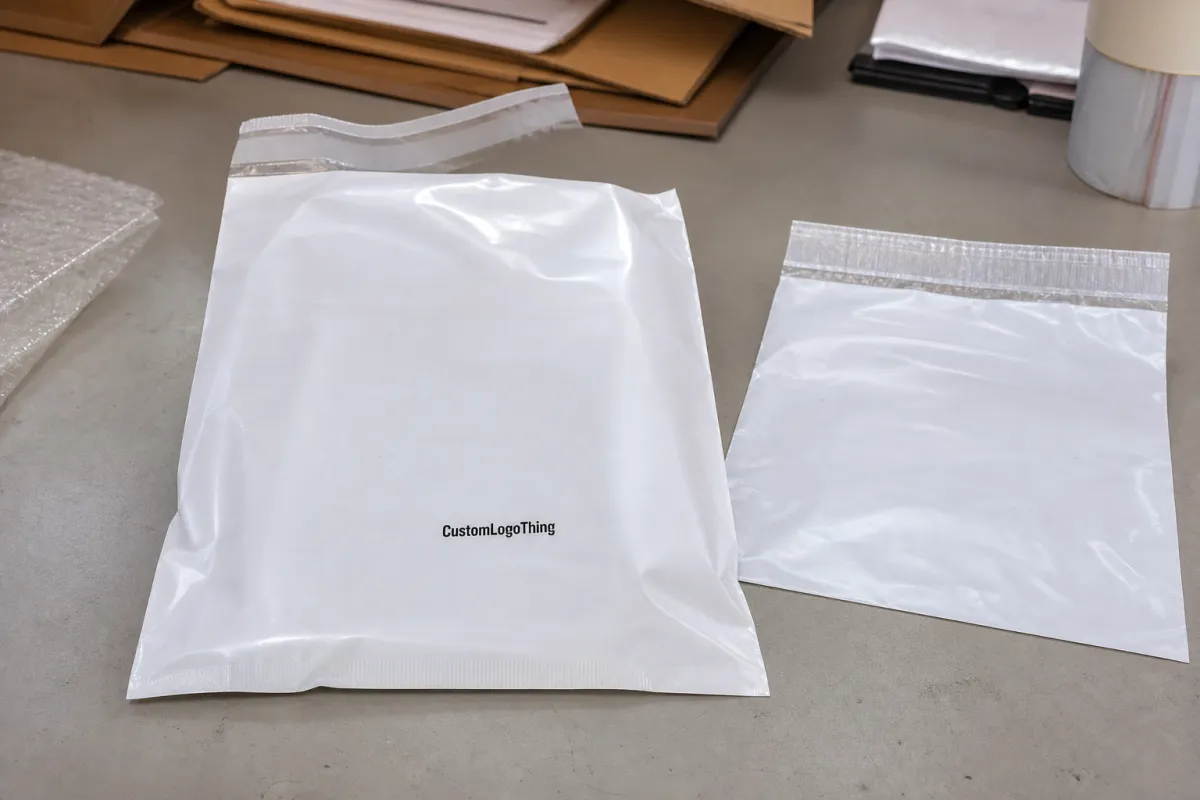
The easiest mistake is treating a tamper-evident bag as if it were a plain commodity pouch. It is not. The bag has to seal, stay sealed, resist puncture, communicate tampering clearly, and survive the rest of the workflow without creating extra touches. Every one of those requirements has a cost, and every failure has one too.
Consider a thin adhesive bag specified only for the lowest quote. It may seal fine on clean, dry samples, then start lifting on dustier or colder product surfaces. The line then absorbs the hidden cost: wiped-down parts, reset seals, repacking, and sometimes a full hold while the team checks what went wrong. Even a small failure rate can wipe out the lower unit price once labor is counted. A better film or a more reliable closure often saves money simply by removing interruptions.
Different applications also punish different weaknesses. Retail security wants a visible opening event. Pharmacy packaging may care more about legibility, lot coding, and closure consistency. E-commerce returns need something that survives repeated handling. Small parts need tear resistance and clarity. Document control often needs serial numbering or a closure that makes unauthorized access obvious. One construction cannot serve all of those jobs well.
Practical rule: if a bag failure creates a manual touch, the real cost is the interruption, not the film.
That is why line speed belongs in the same conversation as unit price. A bag that opens cleanly, seals consistently, and stacks neatly is often the cheaper bag in practice, even if it is not the cheapest quote. The same logic applies across packaging categories, from labels to Custom Printed Boxes: structure that supports repeatable packing usually beats a lower price that causes friction later.
Materials, Closures, and Print Options That Change Performance
Most of the price spread starts with the film. LDPE is common because it is flexible, easy to run, and usually the lowest-cost option. LLDPE tends to improve puncture resistance and stretch behavior, which matters if the bag carries sharper edges or moves through a rougher handling chain. Coextruded film can improve clarity and seal consistency, but it adds process complexity, and complexity tends to show up on the quote.
Thickness matters just as much as resin type. Film is usually specified in mil or microns, and the numbers are not decorative. A thinner bag may look acceptable in a sample photo but feel soft, print poorly, or puncture too easily at corners. A heavier gauge usually adds strength and a better hand feel, but it also raises resin usage and may change sealing behavior. On large runs, that difference is not trivial.
Closures create another layer of cost and performance tradeoff. A basic adhesive strip is usually the least expensive and works well for internal control or light retail use. Zip-lock styles help when repeated access is part of the job. Tear strips make the opening event more visible, which strengthens the evidence function. Numbered evidence tapes and serialized seals add traceability, but they also add setup, inspection, and usually a tighter quality-control step.
Print is where buyers often undercount the work involved. A single warning line is one thing. Add a barcode field, a lot code, a serial number, or a multi-language warning block, and the bag becomes a controlled information carrier. That can be useful, especially in branded packaging or product packaging programs, but it changes production. More print coverage usually means more press time, more proofing, and more chances to catch an issue before the run begins.
- LDPE: economical, flexible, good clarity.
- LLDPE: better puncture resistance and stretch.
- Coextruded film: stronger performance balance, higher processing cost.
- Adhesive seal: simple and budget-friendly for many uses.
- Tear strip or numbered evidence tape: stronger tamper signaling and traceability.
The right construction depends on risk. Lightweight, low-value contents usually do not need the most complex build. High-value, regulated, or dispute-prone items usually do. Buyers save money by matching the bag to the job, not by choosing the cheapest structure available.
Specification Checklist for Size, Gauge, and Compliance
Accurate quoting starts with dimensions, and dimensions need to be specific. Flat width, usable length, gusset depth if there is one, seal position, header area, hang hole, and label panel all affect the build. A vague description may be enough for a rough estimate, but it is not enough for a stable quote. Most packaging mistakes start with an unclear spec, then become expensive after sample approval reveals the gap.
Gauge is the next major variable. A bag that is technically the right size can still be wrong if the film is too thin for the contents or too thick for the intended seal method. Thin film may save material, but it can distort during printing or split under load. Thicker film improves durability, yet it can increase seal time and material cost. Buyers should ask for the gauge in the same message as the size, not as a follow-up after pricing starts.
Compliance and identification details belong in the initial request too. If the bag needs warning text, tamper messaging, serial numbers, lot coding, barcode fields, or a specific traceability format, that should be stated before artwork work begins. For some programs, buyers also want packaging performance to align with standard transit expectations or film testing references such as those used by ISTA. Not every job needs lab certification, but every job benefits from shared expectations about how the bag will be judged.
A simple approval set helps keep the order clean:
- A dimensioned drawing or written spec sheet.
- A material callout with film type and thickness.
- An artwork proof showing copy, placement, and colors.
- A physical sample or preproduction proof.
That process is useful beyond this one item. Teams buying labels, branded packaging, or custom printed boxes alongside the bag can use the same approval package across the whole program. Fewer versions, fewer guesses, fewer surprises later.
Tamper Evident Plastic Bags Packaging Cost Breakdown
A practical tamper evident plastic bags Packaging Cost Breakdown usually has six parts: setup, material, print, finishing, packing, and freight. If a supplier only quotes the unit price, the figure may be technically true and still incomplete. The missing pieces appear later, and they rarely appear in your favor.
Setup charges cover artwork checks, machine changeover, proof handling, and sometimes plate or print preparation. These costs are most visible on short runs, where they are spread across fewer bags. Material depends on size, film type, and gauge. Print adds press time, color control, and inspection. Finishing can include adhesive application, perforation, serialization, or specialized sealing. Packing matters too, because loose bulk packaging costs less to handle than presentation-style packing. Freight can be modest on large orders and surprisingly high on small, urgent ones.
| Option | Typical MOQ | Rough Unit Range | Best Fit | Main Cost Driver |
|---|---|---|---|---|
| Plain tamper-evident bag, adhesive seal | 5,000-10,000 | $0.18-$0.30 | Internal control, light retail packaging, document handling | Bag size and film thickness |
| One-color warning print with stronger film | 10,000-25,000 | $0.24-$0.42 | Branded packaging, pharmacy packaging, controlled parts | Print setup and higher-grade film |
| Serialized bag with barcode field | 25,000+ | $0.32-$0.60 | Traceability, audit trails, regulated workflows | Variable data print and inspection |
| Heavy-gauge bag with tear strip and zip feature | 5,000-20,000 | $0.30-$0.55 | Returns, sharp parts, higher-value product packaging | Construction complexity |
These ranges are planning numbers, not universal quotes. Geography, resin markets, order timing, and print requirements can move them in either direction. The point is not to memorize the table. The point is to understand what drives the number.
MOQ has an outsized effect. A 5,000-unit order carries the same setup burden as a 25,000-unit order, so the unit cost looks less attractive at the lower volume. That does not automatically mean the bigger order is the smarter move. It only makes sense if the spec is stable, the forecast is real, and the bag will not need a revision in two months. Ordering the wrong bag in the wrong quantity is how packaging budgets drift.
The clearest comparison is landed cost, not quoted cost. Add shipping, duties if they apply, sample fees, and secondary packing. Then compare that total against the labor and failure risk the bag introduces or removes. A bag that is five cents cheaper but creates two extra handling steps is not really cheaper. A bag that seals properly and reduces rework usually is.
Production Steps, Lead Time, and Approval Milestones
The production path is predictable: quote request, artwork review, proof or sample approval, material procurement, production, inspection, packing, and shipment. Delays cluster around the same points. Missing dimensions, late artwork changes, and slow feedback on samples cause most of the schedule friction.
Lead time depends on complexity. A plain or lightly printed bag often moves faster than a serialized or highly customized version. A simple job may take about 8-12 business days after approval. A more complex run with variable data, special finishing, or sample revisions can stretch to 12-18 business days. Those are planning ranges only. Material availability and factory load can change the schedule quickly, which is why a complete spec sheet matters before anyone promises a ship date.
Buyers who keep the schedule moving usually do a few things well:
- Lock dimensions and thickness before asking for pricing.
- Send editable artwork instead of screenshots or PDFs with missing text.
- Approve one sample quickly and in writing.
- Confirm carton count, pack format, and ship-to location before production starts.
For high-value goods, the bag should be viewed as part of the transit system, not just a finish item. A bag that survives the line but fails in the truck still creates cost. Testing expectations used in transit planning, including those referenced by ISTA, can help keep the job grounded in how the package actually travels.
From a production standpoint, the approval stage does more than protect the schedule. It locks the spec. Once the artwork, material callout, and closure method are approved, the job becomes much easier to repeat, reorder, and audit. That matters on programs that cannot afford variation from batch to batch.
What to Send for an Accurate Quote and Next Steps
A useful quote begins with useful information. Send the exact bag dimensions, the preferred film type, the gauge, the closure style, the print copy, the target quantity, and the ship-to location. If you need samples, proofing, serialization, or compliance notes, include that too. Each item changes either the price or the timeline, and sometimes both.
Ask for more than one quote on the same spec. Then request that each supplier separate the price into product cost, setup, freight, and any extras such as variable data or special packing. That makes the comparison real instead of decorative. It also reveals whether a low number is actually a low cost or just a shifted cost.
Before ordering full production, approve a sample or preproduction proof. That step matters most for regulated goods, high-value items, or anything that could trigger a dispute if the seal looks wrong. A few minutes of checking can prevent weeks of delay. More important, it protects the part of the job that is hardest to recover once it goes wrong: trust in the packaging itself.
If the bag is part of a larger sourcing program that includes branded packaging, labels, or custom printed boxes, keep one spec sheet per item and compare them on the same terms. That makes future reorders cleaner and helps identify where savings are real versus where they were borrowed from another line item. For tamper-evident bags, the best decision is usually the one that balances line speed, seal performance, and landed cost without adding avoidable labor.
That is the most practical way to use a tamper evident plastic bags packaging cost breakdown: compare the full landed cost, the likely failure risk, and the effect on packing speed, then choose the build that protects the contents without creating extra work.
What drives tamper-evident plastic bag pricing the most?
Film thickness, closure style, and print coverage usually have the largest impact on unit price. MOQ and setup costs matter a lot on short runs, and freight becomes important once you compare landed cost instead of only the bag price.
How does MOQ affect tamper-evident bag cost per unit?
Lower MOQs spread setup and press time across fewer bags, so the unit cost rises. Larger volumes usually reduce the price per bag because the same setup is absorbed more efficiently. If demand is uncertain, ask for tiered pricing at several quantities before committing.
Which bag features are worth paying more for?
A stronger seal or better tear resistance is worth the added cost when contents are valuable, regulated, or likely to be disputed. Barcode fields and serialization are useful when traceability matters. Custom sizing can also reduce waste and repack labor even if the bag price itself is slightly higher.
How long does production usually take after approval?
Simple bags with limited print often move faster than custom serialized runs. Lead time depends on artwork approval, material availability, and whether a sample is required. Ask for a schedule that separates prepress, production, inspection, and shipping so delays are easier to track.
What should I include in a quote request for tamper-evident bags?
Send dimensions, material preference, thickness, closure style, artwork, and target quantity. Include the preferred ship-to location so freight can be estimated accurately. State whether you need samples, proofing, or compliance notes so the quote reflects the actual job instead of a rough guess.

