Restaurant winter headwear is easy to underestimate because it looks simple on paper. A ribbed beanie is only a few ounces of knit, yet it affects comfort, brand consistency, and the speed of reorders across every site that uses it. Miss one detail in the first buy and the cost shows up later as uneven fit, delayed replacements, or a logo that does not hold up after the first wash cycle.
The pressure point is not just quantity. Buyers have to balance warmth, stretch, decoration method, storage space, and the reality that restaurant teams turn over faster than most apparel programs are built to absorb. A strong order plan turns the beanie into a repeatable uniform item instead of a seasonal scramble.
The cheapest blank is rarely the cheapest program if the fit, decoration, and replenishment specs are vague.
Restaurant Ribbed Winter Beanies Bulk Order Planning: What Usually Gets Missed
Most ordering mistakes start with headcount math that is too neat. A single number rarely reflects the way restaurant teams actually operate. One location may need extra stock for open hires, another may need a separate run for managers, and a third may need a different delivery schedule because its winter staffing pattern changes every few weeks. That is before anyone accounts for reserve stock, damaged items, or replacements for staff who move between locations.
Ribbed knit adds another layer of complexity. The stretch helps the beanie fit more heads, but the same rib structure can change how the cuff sits and how deep the crown feels once it is worn. A sample can look fine on one person and feel completely different on another. If the order will cover hosts, prep staff, delivery drivers, and supervisors, one approval sample is not enough to predict how the full team will experience it.
That is why the first buy should create a reusable spec file. The file should capture the beanie style, yarn composition, rib pattern, cuff depth, logo placement, approved color, carton count, and reorder notes. When those details are written down, the next order is faster to quote and less likely to drift. Without them, the supplier ends up reinterpreting the original job every time, which is where variation creeps in.
There is also a seasonal reality that tends to get ignored until the weather changes. A restaurant with patio service into late fall usually needs more inventory buffer than a dining room that stays closed to the outdoors. Delivery teams lose hats faster. New hires need them immediately. Managers often take the last clean item from the stock room if they are short on time. A realistic order plan includes all of that instead of pretending headcount is stable.
Restaurant ribbed winter beanies Bulk Order Planning works best when it is treated like a uniform program with controls, not a one-off apparel purchase. The difference shows up in the second season. Good records protect margin. Poor records force you to re-explain the same basic decisions every winter.
Material, Stretch, and Fit Specs That Keep Crews Warm
Material choice does more than decide warmth. It affects drying time, wash resistance, shape retention, and how the hat behaves under a hood or headset. For restaurant use, acrylic is still the most practical starting point because it is warm, relatively light, and dries faster than wool after laundering. Acrylic blends often feel softer and keep a tidy silhouette a little better. Wool blends are warmer and more premium in hand feel, but they also need more care and usually come with a higher cost.
Three questions usually settle the material discussion quickly: how cold is the work environment, how often will the beanies be washed, and what else will they be worn under? A line cook working near a hot station needs something different from a delivery driver standing outside for 20 minutes at a time. A hat that sits comfortably beneath a hood or hair restraint is worth more than one that feels plush but fights every other uniform layer.
Fit specs deserve more precision than many buyers give them. A useful spec includes stretch range, crown depth, cuff width, and whether the beanie has to cover braids or longer hair. A cuff that is about 2.5 inches wide offers more room for decoration, but a shallower cuff may suit smaller faces and feel less bulky under outerwear. Small differences in depth and width can change whether staff wear the hat correctly or leave it in a pocket.
Rib density is another detail that separates a serviceable knit from one that will look tired too soon. A tighter rib generally holds shape better and resists collapse after repeated shifts. A looser rib can feel softer on first wear, yet it often slouches faster and shows wear sooner. That softer hand may work in retail or lifestyle merchandise. In food service, structure usually matters more.
Buyers should also ask about pilling and colorfastness. A supplier that can describe yarn performance clearly, or provide testing references aligned with standard textile methods, is usually more reliable than one that speaks only in broad claims. You do not need a lab report for every order, but you do want enough detail to know whether the material will still look clean after a season of wear and washing.
| Material | Warmth and drying | Shape retention | Best use | Buyer note |
|---|---|---|---|---|
| 100% acrylic, double-layer rib | Warm, quick drying | Good if knit tension is tight | High-turnover service teams | Usually the most practical option for large restaurant runs |
| Acrylic-blend | Warm with a softer hand feel | Very good, depending on yarn mix | Front-of-house and brand-forward uniforms | Often balances comfort and price well |
| Wool-blend | Warmest feel, slower to dry | Strong if knit is dense | Cold climates, premium programs | May need stricter wash guidance and a higher budget |
If the order includes retail-style inserts, hang tags, or boxed presentation, paper stock matters too. FSC-certified paper is a sensible choice for tags and inserts if the brand already favors recycled materials. For shipping, ask how cartons are packed and whether they are tested against common transit stress. The ISTA testing standards are a useful reference point for compression and handling, even for a simple apparel shipment.
Logo Placement and Decoration Options for High-Wear Service
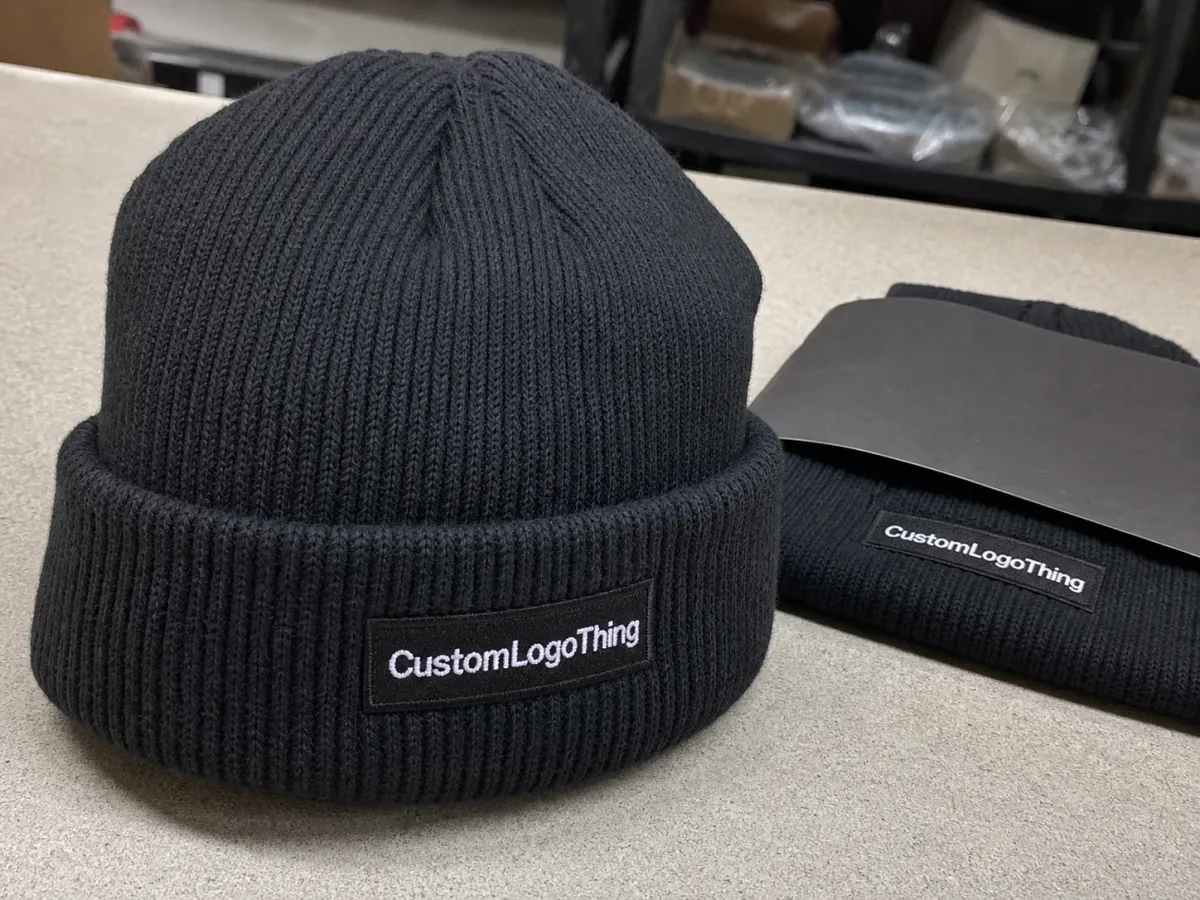
Decoration should follow use, not mood boards. For restaurant headwear, cuff embroidery remains the most durable choice because it sits on a stable section of the knit and usually survives repeated wear better than decorative methods placed on more flexible areas. Woven patches can carry finer detail and are useful when a logo needs sharper edges. Woven labels keep the look more understated and work well if the brand mark is meant to sit quietly on the garment rather than dominate it.
Placement is nearly as important as method. A logo that is too small can disappear into the ribbed texture, especially in dim dining rooms or in photos shot from across the floor. A logo that is too large can overpower the cuff and make the beanie look promotional instead of uniform. For many restaurant programs, a mark roughly 1.75 to 2.5 inches wide on the cuff is a reasonable starting point, adjusted for knit density, logo shape, and how far away the item needs to read.
Ribbed knit compresses detail. Thin lettering, tiny iconography, and close color pairing can blur once they are stitched or woven onto the fabric. That is why a strike-off or production proof matters. A flat digital mockup hides problems that become obvious once the design meets actual yarn texture. If the logo has narrow strokes or a color-on-color treatment, review it on the real material before approving a full run.
Color contrast deserves the same discipline. A red logo on charcoal may look strong on a screen but lose clarity under restaurant lighting. White on black is easy to read, though it can feel harsh if the rest of the uniform already uses strong contrast. The right choice is the one that fits the whole uniform system, not just the beanie alone. FOH, BOH, and delivery staff should still read as part of the same brand family.
A practical way to think about decoration is by role:
- Hosts and managers: smaller embroidered mark, cleaner presentation, less visual clutter.
- Line cooks and prep staff: durable cuff embroidery or woven patch, easier to keep looking tidy through repeated washing.
- Delivery and outdoor staff: higher-contrast decoration for visibility in low light and poor weather.
Ask the supplier how rib tension affects the decoration during stitching. A solid vendor will talk through needle pull, artwork distortion, and proof dimensions instead of offering a vague assurance that “it will look fine.”
Pricing, MOQ, and Unit Cost Breakpoints
The number on the quote is only one part of the cost. Blank cap price, decoration setup, packaging, freight, split shipping, and rush charges all affect the final invoice. Two quotes can look close until those extras are added, and then one suddenly becomes much more expensive. That is why restaurant buyers need to compare complete landed cost, not just the unit price printed next to the cap.
Minimum order quantity usually moves with color choice, yarn type, and decoration method. Standard colors with simple embroidery generally support lower minimums. Custom yarn matches, special trim, or private-label packaging often push the minimum higher. If a supplier bundles those variables together, it becomes hard to see whether the added cost comes from the knit, the artwork, or the packaging.
| Option | Typical MOQ | Indicative unit price | Best fit |
|---|---|---|---|
| Standard acrylic ribbed beanie with one-color embroidery | 100-250 pcs | $3.10-$6.10 depending on volume | Multi-location restaurant groups needing reliable reorders |
| Acrylic-blend beanie with woven patch | 150-300 pcs | $3.90-$7.80 depending on color and coverage | Buyer-facing brands that want stronger visual detail |
| Wool-blend beanie with private-label packaging | 250-500 pcs | $5.20-$10.50 depending on packaging and yarn mix | Premium hospitality groups and colder markets |
These are planning ranges, not promises. The useful comparison is wear life. A beanie that costs less but loses shape after two washes is not actually cheap. A slightly better cap that lasts the whole cold season may reduce replacement orders, shrink manager complaints, and prevent the stock room from filling with items that no one wants to issue.
Ask for tiered pricing at 250, 500, 1,000, and 2,500 units. The step-down between those brackets shows where volume starts to matter. In some programs, the move from 500 to 1,000 barely changes the per-unit price, which can make sense if you want a reserve for replacements and future hires. Embroidery setup commonly falls in the $35-$85 range per logo position, though more complex art or multiple placements can raise that. Freight should be quoted separately so the comparison stays clear.
If the order will be distributed across multiple restaurants, split shipping can be cheaper than sending everything to one warehouse and redistributing later. That is especially true when opening dates are staggered or when stores sit in different weather zones. The cheapest route on paper is not always the cheapest route in practice.
Production Steps and Lead Time From Proof to Delivery
A reliable production timeline starts with the sequence, not the delivery date. A clean order usually moves through quote, spec confirmation, artwork proof, sample or strike-off approval, production, inspection, packing, and shipment. If the supplier cannot show where the order sits in that chain, the quoted date is more guess than schedule.
Keep manufacturing time separate from transit time. That sounds obvious, but it is where many restaurant programs slip. A decorated beanie run may take 12-15 business days from proof approval, sometimes longer if the yarn is custom dyed or the decoration is more involved. Transit can add another 2-6 days domestically and more for remote destinations. Holiday demand, weather, and carrier congestion can compress the window quickly.
Late artwork changes are one of the most common causes of delay. A small edit to logo size, thread color, or placement can force the job back through approval. A single sign-off owner helps a lot here. If three managers are reviewing the proof, the calendar drifts. If one buyer owns the decision and the deadline is clear, the job tends to move.
Ask how cartons are labeled and packed. If the order is split across several locations, carton marks should match the delivery list and the packing slip should mirror the purchase order. If one location opens earlier than the others, the earliest shipment should be packed separately so it does not get buried in a larger shipment. A supplier that handles that cleanly saves the receiving team time before the boxes even leave the dock.
Damage prevention deserves some attention too. Even basic apparel cartons benefit from a clear internal standard for drop, compression, and handling. That is where ISTA language is helpful: it gives the buyer and supplier a shared way to discuss transit risk without guessing. A simple cap order does not need a dramatic shipping process, but it does need one that is consistent.
Ask for lead time ranges by quantity. A 100-piece reorder and a 1,000-piece rollout should not be given the same schedule. If a vendor gives one flat date for every volume, ask for a more realistic breakdown.
Vendor Checks That Reduce Reorder Risk Across Locations
Price matters, but repeatability matters more. The better supplier is the one that can reproduce the same beanie six months later without rebuilding the order from memory. That means they should keep the original artwork file, yarn reference, thread colors, size specs, carton counts, and packing instructions on file. Those records are what make the second and third orders faster and more consistent.
For multi-location restaurant groups, split shipping should be confirmed before the order is released. If one store opens sooner, one market is colder, or one manager receives stock on a different day, the cartons need to be labeled accordingly. Otherwise, inventory ends up sitting where it is not needed while another site runs short. That is an operations issue, not just a logistics issue.
Ask how shortages, dye-lot shifts, and substitutions are handled. Yarn color can vary, trim stock can change, and a reorder can still be affected by those realities. What matters is whether the vendor documents the difference and tells you what changed. Verbal reassurance is not enough. Written confirmation protects the next run.
Receiving should be just as structured as ordering. Someone on the buyer side should count cartons against the PO and check a sample of beanies for logo placement, color, and size as soon as they arrive. That catches errors while they are still fixable. Waiting two weeks to report a mismatch almost always makes the correction harder and more expensive.
Internal recordkeeping also helps. Store the approved proof, the spec sheet, and the packing notes in one place where managers can find them. That way the original decisions do not disappear when a staff member changes roles or a buyer goes on leave. If the program includes future apparel items, the same process can be reused instead of built again from scratch.
Restaurant ribbed winter beanies Bulk Order Planning gets easier once the supplier file and the internal file match. That is the real operational win: fewer surprises, fewer re-explanations, and fewer emergency reorder requests when the weather turns.
Final Checks Before You Release the Purchase Order
Before the PO goes out, lock the details that create rework later. Confirm active headcount, the reserve percentage, color, logo placement, delivery addresses, carton labels, and the name of the person who signs off on art. A small reserve is usually sensible for replacements, new hires, and managers, especially in seasons where staffing changes fast.
Overage should be planned, not guessed. Many restaurant buyers keep an extra 10-15% on hand and store it separately so it does not disappear into daily issue. That reserve does not look dramatic on paper, but it can prevent disruption when a cap is lost, a team member transfers, or a location starts a new shift cycle midweek.
Check the artwork against the actual knit before approval. A design that looks balanced on a flat screen can read differently on ribbed fabric. This is the cheapest point in the process to catch contrast problems, sizing issues, or a logo that sits too high on the cuff. Once production starts, every correction costs real money.
Keep the approved proof, the spec sheet, and the carton instructions together. That file becomes the baseline for every reorder. If the vendor changes account staff or a manager places the next order, the same standards still hold. A restaurant program is strongest when the spec lives in writing rather than in somebody’s memory.
Bottom line: restaurant ribbed winter beanies Bulk Order Planning works best when the first purchase defines the fabric, fit, decoration, pricing structure, and reorder record in one place. That is what keeps winter headwear predictable across locations and across seasons.
What is the best ribbed winter beanie material for restaurant staff?
A double-layer acrylic or acrylic-blend knit usually gives the best mix of warmth, quick drying, and wash resistance for food-service use. Heavier yarns can feel warmer, but they are not always ideal for staff who wear hoods, headsets, or hair restraints during long shifts.
How should a restaurant calculate bulk order quantity for beanies?
Start with active headcount, then add 10-15% for replacements, managers, and new hires so one missing item does not create a stock gap. If your stores open on different dates or operate in different climates, split the quantity by location instead of pooling everything into one total.
What MOQ should I expect for custom ribbed beanies?
MOQ usually changes based on decoration method, color selection, and packaging requirements, not just the blank cap itself. Standard colors with simple embroidery generally support lower minimums than custom yarn matches or private-label inserts.
How long is the turnaround for a restaurant beanie order?
Plan for separate windows for proof approval, production, inspection, and transit instead of treating the delivery date as one fixed number. A decorated run may take 12-15 business days from proof approval, and late artwork changes are one of the most common reasons the schedule slips.
Can I reorder the same ribbed winter beanies later?
Yes, if the supplier keeps the spec sheet, artwork file, and color references from the first order. Ask for dye-lot or trim notes so the next run matches the original as closely as possible.
If the goal is a repeat winter uniform program, keep the spec file current, count the reserve stock, and review each proof against the actual knit. That is how the next order stays cleaner than the first.