Skincare packaging has a habit of exposing weak decisions fast. A bag that looks elegant on a mockup can fail the moment a customer adds a serum bottle, a jar, and a folded insert. The problem is rarely the artwork. It is usually the structure underneath it: width, gusset, paper weight, handle attachment, and whether the bag can stay upright once it is filled.
That is why skincare twisted handle paper bags Bulk Order Planning should start with product behavior, not decoration. Premium skincare is light in volume but awkward in shape. Glass, rigid cartons, and small accessories create uneven pressure points, and those are exactly the conditions that turn a cheap carry bag into a complaint. A bag that survives the handoff, resists creasing, and keeps its shape under store lighting does more for brand perception than a louder print job ever will.
A well-made paper bag does more than carry products. It also carries the brand's price position, and customers notice the mismatch immediately when the bag feels thinner than the box inside it.
Why Skincare Twisted Handle Paper Bags Outperform Generic Carriers
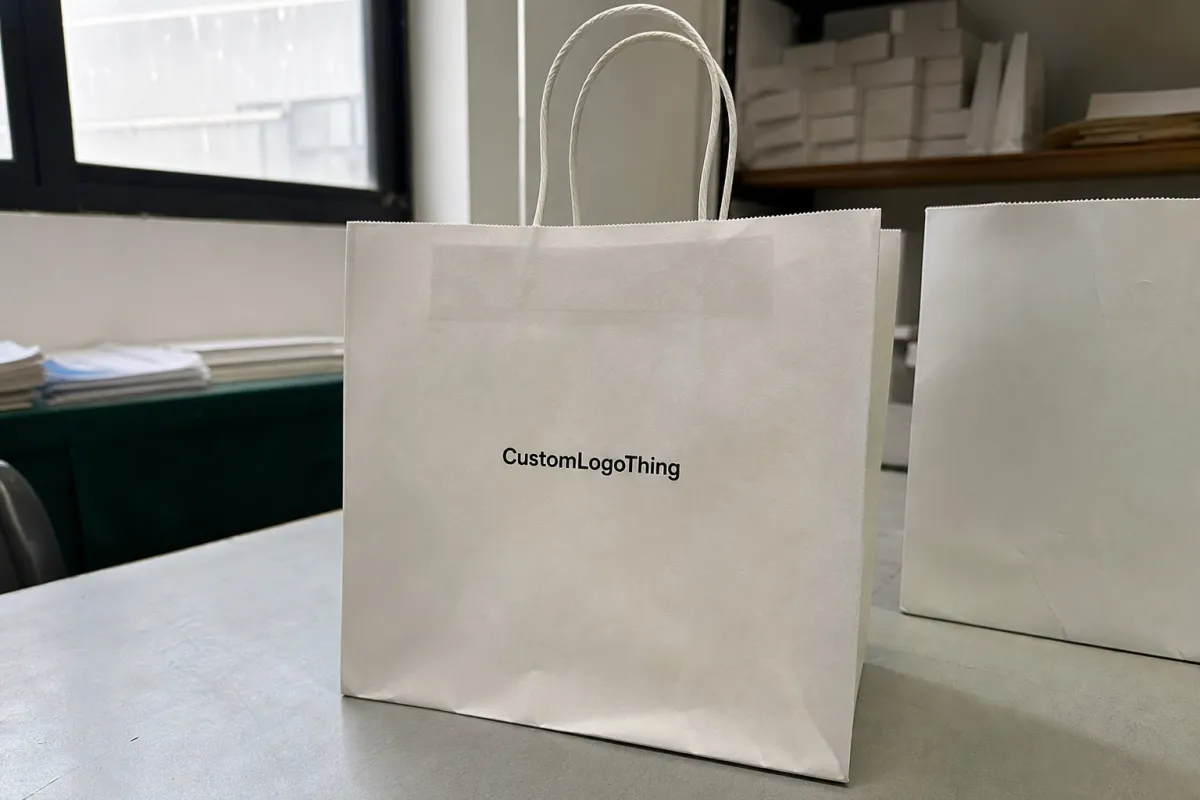
Generic paper carriers are built for convenience. Skincare twisted-handle bags are built for presentation and repeat handling. That distinction matters because skincare purchases are often bundled: cleanser, toner, serum, moisturizer, and a sample card do not sit neatly in one flat rectangle. They shift. They lean. They create a taller load than the bag designer expected. Twisted handles distribute that load more evenly and usually feel steadier in the hand than flatter, lighter alternatives.
There is also a visual reason they work so well in beauty retail. Clean twisted handles, sharp folds, and a straight top edge make the whole package read as deliberate. In a category where texture, finish, and ingredient story are already doing a lot of the selling, the carrier bag should support the same message. A bag that slumps or scuffs quickly can make a prestige product feel underpriced, even if the product itself is excellent.
The business case is less glamorous, but more persuasive to a buyer. Fewer handle failures mean fewer replacements. Better structure means fewer awkward overfills at checkout. Better print surfaces mean fewer reorders caused by a bag that looked acceptable on screen but arrived dull or warped. In small campaigns, those issues are annoying. In a multi-store rollout, they become expensive.
Weight testing should come before artwork approvals. A one-item skincare kit and a full regimen bundle are not the same load. One may need only a medium gusset and standard paper stock. The other may need a wider base, heavier paper, and bottom reinforcement. Ignore that difference and the order stops being a packaging decision and starts becoming a service problem.
The best buyers treat the bag as part of the retail product set. That means the bag should be judged against the product it carries, the environment it moves through, and the number of times it will be handled before the customer gets home. A bag that fits the counter but not the order is not a finished spec. It is a guess.
Skincare Twisted Handle Paper Bags Bulk Order Planning
Skincare twisted handle paper bags Bulk Order Planning works best as a matching exercise. Match the bag to the heaviest SKU. Match the paper to the load. Match the print method to the brand system. Match the quantity to the launch calendar. That sounds obvious, but many teams start with the logo placement and only discover the sizing issue once the sample is packed.
Begin with the actual use case. A boutique checkout bag for one hero item needs a different format from a gift-with-purchase bag carrying several cartons. Spa retail introduces another variable: customers often leave with loosely packed products that move around in transit. Event gifting adds still another layer because the bag has to look polished after being handed across a counter, carried across a venue, and sometimes photographed before it is opened. Each setting changes the required width, height, and load support.
Channel matters too. A store checkout bag can prioritize structure and quick packing. A PR mailer handoff bag may care more about visual impact and a compact folded footprint. A subscription add-on might favor cost control and easier storage. One brand can easily need two or three bag specifications, and trying to force them into one spec usually creates waste somewhere else.
Plan from the largest item first. That is the simplest way to avoid a bag that fits the smallest jar but chokes on the biggest carton. Add clearance for tissue, inserts, and any protective wrap. Then check whether the customer should be able to carry the bag with one hand or whether the load is better split across two bags. That choice affects width, gusset, and handle stress more than most teams expect.
Artwork should follow the structure, not the other way around. A minimal one-color kraft bag sends a different signal from a coated white bag with full coverage print and a soft-touch finish. Both can work for skincare. The wrong choice is one that fights the product line. Clinical brands usually need restraint, clean type, and enough negative space to feel precise. Prestige beauty can tolerate richer surfaces, but not at the expense of durability or readability.
For larger programs, some buyers pair the bag spec with broader packaging planning through Wholesale Programs so the size and artwork stay aligned with annual demand instead of one campaign. That reduces spec drift and makes reorders easier to compare quarter to quarter.
Size, Paper, and Handle Specs That Keep Products Secure
The spec sheet decides whether the bag behaves like packaging or like a problem. For twisted-Handle Paper Bags, the key fields are width, gusset, height, paper weight, handle reinforcement, and whether the bottom needs a board insert. None of these are decorative. They determine whether the bag stands up, resists tearing at the seams, and carries mixed product weights without collapsing in the middle.
Paper choice should reflect both the product and the print finish. For many premium skincare runs, paper in the 150gsm to 210gsm range is common, though the final choice depends on whether the bag is kraft, coated art paper, or a specialty surface. Coated paper usually supports finer print detail and cleaner color fields. Kraft offers a natural, tactile look, but it can show scuffing more quickly and may absorb moisture if the bag is used in humid stores or handled with damp hands.
Handle attachment deserves more scrutiny than it usually gets. A twisted paper handle can look strong while the adhesive area is still marginal. If the glue patch is too small, the handle may survive a light carry and fail once the bag is filled with heavier glass packaging. Ask whether the supplier reinforces the attachment points, how they test pull strength, and whether they check both handles evenly. Small differences in glue coverage can decide whether the bag holds through an entire retail day.
Bottom support is another detail with a big effect. A board insert adds stiffness and helps spread weight across the base. That matters for jars, bottles, and mixed skincare kits. It also helps the bag sit flat on a counter while staff pack products. Without it, a narrow base can sag, and a bag that looks elegant on the dieline may twist once it is loaded.
Fit testing should always use the real products. Empty bags are deceptive. A folded insert steals headroom. Tissue adds height. A bottle with a heavier base changes the center of gravity. Even the placement of the cap can matter if the product sits tall. A sample that fits on paper but rubs at the top fold is not ready for production. The difference between acceptable and frustrating can be only a few millimeters, and those millimeters tend to surface after the order is already in motion.
For brands that expect repeat production, keeping the same dieline is more valuable than endlessly tweaking dimensions. Once a size works, freeze it. That reduces errors in reorders, keeps shelf presentation consistent, and avoids subtle shifts that customers do notice. A millimeter or two may seem trivial in a spreadsheet; on a retail floor, it often reads as inconsistency.
Distribution testing can be worth the trouble if the filled bags travel inside cartons before reaching stores. Standards such as ISTA help teams think about shock, compression, and transit handling in a more disciplined way. Even when the bag itself is not being shipped as a standalone parcel, the packed load still needs to survive movement and stacking.
Cost, Pricing, and MOQ Breakpoints to Plan Before You Quote
Pricing for custom skincare twisted-handle bags is shaped by a small set of variables that can push the cost in either direction: size, paper grade, number of print colors, finish, handle type, and whether the inside of the bag is printed as well. A one-color logo on kraft is a different job from a full-coverage bag with lamination, internal print, and reinforced handles. Buyers often compare those two quotes as if they belong to the same category. They do not.
MOQ affects the price curve in a very visible way. A 1,000-piece order may land around $0.42 to $0.85 per bag depending on size and decoration. At 3,000 pieces, many programs move closer to $0.24 to $0.48. At 5,000 pieces and above, unit costs can fall toward $0.18 to $0.38. Those are planning ranges, not promises. The point is simple: setup cost gets spread over more units, but only if the order is large enough to justify the storage space and the inventory risk.
Short runs are useful for pilot launches, seasonal drops, and design testing. Larger runs make sense when the artwork is stable and the same bag will be used across stores or campaigns. If the brand changes the design every quarter, overbuying creates dead stock. If the order is too small, the unit cost stays high and the project keeps paying setup fees again and again. The right quantity sits between those extremes.
Freight, sampling, and revision charges can matter more than first-time buyers expect. A palletized order may ship cheaply per unit but still add a meaningful landed cost. Split shipments to multiple warehouses can add handling fees. Revised proofs can add time. If the order includes tissue, inserts, or separate cartons, those elements should be priced into the full packout instead of treated as extras later. The quote that looks cheapest on day one is not always the cheapest order by the time it lands.
Some buyers make the mistake of ordering exactly enough for launch week. That can work if demand is very stable. Beauty launches rarely are. A better approach is to order enough for the initial campaign plus a practical reorder cushion, especially if the bag will support influencer seeding, holiday gifting, or store openings. Emergency freight is usually the most expensive line in the file, and it often arrives because the original quantity was too optimistic.
| Order Type | Typical Unit Cost | Best For | Tradeoff |
|---|---|---|---|
| 1,000-piece pilot run | $0.42-$0.85 | Launch testing, limited events, new artwork | Higher setup burden per bag |
| 3,000-piece mid run | $0.24-$0.48 | Regional retail, spa groups, campaign kits | Needs clearer demand visibility |
| 5,000+ bulk run | $0.18-$0.38 | Store networks, repeat launches, standard SKUs | More storage and slower design changes |
For teams that need sourcing documentation, the FSC site is a practical reference for paper claims and chain-of-custody language. Sustainability messaging is only useful if the paperwork can support it and the bag specification stays consistent over repeat runs.
Process and Timeline: From Artwork Approval to Delivery
The production path is longer than many buyers expect because the bag is not a single-step print job. A proper order moves through quote, dieline confirmation, artwork placement, proof review, sampling, production, inspection, and shipping. Any missing detail can slow the file. A missing bleed, the wrong color mode, unoutlined fonts, or artwork that ignores the fold lines can all trigger another revision cycle.
Artwork tends to be the first bottleneck. A logo that looks balanced on a white screen may print too dark on kraft or too flat on a matte coated surface. Small text can disappear if the finish is absorbent. Fine lines can break up if the print area is crowded. Clean files save time, but they also save money because every correction has a production cost attached to it, even when nobody phrases it that way.
Lead time depends on quantity, customization, and factory workload, but custom printed runs generally move slower than plain stock bags. A straightforward order can take roughly 12 to 18 business days after proof approval. More complex work, such as internal print, lamination, or extra handle reinforcement, usually takes longer. Shipping is separate and should be counted separately; on larger orders, transit can take as long as production.
That timeline creates three different clocks. Marketing wants the campaign live. Operations wants the cartons received in time to store or distribute them. Production wants the proof signed off before the line is booked. If those clocks are out of sync, the bag may be finished and still miss the launch. The fix is not better luck. It is a better calendar.
Sample review should be treated like a decision point, not a formality. Measure the packed set, check the handles under real weight, and inspect whether the bag remains square once loaded. If the bag opens too tightly or the top fold crowds the product, adjust the dieline before the bulk run. A small delay during sampling is cheaper than a reorder after production starts.
Supplier communication matters as much as the line items in the quote. A supplier that answers spec questions directly, explains how the bags are inspected, and flags likely issues before production is usually easier to manage than one that only talks about price. In packaging, vague answers almost never become clearer after payment.
Supplier Checks That Protect Repeat Runs and Brand Consistency
Repeat orders are where packaging programs either become stable or drift out of shape. A skincare brand may use the same bag for several launches, and customers notice the small changes: the white shifts warmer, the black print softens, the handle length changes, the corners round a little more than before. Those details seem minor until they are repeated across stores, campaigns, and seasons.
Ask how the supplier handles print registration, color consistency, and handle pull testing. Those three checks reveal more about process control than a glossy price sheet does. If they can explain how they compare samples, verify glue areas, and inspect finished cartons before shipping, that is a good sign. If the answer is vague, the risk is higher than the quote suggests.
Documentation matters as well. If the bag is described as recycled, responsibly sourced, or FSC-certified, the supplier should be able to support that claim with the right paperwork. That matters for product pages, retail training, and internal procurement reviews. A claim that cannot be supported creates problems later, especially for brands that use the same packaging across multiple channels.
Reprint support is worth checking before the first order closes. Can the supplier keep the same dieline on file? Can they recreate the spec without rebuilding the whole job? Can they hold a master reference for future repeats? Those questions are not administrative trivia. They are what keep a packaging program from drifting over time.
Some of the best packaging decisions are invisible because nothing goes wrong. That usually means the supplier controlled the basics: square corners, consistent glue, stable dimensions, clean prints, and cartons that arrived without compression damage. It is ordinary work, but in bulk orders, ordinary work is what protects the brand.
Next Steps for a Clean Reorder Plan and Purchase Order
Before requesting a quote, gather a short brief that includes product dimensions, target quantity, print count, finish preference, and delivery deadline. If the bag will hold a multi-item skincare set, list the largest SKU first and note whether tissue, inserts, or cartons are part of the final packout. That one page can remove a surprising amount of back-and-forth.
Send a real sample of the packed product set if possible. A physical sample gives the supplier more useful information than a rough estimate ever will. A bottle that fits on the table may not fit once a card, sleeve, or tissue wrap is added. In bag planning, those small changes are not small. They decide the dieline.
Prepare print-ready artwork with outlined fonts, correct bleed, and a clearly labeled dieline. Confirm whether the design needs one side, two sides, or full coverage. If the program is meant to feel premium, ask for a proof that shows the logo in relation to the handle placement, top fold, and bottom panel. Then compare two or three quantity tiers so the unit cost can be weighed against storage and reorder risk.
For the final signoff, the sample, the quote, and the timeline should all say the same thing. If one of them conflicts with the others, the project is not ready. The cleanest orders are usually the ones where the buyer locked the size early, checked the packed fit, and understood the tradeoff between quantity and inventory. That is the discipline behind good skincare twisted handle paper bags Bulk Order Planning.
If the brand needs to align packaging questions before a purchase order is issued, the FAQ page can help centralize the most common spec checks. It keeps the internal file cleaner and reduces the chance that a small detail gets missed in the handoff.
How do I choose the right size for skincare twisted handle paper bags bulk order planning?
Measure the largest bundled SKU first, including cartons, inserts, and tissue, then add enough clearance for packing and easy carryout. The gusset should be based on the widest item in the set, not the smallest bottle in the lineup. A fit test with the full packed set is the safest approval step.
What MOQ should I expect for custom skincare paper bags with twisted handles?
MOQ depends on paper stock, print method, and the number of colors, so the lowest offer is not always the best value. Smaller runs are useful for testing, but larger runs usually lower unit cost once setup is spread across the order. Tiered pricing gives the clearest view of the breakpoints.
Can twisted handle paper bags hold glass skincare bottles safely?
Yes, provided the bag width, base strength, and paper weight are matched to the filled product weight. Glass jars and bottles usually justify heavier stock or a bottom board insert. The bag should be tested with the exact product mix before the bulk order is approved.
How long does production usually take after proof approval?
Lead time varies by customization level, quantity, and current production load, but proof approval is the point where the schedule becomes fixed. A simple custom order may take about 12 to 18 business days after approval, while more complex runs take longer. Shipping time should be added separately.
What files do I need to place a branded skincare bag order?
Use print-ready artwork with outlined fonts, correct bleed, and the supplier's dieline. Confirm color values before production so the brand shade stays consistent across reorders. Send the logo, copy, and placement notes in one clean package to reduce revision cycles.

