Shoppers make quick decisions in winter accessory aisles, which means Logo Patch Beanies material options for retail winter displays have to do more than feel comfortable. They need to read as giftable, hold their shape on a table or wall fixture, and make the brand mark visible before a customer has time to inspect the stitching.
That is the part buyers often underestimate. A beanie can feel excellent in hand and still fail in the display because the knit flattens under store lighting, the crown slouches after a few try-ons, or the patch gets lost against the texture. Material selection is not only a comfort call. It affects presentation, handling, replenishment, and the price point a store can realistically support.
Logo Patch Beanies Material Options: What Buyers Miss
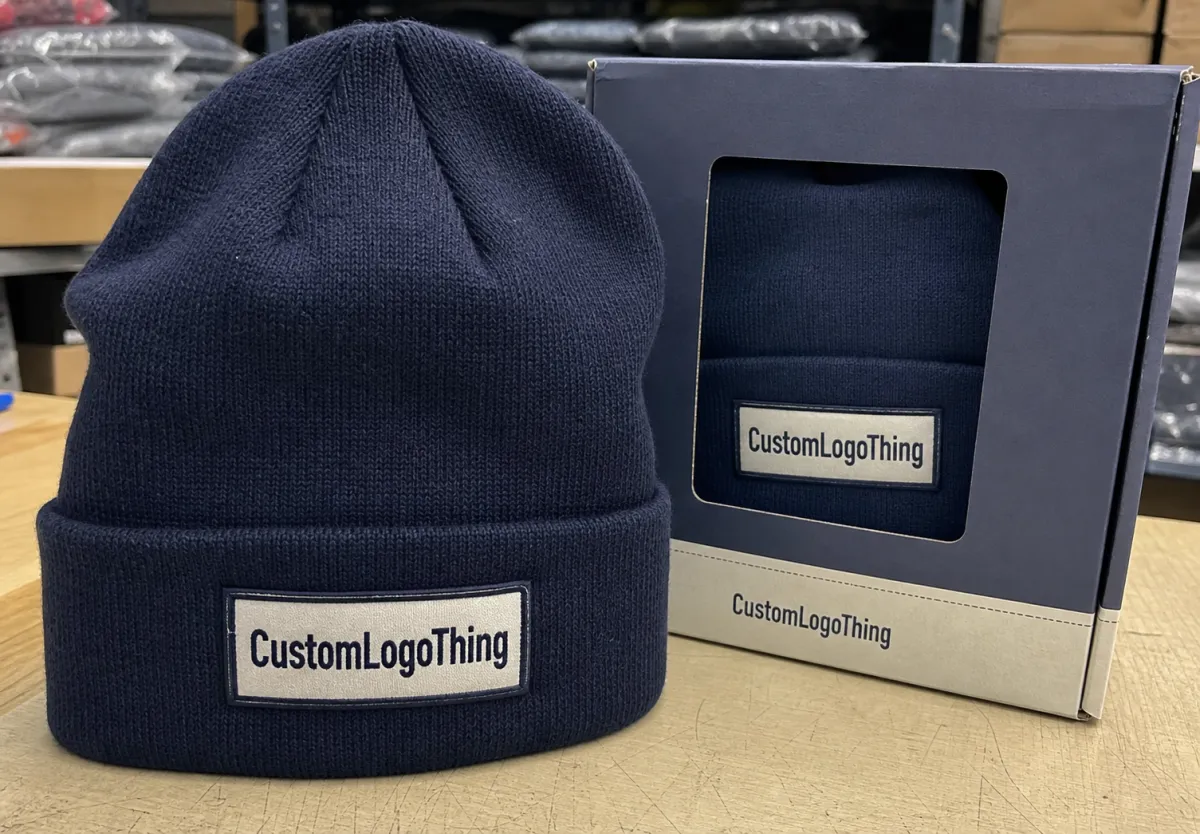
The main material families are familiar enough: acrylic, cotton, wool, wool blends, recycled yarns, and fleece-lined constructions. What matters is how each one behaves once it leaves a sample table and lands in retail. Acrylic remains the most common because it gives consistent color, predictable cost, and reliable production at scale. Cotton has a soft, casual hand but less natural winter authority. Wool carries a stronger seasonal signal and usually a higher perceived value. Blends sit between those poles and are often chosen because they give buyers a little more softness or warmth without pushing price too far.
There are also programs built around recycled polyester, recycled acrylic, or mixed-fiber yarns that support sustainability claims. Those options can be worthwhile, but they come with caveats. Sourcing can be narrower, color matching may take longer, and texture consistency is not always as easy to control as it is with standard acrylic. Fleece-lined beanies sit in their own category: warmer, bulkier, and more complex to sew. They usually feel substantial, which helps in premium assortments, yet the extra lining can change the way the cap sits on a fixture or folds inside a carton.
For retail winter displays, the best material is rarely the most impressive-sounding one on paper. It is the one that looks clean from six feet away, still feels good after handling, and survives the folding, hanging, and repacking that happen during a real season. A dense knit can make a beanie look expensive from a distance. A loose knit can make even a strong patch look like it is floating on top of the fabric. That difference is often where the sale is won or lost.
- Acrylic: broad color range, dependable stretch recovery, and controlled pricing.
- Cotton: soft touch and casual appeal, though lighter warmth and less structure.
- Wool: premium hand feel, strong thermal value, and higher care expectations.
- Wool blends: a practical middle ground for warmth, drape, and cost.
- Recycled fibers: useful for sustainability-led assortments, but sourcing and consistency can vary.
- Fleece-lined or mixed-fiber builds: warmer and more substantial, with added labor and price pressure.
For Logo Patch Beanies material options for retail winter displays, the material conversation needs to include visibility, not just softness. The display is part of the product. If the beanie reads dull under fluorescent light or the patch disappears against the knit, the shopper may never get close enough to appreciate the actual construction.
How Fabric Choice Changes Fit, Feel, and Display Impact
Fit begins with stretch, but it is also a question of recovery. Acrylic knits usually spring back well after customers try them on, which matters when a store has heavy traffic and limited staff to tidy the table. Wool blends can give a more substantial silhouette and a better drape, although tighter knits can feel less forgiving in one-size programs. Cotton tends to feel relaxed and familiar, but it rarely delivers the same winter-specific look or insulation that shoppers expect from cold-weather merchandise.
Hand feel also changes how a shopper reads the item before touching it. A brushed or slightly lofted knit can encourage pickup because it looks soft. A firmer knit can appear more durable and sometimes more premium, especially when the patch is the main visual feature. That is one reason the same beanie can perform well in ecommerce and underperform in a store. Online, the image is doing all the work. In a retail display, the fabric has to support the message from a distance and then hold that message up close.
Patch visibility depends on texture more than many buyers expect. Fine embroidery can get swallowed by a busy knit. Woven patches stay crisp on smoother fabrics, but they can look undersized when attached to a very textured crown. Faux-leather patches often read strongly on clean, low-profile knits because they create enough contrast to pull the eye. The right pairing is not just about style. It is about whether the brand mark can be recognized in the few seconds a shopper gives it.
"A beanie can feel soft in hand and still look thin on shelf if the knit density is too low. Buyers have to judge the touch, the silhouette, and the patch visibility together."
The display fixture matters too. On a hanger wall, crown shape and patch placement become more important than the underside of the knit. On a folded table, texture and color consistency carry more of the impression. Under warm store lighting, some yarns look richer and fuller. Under cool LEDs, the same yarn can appear flatter or slightly washed out. That is one reason a sample that looks strong in a showroom can feel less convincing in a real store environment.
When buyers compare Logo Patch Beanies material options for retail winter displays, they should look for fabric that supports the merchandising story. The shelf does not care which yarn was most expensive. It cares whether the beanie still looks intentional after a dozen hands have touched it.
Cost, Pricing, and MOQ Trade-Offs
Material choice has a direct effect on price, but the spread is usually more manageable than buyers fear. In a 5,000-piece run, standard acrylic beanies often land around $1.20 to $2.40 per unit, depending on yarn weight, knit density, and patch complexity. Acrylic blends with a better hand feel or a slightly richer construction often move into the $1.80 to $3.20 range. Wool blends commonly sit around $2.80 to $5.50, while recycled yarn programs can fall anywhere inside or outside that range depending on fiber source, certification work, and available stock.
The MOQ usually follows the same logic. Stock yarns and standard patch styles can support lower minimums, sometimes 300 to 500 units per color if the factory already has the right base materials. Custom-dyed yarns, specialty patch builds, and retail packaging can push that number up quickly. Buyers building a multi-store winter assortment often do better with a dependable acrylic or blend that can be reordered than with a premium style that is beautiful but too expensive to replenish.
| Material option | Typical unit cost at 5,000 pcs | MOQ pressure | Retail read | Best use case |
|---|---|---|---|---|
| Acrylic | $1.20-$2.40 | Low to moderate | Clean, dependable, mass-market | High-volume seasonal resets |
| Acrylic blend | $1.80-$3.20 | Moderate | Slightly richer hand feel | Mainline retail and gift sets |
| Wool blend | $2.80-$5.50 | Moderate to high | More premium, more giftable | Higher-ticket winter displays |
| Recycled fiber knit | $1.90-$4.20 | Moderate | Modern and sustainability-led | Brand storytelling and eco assortments |
| Fleece-lined build | $2.60-$4.80 | Moderate to high | Warm, substantial, value-added | Cold-weather markets and premium gifting |
Hidden costs matter as much as the base unit price. Fleece lining adds sewing steps. Custom labels add handling. Specialty stitch work can slow the line. Packaging can quietly add both cost and value, depending on how it is handled. A folded beanie wrapped in kraft paper with a simple belly band may look more considered than a loose unit in a generic polybag, especially if the retailer wants a polished table presentation. If the shipment is expected to survive repeated loading, unloading, and warehouse transfer, carton and pack-out decisions should be tested with transportation expectations in mind, including standard distribution checks such as ISTA protocols.
It also helps to think in margin terms rather than just landed cost. A cheaper beanie that looks thin, pills early, or distorts the patch can create markdown pressure later. It may also require more labor in-store if staff need to keep reshaping it. That is a real expense, even if it never appears on the purchase order.
Production Process and Timeline for Retail Orders
Production starts with yarn selection and patch approval, and both decisions affect the rest of the schedule. The sample stage confirms gauge, fit, patch placement, color accuracy, and how the material sits once it is folded. After that comes bulk knitting, patch attachment, finishing, inspection, and packing. Changing a patch material after sampling may seem minor, but it can alter the hand feel, the cost, and the way the beanie behaves on display.
For standard acrylic builds with stock yarn, a sample round may take about 7 to 10 business days, followed by production in roughly 15 to 25 business days. Wool blends, custom colors, recycled yarns, and more complex patch constructions usually take longer. A buyer should assume another one to three weeks can disappear into sourcing, lab dips, or packaging revision. The knitting itself is only part of the timeline; the rest is approvals, component matching, and finishing work that has to land cleanly before bulk packing starts.
Most delays come from a few familiar places: art changes, patch revisions, custom color approvals, and packaging proof loops. A late decision on hang tags or belly bands can slow the whole order because the carton layout or unit pack may need to change with it. If the retailer wants display-ready cartons, insert cards, or recyclable wraps, those details should be finalized before bulk starts. Waiting until the end usually creates unnecessary rework.
Packaging also affects the retail story. Stores often want product that arrives ready to floor, and that means the carton should protect both shape and appearance. Recycled paper wraps, FSC-certified cardboard components, and simple presentation bands can support the environmental message when they are used carefully. The key is to choose packaging that still holds up through transport and backroom handling. If it crushes easily or shifts inside the carton, it can undo the work the garment itself did.
One practical rule holds up across most programs: if the beanie must hit a hard seasonal floor date, build extra time into the schedule. Retail calendars leave little room for sample revisions or freight delays. A plan that looks fine on paper can become tight as soon as approval cycles, shipping, and store allocation are added.
Common Material Mistakes That Hurt Winter Displays
The most common mistake is choosing a fabric for sample-room comfort instead of shelf performance. A beanie can feel soft and still pill fast after shoppers handle it all day. It can stretch out after repeated try-ons. It can photograph beautifully and still sag once it sits folded on a table for two weeks. Retail does not reward ideal conditions. It rewards materials that keep their shape under average use.
Patch failure is another problem that appears too often. Very soft or highly textured knits can make patch edges curl, crack, or lift, especially when the patch is bonded rather than sewn. Fine embroidery can disappear against a busy knit structure. Faux-leather patches look sharp on smoother fabrics, but they can lose that clean outline on a loose or lofty yarn. The wrong pairing makes the decoration look like an afterthought, and that weakens the whole display.
Over-specifying is a quieter mistake. Not every winter program needs a high-cost wool blend. If the assortment is meant to hit an accessible opening price, a strong acrylic or acrylic blend may sell better simply because it fits the store's customer base. The item has to match the retail tier. A premium hand feel means little if it pushes the retail price beyond where the shopper is willing to go.
Color contrast deserves more attention than it gets. A low-contrast patch on a heathered knit may look tasteful in a photo and vanish in-store. Too many low-contrast pieces on one wall can make the whole display feel muddy instead of curated. If the assortment already uses several muted color stories, the beanie needs enough separation to keep the branding legible from across the aisle.
Carton compression is another practical issue. Beanies packed too tightly can crease, flatten, or lose their crown shape. Better carton planning, often with FSC-certified corrugated cardboard or simple kraft paper dividers, keeps the opening presentation intact and reduces the amount of store-level recovery work. That may sound small, but a messy first opening can weaken the display before the season really starts.
The simplest test is still the most useful: if the fabric loses shape, the patch loses definition, or the item looks tired after a few handling cycles, it is not the right retail choice, no matter how good the sample looked under controlled lighting.
Expert Tips for Matching Fabrics, Patches, and Packaging
Start with the patch and work backward into the fabric. A bolder patch shape usually sits better on a knit with visible texture because the fabric already carries movement and depth. A softer or more refined patch often works best on a smoother knit, where it can stay crisp without fighting the surface. That pairing helps the product look deliberate instead of assembled from unrelated parts.
Display context should guide the final choice. Premium gift tables usually benefit from tonal combinations such as navy on charcoal, cream on oat, or black on deep green. These combinations feel calmer and more elevated, which can support a higher ticket. High-traffic wall fixtures need faster visual recognition, so stronger contrast and flatter patch profiles usually perform better there. If the item has to sell from a distance, the branding should be easy to read before the shopper is close enough to notice the texture.
- For premium tables: choose wool blend or brushed acrylic, muted colors, and a subtle patch finish.
- For high-traffic walls: choose acrylic or acrylic blend, high-contrast branding, and a flatter patch profile.
- For sustainability-led displays: use recycled materials, restrained packaging, and claim language that can be supported clearly.
- For gift-focused sets: add hang tags, belly bands, or a folded presentation that makes the item feel finished.
Packaging should reinforce the material story, not compete with it. A beanie that feels premium can lose some of that value if it arrives in a flimsy sleeve. A cleaner wrap in kraft paper, a folded presentation inside a corrugated shipper, or a simple belly band in recycled stock can preserve the sense of care without adding too much to the budget. If the program uses recycled paper or post-consumer content, the presentation should still be strong enough to survive handling and remain tidy on shelf.
Testing should be done in the conditions the product will actually face. Review samples under the same lighting used in stores, on the same type of fixture, at the same shelf depth, and with the same folding method. If the retailer uses a hanger wall, hang the sample. If the product sits in a basket or table stack, test it that way. That is the closest thing to a reliable answer before production starts.
In practice, logo patch beanies material options for retail winter displays work best when fabric, patch, and packaging tell the same story. If one part signals premium and the other two read budget, shoppers notice the mismatch immediately, even if they do not say it out loud.
Next Steps for Building a Retail Winter Display Order
Before placing the order, lock four decisions: the target price band, the store environment, the two material candidates worth comparing, and the patch style that supports the brand most clearly. Then request physical samples. Photos hide too much, especially in knit texture, patch edge finish, and color depth.
- Set the opening retail and margin target first.
- Compare at least two materials under actual store lighting.
- Check patch clarity from three feet away.
- Confirm packaging, carton specs, and any retail-ready presentation requirements.
- Approve artwork early so production does not stall later.
Side-by-side comparison is where the right answer usually appears. A beanie that feels less impressive in hand may look stronger on shelf because the knit is cleaner and the patch sits flatter. Another style may seem richer in a sample room and then fall apart visually once it is placed on a rack. That is why the fixture test matters as much as the touch test.
Once the sample is chosen, lock artwork and packaging quickly. Every revision adds time, and winter seasons do not leave much room for drift. If the program includes display shippers, insert cards, or folding instructions, keep those components aligned with the chosen fabric so the final presentation feels coordinated rather than improvised.
The strongest winter assortments usually balance sell-through, replenishment, and presentation instead of chasing one of those goals at the expense of the others. The best logo patch beanies material options for retail winter displays are the ones that keep their shape, show the brand clearly, and hold up after real handling on a real sales floor.
FAQ
What logo patch beanie material works best for retail winter displays?
Acrylic and acrylic-blend knits usually offer the best balance of cost control, shape retention, and color consistency. They are easier to replenish and tend to hold up well in busy store environments. Wool blends can look more premium, but they usually raise unit cost and care expectations.
Are wool-blend beanies worth the higher price for retail buyers?
They can be, especially when the display needs a more giftable look or the shopper expects a richer hand feel. Wool blends often increase perceived value, which can support a higher retail price. They make less sense when the assortment needs a lower opening price or tighter margin control.
How long does production usually take for custom logo patch beanies?
Typical timelines depend more on sample approval, yarn sourcing, and patch complexity than on knitting alone. Standard programs can move in about 3 to 5 weeks after approval, while custom yarns, specialty patches, or packaging changes can extend the schedule. Buyers should plan backward from the floor date and leave buffer time for revisions.
What MOQ should I expect for retail winter beanie orders?
MOQ varies by factory and by how customized the yarn, patch, and packaging are. Stock yarns and standard patch styles usually support lower minimums than fully custom builds. It is smart to compare MOQ against expected sell-through so inventory does not outrun demand.
Which patch style holds up best on colder-weather knit beanies?
Woven, embroidered, and faux-leather patches all perform differently depending on knit texture and stretch level. Lower-profile patches usually stay flatter and look cleaner on textured or stretchy fabrics. Ask for samples under real handling conditions so you can see whether the patch edge lifts, curls, or cracks.


