Custom Logo Patch Beanies for Event Merch Tables sell because they solve a very plain problem: people notice texture faster than they notice fine detail. On a busy floor, a raised patch gives a knit cap a cleaner silhouette, stronger contrast, and a more finished retail read than a flat print usually can. That difference matters when the buyer is walking, scanning, and deciding in a few seconds whether an item deserves a second look.
From a merchandising standpoint, the beanie has to earn attention before it earns discussion. The logo should be readable, the material should feel substantial, and the price should make sense before anyone picks it up. The same logic that drives good shelf presentation applies here too: product branding has to do some of the selling by itself, especially when the table is crowded and the staff is busy.
A merch table is a speed test, not a gallery. If the logo, texture, and price do not register quickly, the buyer keeps moving.
Why patch beanies outperform flat hats at merch tables
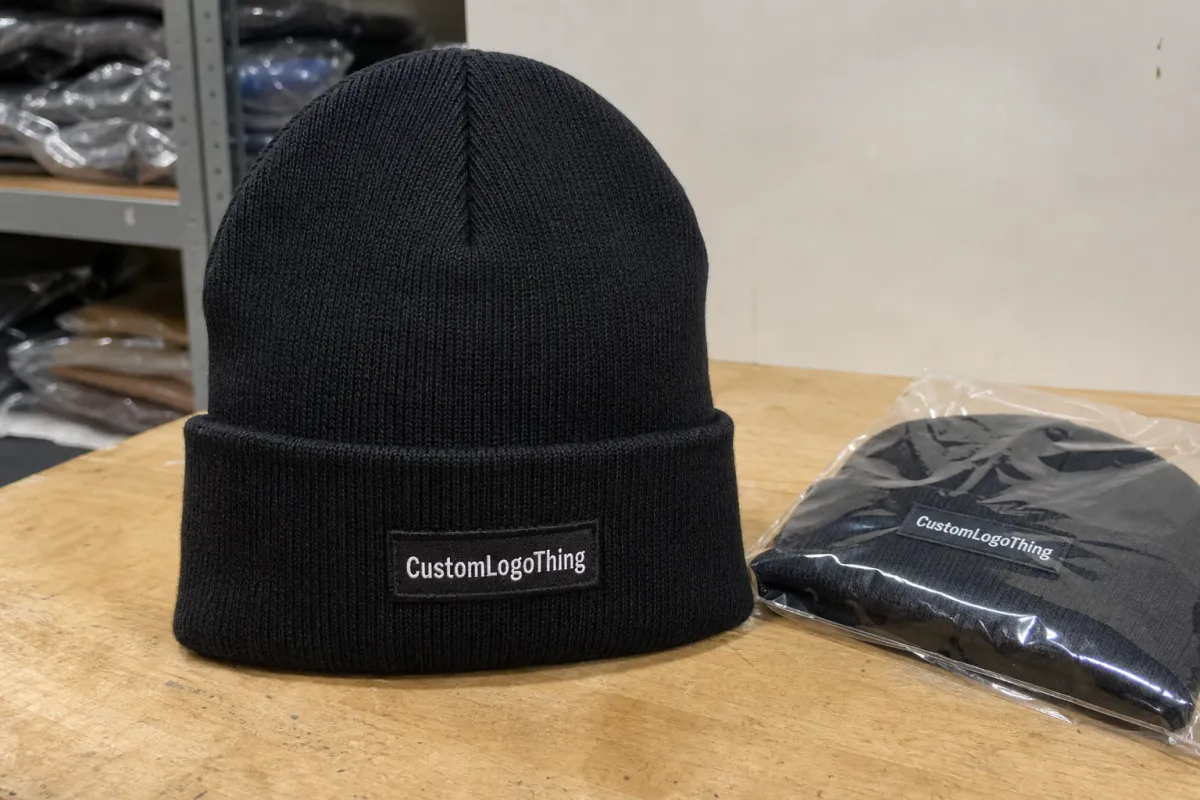
Texture stops the eye. That is the short answer, and it explains most of the appeal. A woven, embroidered, leatherette, rubber, or felt-style patch catches light differently than ink sitting flat on knit fabric. That raised edge gives the beanie a sense of depth, which helps it read as a deliberate product instead of a generic giveaway. In a merch setting, that small visual cue can make the difference between something that blends into the table and something that feels worth the asking price.
Custom Logo Patch Beanies for event merch tables also handle visual clutter better than many buyers expect. Trade shows, campus markets, sports weekends, and winter fundraisers are often packed with competing signals: banners, cards, stickers, drinkware, and piles of apparel all trying to look important. A patch gives the beanie a more defined outline, so even a folded stack can stand out when the table is only one or two items deep.
Compared with embroidery alone, a patch often carries a stronger perceived value because it reads like a separate branded component. That does not make embroidery a weaker choice. It just means the patch adds contrast and structure, which is useful on rib knit fabric where small stitching can disappear at a distance. Buyers who already expect to spend $20 to $35 on event apparel usually understand why a more dimensional decoration can justify the higher end of that range.
This is especially true for cold-weather impulse buys. Gloves, scarves, and blank knit caps often land in the same mental category unless one item looks noticeably more retail-ready. A patch beanie can carry that premium impression without needing a busy front print, and the cleaner face area helps the logo survive folding, stacking, and handling at the table.
These beanies tend to perform best in a few specific settings:
- trade shows where buyers are moving quickly and table space is limited
- sports weekends where the weather gives the product immediate utility
- campus events where style matters as much as function
- fundraisers where a clear price point helps staff close the sale
- winter activations where harsh lighting can flatten weaker decoration
If the merch table is part of a broader branded display, the same retail thinking applies to the rest of the setup. Hero items need the strongest visual signal, and supporting items should stay quieter so the main product stays easy to spot. That is the same logic behind custom printed boxes and other branded packaging systems: the presentation should make the product easier to understand at a glance, not harder.
How the decoration process turns art into retail-ready beanies
The path from logo file to finished beanie is more controlled than many first-time buyers assume. A good supplier usually starts by checking the artwork, confirming stitch limits or tiny details, then recommending the patch type that best fits the mark. From there the process moves through blank selection, proofing, patch production, attachment, and final inspection. If one of those steps gets rushed, the flaw tends to show up in the finished piece.
Patch choice does a lot of the heavy lifting. Woven patches are strong when the logo includes small type or fine lines. Embroidered patches add more texture and can feel especially natural on a cuffed beanie. Leatherette patches give a cleaner, more modern look. Rubber patches work well for bold art that needs a sporty or outdoor feel. Felt-style patches have a softer, more nostalgic finish and can work well for school, club, or heritage branding.
Placement matters just as much as patch material. Center cuff placement is the safest option for broad resale because it is easy to read and easy to display. Off-center placement can feel more styled and less promotional. Low-profile front placement works when the goal is retail apparel rather than a giveaway. The right choice depends on the audience, but the basic rule stays the same: put the logo where it is still visible when the beanie is folded for display.
The technical details matter more than they look on paper. Digitizing has to respect the shape of the logo, or the patch will look crowded. Color matching should hold up under indoor lighting, which can make warm tones look dull and dark colors look heavier than expected. Stitch limits keep fine detail from turning muddy. And on stretch knit fabric, the attachment method has to hold without puckering the crown or curling the cuff. Good packaging thinking shows up here too, because the item still has to look intentional after handling.
| Patch style | Typical look | Best use case | Relative cost impact |
|---|---|---|---|
| Woven | Clean detail, flat surface, crisp text | Fine logos and small lettering | Usually moderate |
| Embroidered | Textured, traditional, slightly raised | Classic merch and school branding | Usually moderate to higher |
| Leatherette | Sleek, premium, understated | Minimalist brand programs | Often higher |
| Rubber | Bold, sporty, dimensional | Outdoor events and active brands | Usually moderate to higher |
| Felt-style | Soft, vintage, tactile | Campus, heritage, and winter lifestyle items | Usually moderate |
One detail that gets missed often: the patch has to look good both flat and folded. A beanie can look perfect in a proof and then read awkwardly when stacked if the patch sits too low or spans too wide across the cuff. That is why a proof with a folded view is more useful than a front view alone.
Production steps and timeline: from proof to delivery
Once the order is released, the process usually follows a predictable path: proof approval, patch production, decoration, inspection, packing, and shipping. It sounds simple, but each handoff adds time if the order is incomplete or the artwork needs work. Missing vector files, late color changes, or a shape adjustment after approval can slow the job more than the sewing itself.
For standard custom Logo Patch Beanies for event merch tables, a realistic timeline is often 12 to 18 business days after proof approval. The range depends on patch type, order quantity, and how many steps are built into the approval process. Rush production is possible, but it usually narrows the margin for error and leaves less room for rework. Simple stock-logo knit caps can move faster; custom patches usually need extra time because the patch itself has to be produced before it is attached.
That extra layer is not cosmetic. The patch is its own mini job, and some styles require separate artwork prep, tooling, or die creation before production can begin. After that, the supplier should still inspect patch placement, stitch consistency, and overall finish before anything ships. A buyer sometimes compares these beanies to blank caps and assumes the difference is only decoration. In practice, the custom patch adds another production checkpoint, and that checkpoint is part of what protects the final result.
Approval delays are another common bottleneck. The art may be fine; the real issue is internal decision-making. One person wants a larger logo, another wants a darker thread shade, and someone else asks for a second colorway after the proof is already out. Every revision pushes the date. If the merch table has a hard launch window, that delay becomes very real very quickly.
Working backward from the event date is usually safer than working forward from the purchase date. Leave time for proof review, freight, and at least one round of corrections. If the event is important or the table is expected to generate meaningful sales, a buffer is worth far more than a last-minute rush. That is especially true for winter campaigns where a late arrival can turn a strong idea into dead inventory.
For shipping confidence, ask how the order is packed. Carton tests and pack-out checks matter even for soft goods, because crushed presentation can make a beanie look cheap before it ever reaches the table. The broader principle is the same one used in shipping standards such as ISTA: the package has to protect the product through handling, vibration, and compression. A beanie will not dent the way a rigid item can, but it still needs to arrive tidy, labeled, and ready to display.
Cost, pricing, and MOQ: what changes the quote
The biggest price drivers are still the same ones most buyers eventually discover on their own: blank beanie style, patch construction, decoration method, quantity, and any added packaging. A thick rib-knit cuffed beanie with a leatherette patch will usually cost more than a lighter stock cap with a woven patch. Add hang tags, individual polybags, custom labels, or premium pack-out, and the price moves again. That is not unusual; it is simply the result of more material and more handling.
MOQ changes the math fast. If a buyer wants three colorways, or wants one neutral option plus a brand color and a limited-edition version, the supplier has to split materials and setup across smaller runs. The same thing happens when mixed finishes or special presentation requirements are added. The per-unit price rises because setup gets spread across fewer pieces.
For most programs, unit cost falls as quantity rises, but first-run setup can make the opening quote feel heavier than expected. Patch digitizing, art cleanup, proofing, and application setup all add front-loaded cost. A 300-piece order may look expensive beside a 2,000-piece order, even if the work is structured correctly. The better comparison is not just price per piece; it is how much is being done to create a retail-ready product that can actually sell.
Here is a practical way to compare quotes without missing hidden costs:
- confirm whether art prep and patch digitizing are included
- check how many proof rounds are covered before revision fees begin
- ask whether patch application is sewn, heat-applied, or otherwise finished
- verify whether individual bagging, hang tags, or label application cost extra
- match shipping methods across quotes so freight does not distort the total
Packaging can influence perceived value just as much as decoration. A beanie packed in clean, consistent cartons with clear labeling and a simple insert looks more retail-ready than loose product tossed into a generic shipper. If your program includes paper inserts or branded collateral, asking for FSC-certified stock can be a sensible move. The FSC system is a useful reference point when sustainability claims matter to the audience.
For teams building a broader merch system, branded packaging and display items can help the beanies feel like part of a larger collection rather than isolated stock. That tends to work better on tables because the hero item stays visually dominant while the support pieces make the whole setup feel more deliberate.
Spec choices that affect sell-through on the table
Color contrast is usually the first spec worth checking. High-contrast logo-and-beanie pairings tend to read better under venue lighting than tone-on-tone combinations. Subtle branding can still work, but it needs a stronger presentation plan because the table has to do more work to earn attention.
Beanie profile changes buyer response more than people expect. Cuffed beanies usually feel most merch-friendly because they give the patch a stable stage. Slouch styles feel softer and more lifestyle-driven. Rib-knit options stretch well and fit more heads comfortably. Thicker cold-weather styles can carry a higher perceived value, especially in outdoor settings where the buyer wants something that feels practical first and promotional second.
Patch size and shape are merchandising tools, not just decoration choices. A larger patch can look bold and sporty. A smaller patch can look more premium and restrained. Round, shield, rectangle, and custom die-cut shapes all create a different rhythm on the cuff. If the logo includes fine detail, the patch may need to be larger just to keep the art legible. If the logo is simple, a compact patch can make the beanie feel cleaner and more expensive.
Display details matter too. Consistent folding keeps the table tidy. Hang tags help explain the price without a long conversation. Stackability matters because a collapsed pile looks discounted even when the product is not. If your table uses tiers, the beanies should usually sit near the middle or top, not buried behind smaller add-ons that pull attention away from them.
That is where packaging and merchandising start to overlap. The physical format should help the buyer understand the product instantly. In that sense, custom logo patch Beanies for Event merch tables behave a lot like packaged retail goods: the shape, label, finish, and presentation all do part of the selling before anyone starts talking.
Common mistakes that make beanies sit unsold
The fastest way to hurt sell-through is to choose a logo treatment that is too small or too busy to read from a distance. Fine lines, crowded type, and weak contrast can disappear on knit fabric, especially after folding. A design that looks crisp on a screen can lose clarity on the table if the patch does not carry enough visual weight.
Inventory mistakes are just as common. Teams often over-order one color because the mockup looked strongest, then discover the audience wanted a more neutral option. Other teams ignore the venue climate and bring too few cold-weather items to an outdoor event, or too many to an indoor show where buyers do not feel much temperature pressure. Price tolerance matters too. A $28 beanie may move well at a fundraiser and stall at a student event where the crowd expects a lower ticket.
Skipping a sample can create avoidable problems. Patch texture, stitch density, and color contrast often look different in person than they do on a monitor, and rib knit fabric changes the look again once it stretches over the head. If the order is small and the stakes are low, that risk may be acceptable. If the item is meant to anchor the table, a sample is cheap insurance.
Late approvals cause another kind of trouble. The shipment may arrive on time but not in the shape the table needs. Rushed freight costs more, and last-minute changes can create inconsistent pieces across the run. That is especially painful when the setup needs to look tight and coordinated. A box of nearly right beanies is still a problem if the event starts in forty-eight hours.
The biggest failure mode is usually not bad decoration. It is weak planning. Buyers know the rough idea they want, but the details decide whether the table feels like retail or leftover stock. The best custom logo patch beanies for event merch tables are the ones that fit the audience, the budget, and the selling window without forcing staff to explain the product from scratch.
Next steps for building a merch-table order that moves
Start with a short checklist. Gather vector artwork. Confirm brand colors in Pantone or with a strong visual reference. Choose one hero beanie style first, not three. Then decide whether the patch should stay simple or carry a second variation for premium pricing or limited-edition use. Clear input saves time at every later stage.
Next, size the order against actual traffic instead of wishful thinking. Estimate attendance, decide how much should sit on the table, and keep reserve stock separate if possible. A tight, well-edited table usually outsells an overloaded one because the buyer understands the offer faster. Too many choices can make a simple purchase feel harder than it should.
If the logo is detailed, the event matters, or the audience is picky, ask for a sample or pre-production proof. That one step can catch a patch that reads too small, a cuff placement that feels off, or a color combination that does not hold up under the venue lights. When the beanie is going to lead the table, it deserves that extra checkpoint.
Then build the rest of the display around the beanie, not the other way around. Use simpler add-ons, clear price tiers, and consistent folding so the hero item stays the focus. The same principle works in broader branded packaging strategy: the strongest product should be obvious, and everything around it should make that product easier to choose. If a companion assortment is needed, keep it restrained and coherent rather than overstuffed with options.
The practical approach is straightforward. Treat custom logo patch beanies for event merch tables like a retail item that happens to live in a live-selling environment. That mindset changes the art, the decoration, the presentation, and the timeline in ways that usually improve sell-through without adding unnecessary complexity.
What patch style works best for custom logo patch beanies for event merch tables?
Woven and embroidered patches usually give the clearest logo read at a distance. Leatherette and rubber patches can feel more premium or more modern depending on the brand, but the best choice still depends on how much detail the logo has and how the beanie will be displayed.
How many custom logo patch beanies should I order for a merch table?
Base the quantity on event traffic, price point, and whether the beanies are the only winter item on the table. A safer plan is to cover expected demand plus buffer stock for staff needs, replacements, and last-minute buyers.
Do I need a sample before ordering custom logo patch beanies in bulk?
A sample is strongly recommended when the logo is detailed, the patch material is new, or the event cannot slip. It helps confirm patch scale, color contrast, and how the beanie looks when folded for display.
What affects the cost of custom logo patch beanies the most?
Quantity, patch construction, blank beanie quality, and application method usually have the biggest impact on price. Rush timing, special packaging, and extra proof rounds can also raise the final quote.
How far ahead should I place an order for event merch table beanies?
Build in time for art approval, patch production, decoration, quality checks, and shipping. A safer schedule is to plan backward from the event date and leave buffer time for revisions or freight delays, especially if the beanies are expected to carry the table.

