Retail Heavyweight Winter Hats MOQ looks like a simple line item until the spec sheet starts adding layers. A thicker knit, a cuff, lining, a woven label, a hang tag, barcode stickers, and retail packing all affect the minimum order and the final landed cost. The count on paper matters, but so does the structure underneath it. A hat that feels substantial on a rack can carry a very different production burden than a soft promotional beanie tossed into a giveaway box.
That gap between appearance and production reality is where many buying decisions go wrong. The safe approach is not to aim for the lowest possible minimum. It is to order a quantity that matches sell-through, replenishment timing, and the level of finish the market will actually pay for.
Heavyweight Winter Hats sit in a useful middle ground. They are practical enough to sell as cold-weather basics and visual enough to carry retail branding without looking overly promotional. Once the spec is right, the category can be surprisingly stable. Once it is wrong, returns and markdowns start to eat the margin you thought you had.
Why MOQ is not just a number
MOQ is usually treated like a bargaining target. In this category, it is more like a reflection of production reality. Yarn availability, knit gauge, color changes, decoration setup, packing instructions, and carton configuration all shape the threshold. A factory can quote a lower number when the build is straightforward and materials are standard. Add custom work, and the floor rises quickly.
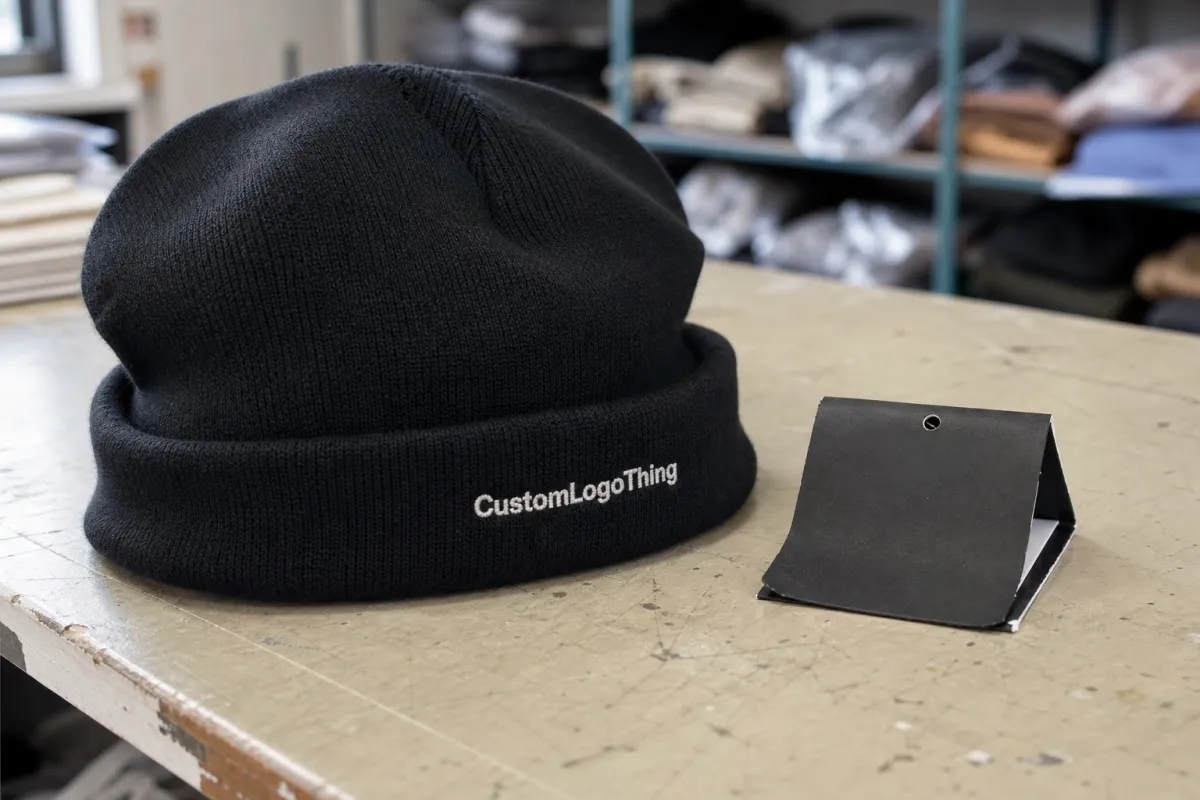
A basic acrylic beanie with a single woven label can often be produced at relatively modest quantities. A double-layer cuffed hat with a patch, custom hang tag, and retail insert needs more handling. The factory may have to stop and reset machines, source separate components, or allocate extra labor to packing. Those steps do not disappear just because the buyer would prefer a smaller run.
Sell-through matters more than pride in order size. A 250-piece Order That Sells cleanly at full price is more valuable than 1,000 pieces that spend the season getting marked down. That is especially true for winter accessories, where the selling window can be short and weather-dependent. A cold snap can lift demand; a warm spell can flatten it almost overnight.
Heavyweight hats also behave differently from lightweight knit accessories once they hit the shelf. The structure gives them a stronger visual presence, which helps retail pricing, but it also means buyers notice construction flaws faster. Loose crowns, sagging cuffs, and poor recovery are easy to spot. Shoppers may not know the gauge, but they know when a hat looks tired before it has been worn.
The other reason MOQ deserves attention is reorder logic. A well-made winter hat with a stable spec can be repeated with fewer surprises than a trend-led accessory. That makes the first order more important than it looks. If the initial build is solid, replenishment becomes a matter of matching the approved reference, not re-solving the whole product.
Pick the heavyweight knit spec that actually sells
The right spec is not always the heaviest one. A retail hat needs warmth, shape retention, and a clean profile when folded or hung. Too much bulk can make it feel clumsy. Too little structure and it reads cheap. The goal is a hat that looks deliberate from three feet away and still feels comfortable in the hand.
For most retail programs, a double-layer cuffed beanie is the safest starting point. It gives the buyer a clear branding zone, helps the hat hold shape, and usually presents better on shelf than a loose single-layer build. A tight single-layer knit can work if the handfeel is dense and the design is minimal, but it is easier to push that style into promo territory by accident.
Acrylic remains the workhorse because it is consistent, widely available, and easier to control in color. Wool blends bring a more premium story and can support higher retail pricing, but they also raise material cost and can complicate color matching. Even small shifts in fiber content can change how the hat drapes, stretches, and pills after use.
Gauge matters more than most buyers expect. A tighter rib structure, such as 1x1 or 2x2, usually recovers better after wear than a looser decorative knit. Crown shaping should close cleanly. Cuffs should sit flat without curling. If the hat relies on a lofty, oversized profile, make sure that shape still looks credible once it leaves the studio lighting and lands in actual store conditions.
Fit should be locked early. A standard adult retail range often sits around 54-60 cm, but that number is only useful if the target customer is clear. A lifestyle brand selling fashion-led accessories may tolerate a closer fit. A workwear or outdoor program may need more room. Crown height matters too. Too short looks stingy. Too tall looks costume-like.
There are a few common ways heavyweight hats go wrong. A loose gauge can pill early. Weak yarn can lose recovery after a few wears. Oversized proportions can create a cozy sample that never quite translates into a practical retail item. These are not dramatic flaws, but they are the kind that show up in returns, review comments, and quiet reorder hesitation.
Experience says the simplest clean build is often the best performer. If the knit holds its shape, the hat will usually look better on shelf than a more complicated style that needs constant explanation.
Decoration and label choices that protect margin
Decoration can reshape the economics of a hat faster than the knit itself. A strong body spec with a poor branding plan can add setup charges, stretch approvals, and make future reorders harder. The best decoration is the one that looks finished, survives production, and does not force the factory to rebuild the job every season.
For Heavyweight Winter Hats, woven labels, embroidered patches, leather patches, rubber badges, and clean hang tags are the usual contenders. Woven labels are straightforward and cost-efficient. Patches can create a more substantial retail feel without driving stitch count too high. Embroidery works well on a dense cuff, but the design needs to be sized realistically. Dense fills, large logos, and multi-position placements all increase machine time.
Label stacks are easy to underestimate. A care label, barcode sticker, size marker, and hang tag all add handling. That can sound minor until the pack list grows and the warehouse starts sorting every unit by hand. If the retailer requires FSC-certified paper on the hang tag, that is usually easier to document than vague sustainability language. The FSC standard is widely recognized, which matters when the buyer needs a paper trail rather than a marketing claim.
Color control is another place where practical thinking helps. Knit yarn is not print ink. Exact matching is possible only within limits, and those limits should be acknowledged early. If the logo depends on a precise brand color, ask for a yarn swatch or approval sample before bulk starts. Minor shade shifts are normal. Large surprises are not.
Placement deserves the same discipline. A patch centered on the cuff reads differently from the same patch shifted toward the side seam. Barcode position matters for retail receiving. A sewn-in care label should be requested early if the channel requires one, not bolted on at the end. Late label changes are a good way to turn a workable order into a correction job.
If the branding uses special tooling, confirm whether the factory treats it as a separate cost item. Rubber patches, custom badge molds, and woven label development can all carry their own setup charges. A quote that hides those charges is usually incomplete. The missing line item has a habit of reappearing later.
Pricing, MOQ, and unit cost drivers
Unit price is the number everyone asks for first, but it only tells part of the story. A useful quote should separate body cost, decoration setup, labels, packaging, inspection, and freight. If those items are merged into one tidy number, it becomes harder to compare offers and harder to spot where the money is going.
MOQ and price move together because fixed costs need volume to be absorbed. Setup charges, sample development, label creation, and packing instructions all cost something before the first unit ships. Spread those costs over 100 hats and the price per piece stays high. Spread them over 500 or 1,000 and the number drops. That is not a trick; it is simple allocation.
The same logic explains why small changes in spec can move the price more than expected. A second color in the body knit, a larger patch, or a more detailed packing requirement can add labor or materials in ways that are not obvious from the sample photo. Buyers sometimes assume that changing the logo is the only cost lever. In practice, the biggest swings often come from yarn choice and packing complexity.
Typical price bands help set expectations, although they are not a promise. Material source, labor market, decoration method, compliance needs, and freight all move the final landed cost. The ranges below are useful for planning, not for quoting a finished order.
| Build | Typical MOQ | Common cost per piece at 300 units | Notes |
|---|---|---|---|
| Stock acrylic, woven label, polybag | 100-200 pcs | $2.40-$3.20 | Simple setup, fast approval, useful for first retail tests |
| Double-layer cuffed knit, small embroidery, hang tag | 200-300 pcs | $3.10-$4.25 | Better shelf presence, moderate setup charges |
| Wool blend, patch branding, custom care label set | 300-500 pcs | $4.75-$6.50 | More premium feel, higher material cost, extra handling |
| Special yarn color, multi-location decoration, retail gift pack | 500+ pcs | $6.00-$8.50 | Fashion-led programs can use this, but MOQ climbs quickly |
For comparison shopping, ask for the same design at 100, 300, 500, and 1,000 units. That reveals the break point where the cost starts to behave more efficiently. It also makes padded setup fees easier to spot. A quote that barely changes between 300 and 500 units may already be close to efficient. A quote that collapses dramatically at 500 usually tells you where the supplier actually wants the order to land.
Color count deserves its own warning. One body color with multiple branding options is often easier to produce than several body colors with the same branding. Each additional yarn run can create its own minimum. If the budget is tight, keep the body spec stable and vary the label or patch instead. That keeps the collection flexible without multiplying production friction.
Process, timeline, and production steps
A well-run order usually follows the same sequence: spec confirmation, artwork review, sample development, approval, bulk production, inspection, packing, and shipment. The sequence itself is not glamorous, but it is where most of the risk sits. If a supplier cannot describe those stages clearly, the order is already drifting.
Sampling often takes 5-10 days, depending on yarn availability and how many revisions the artwork needs. If the decoration is simple and the yarn is in stock, the turnaround can be quicker. If a color has to be matched or a patch tool needs to be made, the clock moves slower. Bulk production commonly lands in the 3-6 week range after approval, then freight adds its own timing on top.
Peak season changes the math. Winter accessory orders can stack up quickly, and a factory that is available this week may be fully booked next week. That makes approval timing more important than buyers sometimes realize. A sample that sits on a desk for a week can push the bulk order behind another run with a faster sign-off.
Dates should be specific. Approval date. Bulk start date. Packing date. Ready-to-ship date. Vague promises create avoidable arguments later, especially if the order is tied to a retail launch or a replenishment window. “Soon” is not a schedule, and it does not help a distribution center plan labor.
Packaging and transit should be discussed with the same seriousness as the knit itself. A hat that arrives crushed in the carton may be technically correct and commercially useless. For shipping cartons and outer packaging, ISTA guidance is helpful because it focuses on drop, vibration, and handling risk. The box does not need to survive a dramatic story; it needs to survive the actual route.
Retail buyers should also think in stages rather than one large leap. A two-stage order can be smarter than a single oversized commitment, especially if the style is new to the line. Start with a core quantity, measure sell-through, then refill the winner. That approach keeps Retail Heavyweight Winter Hats MOQ aligned with real demand instead of forecast optimism.
Keep color, fit, and finish consistent at scale
Consistency is where a good sample either proves itself or falls apart. The bulk run has to match the approved reference on shape, shade, stitch density, and label placement. With heavyweight knits, the gaps usually show up in the small things: a cuff that twists, a crown that sits differently, a logo that looks centered in one box and shifted in the next.
Set tolerances before production starts. A width tolerance of plus or minus 0.5 cm may be reasonable for some knit builds. Height can drift a little more depending on the yarn and finishing method. Shade should be judged against the approved master sample rather than memory, because memory becomes unreliable as soon as the first carton is opened under warehouse lights.
Keep the reference package together. Spec sheet, yarn code, approved photos, label placement, packing instructions, and any sample notes should live in one file or folder. That record protects the reorder. Without it, the next buyer or merchandiser may describe the same hat differently, and the factory will not know which version to follow.
Packaging consistency matters more than it seems. Warehouses prefer uniform inner packs and carton counts because they speed up receiving and sorting. If inner quantities vary or labels are inconsistent, the receiving team ends up fixing the order before it can even be counted properly. That is labor you do not want to buy.
Quality control on heavyweight winter hats should include a few direct checks: stitch count, body width, crown height, seam strength, label placement, and pack count. Add pilling resistance if the yarn is soft or loosely spun. If the order is intended for a retailer with compliance requirements, document the packaging materials carefully. Recycled stock or FSC-certified paper can be useful, but only if the supporting paperwork is kept with the order file.
Small inconsistencies can be expensive because they create uncertainty. A hat that varies enough to look “almost right” is often the hardest product to manage. It passes a casual glance and fails the buyer’s confidence test.
What to prepare before you request a quote
The best quote starts with a complete brief. Not a mood board. Not a message that says “similar to this but better.” A complete brief. That saves time, lowers confusion, and makes it far easier to compare vendors on the same basis.
Start with quantity by color. Then define construction: single-layer or double-layer, cuffed or uncuffed, acrylic or wool blend. Add the decoration method, logo placement, label requirements, packaging format, and target delivery date. If the order has a ship-to destination, include it. Freight can change the landed number enough to matter, especially on smaller runs.
If the color is critical, ask for swatches or a pre-production approval step. If the design is new, ask for a sample or mockup before bulk begins. If the margin is tight, request two or three spec options so you can see the tradeoff between finish, MOQ, and Cost per unit. That comparison is often more useful than one polished quote that hides all the compromises inside it.
These six items usually sharpen a quote fast:
- Target quantity by color and size range
- Knit construction, yarn type, and cuff style
- Decoration method and logo placement
- Label, barcode, and packaging requirements
- Target retail price and delivery deadline
- Any carton, insert, or compliance requirements
Buyers who keep the brief tight usually get better pricing and fewer surprises. Buyers who keep it vague tend to discover their real spec during sampling, which is the most expensive place to discover it.
The smarter way to work is to compare total landed cost, not just the sticker price. Once the samples, freight, and packaging details are visible, it becomes much easier to see which build supports the retail margin and which one only looks attractive on paper. That is where retail heavyweight winter hats MOQ turns from a sourcing question into an actual buying decision.
What is a realistic retail heavyweight winter hat MOQ?
A common starting range is 100 to 300 pieces per style or colorway, but the exact minimum depends on the yarn, decoration method, and packaging requirements. Stock yarns and one-color builds usually keep MOQ lower, while custom colors, multiple labels, or more complex decoration can push the minimum up. Ask for a quote by spec rather than by hat count alone so you can see where the minimum comes from.
Can I lower the heavyweight beanie MOQ by reducing colorways?
Yes. Fewer colorways usually mean fewer setup changes, less yarn switching, and a lower overall minimum. A single body color with multiple label or patch options is often easier to produce than several different knit colors. If budget is tight, keep the body spec fixed and vary branding instead.
How does embroidery affect price on retail heavyweight winter hats?
Embroidery raises unit cost based on stitch count, placement, and whether the design needs one or more locations. Simple front embroidery is usually cheaper than large, dense, or multi-position work. If the goal is a cleaner retail finish, compare embroidery against woven labels or patches before committing.
What lead time should I expect after sample approval?
A realistic sample stage is often 5 to 10 days, depending on artwork and yarn availability. Bulk production commonly lands in the 3 to 6 week range after approval, with freight added on top. Rush orders are possible only when materials are already available and the schedule has open factory capacity.
What details do you need for an accurate quote?
Send the quantity by color, the knit construction, the decoration method, the label plan, and the packaging requirement. Include the target retail price, delivery date, and ship-to address so the quote reflects real landed cost. If the spec is still flexible, ask for two or three pricing options so you can compare tradeoffs before you order.
Retail heavyweight winter hats MOQ stops being a guessing game once the spec is specific, the decoration is realistic, and the approval steps are short. The best order is not the biggest one. It is the one that matches the product, the season, and the margin you still want to keep.