A custom Retail Merch Beanies bulk order can move through approval faster than many apparel runs, and that still surprises buyers who are used to sizing grids, fabric minimums, and style debates that go nowhere. Beanies are simpler. They are usually one size, easy to store, and strong at retail because the product reads as practical before it reads as promotional.
That matters in a store. A beanie has to do several jobs at once: fit the seasonal assortment, sit comfortably inside the target price, and carry a brand mark that feels intentional rather than stamped on at the last minute. If those pieces line up, the result is a compact product with low sizing risk and decent shelf efficiency. That is a rare combination in branded merchandise.
They work in campus stores, ski and resort shops, gift counters, stadium merch tables, pop-up retail, employee bundles, and winter capsule drops. The best orders are more than "put a logo on a hat." They account for yarn choice, decoration method, label placement, packaging, and how the product looks next to the rest of the assortment.
Why Custom Retail Merch Beanies Bulk Order Moves Fast
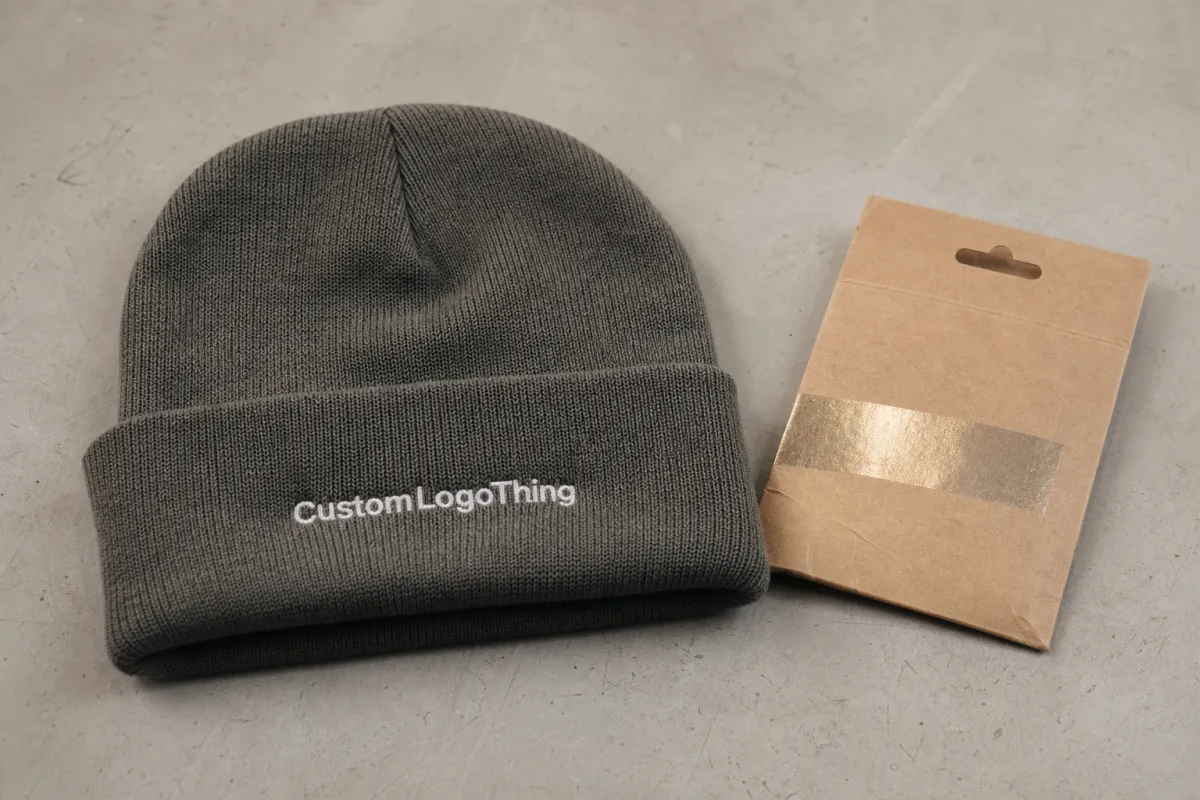
The retail math is straightforward. One size removes the biggest fit problem. A knit beanie also occupies very little space, which makes it easy to test in a seasonal planogram or stack beside scarves and gloves without crowding the shelf. That is one reason a custom retail merch Beanies Bulk Order often gets approved faster than a more complicated garment program.
Beanies sell on feel as much as on logo. A shopper sees warmth, utility, and a small status bump if the stitching is clean and the color palette looks deliberate. The item does not have to be flashy to work. It has to feel useful and current. That is why beanies hold up well in retail channels where display space is tight and buyers are looking for a product that can turn over without a long education process.
The business case is usually better than buyers expect:
- Low sizing risk: fewer returns and fewer complaints about fit.
- Strong brand visibility: a cuff or patch gives you a clear logo area without covering the whole product.
- Compact stock footprint: easy to ship, easy to store, easy to reset by color.
- Fast seasonal fit: winter and shoulder-season buying windows move quickly, so a product that can be approved quickly has real value.
The buyer lens matters here. A beanie is not just a blank canvas. It has to match the mood of the store, support the retail price, and look like it belongs with the rest of the line. If it feels generic, the shelf exposes that immediately. The product may still sell, but it will not carry the brand as well as it could.
Beanie Styles, Materials, and Decoration That Sell
Most retail buyers narrow the field to five styles: cuffed knit, slouch, fisherman, pom-pom, and ribbed. Cuffed beanies are the easiest to brand because the cuff gives you a flat zone for embroidery or a woven patch. Slouch styles read more casual and streetwear-friendly. Fisherman beanies sit shorter on the head and lean minimal. Pom-pom styles tend to work well in resort towns, holiday assortments, and gift programs because they feel seasonal without becoming costume-like.
Decoration should be judged from a few feet away, not just in a mockup. For a custom Retail Merch Beanies bulk order, the logo has to remain readable on a store wall, in a basket, or in a folded stack. If the mark collapses into tiny thread detail, or the patch color disappears into the knit, the beanie loses impact fast.
Here is the short version on decoration choices:
- Embroidery: best for clean logos, simple text, and a classic retail look.
- Woven patch: better for small details, sharper edges, and a more premium finish.
- Woven label: quieter branding for stores that want the product to feel understated.
- All-over knit: strongest custom feel, but usually slower and more expensive.
Material choice matters just as much. Acrylic is the workhorse. It is warm enough for most retail programs, holds color well, and keeps the cost inside a bulk-friendly range. Acrylic-wool blends usually feel softer and can support a higher retail price. Recycled fibers can make sense for a brand that wants a sustainability angle, but only if the hand feel and durability still hold up. A recycled claim does not help if the beanie feels scratchy or loses shape after a few wears.
For most buyers, the safest retail formula is a cuffed acrylic beanie with embroidery or a woven patch. It is familiar, easy to stock, and flexible across campus, lifestyle, and gift channels. If the brand wants something more fashion-forward, slouch or ribbed styles can work, but they need actual merch approval. A mockup that looks cool on a screen can still fail when the product is stacked, tagged, and price-marked.
| Style | Retail Fit | Typical Decoration | Typical Price Tier at 250 Units |
|---|---|---|---|
| Cuffed knit | Classic, broadest appeal | Embroidery or woven patch | $4.20-$6.80 |
| Ribbed beanie | Clean, modern, slightly more fitted | Embroidery, woven label | $4.60-$7.40 |
| Slouch beanie | Casual, lifestyle, streetwear | Patch or woven label | $5.10-$8.20 |
| Fisherman beanie | Shorter profile, fashion-led | Small embroidery or label | $5.00-$8.50 |
| Fully custom knit | Most distinctive, least flexible | All-over knit pattern | $6.50-$11.00 |
If the order is tied to gift sets or premium retail, packaging starts to matter more. A beanie folded into a custom printed boxes program or paired with a belly band can raise perceived value quickly. If you are comparing packaging paths, the Custom Packaging Products page is the right place to weigh options before the spec locks.
Specs That Decide Fit, Finish, and Shelf Appeal
Before requesting a quote for a custom Retail merch beanies bulk order, lock the details that actually change the result. Most delays come from vague requests like "something warm" or "a nice beanie." Useful briefs include gauge, yarn weight, cuff height, logo size, color count, label placement, and packout style. That gives the supplier enough information to price the job without guessing.
Gauge is one of the first decisions to make. A chunky 5-gauge or 7-gauge knit feels thicker and more winter-forward. A finer 9-gauge or 12-gauge knit looks cleaner and often reads more polished on a retail wall. Yarn weight changes drape and warmth, but it also affects how embroidery sits on the surface. Thick yarn plus dense stitching can make a logo pucker if the art is not built for that structure.
Fit deserves a real discussion. Most adult knit beanies stretch comfortably, often covering roughly 21 to 24 inches of head circumference once worn, but that range depends on knit structure and yarn recovery. Slouch and oversized styles need more attention than people assume because a relaxed fit can drift into a sloppy one very quickly. That difference is visible on shelf and even more visible in product photography.
Packaging details are not a side issue. For retail, I would ask about individual polybags, hangtags, barcode stickers, case counts, and master carton labeling before approving production. If the beanies go straight to shelf, shelf-ready packout saves labor. If they are part of a gift set, the packaging has to support the set instead of fighting it. Clean branded packaging makes the order feel planned rather than assembled in pieces.
Artwork prep is where the quality either gets protected or quietly damaged. Send vector files, not screenshots. Use Pantone references for color. Keep stitch count realistic, especially for small text. Confirm logo placement early, because a mark that sits too high or too low can make a good beanie feel off-balance and cheap. Packaging design works the same way: the details do not have to shout, but they do need to be correct.
For shipments that need to survive distribution, ask how cartons are packed and tested. The ISTA standards library is a useful reference if you care about drop and vibration handling. A beanie itself is soft, but cartons, labels, inserts, and gift boxes still need to arrive intact.
If your team is using recycled yarn or FSC-linked materials, confirm the documentation before you place the order. The FSC site explains certification basics clearly enough for a buyer to ask better questions. Claims are easy to print. Proof is what keeps a retail program clean.
Cost, Pricing, MOQ, and Quote Breakpoints
Pricing changes with quantity, and that is where buyers lose time by staring at one random number. A Custom Retail Merch beanies bulk order should be quoted across more than one tier so you can see the real breakpoint. I usually want 100, 250, 500, and 1,000 units because those levels show whether the run is meant for a test drop or a wider retail push.
The main cost drivers are predictable: decoration method, yarn type, number of colors, custom labels, packaging upgrades, and any special finishing. A simple embroidered cuff beanie in standard acrylic yarn might land around $3.80 to $5.50 at higher volumes. Add a woven patch, premium blend, or full knit pattern, and the number climbs. Add retail packaging, and landed cost rises again. The price itself is not the whole story; the delivered, sellable unit is what matters.
MOQ depends on construction. Embroidered beanies usually start lower because the base style already exists and the logo is the variable. Fully custom-knit beanies usually need a higher minimum because the setup is more involved and the pattern work has to be dialed in before production. If you want a custom label, a special hangtag, and a unique carton layout, expect each element to be treated as a separate production task. That is not resistance. That is how manufacturing works.
Ask for line-item pricing. A good quote separates the base product, decoration, sample fees, packaging, and freight. That matters because it lets buyers see where the money goes and decide whether a woven patch is worth the increase or whether a simpler embroidery lockup gives the better margin. Without that breakdown, you are comparing dressed-up totals instead of actual costs.
Here is a practical way to read a quote:
- Base product: knit style, yarn, and construction.
- Decoration: embroidery, patch, woven label, or full knit pattern.
- Packaging: polybag, barcode sticker, hangtag, gift box, or branded insert.
- Freight: carton count, destination, and service level.
If your program sits inside a larger assortment, compare it against other volume tiers in the Wholesale Programs section so you are not making the decision off a single line item. And if the supplier gives you one price without separating packout and freight, that is not a quote. It is a teaser.
Process, Timeline, and Production Steps From Proof to Delivery
The cleanest workflow for a custom Retail Merch Beanies bulk order is boring in the best way: brief, mockup, proof, sample, production, quality check, shipping. Each step exists because skipping it usually costs more later. Buyers like speed, but they like on-time delivery and accurate color more.
Clean artwork speeds everything up. Final logo files, one approved color list, and a fixed delivery window can save days at the start. On the other side, revisions, missing files, and late changes to packaging instructions can eat an entire week before production even starts. If the order includes barcode stickers, custom cartons, or gift packaging, lock those details early. Midstream changes create avoidable delays.
Realistic timing looks like this: simple embroidered beanies often move in about 10 to 15 business days after proof approval, assuming the artwork is clean and the material is standard. Custom-knit programs usually need 3 to 5 weeks, and sometimes longer if the pattern is complex or the label package is custom. Add a few more days if you are waiting on samples or if the packout spec is unusually detailed.
It helps to ask for a dated milestone plan before you approve anything. A buyer should know when the proof lands, when the sample is due, when production starts, when QC happens, and when freight leaves. That is basic project control, not a luxury feature.
"If the sample looks right but the full run comes back loose, uneven, or off-color, the issue was never the mockup. It was the process around it."
Quality control should cover stitch cleanliness, logo placement, color match, yarn consistency, and packout accuracy. If the product is headed to retail, I would also want carton labeling and barcode checks before shipment. A warehouse can forgive a lot of things. A store with launch timing and limited staff cannot.
For buyers who need a standard ordering path, the FAQ page is a useful fallback for proofs, minimums, and common order questions. It is faster than trading five emails about the same issue.
What a Reliable Beanie Supplier Should Prove Before You Order
Do not buy on mockup alone. A supplier can draw a beautiful beanie in ten minutes. That tells you almost nothing about the actual run. For a custom retail merch beanies bulk order, the real question is whether the factory can repeat the approved sample across the full quantity without drifting in stitch quality, sizing, or color.
Retail readiness shows up in the unglamorous parts: consistent color matching, clean stitching, accurate logo placement, tidy labeling, and packout that arrives shelf-ready. If the supplier cannot explain how those details are controlled, the order is a gamble. Some buyers like gambling. They usually stop liking it when the shipment looks different from the approval image.
Communication standards matter too. Good suppliers give dated milestones, confirm the MOQ in writing, and warn you when a timeline is slipping. They do not hide behind vague phrases or act as if the carton spec is "basically handled." A serious factory or merch partner should also be able to share real production photos, not only stock imagery. Stock images are how people end up disappointed after the money is already moving.
Ask direct questions:
- Can you show a production sample or a recent run with the same decoration method?
- What changes the MOQ: the decoration, the style, or the packaging?
- Do multiple colors count as separate SKUs?
- Can you provide packaging and carton labeling details before production starts?
- Will the final run match the approved sample within a normal production tolerance?
For buyers who care about product packaging, retail packaging, and branded presentation all working together, the beanie vendor should understand the full handoff, not just the knit. If they can also speak clearly about branded packaging and custom printed boxes, that usually means they have thought through the retail path instead of just the garment.
Next Steps: Build a Beanie Order Brief That Gets Quotes
If you want faster pricing, send a brief that answers the obvious questions up front. For a custom retail merch beanies bulk order, that means logo file, target quantity, preferred style, color palette, packaging needs, ship date, and budget range. A clean brief saves everyone from the "just send me options" loop, which usually means the project is already drifting.
Ask for two quotes if you are still deciding. One should be the base spec, and one should include the upgrades you are considering. That lets you see where the extra cost lands, whether it is a woven patch, a custom label, a retail hangtag, or a more premium yarn blend. The goal is not to buy the cheapest version on paper. The goal is to buy the version that actually fits the store and the price point.
If the beanies are tied to a launch, order a physical sample. A photo can hide poor hand feel, weak stretch, or patch placement that looks fine on screen and awkward in person. If the order is replenishment, a previous production sample may be enough, but only if the style, decoration, and packout are unchanged.
Use this simple buyer checklist before requesting pricing:
- Final logo file in vector format.
- Quantity by color for each SKU.
- Preferred style: cuffed, slouch, ribbed, fisherman, or custom knit.
- Decoration method and placement.
- Packaging requirements, including any custom printed boxes or labels.
- Required delivery date and destination.
- Target landed budget, not just unit cost.
If the order sits inside a broader merchandise rollout, review the Wholesale Programs page before you settle on run size. If you need related accessories, the Custom Packaging Products page can help you pair the beanies with packaging that feels planned rather than improvised. And if your team wants faster answers to common ordering questions, the FAQ keeps the basics in one place.
Send the brief, ask for the line-item quote, and compare landed cost against the retail price you actually want. That is how a custom retail merch beanies bulk order becomes a useful product instead of a drawer full of expensive guesses.
What is the MOQ for a custom retail merch beanies bulk order?
MOQ depends on construction, decoration, and packaging. Embroidered cuff beanies usually start lower than fully custom-knit styles because the base item is simpler to produce. Ask whether the minimum is tied to the decoration method, the finished style, or the packaging, because those are not always the same thing. If you want multiple colors, confirm whether each color counts as a separate SKU.
How long does a custom retail merch beanies bulk order usually take?
The schedule usually includes proofing, sample approval, production, quality control, and freight, so it is measured in weeks rather than days. Clean artwork and a simple decoration method shorten the timeline; custom labels, complex knit patterns, and packaging add time. Ask for a dated milestone plan before you approve the order so you know when the proof, sample, and ship dates should land.
Which decoration works best for a custom retail merch beanies bulk order?
Embroidery is the safest choice for simple logos and strong retail visibility. Woven patches work better when the art has small detail or needs a more premium finish. Woven labels are a good fit when the brand wants subtle placement instead of a loud front logo.
What changes the unit cost most on a custom retail merch beanies bulk order?
Quantity is the biggest driver, followed by decoration complexity and yarn choice. Extra colors, custom packaging, and label upgrades raise the price faster than most buyers expect. Freight and sample charges matter too, so compare landed cost instead of only the base unit price.
Can I mix colors in one custom retail merch beanies bulk order?
Sometimes, yes, but mixed colors may be treated as separate SKUs depending on how the beanies are made. If you want a color mix, ask whether the factory can split the run without pushing the price up too much. For retail programs, confirm which colors should be the main stock color and which are secondary or limited-run options.

