Retail Merch Beanies low moq custom order for stores
Retail Merch Beanies low moq custom order programs solve a practical retail problem: how to put branded product on shelf without filling a storeroom with inventory that may not move. A 50-piece or 100-piece run can reveal more than a large blind buy, especially when the item is seasonal, visible near checkout, and easy for shoppers to pick up as a gift.
The appeal is not just warmth. A beanie can carry store identity, support event drops, fit staff kits, and anchor a limited retail display in very little square footage. For buyers protecting cash flow, the math is straightforward. Smaller runs reduce dead stock, and faster feedback makes the next order easier to size.
Handled well, this kind of order is a test of more than demand. It checks logo clarity, color choice, decoration quality, and packaging fit before anyone commits to a larger seasonal buy. That matters more than many merchants admit, because the first impression of a knit accessory is usually the one that decides whether it sells at full price.
Retail merch beanies low moq custom order basics
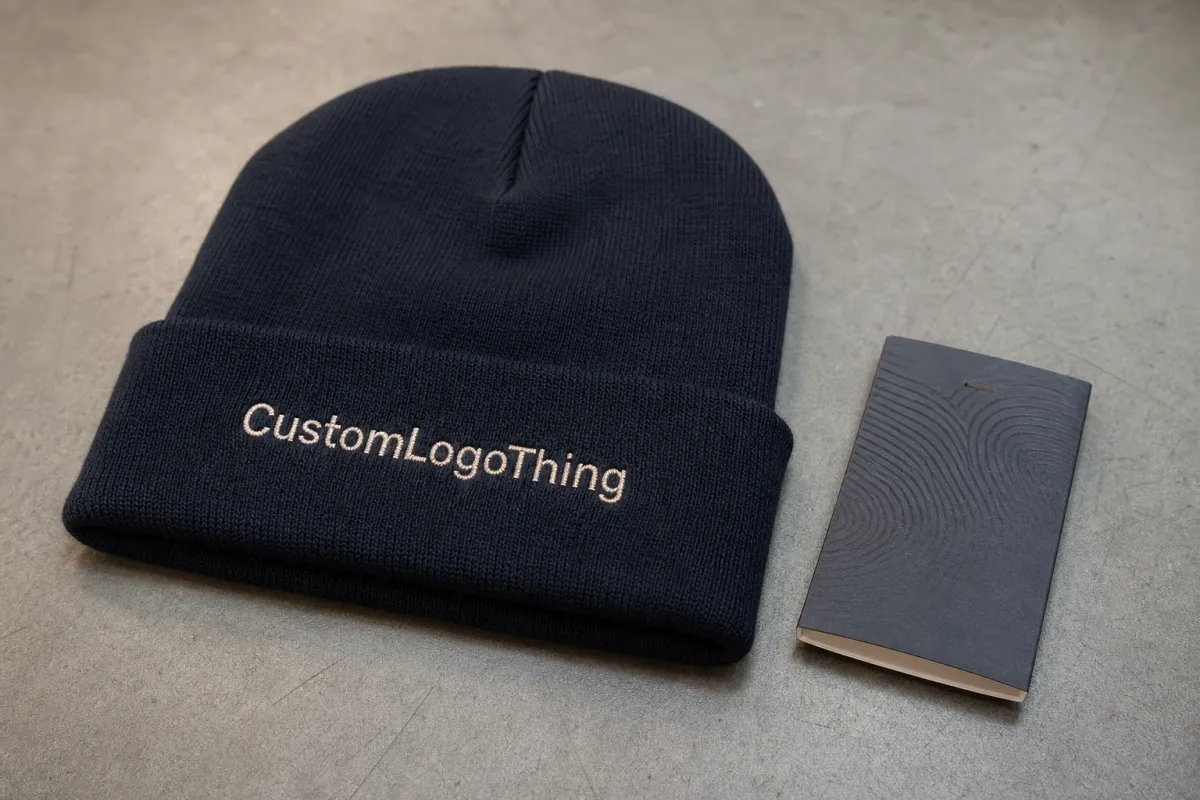
Low MOQ changes how a buyer thinks. Instead of treating the beanie as a bulk apparel line, the store can test it like a retail SKU. With Retail merch beanies low moq custom order programs, a team can see whether a logo reads clearly on a cuff, whether neutral colors outperform bright ones, and whether the product belongs on a winter table, at checkout, or in a gift section.
That is a different decision from standard clothing sourcing. A beanie is compact, seasonal, and easy for the shopper to understand in a second. If the display is strong, the unit can outperform larger garments simply because the value proposition is obvious. Customers rarely need much explanation for a knit hat.
Packaging also shapes the result. The beanie may be the main item, but a hang tag, polybag, size sticker, and shelf presentation influence how premium it feels. If the program includes bundled scarves or gift sets, retailers sometimes add Custom Packaging Products such as printed inserts or sleeves to make the display feel tighter and more deliberate. That can lift perceived value without forcing a large jump in unit cost.
A small test order can be more useful than a large one. Suppose one store orders 75 pieces in a single colorway and another location wants a different color. That is enough volume to compare sell-through, measure shopper response, and adjust the next purchase before expanding. If the first run clears in four to six weeks, the merchant has a real signal. If it slows down, the lesson is still valuable. The numbers tell a cleaner story than opinions do.
These programs also fit employee kits and event merch. A beanie can be worn by staff, sold as branded merchandise, or added to a limited holiday package. That flexibility matters because the product can move across channels without forcing a new design each time. For a cautious buyer, that is a useful form of optionality.
MOQ is not only about the smallest possible quantity. It is about the cost of learning. A lower minimum usually means less exposure and faster testing, but the price per piece can rise. The right quantity is not the smallest one available. It is the number that gives clean feedback without damaging margin.
Styles, materials, and decoration choices that sell
Style choice affects sell-through more than many buyers expect. A cuffed knit beanie remains the safest retail format because the logo sits cleanly on the front and the silhouette feels familiar on a shelf. Slouch styles lean more fashion-forward. Ribbed beanies read as cleaner and more structured. Fisherman cuts suit trend-led stores, while pom beanies work well in holiday assortments and higher-energy displays.
Material is the next filter. Acrylic is common because it is consistent, warm enough for most retail use, and usually the easiest path for low-MOQ production. Acrylic-wool blends add softness and a more premium feel, but they also push price upward. Recycled yarns are increasingly relevant for stores that want stronger sourcing language and a better fit with sustainability messaging. If the rest of the packaging uses certified paper, FSC can support that story without looking forced.
Decoration should follow the artwork, not the buyer's preference for a certain finish. Embroidery is still the most dependable choice for simple logos, short text, and everyday wear. Woven patches work well when the design has more detail or when the retailer wants a collectible look. Faux leather patches create a rugged feel that suits outdoor or workwear-adjacent stores. Woven labels are quieter, but they work when the logo needs to sit lightly on a premium knit.
For small retail buys, decoration density matters. A logo that looks sharp on a screen can turn muddy on ribbed yarn if the stitches are too tight or the art is too fine. Thin lines, tiny type, and high-color-count art are the usual problem spots. The best results usually come from simplifying the mark, enlarging the key shape, and keeping contrast strong.
Packaging can raise shelf impact more than expected. A clean polybag, barcode-friendly sticker, and good hang tag can make a low-MOQ item look like a planned retail program instead of a leftover sample. If the beanie ships in a gift-ready set or a bundled promo kit, retail packaging can matter as much as the decoration itself. In some assortments, a small amount of printed box work or a branded sleeve gives the item a more finished presence without adding much operational complexity.
Here is a useful way to compare common options before requesting quotes:
| Option | Best use | Typical strengths | Watch-outs |
|---|---|---|---|
| Cuffed acrylic beanie with embroidery | Core retail SKU | Simple logo placement, easy replenishment, stable margin control | Less texture than premium knit styles |
| Slouch beanie with woven patch | Trend-led display | More fashion feel, stronger shelf distinction | Patch cost can raise the landed price |
| Ribbed knit with faux leather patch | Premium assortment | Clean look, strong tactile appeal | Not ideal for highly detailed artwork |
| Pom beanie with woven label | Seasonal or gift item | High visibility, strong impulse appeal | Can skew too playful for some stores |
A simple style matrix is usually enough: one premium option, one budget option, and one middle-ground choice. That gives the team a clean read on demand without turning the first buy into a sprawling lineup.
"If the sample does not feel right on a shelf, do not assume the sell-through will rescue it. Retail buyers pay for clarity, not optimism."
Pricing, MOQ, and unit-cost drivers
Quoting for a small custom beanie program usually starts with five pieces of the puzzle: blank cost, decoration setup, art preparation, sample cost, packaging, and freight. If one of those lines is missing, the quote is incomplete. That sounds obvious, yet it is where many retail buys become harder to manage than they should be.
Decoration drives the biggest swings. A simple embroidery logo with one or two thread colors is generally more economical than a dense patch design with fine detail. More thread colors mean more machine time and more risk of color mismatch. Custom woven labels and hang tags add cost, but they also help the product read more finished on shelf. Setup fees often sit in the $40-$120 range depending on decoration method, while a patch upgrade might add roughly $0.60-$1.50 per unit. Exact figures vary, but the pattern stays the same.
Quantity is the other lever. A 50-piece run protects cash and tests the market fast. A 100-piece order usually improves the per-unit rate enough to matter. By 250 pieces, the price break often becomes meaningful, but inventory exposure also rises. At 500 pieces, the economics are usually better still, though only if the item has broad appeal or a clear reorder path. That is why retail merch beanies Low MOQ Custom Order programs need a margin model, not just a quote.
There is another cost that gets overlooked: the cost of a bad assumption. A store may think it needs a low price, when what it really needs is a faster test. Or it may chase the smallest unit cost and end up with too much stock. The cheapest line on paper is not always the best retail decision.
Below is a practical comparison using a single-color embroidered cuffed beanie, before freight and duties:
| Order size | Typical unit cost | Best fit | Margin note |
|---|---|---|---|
| 50 pieces | $8.50-$12.00 | One-store test, event merch, pilot program | Highest setup impact per unit |
| 100 pieces | $6.50-$9.20 | First retail drop, limited seasonal run | Good balance of risk and learning |
| 250 pieces | $5.10-$7.40 | Multi-store rollout, proven design | Better pricing, more inventory exposure |
| 500 pieces | $4.25-$6.20 | Seasonal replenishment, broad sell-through | Best unit economics, highest commitment |
That table only helps if the quotes are truly comparable. Ask every supplier to hold the same style, same decoration, same packaging, and same shipping basis. Then compare one-time charges separately from recurring unit cost. A low first quote can hide expensive setup, sample, or packing charges that appear later.
For retailers that source other merchandising items, the same discipline applies to Wholesale Programs and to broader product packaging plans. The strongest buyers look beyond the sticker price. They compare landed cost, reorder cost, and the amount of shelf time needed to recover margin.
Process, timeline, and production steps from proof to delivery
The cleanest order process is usually simple: send a brief, confirm the style, approve the artwork, review the sample, move into production, inspect the finished goods, and ship. Buyers who keep that sequence tight save time. Buyers who skip steps usually create the delays themselves.
In a typical low-MOQ run, the first proof may come back in one to three business days after the artwork is submitted. A physical sample, if requested, often takes five to ten business days depending on decoration complexity and workload. Production after sample approval commonly runs another 10-18 business days. Shipping is separate. Domestic freight may add two to seven days, while cross-border transit can take much longer depending on customs and carrier conditions.
Most delays happen in the same three places: artwork revisions, color changes after proofing, and a sample that needs another round of correction because the logo size or stitch density looked different on knit than it did on screen. Freight congestion can add noise too, especially if the beanies are packed with other seasonal goods or tied to a wider retail packaging schedule.
If the launch date matters, build in slack. A buyer planning for a holiday table or a back-to-school event should assume one extra week for proof changes and another buffer for shipping. That is not pessimism. It is how experienced merch teams protect the calendar.
For stores that need stronger transit protection, shipping cartons should be specified clearly. If the beanies are being packed with other items or sent into a distribution network, test methods from ISTA are a useful reference for carton integrity and damage control. That matters most when a small accessory order sits inside a larger branded packaging program.
One more planning rule helps a lot: approve the sample early, then stop changing it. Every late edit adds calendar risk. On a small custom program, speed often depends less on the factory and more on decision discipline.
How to choose a supplier for small retail buys
Price matters, but repeatability matters more. A supplier that can deliver the first order and the reorder at the same quality is worth more than a slightly cheaper quote that changes hand feel, logo size, or label placement on the second run. For retail buyers, consistency is the real asset.
Ask for proof that the supplier can handle low-volume production without cutting corners. That means clear stitch density, stable yarn selection, clean seam finishing, and controlled color matching. If the sample looks good but the delivery photos show loose trim or poor alignment, the order may not match the proof. That is a warning sign, not a minor flaw.
Communication is part of quality. Fast answers, clean mockups, and explicit correction notes matter more on a small custom order than on a commodity purchase. Small retail programs do not have much room for ambiguity. If the supplier cannot separate unit cost from setup cost, or cannot explain what happens on a reorder, the buyer is being asked to accept hidden risk.
Good suppliers also understand private-label needs. They know that future replenishment may require the same yarn color, the same patch placement, or the same hang tag size. That matters if the first run sells through and the store wants a second drop that looks identical. Reorder continuity is a better test than a polished sample photo.
Packaging support can help too. If the beanie needs a hang tag, belly band, or bundled insert, the same vendor may keep the retail packaging aligned with the rest of the brand. That is where package branding becomes operational, not decorative. A neat pack-out reduces mistakes at the store level and makes the product easier to display.
Use this short red-flag list before approving a supplier:
- Vague timelines with no proof stage
- Quotes that do not separate setup, sample, and per-unit charges
- No evidence of low-volume production experience
- Unclear rules for color matching or reorder consistency
- Missing packaging or labeling details
If you want a broader reference point for order basics, the brand's FAQ can help clarify common questions before the quote stage. That often saves time and improves the first proof.
For some retailers, the decision is even simpler: if the supplier can handle both the beanie and the supporting merchandise, the buying team gets fewer handoffs. That matters when the full program also includes Custom Packaging Products or a cross-channel Wholesale Programs strategy.
Next steps for a retail buy that is ready to order
Before requesting quotes, prepare five things: logo files, preferred beanie style, target quantity, color palette, packaging needs, and the delivery zip code. If the buyer can also define the selling price, the margin target, and the store date, the supplier can give a more useful quote on the first pass.
Then compare like for like. A quote for embroidered cuffed beanies with plain polybags should not be lined up against a quote for patch decoration, branded tags, and custom printed boxes. Those are different products. They may look similar on paper, but the landed cost and shelf impact are not the same.
If speed matters, approve the sample early. That single move lets Retail Merch Beanies low moq custom order work move from proof to production without a restart. It also reduces the chance that a launch date gets eaten by another round of revisions.
Before the purchase order goes out, run a final check: Is the margin strong enough at the selling price? Does the design read clearly from three feet away? Can the store reorder if it sells through? Is the quantity matched to the shelf date, not just to the supplier's MOQ? If the answer is yes, the order is probably ready.
For buyers who want a disciplined start, request a spec sheet and a firm quote, then confirm sample approval and timeline in writing. That is the point where a cautious test becomes a real retail program.
What is the usual MOQ for retail merch beanies with custom decoration?
MOQ varies by style and decoration method, but small retail programs often start below standard apparel minimums. Lower quantities can raise unit cost, so compare the price break at 50, 100, and 250 pieces before choosing a run size. Ask whether one style can be offered in multiple colorways under the same order.
Can I place a low-MOQ custom order if I only need one store's inventory?
Yes. Many suppliers support single-store programs when the artwork is simple and the style is already confirmed. A one-store buy is useful for testing sell-through before expanding to a wider rollout. Keep the design focused so setup fees do not overwhelm the margin.
How long does a retail beanie custom order usually take?
Proofing and sample approval often take the first few days, then production and finishing can take several more weeks depending on complexity. Orders with special packaging, embroidery, or patch work usually need more lead time than blank or lightly decorated beanies. Shipping time should be added separately.
Which decoration method works best for small retail merch beanies?
Embroidery is a strong choice for simple logos and short text because it looks premium and usually holds up well in retail. Patches work well when the artwork has detail or needs a more collectible look. The best method depends on logo complexity, budget, and the selling price you need to hit.
How do I compare quotes for retail merch beanies low moq custom order programs?
Compare the same style, decoration method, packaging, and shipping terms across every quote. Separate one-time setup charges from true per-unit cost so a low quote does not hide expensive extras. Ask for reorder pricing too, because replenishment costs may matter more than the first run if the product sells through.

