Buyer Fit Snapshot
| Best fit | Retail Packaging for Ecommerce projects where brand print, material claims, artwork control, MOQ, and repeat-order consistency need to be specified before quoting. |
|---|---|
| Quote inputs | Share finished size, material target, print colors, finish, packing count, annual reorder estimate, ship-to region, and any compliance wording. |
| Proofing check | Approve dieline scale, logo placement, barcode or warning zones, color tolerance, closure strength, and carton packing before bulk production. |
| Main risk | Vague material claims, crowded artwork, missing packing details, or unclear freight terms can make a low unit price expensive after revisions. |
Fast answer: Retail Packaging for Ecommerce: Strategy, Cost, and Fit should be specified like a repeatable production item. The safest quote records material, print method, finish, artwork proof, packing count, and reorder notes in one written spec.
Production checks before approval
Compare the actual filled-product size with the drawing, then confirm tolerance on folds, seals, hang holes, label areas, and retail display edges. Reserve space for logos, QR codes, warning copy, and material claims before decorative graphics fill the panel.
Quote comparison points
Review material grade, print process, finish, sampling route, tooling charges, carton quantity, and freight assumptions side by side. A quote is only useful when the supplier can repeat the same color, closure quality, and packing count on the next order.
Retail Packaging for Ecommerce: Strategy, Cost, and Fit
The cheapest box on a spreadsheet can turn into the most expensive line item in a warehouse. I have seen that happen more than once. A carton looks inexpensive until the corner crushes, the insert shifts, the carrier slaps on a damage claim, and the customer opens the parcel with the face of someone who was expecting a better day.
That is the real job of retail packaging for ecommerce. It has to protect the product, carry the brand, and survive shipping without forcing fulfillment into a tiny engineering lab. Good packaging is not decoration. It is damage prevention, labor control, and customer confidence wrapped into one spec.
From a packaging buyer's perspective, the challenge is the split personality. The package has to read like retail packaging at the customer-facing level, then behave like shipping equipment once it leaves the dock. Fail either test and the savings vanish. Cheap turns into expensive by a different route, which is usually the annoying part.
The strongest retail packaging for ecommerce is rarely just a print file. It is structure, process, and a chain of decisions about materials, fit, freight, and presentation. Get those pieces aligned and the packaging starts protecting margin. Miss them and the discount disappears into claims, repacks, and avoidable waste.
I have sat through launch meetings where the sample looked beautiful under bright lights and then fell apart in a 3PL after two days of real use. The math changes fast once humans, tape guns, and stack pressure enter the picture.
Retail Packaging for Ecommerce: What It Actually Means
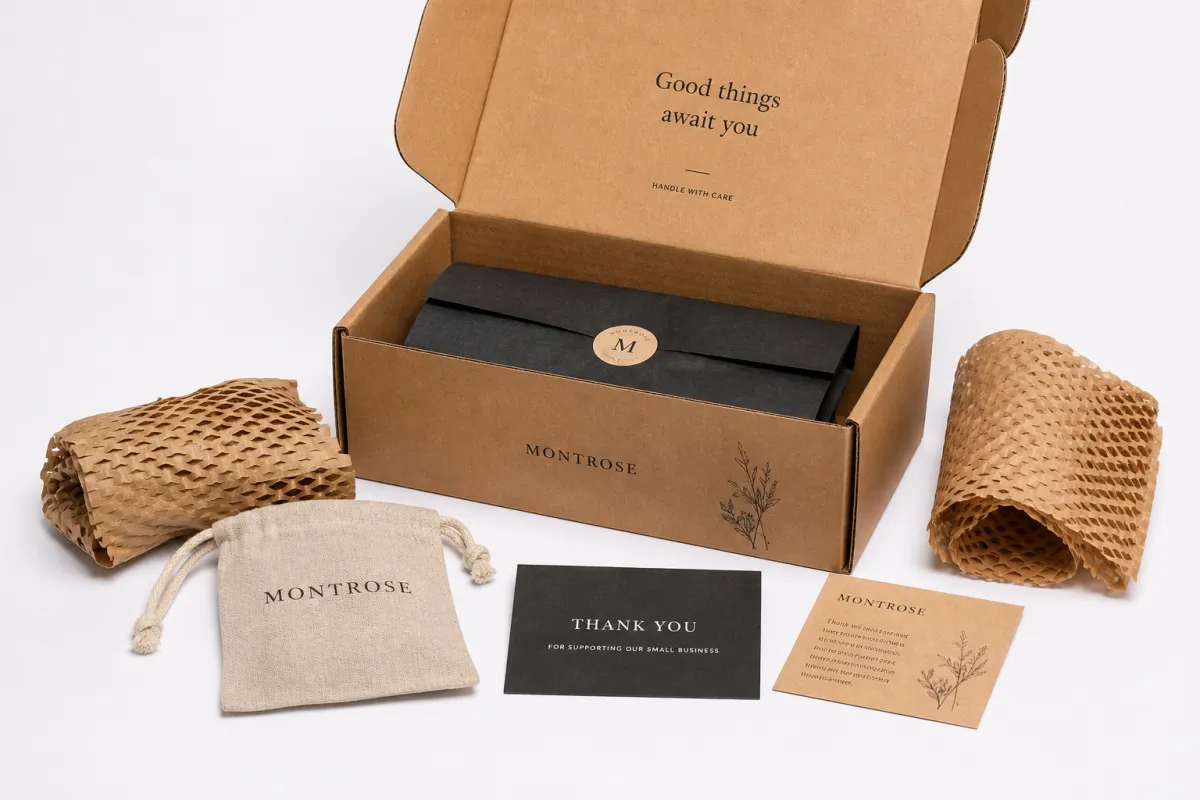
Retail packaging for ecommerce is the full system that moves a product from shelf to doorstep without losing its shape, its function, or its identity. It protects the item, communicates the brand, and gives the customer a package that feels designed rather than assembled in a hurry. Simple idea. Complicated reality, especially once product variation, print quality, and fulfillment speed all share the same order form.
Three layers do most of the work, and each one has a different job:
- Outer packaging: the mailer, corrugated carton, or shipping box that takes the abuse.
- Inner protection: inserts, dividers, cushioning, tissue, or molded components that stop movement.
- Presentation layer: printed surfaces, branded packaging, stickers, inserts, and details the customer actually sees.
All three matter. A sharp print job cannot rescue a product that bangs around in transit. A strong outer box does not help if the insert lets the item rub against itself. A polished presentation layer does not matter if the packout takes twice as long because the structure was built for a photoshoot, not a warehouse floor.
Shipping-only packaging tries to survive the trip and nothing else. Retail-ready packaging for ecommerce has to survive the trip and still look like a deliberate brand choice. Customers notice. So do returns teams, usually for less pleasant reasons.
A cheap box is not cheap if it turns into a damage claim, a replacement shipment, and a customer who remembers the bad delivery more than the product itself.
For growing brands, retail packaging for ecommerce also shapes retention. The second order often depends on whether the first delivery felt competent and consistent, not just whether the product worked. Package branding, product packaging, and packaging design start affecting revenue once the customer ties them to trust. A stable-looking box makes a small brand feel reliable. A weak box makes the operation look smaller than it is.
Fit matters as much as appearance. Oversized packaging drives up freight and filler. Undersized packaging creates damage and labor headaches. Overbuilt presentation slows pack time and clutters inventory. Every extra inch, flap, or insert has a cost attached to it, even if the invoice hides it until later.
Product category changes the answer too. A candle, a skincare set, and a metal accessory do not want the same structure even if they ship from the same building. Smart retail packaging for ecommerce respects weight, fragility, shape, and order frequency. One universal box for every SKU sounds tidy. It usually becomes the reason the packing line keeps pausing.
There is also a trust issue hiding inside all of this. If a carton looks flimsy, customers assume the operation is flimsy. Fair? Not always. Real? Absolutely.
How Retail Packaging for Ecommerce Works in Fulfillment
Retail packaging for ecommerce lives or dies on the packing line. A mockup can look elegant. The warehouse decides whether that elegance is useful or ornamental. Pickers, packers, and 3PL teams need to move through the order without confusion, delays, or awkward extra motions that slow the entire shift. Pretty packaging that fights the warehouse is just self-sabotage with a better render.
Here is the usual flow:
- The item is picked from inventory and checked against the order.
- The packer chooses the right outer shipper, mailer, or carton.
- Inner protection is added where needed, based on fragility and movement risk.
- The product is placed and secured so it does not shift in transit.
- Branding elements, inserts, or tissue are added if the spec calls for them.
- The package is sealed, labeled, and handed off for carrier pickup.
Each step affects retail packaging for ecommerce. If the closure is awkward, pack time goes up. If the insert takes two extra motions, labor rises. If the label surface is weak, rework starts creeping in. Those tiny frictions stack up in a busy warehouse the way a bad diet shows up in a lab result: not dramatic in the moment, obvious over time. Packaging choices belong in the room with the shipping team, not only in the design review after the boxes arrive.
Order mix matters too. A brand shipping one SKU in one box has a very different problem from a brand shipping multiple SKUs together in mixed orders. Retail packaging for ecommerce has to handle that range without turning every order into a custom assembly puzzle. Assortment changes? Some flexibility helps. Fragile product? Inner protection deserves more attention than the print finish. Dense, heavy packs? Corrugated strength beats decorative extras.
Branding still belongs here, just not at the expense of throughput. Printed mailers, tissue paper, stickers, and inserts can improve package branding without making fulfillment miserable. Restraint matters. The customer should feel that the unboxing was considered, not that an overcaffeinated marketing team tried to stage a miniature theater production inside a shipper.
That balance sits at the center of retail packaging for ecommerce. A good design keeps the product stable, keeps labor predictable, and keeps the brand visible. A weak design slows the warehouse and makes the customer suspicious. Neither result is hard to measure once the returns start coming back.
I once reviewed a cosmetics launch where the outer box looked expensive and the insert looked clever. The pack line hated both. The closure caught on the tape station, and the insert required a second hand motion the team never planned for. The packaging looked premium on paper and kind of annoying in real life.
Cost, Materials, and Pricing Tradeoffs
Pricing for retail packaging for ecommerce comes down to a few variables: material grade, print method, dimensions, quantity, tooling, and structural complexity. That is the short list. If a quote looks unusually low, something is missing. Usually it is protection, print quality, or honest freight math.
For common shipping and retail packaging formats, rough unit costs can look like this at mid-size volumes:
| Packaging Option | Typical Unit Cost | Best Use | Main Tradeoff |
|---|---|---|---|
| Plain corrugated mailer | $0.35-$0.90 | Everyday ecommerce orders, light to medium protection | Lower branding impact unless printed |
| Custom printed folding carton | $0.18-$0.45 | Light retail product packaging inside an outer shipper | Needs outer protection for rough transit |
| Rigid setup box | $1.75-$4.50 | Premium gifting, high-end retail presentation | Higher cost, higher storage space, longer lead time |
| Custom insert set | $0.08-$0.40 | Hold product in place, reduce movement and damage | Extra setup and fitting work |
| Void fill or cushioning | $0.03-$0.15 per order | Gap control, lightweight protection | Can slow pack speed if overused |
That table only helps if you separate unit cost from total cost. Retail packaging for ecommerce can look cheaper on paper when damage risk, dimensional weight, labor time, and storage are left out. Then the box arrives too large, the carrier charges more, the team stuffs in filler, and the "cheap" option becomes expensive in half a dozen ways.
Material choice matters just as much as price. Corrugated mailers are a sensible default for most ecommerce shipments because they balance strength and cost. Folding cartons work well for lighter retail packaging and custom printed boxes, especially when an outer shipper adds another layer of protection. Rigid packaging makes sense for premium products, but only if the brand can justify the spend. Otherwise it becomes a very elegant way to lose margin.
Some buyers focus only on the box line item and miss the hidden costs:
- Dimensional weight: oversized packaging can push carrier charges up fast.
- Storage space: bulky packaging takes up valuable warehouse cube.
- Assembly time: complicated packouts slow labor and raise per-order cost.
- Rework: wrong sizes or damaged print runs create waste and delay launches.
- Returns: damaged shipments erase whatever the cheap box saved.
Here is a cleaner buying rule: pay for the packaging that protects margins, not the packaging that only looks inexpensive on a spreadsheet. Retail packaging for ecommerce is a systems decision. It should protect the product, fit the warehouse, and support package branding without creating a theater of unnecessary expense.
Material specs narrow the field fast. A 32 ECT corrugated mailer can work for lighter goods, while heavier shipments often need stronger board or a double-wall structure. Folding cartons commonly use 16pt to 24pt SBS or CCNB stock, depending on the presentation target and protection needs. Rigid boxes can use wrapped greyboard around 1,200-1,500 gsm, but that only makes sense if the brand is priced for it. Retail packaging for ecommerce is not about the fanciest thing available. It is about the right thing for the order and the operation.
If the packout needs three extra minutes and an extra dollar in freight just to feel premium, that is not premium. That is just expensive.
Brands comparing sustainability claims should ask for board and ink details, recycled content percentages, and certifications where relevant. FSC-certified paperboard may matter for certain buyers, and material suppliers should be able to state the spec clearly. Shipment performance testing belongs to the ISTA test family rather than to guesswork based on how a sample feels in your hand. Hunches are a poor substitute for quality control.
One honest caution: sustainability claims can get sloppy fast. Recycled content is useful, but only if the package still holds up. A greener box that damages the product is not greener in any meaningful sense. It is just another box.
Step-by-Step: Building a Retail Packaging for Ecommerce Program
Retail packaging for ecommerce works best when it functions like a program, not a one-off purchase. Start with a packaging audit. Measure the product. Trace the shipping path. Find the failure points. Do not begin with color swatches and hope the box turns functional on its own. That path leads to attractive packaging and messy returns.
A practical build process looks like this:
- Measure the product accurately. Capture length, width, height, weight, and any fragile points or protrusions.
- Map the journey. Note whether the order ships direct to consumer, through a 3PL, or through a retail channel with additional handling.
- Define the failure mode. Is the real risk crushing, abrasion, movement, moisture, or opening damage?
- Choose the structure. Match the box style to the product, not to a mood board.
- Prototype before volume. Make sample runs, pack real inventory, and watch how the team handles it.
That last step matters more than many teams expect. Retail packaging for ecommerce often looks fine until a human has to fold it, tape it, fill it, label it, and repeat the process hundreds of times. Prototypes reveal the truth quickly. They show if the insert is too tight, if the print scuffs during handling, if the closure opens too easily, or if the box design is eating time in the packing line.
Testing should stay practical. Drop tests, compression checks, and warehouse handling tests tell a useful story. For some products, an ISTA-style drop and vibration test gives a sensible benchmark. For heavier or more complex shipments, ASTM D4169 distribution testing may fit better. No test replaces real-world packout, but a test beats hoping the box "feels sturdy."
After the structure passes the basics, lock the spec. That means die lines, board grade, print colors, coating or lamination, inserts, fold directions, closure style, and pack instructions. Share it with the fulfillment team. Retail packaging for ecommerce fails more often because the process drifted than because the design was flawed. A clear spec keeps the operation consistent when the order volume rises.
If you are comparing structures or building a fuller packaging lineup, review Custom Packaging Products that fit the product size and ship method. For many brands, the answer is not one magic box. It is a set of packaging options that cover the main SKU families without creating chaos in inventory.
Keep the first rollout narrow. Start with one high-volume SKU and one fragile SKU. That gives you a clean comparison between a straightforward packout and a more demanding one. Retail packaging for ecommerce gets easier to manage once real data replaces opinions from three departments that never have to tape the final carton themselves.
How Long Does Retail Packaging for Ecommerce Take?
The short answer is that stock packaging can move in days, while Custom Retail Packaging for ecommerce usually takes weeks because sampling, proofing, and production all need to happen in sequence. If the order includes custom printed boxes, inserts, specialty coatings, or a structural change, the calendar stretches. That is normal. Panic orders are only fast when they ignore everything that makes the packaging useful.
Timeline planning is where retail packaging for ecommerce projects either stay sane or become a scramble. Stock packaging moves fast. Custom work takes time. Approval delays are usually self-inflicted. That sounds blunt because it usually is true.
Samples and proofs
For many projects, the sample phase takes a few business days if the supplier already has the right dieline and board on hand. Structural changes extend the process. Retail packaging for ecommerce tends to move fastest when the brief is specific: product dimensions, target quantity, print coverage, and shipping method. Vague approvals are where timelines go sideways.
Expect one or two sample rounds if the packaging includes custom printed boxes, specialty coatings, or inserts that must align tightly with the product. If you are choosing between multiple styles, ask for all of them at once. Waiting for a second round because the first sample was never quite right is how simple launches miss their window.
Production and transit
Once the sample is approved, production often lands in the 12-15 business day range from proof approval for standard custom work, though more complex retail packaging for ecommerce can take longer. Rigid boxes, special foils, structural changes, and custom inserts all add time. Overseas production adds transit time whether the calendar likes it or not.
Planning buffers matter because seasonal drops, product relaunches, and replenishment orders should not be scheduled as if the factory, freight carrier, and customs process are feeling cooperative. They are not. If a launch date needs to hold, leave room in the schedule and order before the panic starts.
A simple planning range for retail packaging for ecommerce looks like this:
- Stock packaging: often 3-7 business days if inventory is available.
- Standard custom cartons: often 12-15 business days after proof approval.
- Complex premium packaging: often 20-35 business days or more.
- Offshore production plus freight: usually needs the most buffer, especially during peak shipping periods.
Speed suits launches that are small, temporary, or still being validated. Custom packaging fits brands that need specific fit, protection, or package branding that stock packaging cannot deliver. Retail packaging for ecommerce should not turn into an emergency purchase every quarter. That pattern usually means the spec was never truly owned.
One more practical note: reorders go smoother when the packaging spec is documented in plain language. Keep the dieline, board spec, print files, and carton count in one place. If the team has to describe the packaging from memory, there is no system yet. There is only a story. Stories are unreliable for repeat production.
Common Mistakes That Make Packaging More Expensive
Retail packaging for ecommerce gets expensive fastest when brands confuse "lower unit price" with "lower total cost." Oversized packaging is the classic mistake. It wastes board, raises dimensional weight, needs more void fill, and makes the product look like it was packed by someone who stopped caring halfway through the shift.
Another common error is designing for the photoshoot instead of the warehouse. Custom printed boxes can look excellent in a render. The render does not show pack speed, stacking strength, or whether the adhesive strip misbehaves in cold storage. Real retail packaging for ecommerce has to survive the boring parts of operations, not just the polished marketing assets.
These are the mistakes that show up most often:
- Skipping fit tests: the product moves, shifts, or gets crushed because the dimensions were guessed.
- Skipping drop tests: small damage becomes a large returns problem after launch.
- Overprinting too early: inventory gets stuck when branding or messaging changes.
- Using one box for everything: mixed-SKU orders create sloppy packouts and higher waste.
- Ignoring training: the process breaks when the fulfillment team never saw the final spec.
Testing matters more than many teams want to admit. A packaging sample in a conference room is not the same thing as a production-ready pack. Retail packaging for ecommerce should be checked under actual handling conditions with the right inserts, tape, and labeling workflow. For a reference point on material sourcing, the standards from FSC help. For disposal and recycling communication, EPA recycling guidance is useful. Customers notice when claims sound sloppy.
Ordering too much too soon is another trap. Packaging changes faster than many brands expect. Product sizes shift, compliance copy changes, and seasonal artwork ages out. Retail packaging for ecommerce that sits in a warehouse for six months can become dead inventory if the product changes. That is not foresight. That is a future write-off with better lighting.
Fulfillment training is the quiet failure point. If the packaging is excellent but the packout steps are unclear, the final result still breaks down. One shift may build the box correctly while another overfills it, crushes it, or places the insert backward. A one-page pack guide can save more money than a more expensive print finish. Practical usually beats polished.
Retail packaging for ecommerce gets cheaper when design, testing, and process point in the same direction. It gets more expensive when each department optimizes for its own favorite metric. Marketing wants the dramatic reveal. Operations wants speed. Finance wants the lowest unit price. The best spec gives each side enough of what it needs without letting anyone sabotage the rest.
Expert Tips and Next Steps for Retail Packaging for Ecommerce
The quickest way to improve retail packaging for ecommerce is to stop judging it by taste. Start with one high-volume SKU and one fragile SKU, then compare how each performs in real fulfillment. That gives a real read on cost, damage rate, and pack speed without pretending every product needs the same solution.
A simple scorecard helps:
- Cost per shipped order: include box, insert, filler, and freight effects.
- Damage rate: watch both carrier damage and product scuffing.
- Pack time: measure how long the final packout really takes.
- Customer feedback: unboxing comments can reveal issues that internal teams miss.
Ask suppliers for samples in at least two material options. Compare total landed cost, not just unit price. Retail packaging for ecommerce often has a low-looking option that becomes expensive once freight, storage, and labor enter the equation. A second sample may cost a little more up front and save much more later. That is usually the smarter trade.
If the packaging program needs to move quickly, use a 30-day action plan:
- Audit one product and document the failure points.
- Spec one prototype with exact dimensions and material details.
- Run one fulfillment test with the real packing team.
- Revise the spec based on handling data, not opinions.
After that, document the final version so it can be reordered cleanly. If the team needs a broader product mix, use Custom Packaging Products as a starting point for comparing mailers, cartons, inserts, and branded packaging options. That kind of structure keeps retail packaging for ecommerce from becoming a recurring fire drill every time sales pick up.
One last point: build packaging to scale, not to impress the sample table. Retail packaging for ecommerce should be repeatable, easy to explain, and strong enough to survive the shipping path without bloating cost. If you can reorder from a spec, train a new packer quickly, and keep damage in check, the packaging is doing its job. If not, the box is probably winning the argument against the business.
My practical takeaway is simple: choose one SKU, one ship method, and one fulfillment team, then lock the package around actual handling data. That gives you a spec you can trust, and trust is what keeps the whole thing from drifting into expensive guesswork.
What is retail packaging for ecommerce?
It is the packaging system that protects a product, supports branding, and survives shipping from warehouse to customer. Retail packaging for ecommerce usually includes the outer shipper, inner protection, and the presentation layer the customer sees first. The strongest version balances cost, damage prevention, and pack speed instead of trying to look fancy for no reason.
How much does retail packaging for ecommerce cost per order?
Cost depends on size, material, print method, quantity, and how much assembly is required. Small custom cartons can be inexpensive at scale, while rigid or highly finished packaging costs much more per unit. The real number should include freight, storage, labor, and damage risk, not just the box price.
What materials work best for retail packaging for ecommerce?
Corrugated board is the safest default for most shipped products because it balances protection and price. Folding cartons work well for lightweight retail items, especially when the shipper adds outer protection. Rigid packaging makes sense for premium products, but only if the brand can justify the cost and lead time.
How long does retail packaging for ecommerce take to produce?
Standard stock solutions can be fast, while custom packaging usually needs time for dielines, samples, proofing, and production. Lead time gets longer when the packaging uses specialty print, custom inserts, or structural changes. The safest move is to plan with buffer time and never assume a last-minute reorder will fix the launch.
How do I choose the right retail packaging for ecommerce for my brand?
Start with product size, fragility, shipping method, and order volume. Test a few structures against real fulfillment conditions before choosing a final spec. Use cost per shipped order, damage rate, and pack time as the decision metrics, not just appearance. That is how retail packaging for ecommerce stays useful instead of becoming expensive decoration.


