Ribbon Handle Paper Bags MOQ: What Buyers Need to Order
If you are comparing Ribbon Handle Paper Bags minimum order quantity, the real issue is not just how low a factory will go. It is whether the bag carries the product safely, looks right on the shelf, and still makes sense once paper, ribbon, print, freight, and waste are included.
Ribbon-handle bags sit between a standard carrier and a rigid gift box. They feel more polished than a twisted-handle bag, but they are simpler and lighter than a carton. That makes them useful for boutiques, bakeries, cosmetics, event kits, and corporate gifting where presentation matters.
The fastest way to get a useful quote is to lock four points early: finished size, paper stock, print method, and ribbon color. If those are vague, suppliers will fill in the blanks differently and the numbers will not compare cleanly.
Ribbon handle paper bags minimum order quantity: where the premium upgrade makes sense
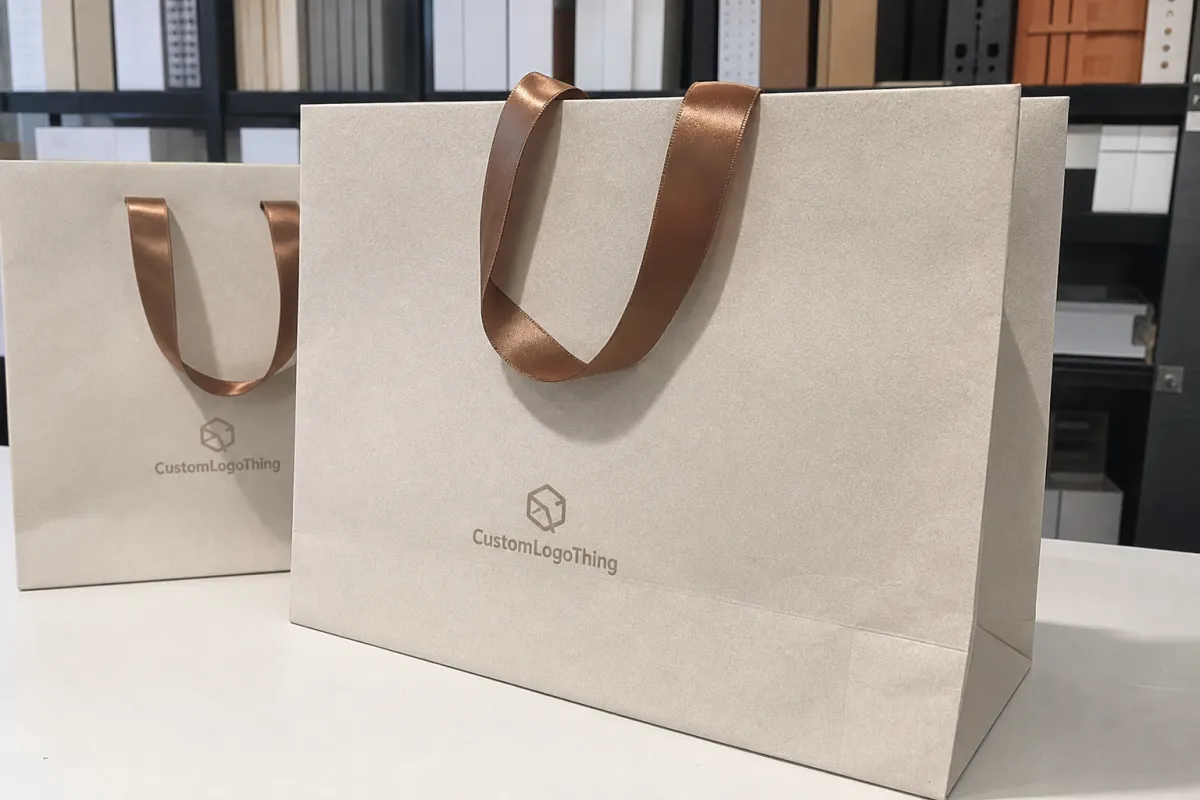
These bags work best when the package is part of the product experience. They suit candle sets, folded apparel, pastries, small gifts, and branded event packs because they improve the first impression without the cost of a hard box.
The Ribbon Handle Paper Bags minimum order quantity becomes worthwhile once the bag is expected to do more than move an item from shelf to customer. If you only need a simple carrier, plain paper bags are cheaper. If the bag needs to read as a gift or premium retail item, the ribbon handle earns its place.
Buyers sometimes compare ribbon-handle bags to basic kraft carriers and miss the extra work involved. The handle needs more finishing, and the top edge often needs reinforcement so the bag does not fail where the load pulls hardest. That is why the price is higher.
For bakery launches, seasonal retail, and event packaging, a smaller run can still be justified because the bag is visible, photographed, and handled in public. In those cases, the right packaging is often more valuable than a slightly lower minimum.
"If the bag has to feel premium in hand and still survive transit, the handle structure is usually where the cheapest quote starts to fail."
A small order at a higher unit price can still be the right decision if the packaging is tied to a launch, campaign, or short event window. The wrong bag in the wrong quantity creates more waste than a slightly higher MOQ.
Construction details that change feel, strength, and cost
Ribbon handles are only one part of the build. Paper weight, board inserts, reinforcement, and shipping format all affect appearance and performance. A light kraft bag and a board-backed art-paper bag may look similar in a mock-up, but they behave differently in use.
Paper choice is one of the biggest cost and quality decisions. Thin stock can crease once loaded. Heavier stock keeps its shape better, especially on wider gussets or taller bags. Common material ranges include:
- 140-170gsm kraft for light retail items and simple branded packaging.
- 210-250gsm art paper or C1S for a smoother print surface and firmer body.
- 250-350gsm board-backed builds for bags that need more structure and a more gift-like feel.
Reinforcement is easy to overlook on a drawing and obvious in use. A glued bottom board helps the bag hold shape. Side gusset support keeps the walls from collapsing. Handle anchoring matters most; if the ribbon is attached only to the top layer, the bag may look finished while still failing under load. Good builds use internal backing or a stronger folded edge.
Flat-fold bags ship more efficiently and save storage space. Fully assembled bags are faster to hand out at events, but they use more freight volume. For larger orders, that difference can matter as much as the print method.
For buyers comparing transit or paper sourcing claims, ISTA provides common language for shipping tests, and FSC is the better-known reference for responsible paper sourcing. They do not make the bag better by themselves, but they help you ask better questions.
Locking size, paper weight, and finish before you request pricing
Before asking for pricing on ribbon handle paper bags minimum order quantity, lock the dimensions. The important numbers are width, gusset, and height. A bag at 180 x 80 x 240 mm behaves very differently from one at 250 x 120 x 320 mm, even if both are called medium.
Start with the product, not the bag. Measure the packed item, then add enough clearance for easy insertion and for the material to flex without bowing. Many first-time buyers choose by visual reference and end up with bags that are cramped or oversized.
Paper weight affects stiffness, print clarity, and how sharply the bag holds a crease. Surface finish also changes the result. Matte often reads as softer and more premium, while gloss gives stronger color and shine but shows scuffs more easily. If the bag will be handled often or sit under bright lights, finish choice matters.
Fix these specs early:
- Handle width: narrower ribbon looks lighter; wider ribbon feels sturdier and is easier to carry.
- Ribbon color: match the brand system or campaign palette, and keep the code stable for reorders.
- Finish: matte, gloss, or uncoated depending on the image and scratch resistance you need.
- Board inserts: add bottom or top reinforcement for bottles, glass, and heavier sets.
Late changes usually trigger a new die, revised proof, or reworked handle process. Even small changes can force another round of sampling, so lock the spec before asking for final numbers.
Print, ribbon, and decoration choices that shape the final look
Printing often looks cheaper on paper than it does in the finished bag. A one-color logo usually keeps setup simple and controls cost well. Full-color print works for artwork-led brands, but it adds approval and production time. Specialty decoration raises price quickly, so it should support the design, not just fill space.
A restrained one-color mark on kraft can look sharp. A foil logo on matte black stock can look expensive without becoming loud. Full-coverage print works for beauty, fashion, and campaign packaging, but it needs clean artwork and careful layout.
Artwork quality matters. Files with vague colors, missing bleed, or unoutlined fonts slow proofing and create avoidable revisions. For color-sensitive work, Pantone references are better than general descriptions, especially when the bag needs to match repeat orders.
Typical cost and MOQ patterns look like this:
| Option | Typical MOQ | Unit Price Range | Best For | Main Tradeoff |
|---|---|---|---|---|
| One-color logo, standard ribbon | 500-1,000 pcs | $0.55-$0.95 | Retail, events, bakery use | Simple appearance, limited decoration |
| Custom size, one- or two-color print | 1,000-2,000 pcs | $0.68-$1.25 | Corporate gifting, boutique launches | More setup, better brand fit |
| Full-color print with matte lamination | 1,000-3,000 pcs | $0.85-$1.60 | Cosmetics, fashion, campaign packaging | Higher waste risk if artwork is not clean |
| Foil, embossing, spot UV, premium ribbon | 3,000 pcs+ | $1.20-$2.80 | Luxury retail, VIP gifting | Higher setup cost and stricter approvals |
Decoration only works when the structure is sound. A foil mark on a weak bag still looks like a weak bag. The base build has to hold shape before the finish can add value.
What actually drives MOQ, pricing, and unit cost
The ribbon handle paper bags minimum order quantity is not fixed across every factory. It changes with size, paper weight, print method, handle construction, and destination. Smaller stock-based bags may start around 500 to 1,000 pieces. Larger custom builds or specialty finishes can push the floor to 2,000 or 3,000 pieces.
Unit cost falls as volume rises because one-time charges are spread across more bags. Plates, dies, sample prep, and color matching all need to be paid for somewhere. On a 500-piece order, those costs are visible. On a 5,000-piece order, they are much smaller per unit.
Ask for the full landed picture, not just the ex-works number. Request samples or pre-production mock-ups, tooling charges, packing details, carton count, carton size, and the freight assumptions behind the quote. If the order crosses borders, duty or tax exposure should also be part of the discussion.
Freight cube often changes the math. Two quotes can look close on paper while shipping very differently. A flat-packed bag and an assembled bag may share the same structure, but the assembled version can take far more carton space. In that case, the lower unit price may not be the lower total cost.
Practical rule: ask for tiered pricing at 500, 1,000, and 3,000 units. That shows the real break points. Sometimes the jump is small. Sometimes it is the difference between a workable order and a warehouse problem.
Cost also rises with finish complexity. A one-color bag with standard ribbon often lands near the low end of the market. Add embossing, spot UV, special ribbon shades, or lamination, and the price moves quickly. If the bag is disposable after a single use, a heavy premium spec is usually wasted. If it is tied to a launch, wedding, or branded gift, the extra spend may be justified.
Production flow and turnaround from artwork to shipment
A normal order follows a simple path: brief, dieline, proof, sample or pre-production approval, production, QC, and packing. The more ordinary that process is, the less likely the bags arrive with the wrong size, color drift, or handle weakness.
For custom ribbon-handle bags, turnaround is usually 12-20 business days after proof approval for standard specifications. Specialty finishes, uncommon paper stocks, and imported ribbon shades add time. If sea freight is involved, shipping can add several weeks depending on the route and sail schedule. Work backward from delivery, not from the order date.
These items keep the schedule moving:
- Clean artwork files with bleed and outlined fonts.
- Clear color references instead of vague descriptions.
- Stock materials already available in the needed paper or ribbon shade.
- Fast approval on proofs and samples.
Most delays are predictable. Late approvals are common, and so are last-minute changes to size, ribbon color, or print placement after the sample is made. Once a production line is set for a specific spec, revisions slow everything down.
Quality control should be specific, not generic. Expect checks on dimensions, print registration, ribbon attachment, adhesive clean-up, bottom board placement, and carton count. For heavier items, pull testing on the handle is worth asking about.
For common sample and proof questions, our FAQ covers the basics. If you are planning repeat volume or seasonal packaging, the Wholesale Programs page explains how recurring orders change price and timing.
Why repeat buyers stay with a dependable supplier
Repeat buyers care less about the prettiest quote and more about consistency. They want handle attachment that holds, color that stays close from one run to the next, and print that matches the approved sample. Once a bag is in market, even small changes are obvious.
Good suppliers give realistic MOQ guidance instead of pretending every request can be made at the lowest number. A factory that says yes to 200 pieces without warning you about pricing structure is not helping you make a better decision.
Repeat buyers also think in tradeoffs. They do not always want the fanciest finish. They want the right balance of appearance, storage, freight, and reorderability. Sometimes that means a lighter stock with stronger print. Sometimes it means a wider ribbon on a simpler bag. Sometimes it means removing one decoration so the order stays within budget.
Reliable suppliers do more than sell a bag. They help prevent the wrong spec from being ordered in the wrong quantity.
For reorders, the key question is whether the supplier can reproduce the first approved run without drift. If they keep records of the die, ribbon width, color codes, and finishing notes, a reorder is much easier. If they do not, every new order starts from scratch.
How to brief a quote without losing time or money
Start with the basics: finished size, target quantity, print method, and ribbon color. Those four points determine most of the cost. If you already know the delivery country, include that too, because freight and duty can move the landed number more than many buyers expect.
Then send the material that removes guesswork. Logo artwork, brand colors, product photos, and any reference packaging help a supplier understand whether the bag should feel like retail packaging, a gift bag, or a formal presentation carrier. If you have an old bag you like, send its measurements and a photo. A real sample is better than a long description.
Ask for pricing at several quantities instead of only one number. A 500-piece line, a 1,000-piece line, and a 3,000-piece line usually tell you more than a single quote. That spread shows where setup costs stop hurting and where economies of scale begin. If one quote is far lower than the others, check the spec again before assuming it is a better deal.
For buyers comparing ribbon handle paper bags minimum order quantity across suppliers, the cheapest option is not always the smartest one. The useful order is the smallest run that still gives you clean construction, stable color, acceptable freight, and a finish the customer will keep in hand. That is the point of planning the MOQ carefully: getting the right bags made in a quantity that fits the job.
What is the usual MOQ for ribbon handle paper bags?
Most factories price these bags in tiers, often starting around 500 to 1,000 pieces depending on size, paper, and print. Custom dimensions, heavier paper, or specialty finishes can push the minimum higher. Ask for the smallest run that still keeps the unit price sensible, not just the lowest number a supplier is willing to quote.
Can I mix sizes or colors in one ribbon handle paper bag order?
Sometimes, but mixed specs often require separate setup charges or separate production runs. Changes in ribbon color, print, or lamination can interrupt the line and raise cost. If variety matters, ask whether one base size with color swaps is cheaper than multiple full custom SKUs.
How do ribbon handles affect the price compared with rope handles?
Ribbon handles usually add labor and material cost because the attachment needs to be neat and secure. They also create a more premium look, which can justify the higher unit price for retail or gifting. The gap depends on ribbon width, color matching, and whether the handle is sewn, knotted, or reinforced internally.
Can I get a sample before placing a full order?
Yes, and for launch products or premium packaging, that is the safer route. A sample helps confirm size, handle feel, paper stiffness, and print placement before the full run starts. Ask whether the sample is a stock mock-up, a digital proof, or a pre-production sample, because those are not the same thing.
What is the typical turnaround after artwork approval?
Standard production is usually counted after proof approval, not after the first inquiry. Simple orders move faster than special finishes, custom sizes, or jobs waiting on imported materials. Get the timeline in writing with checkpoints for proofing, production, inspection, and shipping.

