Two paper bags can look nearly identical in a mockup and still feel completely different in hand. One keeps its shape, carries cleanly, and presents the brand with quiet confidence. The other sags at the base, twists at the handle, and makes even a good logo look underwhelming. That is why a Ribbon Handle Paper Bags logo print quote should be built on actual production details, not broad assumptions.
Buyers usually need the same three things from a custom bag: it has to carry the product safely, represent the brand clearly, and land at a unit cost that still works after freight and packing. Ribbon handle bags can do all three well, but only if the paper stock, handle attachment, print method, and finish are matched to the job instead of added as disconnected features. A premium look is useful only if the construction holds up on the sales floor and in transit.
There is also a practical side that gets overlooked. A bag that looks expensive but uses weak board or poor reinforcement can create more problems than it solves. The right spec is usually the one that makes the bag feel intentional without making every unit expensive to produce. That balance matters for boutiques, gift packaging, hospitality kits, and retail launches where the bag is part of the product experience, not just a carrier.
Why Ribbon Handle Bags Win Before the Logo Is Even Seen
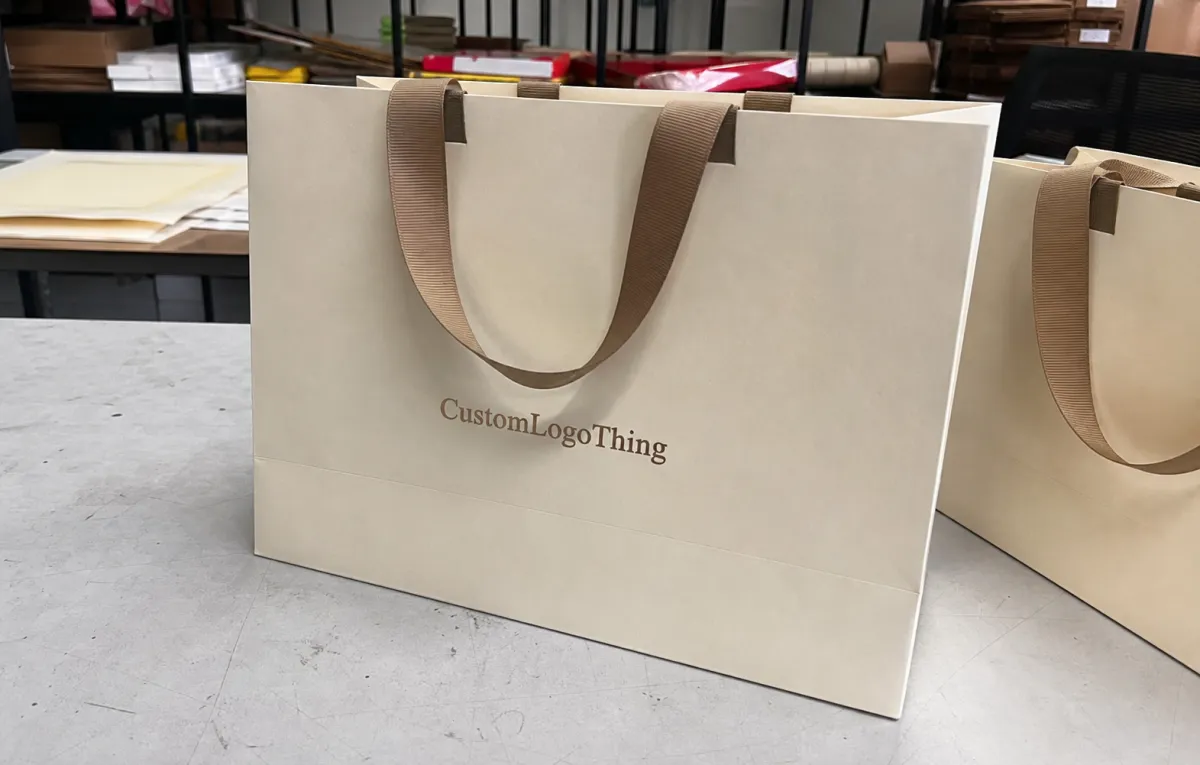
Ribbon handle bags have a polished profile that reads differently from twisted paper handles or basic tape handles. The ribbon lies flatter, frames the top edge more neatly, and gives the bag a composed look even before the artwork is noticed. In a store, that first impression matters. Customers touch the bag, lift it, and notice how it hangs before they read the logo.
The strength of the style comes from a few practical advantages. A wider ribbon spreads pull across the hand and the top edge, which helps the bag feel steadier under load. Grosgrain has a more textured grip and a slightly structured appearance. Satin looks smoother and more reflective, which can push the package toward a dressier feel. Both can work well, but they signal different things.
Ribbon handles also help a bag stack and store more neatly than bulky alternatives. That is useful for retail back rooms, kit assembly, and cartons that need to stay compact. The bag feels more deliberate on a counter or in a gift bag wall, even if the printed artwork is only one color. A simple logo often looks stronger on a well-made bag than a crowded design on a bag that lacks structure.
A clean logo does not rescue a bag that caves in at the bottom or twists at the handle anchors. Structure first, artwork second.
That last point comes up often in buyer conversations. Teams sometimes focus on foil, lamination, or large print coverage before the base build is settled. That order usually creates avoidable compromises. If the board is too light, the handle attachment is weak, or the proportions are off for the product, no amount of decoration will make the bag feel premium. A restrained finish on a strong build usually delivers better value than a highly decorated bag that performs poorly.
For that reason, the style is popular in boutiques, cosmetics, small home fragrance lines, jewelry packaging, and seasonal gift programs. It brings a sense of care without needing heavy embellishment. A Ribbon Handle Paper bag can carry modest artwork and still look considered, which is often the most efficient way to communicate quality.
Paper Grades, Ribbon Handles, and Print Finishes
The paper stock changes how the whole bag reads. Kraft board gives a warmer, more natural look and suits brands that want a grounded, less polished presentation. White SBS or coated artboard gives cleaner contrast, sharper logo edges, and more reliable color reproduction. Specialty stocks can add texture or a more luxurious hand feel, but they often bring higher cost and fewer sourcing options.
For most logo-printed bags, the stock should be chosen after the intended carry weight and brand tone are clear. A luxury brand does not always need a heavy coating. A lifestyle brand does not always need a textured specialty sheet. What matters is whether the board supports the print and the load, then whether the finish supports the story the bag is meant to tell.
Print method should follow the artwork rather than the other way around. Offset printing is a strong choice for sharper detail, smoother solids, and consistent branding on coated stocks. Digital printing makes sense for shorter runs, faster proofing, and designs that may still change. Flexographic printing works well for simpler artwork, especially on kraft applications where the design uses fewer colors and the goal is efficiency rather than photo-level reproduction.
Color control deserves a clear note in the brief. If the brand has a defined Pantone value, include it. If the logo will run in CMYK only, say that plainly. Small reversed type is worth checking at actual size, because white text on a dark field can close up faster than it looks on a monitor. Buyers are often surprised by that. What appears crisp in a file can lose legibility once paper stretch, ink gain, and finishing are factored in.
Ribbon selection is not cosmetic detail; it changes both feel and cost. A ribbon that is too narrow can look delicate but feel underbuilt. A ribbon that is too wide can overpower the face of the bag and crowd the top edge. In many retail programs, a 10- to 15-mm ribbon is a practical range, with grosgrain offering more texture and satin providing more sheen. The right choice depends on the paper color, logo treatment, and the general tone of the packaging.
Attachment method matters just as much. Ribbon handles can be tied through reinforced holes, secured under the top fold, or fixed with internal reinforcement patches. Stronger attachment methods usually take more labor, but they reduce pull-out risk and improve how the bag hangs when loaded. If the bag will be used repeatedly or carry slightly heavier items, that extra reinforcement is usually worth the small increase in cost.
Finishes should be treated with the same discipline. Matte lamination softens glare and keeps the presentation understated. Gloss can brighten color and help with scuff resistance on some jobs. Soft-touch gives a velvety surface, though it can show handling marks if the bags are packed or moved roughly. Foil, embossing, and spot UV can work well, but they should have a clear purpose. A small logo on a solid board often looks more confident than a full panel crowded with effects.
If recycled content or FSC sourcing is part of the brief, mention it early rather than as an afterthought. That request can affect paper selection, sourcing lead time, and documentation. For buyers who want to review certification standards directly, FSC is the right place to verify what the mark means and what documentation may be needed. If shipping durability is part of the concern, packaged-carton performance also matters, and ISTA provides useful packaging test standards for that side of the workflow.
Artwork Setup and Logo Placement That Print Cleanly
Good logo printing begins with the file. The supplier needs vector artwork, accurate color references, and a verified dieline. A low-resolution JPEG might be fine for a website, but it rarely gives a clean enough edge for production. If the logo is fuzzy, the lines are thin, or the artwork is built from screenshots and pasted text, the printed result will usually show it.
Safe zones are not optional. The logo should sit far enough from folds, side seams, top turns, and handle anchors that it still reads clearly once the bag is formed. A design that looks centered on a flat layout can shift visually after folding and gluing. That is why a proof should show the finished bag, not just the artwork floating on a blank panel.
Placement affects cost as well as appearance. A single front-panel print is typically the most efficient. Add back-panel or gusset print areas, and setup grows more complex. Bottom-panel printing can be done on some jobs, but it should be a deliberate choice rather than a backup place to move artwork at the last minute. Every additional print position adds room for variation and more chances for the proof to miss something.
These are the details worth checking before approval:
- Spelling and spacing in the logo and any supporting copy.
- Pantone or CMYK references for brand colors.
- Logo scale relative to the bag face and handle placement.
- Image resolution for any illustration or photo elements.
- Barcode or compliance text if the bag needs retail information.
A production proof should show the exact print area, color notes, and any clearance around handles or folds. If the artwork is still moving, ask for a simple proof before committing. That reduces the chance of corrections later and avoids the kind of back-and-forth that slows a ribbon handle Paper Bags Logo print quote more than the print process itself.
One small practical warning: very fine type and thin lines are often the first things to disappear on textured paper or during conversion. If the logo has delicate lettering, test it at the actual size rather than trusting a zoomed-in file. The same is true for hairline rules, especially on darker backgrounds or uncoated stocks. They may survive in proofing and still be too light in mass production.
Size, Strength, and Construction Specs Buyers Should Verify
Bag size should come from the product, not from a generic category. Finished width, gusset, and height need to fit the item with enough room for insertion and a presentation that still feels neat. If the bag is too small, the sides bulge and the handles work harder. If it is too large, the product shifts around and the bag starts to feel wasteful.
Construction details matter just as much as dimensions. A useful spec should list paper weight, bottom insert style, handle length, and any reinforcement at the top edge or handle points. For premium retail work, board weights in the 200 to 350 gsm range are common, depending on bag size and carry load. Smaller bags can use lighter board if the contents are modest. Larger bags usually need more structure to keep the side panels square and the base stable.
Tolerance should be discussed before the first run. Slight variation in cut accuracy, fold position, and color density is normal in paper converting. What matters is whether those variations stay within agreed limits. If the bag will be displayed in a set or lined up in a retail wall, the supplier should explain what variation to expect so the final result can be judged fairly. Repeat orders need this clarity even more than first runs do.
For heavier items, a sample or prototype is worth the time. It lets you test handle pull, board stiffness, bottom support, and how the printed surface handles scuffing in transit. A flat proof cannot reveal whether the bag will stay tidy under load. That becomes important with boxed fragrance, candles, apparel boxes, or any item with hard edges that can stress the bag from the inside.
Packaging buyers also need to think about carton behavior. A bag that looks fine loose on a table can arrive damaged if the cartons are underpacked or the nesting pattern is poor. That is why packing method should be part of the discussion early. Ask how many bags go into each carton, whether the cartons are reinforced, and whether pallets are part of the plan if the order is traveling long distance.
Ribbon Handle Paper Bags Logo Print Quote: Pricing, MOQ, and What Actually Shapes the Price
This is the part buyers usually want first, but it only makes sense once the spec is clear. A ribbon handle Paper Bags Logo print quote is shaped by paper grade, bag size, print method, number of colors, finish, handle style, packing method, and shipping destination. Change any of those variables and the price can move quickly.
MOQ has the biggest effect on unit price because setup costs get spread across the run. A low quantity carries more of the prepress, color setup, cutting, and converting burden per bag. A larger order usually lowers the per-piece cost because the setup is diluted. That is why tiered pricing is more useful than a single number. Three quantity breaks show the real trade-off much better than one flat quote.
| Quantity | Typical Unit Range | Best For | Common Cost Drivers |
|---|---|---|---|
| 1,000 pcs | $0.85-$1.40 | Short campaigns, launches, testing | Setup spread across fewer bags, simple print preferred |
| 3,000 pcs | $0.52-$0.90 | Seasonal retail, event kits | Moderate setup, one or two print colors, limited finishing |
| 5,000 pcs | $0.34-$0.62 | Ongoing retail programs | Better efficiency, stronger case for offset printing |
| 10,000 pcs | $0.22-$0.40 | Recurring brand packaging | Lower unit cost, higher carton and freight planning importance |
Those figures are directional only. A small coated bag with one spot color will price very differently from a large specialty-stock bag with foil, lamination, and a custom ribbon. Freight and packing can also move the number more than people expect, especially if the order needs reinforced cartons, palletizing, or export handling.
Ask what the quote includes. A useful estimate should state whether prepress, proofs, plates or screens, packing, and freight assumptions are part of the number. If those items are missing, the headline price may look attractive while the final cost rises later. That problem is common when two suppliers are being compared on different assumptions.
These items usually add cost quickly:
- Lamination, especially matte or soft-touch.
- Foil stamping, embossing, or spot UV.
- Custom ribbon colors or wider ribbon widths.
- Extra reinforcement at the handles or base.
- Multiple print positions across several panels.
If the budget is tight, keep the design focused. A good paper stock, a clean logo, and one or two print colors often deliver more value than a stack of finishes. In many cases, the strongest result comes from a bag that feels well built and stays visually calm. That approach keeps the quote realistic and reduces the chance of paying for effects that do little for the brand.
Production Steps and Lead Time from Artwork to Delivery
Production usually follows a predictable path: artwork review, proof approval, material sourcing, printing, converting, inspection, packing, and shipping. A complete brief at the start keeps the job moving. A missing dieline, an unclear logo placement, or a late color change tends to slow things down fast.
Lead time depends on both method and complexity. Digital jobs can move faster because they avoid some tooling steps. Offset and flexographic work may need extra setup, plate preparation, or color adjustment. Custom ribbon colors, specialty finishes, and paper that must be sourced separately can add days or even a week or two if the supply chain is tight.
Late artwork changes are the most common cause of delay. If the proof is already approved and the logo changes, the schedule usually shifts immediately. Shipping instructions create another bottleneck if they are unclear. Carton count, pallet needs, split shipments, and delivery destination should all be settled before the run starts, not after the goods are on the press schedule.
Three dates are worth asking for before approval:
- Production start date
- Estimated ship date
- Contingency date if revisions are needed
That small habit keeps the plan real. It helps with store openings, seasonal launches, and promotional calendars where a late shipment can create an expensive gap. If timing is tight, say so plainly and ask the supplier to confirm whether the Ribbon Handle Paper Bags logo print quote reflects the schedule you actually need.
How to Compare Suppliers Before You Approve
The lowest number is not always the best value. A better comparison looks at proof clarity, material transparency, response speed, and repeatability. If a supplier explains the board, handle attachment, print process, and packing method in straightforward language, that usually tells you more than a one-line quote with no context.
Ask for sample photos and, if possible, a recent spec sheet that matches the same construction style. You want to see handle behavior, print crispness, corner finish, and board rigidity. A real example is useful. A stock image tells you very little about the actual build.
The best suppliers also point out risks before production begins. If the artwork is too fine for the chosen print method, they should say so. If the ribbon color is likely to vary because the exact weave is not in stock, that should be disclosed early. Honest guidance at the quoting stage usually saves more time than a fast answer that creates a problem later.
Communication during production matters too. Ask how sample approval works, how rush jobs are handled, whether split shipments are possible, and how corrections are managed if something changes after proof sign-off. That is especially useful for buyers placing repeat orders across seasons. The second run should feel like the first one, not like a different product that just happens to share the same logo.
If a supplier cannot explain the bag build clearly, they are probably guessing on more than the price.
A proper ribbon handle paper bags logo print quote is only part of the decision. The rest is whether the supplier can reproduce the same color, handle feel, and carry performance again. That repeatability is where a packaging program earns its value.
What to Send for a Fast Quote and Order Lock-In
If you want a quick response, send a clean spec bundle. Include the finished size, quantity breaks, logo file, print colors, paper stock, handle color, finish choice, and delivery destination. If those items are missing, the quote will be based on assumptions, and assumptions are where pricing problems usually begin.
A rough mockup still helps if the artwork is not final. It gives the supplier a sense of placement, panel coverage, and print count. If you already have a dieline, send it. If you do not, say so clearly and ask the supplier to provide one. That is better than sending a logo alone and hoping the bag geometry gets guessed correctly later.
Before approving the order, ask for the following in writing:
- Unit price by quantity
- Written proof with print placement and color notes
- Freight estimate or shipping assumption
- Carton count and packing method
- Sample availability if verification is needed
If the bags will be warehoused, moved through retail back rooms, or shipped with other goods, confirm pallet needs and carton strength before release. That detail is easy to overlook and annoying to fix later. For premium packaging, the arrival condition matters almost as much as the print because the bag is part of the branded experience the moment it comes out of the carton.
Send the full brief, compare the proof carefully, and approve only after size, build, print, and timing are all aligned. That is the most reliable path to a ribbon handle paper bags logo print quote you can actually turn into production without surprises.
What details do I need for a ribbon handle paper bags logo print quote?
Send the finished size, gusset, target quantity, artwork file type, number of print colors, paper stock, handle color, finish choice, and delivery location. If you already have a dieline or mockup, include that too so the quote is based on the actual bag layout rather than a rough guess.
How does MOQ change the unit cost for logo-printed ribbon handle bags?
Higher MOQ usually lowers the unit price because setup is spread across more bags, while smaller runs cost more per piece because prepress and machine time are divided across fewer units. Ask for pricing at two or three quantity breaks and check whether sampling or proofs are included in the quoted cost.
Which paper stock is best for a custom ribbon handle bag?
Kraft works well for a natural look and everyday carry use, while white SBS or coated stock usually gives sharper logo contrast and cleaner color. Specialty stocks can feel more premium, but they may raise cost and narrow recycling options, so choose based on brand feel, print method, and the weight the bag must carry.
What lead time should I expect after proof approval?
Lead time depends on material availability, print method, quantity, and whether custom handles or finishes need extra sourcing. A complete file and quick proof approval help keep the schedule moving, and it is smart to ask for the estimated ship date before you approve the order.
Can I order a sample before placing the full ribbon handle paper bag run?
Yes, and in many cases you should. A sample is especially useful when the bag will carry heavier product, needs exact color match, or represents a premium brand, because it lets you verify handle feel, print placement, and construction before the full run is locked in.

