For a streetwear release, packaging is part of the product, not decoration around it. The right Slider Lock Bags for Streetwear labels moq guide choice can make a folded tee read like a retail item instead of loose inventory, and that shift is visible the moment someone picks it up. A bag like this has to do three things at once: protect the garment, carry the brand, and signal whether the item belongs on a pop-up table, in a fulfillment stack, or on a resale listing.
That is why buyers keep coming back to Slider Lock Bags. They reseal better than a plain flap pouch, they present cleanly in photos, and they help a small run look deliberate rather than improvised. The practical question is not whether they look better. It is how closure style, film thickness, print area, and MOQ affect the order in real terms.
Why slider lock bags change the first impression
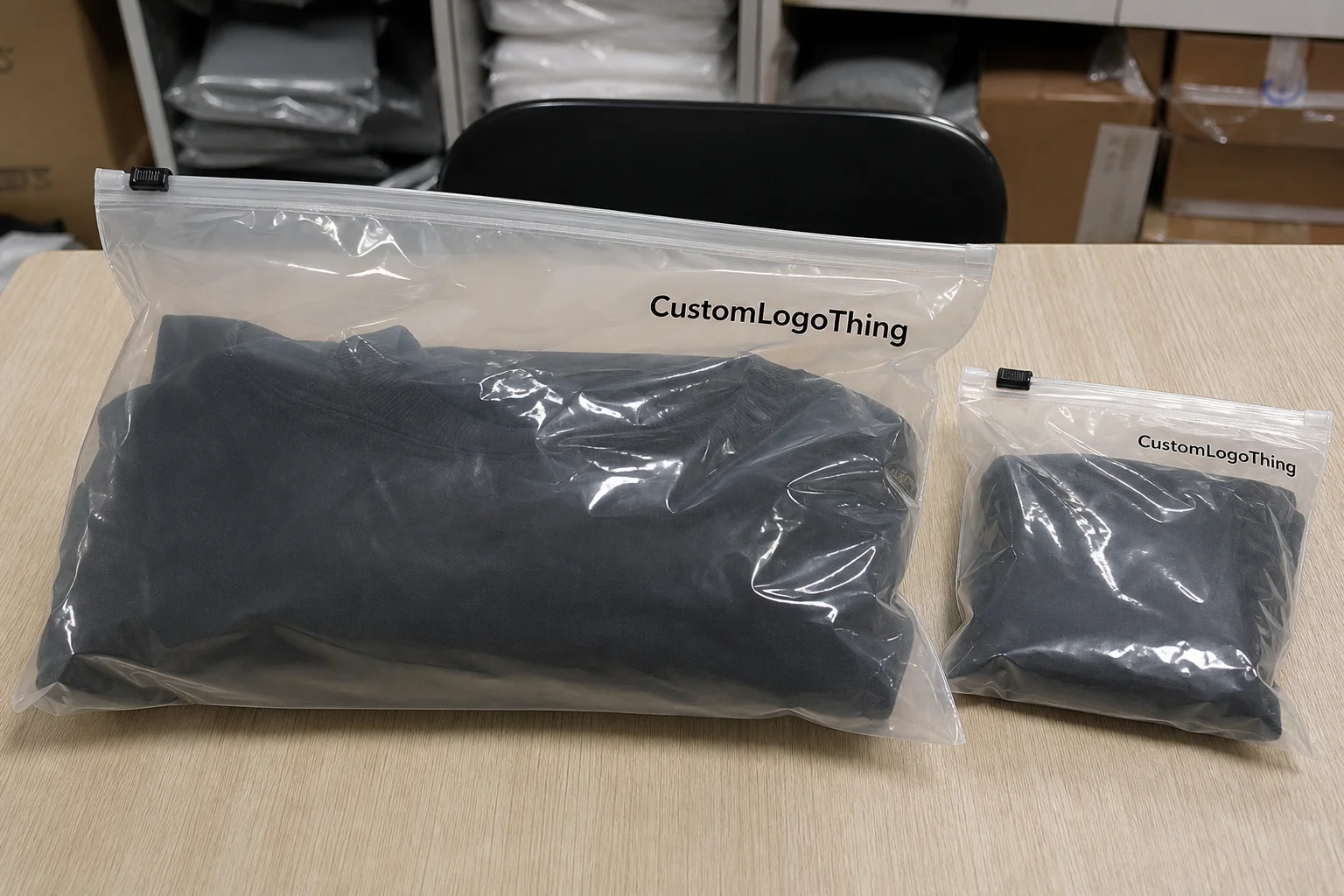
A good bag changes the reading of the product before the garment is even unfolded. A heavyweight tee in a rigid, clear bag feels different from the same tee in a thin generic pouch. One looks curated. The other looks like it came straight from a storage shelf. That difference is subtle on a spec sheet and obvious on a table.
Streetwear labels use slider lock bags because the format works in more than one setting: launches, pop-ups, store display, resale, and shipping prep. The customer can open and reseal the bag without destroying it, which matters for garments that get handled, tried on, returned, or stored again. The closure also helps with multi-piece sets, caps, socks, and accessories that move through several hands before they are worn.
There is a real business case here. Better presentation can reduce complaints about wrinkled goods, improve shelf presence at events, and make a short production run look more intentional. I see the same pattern in brands that also invest in Custom Labels & Tags: once the packaging and labeling speak the same visual language, the product stops feeling assembled from spare parts. For a label living on narrow margins, that is not cosmetic. It affects how buyers justify the price.
There is also a handling benefit. Slider lock bags help reduce dust, scuffing, and minor abrasion during transport and backroom storage. They are not shipping armor. They do, however, protect the garment from the kind of wear that weakens first impressions before the customer ever sees the piece.
“If the bag feels flimsy, the product inherits that weakness. If the closure works cleanly and the film holds its shape, the entire order reads as planned.”
Closure style, print coverage, and brand presentation
The slider mechanism is the main reason this format gets chosen over a basic zip bag. It opens and closes with less friction, and that matters when apparel is handled repeatedly and then stored again. A customer who can reseal the bag easily is more likely to keep it. That means the packaging stays in circulation longer, which gives the brand more visibility after purchase.
Film finish changes the visual read quickly. Clear film shows the garment and works well when the product itself is part of the presentation. Frosted film softens what is inside and often feels more premium because it hides folding marks and minor color mismatch in the garment stack. Tinted film is more directional; it can sharpen contrast for bold graphics, but it can also hide detail if the shade is too heavy. For most streetwear labels, clear film wins unless the artwork or texture benefits from partial concealment.
Print coverage should match the brand, not the available print area. A single-color logo on one clean panel often does more than a full wrap graphic. Subtle branding lets the garment remain the focal point. Full-panel art can work for statement drops, but it raises cost and can make the bag feel crowded. Care text, size marks, and warning copy sometimes need to be there, though they should be placed with restraint so the bag still feels like part of the line rather than a compliance sheet.
Details matter more than buyers expect. Hang holes can improve retail display. Tear notches make opening more predictable. A gusseted bag can handle thicker garments, but it also changes how the pack sits on a shelf and how it nests in cartons. The closure itself should be tested for smooth travel, firm lock engagement, and repeat opening without tearing the edge. A slick sample that jams after three uses is a packaging problem, not a design detail.
Film gauges, sizes, and protection specifications
Thickness is where many packaging projects drift off course. A thin bag may look fine in a sample photo and feel flimsy in hand. A heavier gauge adds stiffness, improves puncture resistance, and gives the bag a cleaner retail feel, but it also changes cost per piece. For tees and lighter accessories, a thinner film can be enough. For hoodies, denim, and boxed sets, moving up in gauge is usually the safer call because the bag has to survive folding, packing, transit, and store handling.
Size should be based on the folded garment, not a guessed measurement from the product page. Measure the finished fold, then add enough clearance for easy loading. Oversized bags are common and usually avoidable. They create air pockets, slide around on shelves, and make the package look less considered. Undersized bags are worse because they wrinkle the product or put stress on the closure. The right fit is usually snug enough to look clean and loose enough to load without fighting the bag.
Before quoting, buyers should lock the core spec fields:
- Width
- Height
- Film gauge
- Closure type
- Print area
- Gusseted or flat construction
- Hang hole, tear notch, or other finishing details
There are also compliance questions worth asking early. If a supplier uses broad packaging language, confirm whether they are assuming food-contact claims, recyclability claims, or regional rules that do not apply to apparel packaging. For packaging performance and test methods, sources such as ISTA are useful. For broader recycling guidance and material handling references, EPA recycling guidance is a practical starting point. If the supplier talks about certified fiber components, FSC is the standard to verify for paper-based elements, though it does not apply to plastic film itself.
In real buying work, this spec stage is risk control. A few millimeters or a small gauge change can be the difference between packaging that supports the product and packaging that makes it feel cheaper.
Pricing, MOQ, and unit cost tradeoffs
This is where the buying decision becomes concrete. The headline price is only part of the picture. Film thickness, bag size, print count, color count, slider hardware, carton configuration, and whether the order is stock-based or fully custom all affect bulk pricing. The same visual design can price very differently depending on whether the supplier is cutting a standard size or running a new spec.
MOQ usually falls into tiers. A small test run can look attractive because it lowers commitment, but the unit cost is almost always higher. Once the order moves into repeat-production territory, the cost per piece usually drops because setup gets spread over more units. That is the basic math behind custom packaging. The hard part is knowing where the savings begin and how much volume is needed to justify them.
| Order type | Typical MOQ behavior | What drives cost | Best use case |
|---|---|---|---|
| Stock bag with branding label | Low | Label application, shipping | Fast launch, small test drop |
| Printed standard-size slider bag | Moderate | Print setup, color count, film gauge | Recurring tee and hoodie drops |
| Fully custom size and print | Higher | Tooling fees, setup charges, proofing | Established labels with repeat volume |
Ask directly about the hidden line items. Setup charges, plate or tooling fees, sample fees, freight assumptions, and color-match requests can move the landed cost more than buyers expect. A quote that looks lowest on paper may become the most expensive option once tooling and shipping are added. A supplier worth working with will spell out whether the number includes print setup, packaging, and domestic or international freight.
For streetwear brands, the better comparison is not only total spend. It is order economics. A bag that costs a little more per piece but performs well in retail, shipping prep, and storage may be the better buy because it reduces waste and protects the garment. That matters more when the packaging is visible at every customer touchpoint.
Practical quoting framework: ask for pricing at three quantities, such as launch volume, mid-volume, and reorder volume. That shows how quickly the cost per piece changes and whether the supplier is giving true MOQ pricing or just a single-point quote.
Production process and turnaround details
The workflow is predictable if the brief is clean. It starts with specs, then artwork review, then a proof or sample, followed by production, inspection, packing, and shipment. Each step is ordinary. The delays show up when the inputs are vague.
The most common slowdown is incomplete artwork. The second is dimensions that are estimated instead of measured. The third is late changes after the quote is already approved. Every revision can trigger another proof round, and that is where lead time slips. If a label is planning a drop, packaging should not be treated like a last-minute add-on. It can become the critical path faster than garment production itself.
Lead time depends on print complexity and order size. Unprinted or lightly printed runs are usually faster. Printed custom jobs take longer because they need proof approval and production scheduling. In practice, many orders land in the range of 12 to 15 business days after proof approval, but that depends on the supplier, quantity, and freight lane. Rush scheduling exists, but it reduces room for correction, so it should be used carefully.
One detail buyers forget to build in is inspection time. A well-run order still needs a check for print registration, closure function, bag dimensions, and carton count. If the shipment is blind-sent straight into fulfillment, a defect can show up after the deadline instead of before it. That is a bad place to discover an off-center logo or a closure that feels loose on half the run.
Once the specs are locked, the next order should move faster. The supplier can reuse drawings, print notes, and prior settings. That repeatability is one of the most useful benefits of documenting the order properly the first time.
What to verify in a packaging supplier before you reorder
Repeatability matters more than a glossy sample photo. If the first order looks good but the second one arrives with different clarity, weak closure performance, or shifted print placement, the packaging stops being an asset. Reordering should mean consistency, not another troubleshooting round.
Ask how the supplier handles color matching, closure function, and film tolerance from one production run to the next. A serious partner can explain acceptable variance without hiding behind vague language. They should also be able to describe how they inspect for defects, how they pack bulk cartons, and what happens if a shipment arrives with a problem. Clear answers are a stronger signal than polished sales language.
There is a difference between a vendor who quotes and a supplier who supports production. The first may send a number quickly. The second sends drawings, confirms tolerances, flags weak artwork, and gives straight answers about what is and is not possible at a given MOQ. That distinction matters if the same bag will be reordered across multiple drops.
Operationally, the better suppliers store previous specs and reduce quote drift. The next order should not restart from zero. It should begin from the last approved drawing, the last approved print file, and the last known film spec. That cuts friction and lowers the chance of surprise costs.
For buyers building a tighter packaging system, it helps to align the slider bag with the rest of the program. If the hang tags, labels, and bag all share the same logic, the product line feels more mature. The order is easier to manage, and the customer reads the brand as more consistent.
Next steps for a streetwear label to place an order
Start with a spec sheet that is concrete enough to quote without back-and-forth. Include garment type, folded dimensions, target bag size, thickness preference, closure style, print colors, artwork files, and quantity bands. If the order is for hoodies, say so. If it is for tees only, say that too. That helps the supplier recommend the right gauge and avoids upsizing a bag that does not need it.
Ask for tiered pricing so you can compare launch quantity against reorder quantity. That is the cleanest way to see where the cost per piece improves and whether the order should be split or consolidated. If your design depends on exact placement or a specific finish, request a sample or proof before production. For a simple single-color logo on clear film, a proof may be enough. For a higher-contrast frosted bag or a more elaborate print, a physical sample is worth the time.
Then build the production calendar backward from the drop date. Approval, production, inspection, freight, and receiving all take time. If the packaging lands late, the launch can stall even if the garments are ready. That is why experienced buyers treat packaging as part of the release schedule, not as an afterthought.
For labels that need a repeatable buying process, the key is simple: send a clear brief, compare quotes at multiple quantities, confirm the proof, and keep the reordering spec on file. That is how the slider Lock Bags for Streetwear Labels moq guide becomes a practical sourcing reference instead of a loose price check.
What MOQ should I expect for slider lock bags for streetwear labels?
MOQ usually depends on bag size, print complexity, and whether the order is stock or fully custom. Smaller test runs are possible, but the unit cost usually falls more sharply once the order moves into repeat production. Ask for tiered pricing so you can compare launch quantity and reorder quantity against the same spec.
Can slider lock bags be printed for hoodie and tee drops?
Yes. The main task is matching the print area to the artwork and making sure the film can support the coverage you want. Folded hoodies usually need larger bags and stronger film than tees or accessories. For premium drops, a subtle logo on clear or frosted film often looks better than full coverage.
Which bag thickness is best for apparel packaging?
Lightweight tees can use thinner film, while hoodies, denim, and boxed sets usually need a heavier gauge. Thickness affects puncture resistance, hand feel, and whether the bag looks crisp on a retail table. If the bag will be handled repeatedly or shipped, move up in gauge rather than chasing the lowest price.
How long does production take after artwork approval?
Timeline depends on whether the order is printed, how much artwork checking is needed, and whether a sample or proof comes first. Faster jobs are usually simple unprinted or limited-print runs with final specs already approved. Build in extra time for freight and revisions because proof changes are one of the most common causes of delay.
What do I need to send to get an accurate quote?
Send bag dimensions, thickness, closure type, print colors, artwork files, and your target quantity range. Include the garment type so the supplier can confirm fit and presentation. If you need a delivery date, state it upfront so the quote reflects real production capacity instead of an unrealistic lead time.


