Streetwear packaging gets judged before the garment does, and the judgment is quick. If you are comparing zip lock Bags for Streetwear Labels moq guide options, the useful question is not whether the mockup looks premium. It is whether the bag stays flat, seals cleanly, fits the fold, and survives the packing line without creating a second job for fulfillment. A flimsy bag makes a clean product feel cheap. A crisp seal and the right film weight do the opposite.
The buying mistake I see most often is treating the bag as a generic supply item. It is not. It is part of the product presentation, part of the warehouse workflow, and sometimes part of the first complaint when a launch goes wrong. If the spec is vague, the quote will be vague too. If the spec is tight, the supplier has a chance to quote a real job instead of an approximation.
That is why the best orders start with the basics nailed down: material, closure style, thickness, print method, bag size, and packing format. Once those pieces are clear, the numbers usually make more sense, and so does the lead time.
Why Streetwear Bags Win or Lose in the First 10 Seconds
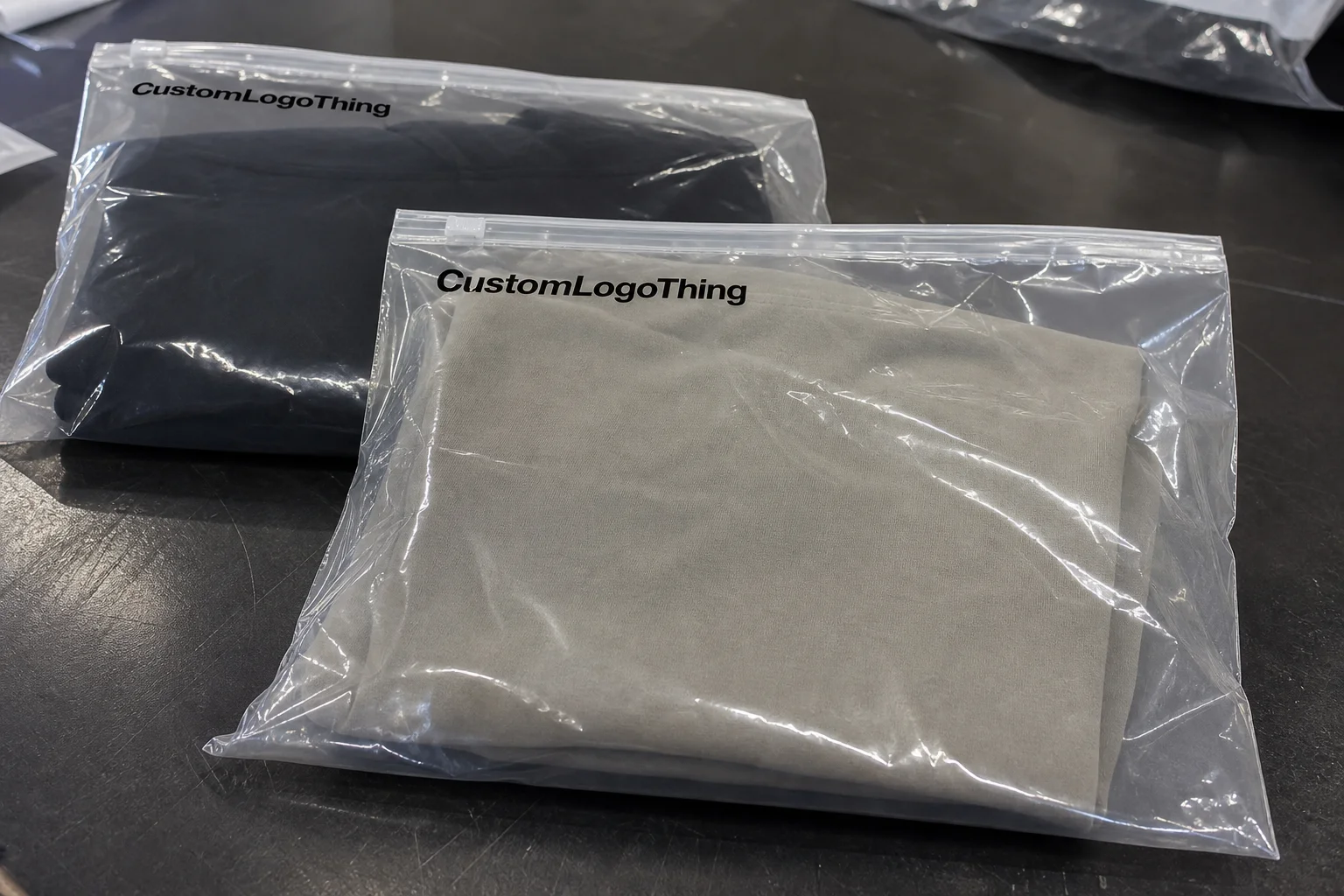
Streetwear packaging is not judged like industrial packaging. It is judged like merchandise. The bag sits on a shelf, in a pop-up, on a packing table, or inside a mailer, and people see the bag before they touch the tee, hoodie, cap, or accessory inside it. That first glance does a lot of work.
Clarity matters because the product needs to read as intentional. A transparent or lightly frosted bag lets the fold, label, and print do their job. A cloudy film, uneven zipper, or sloppy side seal makes the whole package feel less considered. Buyers notice that, even if they do not name it out loud.
For brands ordering Zip Lock Bags for Streetwear labels moq guide quantities, repeatability matters just as much as appearance. If the zipper closes the same way on every unit, packers move faster. If the bag holds its shape, garments stack cleanly. If the dimensions are right, you avoid overstuffing, which is one of the easiest ways to create wrinkles, split seals, and rejected pieces later in the chain.
There are three visible signals worth protecting:
- Clarity - the garment should remain visible enough to feel deliberate, not hidden.
- Seal quality - the closure should feel secure without slowing the pack line.
- Flat presentation - the bag should stack well and keep the fold under control.
Extra decoration does not always improve those signals. In many cases, more print coverage, oversized hang features, or complicated inserts raise cost without improving shelf presence. A tighter spec, a better zipper, and the right film weight usually do more. If the bag is part of a larger label and trim program, pairing it with matching branding on Custom Labels & Tags helps the line feel coordinated without adding clutter.
The cheapest bag is rarely the cheapest packaging choice if it creates repacking, damage, or a weak first impression at arrival.
A good bag should disappear into the brand story while doing a boring but important job. That is the ideal. Anything beyond that needs a reason.
Material and Closure Choices That Match the Brand
Material choice shapes both the look and the handling feel. Clear PE is the standard workhorse because it gives visibility, folds neatly, and keeps unit cost under control. LDPE usually feels softer and more flexible, which helps when the garment is thicker or when the brand wants the bag to drape rather than crease sharply. Frosted film has a more curated look, but it can mute visibility and usually costs more than clear stock.
Closure style changes the user experience more than many buyers expect. Press-to-close zippers are common because they are quick to run through a pack line and easy to reclose. Slider closures feel more premium and can be easier for end users, but they add cost and often require more care during setup. Reinforced seams help when the bag needs more puncture resistance, especially for accessories, pins, belts, or packaging inserts with edges.
For heavier hoodies, stacked sets, or bundled accessories, the first question should not be “Can we make the film thicker?” It should be “What fits the product best?” Sometimes a slightly wider bag or a small gusset solves the problem better than adding more gauge. That produces a cleaner pack, less trapped air, and fewer crushed corners in transit.
Most streetwear brands also need some kind of branding zone. A logo, barcode, care note, or SKU mark can sit on the bag, but placement has to respect the zipper line and the side seals. If the artwork crowds those edges, print quality usually suffers. For buyers managing labels, tags, and packaging together, consistency matters more than ornament. A bag that shares the same visual language as the rest of the set feels intentional.
Sustainability claims deserve proof. If a supplier mentions recycled content, recycled resin, or paper-based components in a broader packaging program, ask exactly what is certified and what is just part of the material mix. If the job references certified sourcing, the FSC site is the right place to understand what that claim actually covers. A logo on a quote sheet is not evidence.
Size, Gauge, and Print Specs to Lock Before Quote
Quotes get messy when the dimensions are loose. A supplier needs the bag width, usable length, seal allowance, and any gusset or bottom expansion before they can give a number worth trusting. For folded tees, a common starting point may be 10 x 13 inches or 12 x 16 inches, but the garment and fold style should decide the size. A generic template is only useful if it actually fits the product.
Gauge, or thickness, changes how the bag behaves on the line and on the shelf. Thinner film can work for light tees, but it tends to feel less substantial and may wrinkle more easily. Heavier gauges improve stiffness and puncture resistance, though they can also make the bag harder to fold and slightly increase freight weight. That tradeoff matters. Packaging cost is not only the unit price; it is also labor, shipping, and how well the bag behaves during packing.
Print is where many quotes become optimistic. One-color work is usually straightforward. Multi-color artwork, white ink coverage, tight registration, and edge-to-edge branding all introduce more setup, more proofing, and more room for mismatch. Tiny type and thin lines are common failure points. If the logo only looks good at perfect resolution on a screen, the print method may not like it nearly as much.
Buyers should ask for tolerances before the order is placed. Dimensional variation is normal in custom packaging, and zipper placement or side seal alignment can shift slightly from run to run. If the fit matters, request a blank sample first and test it with the actual folded garment. A similar item is not good enough when the pack is meant to sit flat and clean.
Distribution stress also deserves a reality check. Packaging is not only a visual product; it has to survive handling, stacking, and carton movement. Industry references such as ISTA are useful because they remind buyers that the shipping path can change how a bag performs. A spec that looks fine on a desk can fail once cartons are compressed, tossed, or stored too tightly.
Before asking for pricing, lock these details:
- Flat dimensions and usable internal size
- Film type and thickness in microns or gauge
- Closure style: press-to-close, slider, or reinforced seam
- Print colors, print area, and logo placement
- Bag color: clear, frosted, tinted, or opaque
- Any hang-hole, barcode, or label placement requirement
MOQ and Unit Cost: What Actually Moves the Price
MOQ is not random. It is the point where setup cost, material waste, printing prep, and production efficiency start to work together. For zip Lock Bags for Streetwear labels moq guide orders, the MOQ usually rises as the bag gets larger, thicker, or more decorated. A plain clear bag in a standard size can sit at a lower entry point than a custom-printed frosted bag with a slider closure and white ink.
The useful question is not “What is the cheapest quote?” It is “What is included in this quote?” A proper comparison separates the bag spec, decoration method, sample cost, tooling or plate charges, setup charges, and freight. Without that breakdown, the number on the page can be misleading. A lower unit price can hide expensive artwork prep or a shipping method that wipes out the savings.
| Spec Type | Typical MOQ Pressure | Indicative Cost Range | Buyer Impact |
|---|---|---|---|
| Plain clear PE, standard size | Lower | $0.08-$0.16 per piece at higher volumes | Good for testing drops and core basics |
| Frosted film, custom size | Medium | $0.12-$0.24 per piece | Stronger premium feel, higher setup discipline needed |
| Printed bag, one to two colors | Medium to higher | $0.18-$0.32 per piece depending on volume | Better branding, more proofing and setup charges |
| Slider closure or specialty feature | Higher | $0.25-$0.45+ per piece | Convenient and premium, but less price-flexible |
Those figures are directional, not fixed. Thickness, artwork coverage, carton count, and shipping lane can move them quickly. A 5,000-piece order and a 20,000-piece order can have very different economics even if the bag looks similar. Bulk pricing usually improves with volume, but only if the spec stays efficient. Oversized bags, narrow lead times, and complex artwork can erase the advantage surprisingly fast.
Ask for the comparison in writing:
- Unit cost at each quantity tier
- Sample cost and whether it is refundable
- Tooling fees or plate charges
- Setup charges for print and zipper configuration
- Freight method and packing count per carton
That is the only way to tell whether the MOQ is reasonable or padded. A supplier who cannot explain why the order floor sits where it does is usually telling you something, even if the answer is indirect.
Production Steps and Turnaround from Proof to Ship
A clean production flow protects both timing and accuracy. The job should start with a brief intake, move to a digital proof, then a blank sample or pre-production check if needed, followed by production, inspection, packing, and dispatch. If a supplier skips those steps or compresses them too much, errors usually show up later as misprints, zipper problems, or carton mix-ups.
The biggest delay is often not the machine time. It is approval. Missing artwork dimensions, unclear logo placement, late sample sign-off, and last-minute revisions all add time. Buyers who treat proofing as part of production instead of an internal side task usually get better results. The schedule becomes easier to trust once the spec sheet is complete and the file is final.
For smaller custom runs, timing can be reasonable if the job is straightforward. For more complex work, a realistic lead time may be 12-15 business days from proof approval, then additional time for freight. Larger quantities or specialty closures can stretch the window further. Rush requests are possible in some cases, but they usually create pressure somewhere else, often on cost or flexibility.
Good suppliers handle the handoff details that buyers do not want to chase. That means tracked approvals, clear proof notes, carton packing counts, and direct communication about ship windows. If a sample is available, use it for function testing, not just appearance. Check zipper feel, seam strength, fold fit, and whether the garment sits flat without trapped air.
The practical rule is simple: work backward from the launch date and include a buffer. Packaging rarely fails loudly at the quote stage. It fails quietly in the calendar, when artwork is still moving after the bag slot has already been reserved.
What a Good Supplier Must Deliver Besides the Bag
A supplier is not just a price source. It is a risk filter. The better ones reduce mistakes by checking artwork, confirming dimensions, flagging weak specs, and documenting the run clearly. That matters because color stability, seal consistency, and repeatable sizing are what keep a reorder from becoming a new project.
Trust is measurable. Response time matters. Proof accuracy matters. Production documentation matters. If the supplier can tell you what was approved, when it was approved, and how it was packed, you are dealing with someone who understands replenishment, not just one-off sales.
Operational support matters too. A good supplier should be able to explain how the bags will be carton-packed, how many go into each inner bundle, and whether the packing format matches your warehouse workflow. For streetwear brands that reorder often, those details save time at receiving and reduce counting errors.
Quality control should not be hand-wavy. Ask how defects are measured and what happens if the run misses spec. Even if the exact inspection method changes by factory, buyers should expect a documented process for checking seals, print registration, and size tolerances. If the supplier cannot describe the inspection step in plain language, the quote is incomplete.
Reorder discipline is easy to overlook and expensive to ignore. Once a bag spec is approved, the supplier should be able to retrieve the file, match the prior quantity tier, and quote the next run without rebuilding the job from scratch. That is where packaging starts to pay back the time invested in setup.
For brands building a broader presentation system, the bag should work with labels, tags, and packaging inserts as one set. The line should feel planned. If it looks assembled by accident, the customer notices that too.
Next Steps to Request a Quote Without Rework
If you want a fast, accurate quote, send a spec sheet instead of a loose description. Include dimensions, material preference, thickness, closure style, print colors, quantity bands, target ship date, and whether the bag is for tees, hoodies, accessories, or a boxed set. The more complete the brief, the less likely you are to get a quote that needs six clarifications before it can move.
Ask for a blank sample if the fit or zipper feel matters. Ask for a printed proof if artwork placement affects how the product reads on shelf or online. Ask for a quote that separates unit cost, sample cost, tooling fees, setup charges, and freight. Those lines are the only way to compare options cleanly.
For buyers comparing Zip Lock Bags for streetwear labels moq guide options, the right move is to treat packaging like part of the product spec, not an afterthought. If the bag supports the garment, the fold, and the launch schedule, it earns its place. If it does not, the lowest price will still be expensive once mistakes, repacking, and delay are added back in.
Send the exact brief, confirm the sample path, and ask the only question that matters: does this quote match the real bag you need, or only the rough idea of one?
What MOQ should I expect for zip lock bags for streetwear labels?
MOQ usually rises with larger sizes, thicker film, and more print colors, so ask for tiered pricing instead of one flat number. If you are testing a drop, request a lower first-run quantity and confirm whether repeat orders can use the same setup.
Can I approve a sample before ordering zip lock bags for streetwear labels?
Yes. Ask for a blank sample to verify fit and zipper feel, then a printed proof if artwork placement affects the final look. Use the sample to check clarity, seal quality, and whether the garment folds correctly inside the bag.
Which material is best for streetwear label zip lock bags?
Clear PE or LDPE works for most retail presentation because it keeps the garment visible and looks clean on shelf. Choose frosted or heavier-gauge film when the brand wants a more premium feel or the product needs extra puncture resistance.
How long do custom zip lock bags for streetwear labels take to produce?
Timing usually depends on proof approval, sample sign-off, production volume, and freight method. Rush orders are possible in some cases, but incomplete artwork or changing specs will slow the schedule.
What details do you need for a quote on streetwear label zip lock bags?
Send flat dimensions, material preference, thickness, closure style, print colors, quantity bands, and target delivery date. If you already have artwork, include the file format and any placement notes so the first quote is accurate.


