Most buyers start searching for Slider Lock Bags for boutiques cost breakdown after a quote lands higher than expected for a bag that looks ordinary. That surprise is understandable. A slider bag appears simple, but the price is built from a stack of decisions: film grade, thickness, dimensions, closure quality, print coverage, and how many units are being produced.
The mistake is treating packaging as if it were a uniform commodity. It is not. Two bags that look similar on screen can behave very differently in hand, on a shelf, and in transit. One seals cleanly and keeps its shape. Another scuffs easily, clouds under light, or feels weak at the track. The cheap one may only be cheap because the hidden costs have not shown up yet.
That is why the useful question is not “What is the lowest bag price?” The better question is “What is the lowest total cost for a bag that protects the product, supports the brand, and does not create returns or repacking labor?” Once you ask it that way, the quote starts making more sense.
Good pricing comes from good specifications. Vague requests produce vague numbers. “Nice packaging” is not a specification, and neither is “premium look.” If you want accurate bulk pricing, the supplier needs dimensions, material preference, thickness target, closure style, print method, and quantity before the math can be trusted.
Why boutique buyers overpay for simple slider bags
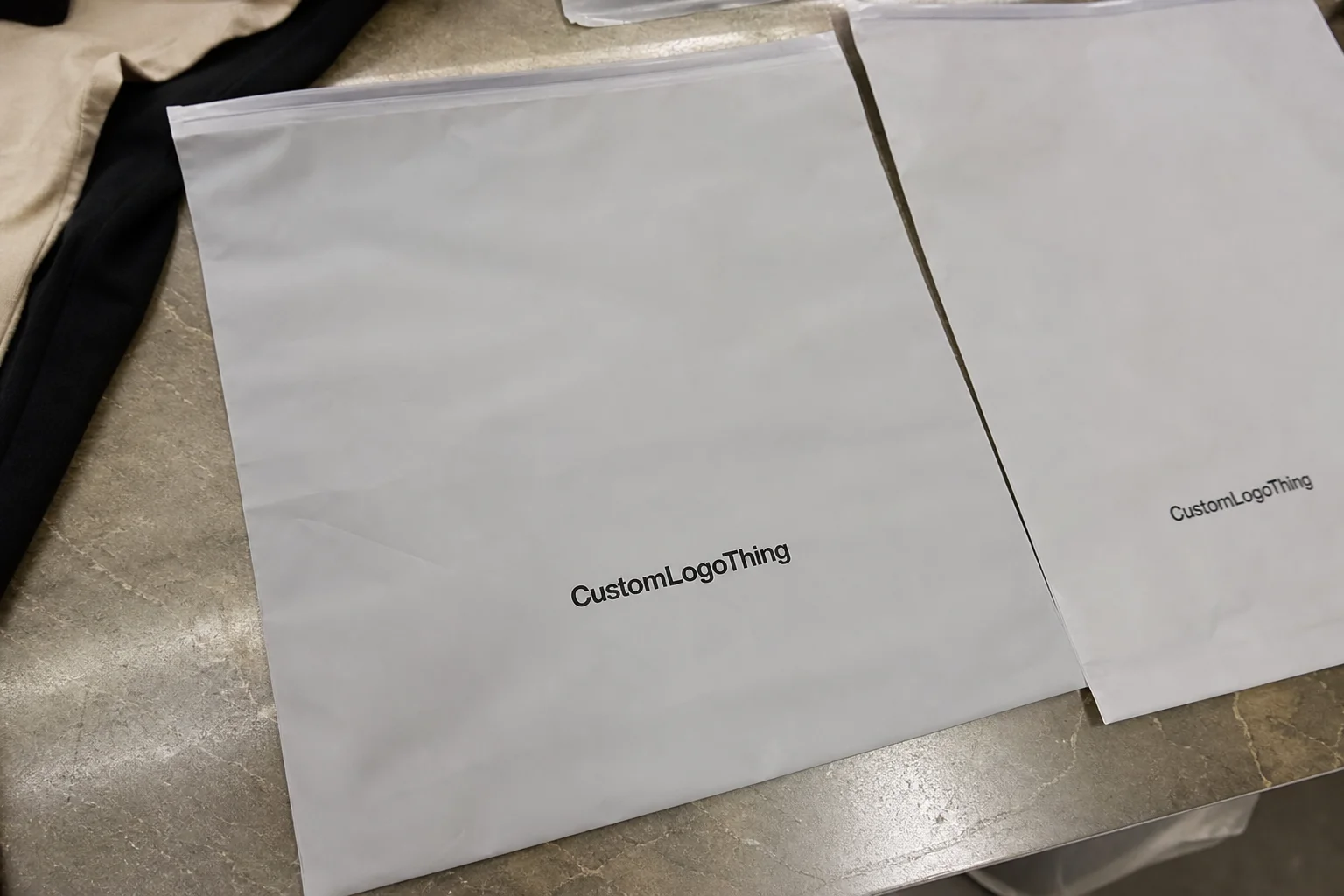
Boutique buyers often overpay because the bag looks basic. A clear slider bag does not signal complexity, so the quote can feel inflated even when it is perfectly normal. The price is usually doing exactly what the spec tells it to do. Standard polyethylene, frosted film, heavier gauge material, custom sizing, and tighter sealing all push the cost in different directions.
The second problem is weak sourcing language. Buyers ask for “a clear Bag with Logo,” then receive a price that bundles setup, tooling, freight assumptions, and print method into one number. That number may be real, but it is not useful until the components are visible. A clean quote should show what is being paid for and what is being reused from a previous run.
For boutiques, the value of the bag is not limited to containment. It affects presentation, damage rates, and how the product feels when a customer opens it. A well-built resealable bag can make apparel, accessories, gift sets, or cosmetics look intentional without turning packaging into a line item that swallows margin.
If the order cannot be described in numbers, somebody is about to pay for assumptions.
Thin film, poor seals, or a weak slider mechanism create a different kind of expense. Bags split in shipping. Product edges press through the film. Customers struggle to reopen the closure and stop trusting the packaging. Then the business saves a few cents on the unit and spends far more correcting the experience. That is not efficiency. It is just deferred cost.
For buyers who care about shipping performance, transport standards matter more than a glossy image on the quote sheet. Independent references such as ISTA are useful when evaluating how a package behaves in movement, vibration, and stacking. If packaging uses paper inserts, swing tags, or outer cartons, material claims may also intersect with FSC certification. Different materials, different compliance questions, different cost effects.
In practice, the “too expensive” quote is often just the first honest quote. The lower one may be missing something critical: thicker film, a better slider, a print setup charge, or freight that has not been calculated carefully. Those omissions look attractive right up until the order lands badly.
Product details that change the final bag cost
Slider Lock Bags are built from choices that matter more than their size suggests. Film type is the first lever. Clear polyethylene is usually the lowest-cost option and works well for straightforward retail use. Frosted film adds a softer visual finish and tends to cost more. Opaque or specialty films move the price up again because they change both material usage and production handling.
Thickness is the next major variable. Lightweight film can be enough for small accessories, short-term display use, or secondary packaging. Heavier-gauge material creates a more structured feel and generally improves puncture resistance, but it uses more resin and can increase shipping weight. For boutique packaging, the difference between “adequate” and “polished” is often a small increase in thickness, not a dramatic redesign.
Closure hardware matters more than buyers expect. A standard slider is fine for many uses. A reinforced slider, a smoother track, or a tighter engagement mechanism costs more, but it usually feels better in the hand and reduces the chance of the bag failing after repeated opening. If the bag is meant to be reused by the customer, that detail is not cosmetic. It affects value.
Shape changes cost as well. Straight-sided bags are easier to manufacture. Gusseted bags require additional material and more careful control during production. Stand-up formats, hang holes, and custom bottom geometry all add complexity. None of this is mysterious. It is material, labor, setup, and scrap rate moving in the same direction.
Print is where many boutique orders drift upward. No print is simplest. A one-color logo is often the most economical branding choice and can still feel premium if the layout is restrained. Full-color artwork, metallic ink, or white ink on tinted film adds setup work and more points of failure. The more the design asks the factory to do, the more the quote has to cover.
- No print: lowest setup burden, useful for stock use or temporary events.
- One-color logo: common middle ground for boutiques that want brand presence without overspending.
- Full-color print: stronger visual identity, higher setup cost, less tolerance for artwork mistakes.
- Special finishes: matte, frosted, and opaque builds usually cost more than clear film.
Several smaller choices also move the price: custom size, hang hole shape, tamper evidence, upgraded tracks, and color-matched sliders. None of these looks dramatic on a quote, but together they can move an order out of a budget tier. The biggest error is assuming each add-on is trivial because each one is small. They accumulate fast.
A cheaper bag can still be the more expensive choice. If it causes damage, repacking, or a weaker first impression, the unit savings vanish. The useful standard is not “lowest price.” It is “lowest cost for the spec that actually works.” That distinction matters more in boutique retail than in almost any other packaging category.
Specification checklist: size, thickness, and closure type
Accurate quotes begin with measurement. Product name alone is not enough. Give width, length, and gusset depth if the item has volume. If the product includes folds, hardware, texture, or irregular edges, the bag needs enough room to accommodate the real shape, not the idealized one. A bag sized too tightly can look cramped even before it is filled.
Thickness is usually stated in mils. Thin bags can work for lightweight goods, but they often look less substantial and are more vulnerable to puncture. Increasing thickness improves structure and protection, although it raises raw material cost and sometimes freight weight. In boutique packaging, a modest increase in gauge is often one of the best returns on spend because the visual difference is immediate.
Closure quality deserves its own line in the spec sheet. Standard sliders are acceptable for many applications. Better sliders reduce friction, close more consistently, and feel less fragile during repeated use. If the closure is hard to align or feels loose, customers notice immediately. That kind of failure is not subtle.
Use a measurement rule that actually works
Measure the product first, then add allowance for insertion, closure, and presentation. Do not size to the smallest possible fit unless the product is rigid and the intended look is intentionally tight. Most boutique items need a little margin. Without it, the bag looks pinched, the film distorts, and the package loses the clean profile buyers want.
Apparel usually needs more allowance than people assume because folded garments rebound and trap air. Cosmetics and rigid items need less room, but they still need edge protection. Gift sets are their own category; the combined footprint of the contents matters more than any single component. The bag must fit the group, not just the largest item inside it.
Ask for samples before bulk approval
Sample review is not busywork. The same specification can feel very different depending on clarity, seal strength, slider action, and print coverage. A sample or swatch pack lets you check the actual build before the order is locked. That is a low-cost way to avoid expensive disappointment later.
If a supplier cannot support sample review, treat that as a signal to slow down. It is not always a deal-breaker, but it usually means the quote should be checked more carefully. A clean sample often reveals the small things that matter most: cloudy film, poor tracking, weak seals, or artwork that looks louder than expected.
For repeat orders, keep the approved sample and compare it against the next production run. Small shifts in transparency, seal finish, or slider feel are easy to miss if nobody is checking against a reference. Packaging quality drifts when the spec becomes memory instead of documentation.
Slider lock bags for boutiques cost breakdown by order size
The most practical way to view Slider Lock Bags for boutiques cost breakdown is by order size, not by guesswork. In small runs, setup and production prep are spread across fewer units, so the per-piece price rises quickly. In larger runs, the fixed work gets diluted and the unit cost drops. That is normal packaging economics, not a supplier trick.
For boutique buyers, the quote is usually a combination of unit cost, decoration cost, setup charges, tooling, and freight. Depending on the route and the spec, taxes or duties may also appear later. When those pieces are separated, a “higher” quote often turns out to be more transparent rather than more expensive. Transparency is worth something, because it shows where the money is going.
Here is a practical pricing range to use as a benchmark. These are directional numbers, not promises. Final pricing depends on size, film grade, print coverage, and where the order ships.
| Order size | Typical spec | Approx. cost per piece | What usually drives the price |
|---|---|---|---|
| 1,000 to 3,000 | Standard clear bag, light print or no print | $0.28 to $0.65 | Setup charges, low-run efficiency, freight spread over fewer units |
| 5,000 to 10,000 | Clear or frosted, one-color logo, standard slider | $0.18 to $0.38 | Better material utilization, lower setup burden per unit, more efficient production |
| 20,000+ | Custom size, printed branding, upgraded closure options | $0.09 to $0.24 | Lower unit cost, but tooling and freight still affect the total |
Use the table as a check against reality. A tiny accessory bag and a large gusseted apparel bag are not interchangeable, even if both use a slider closure. A one-color logo and a full-color print are different processes. Add special finishes or upgraded hardware and the quote moves again. The unit price only makes sense inside the full spec.
A useful tactic is to request two versions of the same bag. One can be the budget build: standard clear film, no print, basic slider. The other can be the premium build: heavier gauge, one-color logo, better closure. Side by side, the tradeoff becomes obvious. In many cases, the premium version only adds a small amount per unit, but the perceived quality jumps much more than that.
That comparison also exposes where the real cost lives. Sometimes the print is cheap, but the setup is not. Sometimes the bag itself is inexpensive, but the freight or packaging format turns the order into a poor fit for the budget. A line-item quote is the only honest way to see it.
Ordering process and lead time from quote to delivery
The quoting process should be straightforward. Send the dimensions, material preference, print file, quantity target, and delivery deadline. The supplier confirms the spec, issues a proof, and sends a sample if the order is new or high-visibility. After that, production begins. If any of those steps are missing or fuzzy, delays are almost guaranteed.
Lead time depends on quantity, artwork complexity, sample approval speed, and shipping method. A reorder with approved tooling moves faster because fewer variables need to be checked. A first-time custom run takes longer because the factory has to verify the film, print placement, closure behavior, and packout before it can commit to volume.
Typical production time for a straightforward order is often 12 to 20 business days after proof approval. That range can stretch if the job requires new tooling, unusual film, or multiple artwork revisions. Shipping adds another layer. Air freight shortens transit time but raises cost. Ocean freight lowers per-unit transit cost but adds calendar time and more points of delay.
What slows orders most often is not the run itself. It is incomplete information. Missing dimensions, late artwork files, unclear approval chains, and last-minute spec changes waste time fast. If the launch date matters, ask about production slot availability and transit estimates before the final approval. That question prevents a lot of false certainty.
- Request a quote with full specs.
- Review the proof and confirm print placement.
- Approve a sample if the order is first-time or high-visibility.
- Lock the production slot and confirm shipping terms.
- Track the order against the launch date, not against hope.
There is also a practical QC point here. Ask how the supplier checks seal integrity, slider alignment, and print registration before shipment. A lot of packaging problems are not dramatic failures; they are small defects repeated across a whole run. One crooked print can be ignored. Fifty thousand crooked prints cannot.
Why custom packaging specs beat generic retail bags
Generic retail bags are fine until they are not. They can be cheaper on paper, but they often waste space, miss the brand look, or create inconsistent presentation from one product to the next. For boutiques, that inconsistency shows up quickly. A product line that looks carefully built should not be held in packaging that feels borrowed.
Custom specifications tighten the fit. Better fit means less excess material, less movement inside the bag, and fewer workarounds such as extra labels, tissue, or fillers to make the package feel intentional. Those workarounds cost money too, even if they never appear in the packaging line item.
There is another advantage that buyers often underestimate: consistency across collections. Customers notice when one item ships in a clear bag, another in a cloudy bag, and a third in a size that barely closes. The brand starts to look uncoordinated. A proper spec sheet keeps the packaging language stable, which matters more for boutiques than for mass-market sellers.
Custom packaging also helps when the product itself is not easy to fit. Cropped apparel, textured accessories, boxed sets, and items with hardware all benefit from a size made around the actual merchandise rather than a generic retail template. The bag works harder when it is built around the item instead of the other way around.
The strongest argument is often repeat-use value. A good slider bag can be reused by the customer, which extends the brand impression beyond the original purchase. That does not mean every bag needs to be overbuilt. It means the film and closure should match the product and the expected handling. Overengineering is wasteful. Underengineering is worse.
Custom specs also reduce argument later. There is less confusion about what was approved, what was shipped, and what should have arrived. Clear documentation is not glamorous, but it protects both margin and timeline. That is the sort of benefit that only shows up when something goes wrong.
If you are comparing suppliers, compare the exact same spec. Not a similar one. Not “close enough.” The same one. Otherwise, the pricing comparison is just a race between different assumptions, and assumptions do not manufacture well.
Next steps to price your boutique bag order accurately
Before requesting quotes, gather the facts: product dimensions, product weight, desired bag size, thickness target, print file, target quantity, and delivery deadline. If the bag will carry heavier items, say so. If the product is cosmetic, food-adjacent, or sensitive to scuffing, say that too. Useful quotes begin with useful inputs.
Then compare at least two versions of the same packaging. One should be the lowest-cost workable spec. The other should be the cleaner premium build. That comparison usually shows exactly where the extra money improves the bag and where it just adds noise. Buyers make better decisions when the tradeoff is visible.
Ask for a sample or swatch pack before committing to bulk. Film clarity, slider action, seal quality, and print feel are easier to judge in hand than on a screen. If the sample looks wrong, the fix is cheap at that stage. If the sample looks right, the order can move forward with much less risk.
The fastest route to a real quote is simple: product type, bag size, material preference, logo usage, target MOQ, and delivery deadline. Give those six items clearly and the pricing conversation gets cleaner immediately. Leave them out and the estimate turns fuzzy, which usually means more back-and-forth and a higher chance of ordering the wrong thing.
That is the real lesson behind Slider Lock Bags for boutiques cost breakdown. Price is not just a number pulled from a rate card. It is the result of the spec you choose, the run size you order, and the level of finish you actually need. Clear specifications lower waste, tighten unit cost, and make the order easier to approve, produce, and receive on time.
What affects slider lock bags for boutiques cost the most?
Bag size, film thickness, print method, and closure quality usually drive the biggest price changes. Lower MOQs also raise the unit cost because setup charges are spread across fewer bags.
What MOQ should a boutique expect for custom slider bags?
MOQ varies by size and print complexity, but smaller runs are usually possible at a higher cost per piece. If you want better bulk pricing, plan for a larger order or simplify the spec.
How do I choose the right size for boutique packaging?
Measure the product itself, then add enough allowance for closing and presentation. If the item has bulk, folds, or hardware, add more room so the bag does not look cramped.
Are printed slider lock bags worth the extra cost?
Usually yes if the bag is part of the customer experience or visible at checkout. Printing adds cost, but it can reduce the need for separate branded inserts or labels.
How long does production usually take after approval?
Lead time depends on quantity, artwork, sample approval, and shipping method. Simple reorders move faster than first-time custom orders with new specs or extra revisions.


