A cap can fail quietly. That is why a snapback Caps Sample Approval Checklist matters before anyone releases 5,000 units into bulk production.
The photo looks fine. The front logo seems centered. The supplier says the sample is ready. Then the shipment arrives with a brim that waves slightly, a crown that sits 8 mm shallower than expected, or embroidery that puckers under store lighting. One defect feels small. Multiplied across cartons, it becomes inventory risk, rework, delayed launches, and awkward conversations with sales teams.
Sample approval is not a ceremonial thumbs-up. It is the last controlled checkpoint before the factory starts repeating the same decisions at scale.
Why a Sample Approval Checklist Prevents Expensive Surprises
A snapback Caps Sample Approval Checklist is not paperwork for people who enjoy paperwork. It is a risk control tool. After approval, the factory is no longer testing. It is buying materials, scheduling labor, setting machines, preparing trims, packing cartons, and producing against the approved reference.
That distinction matters. A 2 mm logo shift on one sample is a note in an email. On a retail wall, in a team photo, or in a product launch shoot, it becomes a brand consistency problem. Caps are inspected at face level. People touch them, bend the brim, try them on, photograph them, and judge them from three feet away. Tiny inconsistencies travel fast.
From a buyer's point of view, sample approval checks five things at once:
- Physical construction: crown height, panel symmetry, brim shape, stitching, closure strength, and sweatband quality.
- Branding accuracy: logo size, placement, thread color, patch finish, label content, and artwork registration.
- Comfort and fit: head feel, crown depth, back opening, snap tension, and fabric stiffness.
- Packaging readiness: hang tags, polybags, carton marks, barcode labels, retail presentation, and shipping protection.
- Commercial alignment: MOQ, unit cost, setup fees, production timeline, freight terms, and approved specifications.
Promotional buyers, merch managers, fashion startups, brewery merch teams, sports clubs, and agencies run into the same trap: the cap is treated as simple because it is familiar. Bad assumption. A snapback is a shaped textile product with branding on a curved surface. Tension, symmetry, decoration technique, fabric weight, and panel structure all interact.
Approval is not about being difficult with the factory. It is about making decisions visible, measurable, and repeatable before changes become expensive.
The strongest checklist turns “looks good” into “front logo is 68 mm wide, centered on the front seam, 22 mm above the brim seam, with no visible puckering under daylight.” That is control. “Looks good” is hope wearing a nice shirt.
How Sample Approval Works Before Bulk Snapback Production
An approval sample is the physical reference cap that locks the agreed design, construction, color, logo application, trims, labeling, and packaging approach. Once approved, quality control teams should compare bulk production against that cap, not against memory, screenshots, or a loose description buried in a message thread.
The usual flow is simple on paper. The buyer submits artwork and product specs. The supplier creates a digital mockup or pre-production proof. The factory makes the physical sample. The buyer inspects it, requests revisions if needed, and gives final written approval. Bulk production should start only after that approval is clear.
Not all samples mean the same thing. A prototype tests an idea, often before materials and trims are final. A counter sample attempts to match an existing reference cap. A pre-production sample becomes the production standard. A shipment sample checks finished goods after the bulk run is underway or complete.
Photos help. They are not enough for most custom snapback programs. Brim stiffness, crown height, sweatband feel, closure tension, embroidery texture, and cap balance need hands-on inspection whenever practical. A cap can look crisp in a front-facing image and still feel cheap if the brim board is too thin or the sweatband is rough.
Factories need written approval because it creates a reference point. If bulk units later vary, both sides can ask a grounded question: does this match the approved sample? Strong suppliers often keep one approved sample at the factory and send one to the buyer, so production teams and brand teams compare against the same physical benchmark.
A practical snapback caps Sample Approval Checklist should reference the sample version, artwork file, Pantone or fabric swatch, decoration method, packaging plan, and quoted production quantity. If one of those changes after approval, treat it as a new decision. Small changes have a bad habit of becoming large invoices.
Specs to Check: Crown Shape, Brim, Panels, Fit, and Closure
Start with the crown. Did you request high-profile, mid-profile, or low-profile? A high-profile snapback may sit around 16-17 cm from brim seam to top button, while a lower crown may sit closer to 14-15 cm depending on block shape. Those ranges vary by supplier, so measure the sample against the agreed spec instead of trusting category names.
Then look at how the cap behaves. Does the front panel collapse when placed on a table? Does the crown bulge near the top button? Does it sit too tall on an actual head? Structured buckram, foam-backed panels, cotton twill, polyester, wool blend, corduroy, mesh, and recycled fabrics all behave differently under tension.
Panel symmetry deserves more attention than buyers usually give it. Six-panel snapbacks reveal uneven stitching quickly, especially around the center seam, side seams, and eyelets. A cap that looks slightly twisted on a table often looks worse on a model because the face gives your eye a reference line.
The brim needs its own inspection. Check curvature, stiffness, edge alignment, stitch spacing, and underbrim finish. A flat brim should remain flat without rippling. A curved brim should bend evenly without one side dipping lower. Many snapbacks use 6-8 rows of brim stitching; if spacing wanders, the cap can look lower grade even when the fabric is acceptable.
Fit is not solved by an adjustable snap alone. Try the sample on several actual heads if possible. Crown depth, sweatband thickness, inner seam bulk, and the back opening shape affect comfort more than buyers expect. A cap can technically fit a 58 cm head and still feel wrong because the crown presses at the front or the closure sits too high.
Closure quality is small but commercial. Inspect plastic snap spacing, button alignment, hole strength, color match, and how securely the snap holds when pulled. Open and close it 10-15 times. Cheap snaps often reveal themselves through whitening stress marks, weak grip, sharp edges, or inconsistent molding.
| Checkpoint | What to Measure or Confirm | Typical Buyer Risk |
|---|---|---|
| Crown profile | Height, structure, collapse resistance, fit on head | Cap looks taller, shallower, or cheaper than approved design |
| Brim | Width, stiffness, curve, edge stitching, underbrim color | Warped shelf appearance or inconsistent retail photos |
| Panels | Seam alignment, eyelet position, fabric tension | Twisted front view or uneven logo placement |
| Closure | Snap grip, spacing, color, stress marks | Returns, poor fit, or caps opening during wear |
Use a simple rule: if the cap cannot sit correctly, close securely, or hold its shape, branding approval should wait. Decoration can only improve a sound base cap. It cannot rescue bad construction.
Logo Decoration Checks: Embroidery, Patches, Printing, and Labels
Decoration creates the most visible failures because it sits where people look first: the front panel. Check the sample under daylight, indoor lighting, and camera flash if the cap will be promoted online. Thread sheen changes under light. So do rubber patches, faux leather patches, and heat transfers.
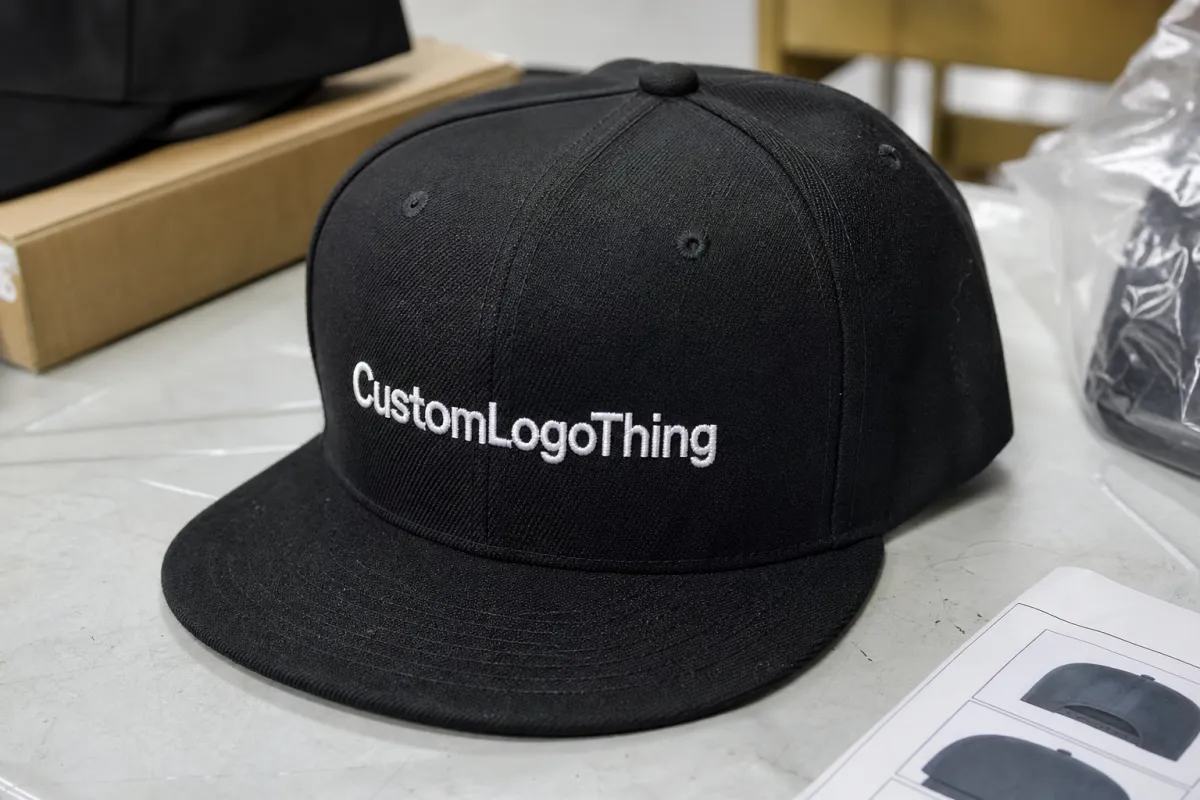
For embroidery, inspect stitch density, thread color, thread sheen, edge sharpness, small-letter readability, registration, backing residue, and puckering around the logo. Dense embroidery on a thin front panel can distort the cap if the fabric is not stabilized correctly. A logo with small text under 5 mm tall may need simplification, especially on textured twill or corduroy.
Measure logo placement from fixed points. Use the brim seam, center seam, and panel edges. “Looks centered” is weaker than “logo is 70 mm wide and centered on the front seam, with the bottom edge 24 mm above the brim seam.” That measurement should be easy to repeat during inline quality checks.
For woven patches, rubber patches, leather patches, and PVC badges, check patch size, edge finish, placement, attachment method, color accuracy, and whether the patch curves naturally with the crown. A stiff patch on a curved front panel can lift at the corners if the backing, adhesive, or stitch-down method is wrong.
For screen printing, heat transfer, or sublimation, inspect opacity, cracking risk, stretch behavior, color match, and whether the print sits cleanly over seams or textured fabric. Heat transfers can look sharp on day one but fail bend tests if the film is too rigid for the fabric. Ask for the decoration method in writing, not just “printed logo.” That phrase hides too much.
Labels and trims belong in the same inspection. Inner tags, hang tags, size stickers, brand labels, care labels, barcodes, polybags, and carton marks all need approval before scale-up. If the cap is for retail, barcode readability and carton labeling are not afterthoughts. They are part of inventory control.
For packaging-related requirements, buyers can borrow discipline from transit testing. The International Safe Transit Association publishes testing frameworks at ista.org. Not every cap order needs formal ISTA testing, obviously, but the mindset is useful: define the condition goods must survive before they move.
Buyer-friendly rule: if the logo looks acceptable only from one angle, it is not approved yet.
Process, Timeline, and Lead Time from Sample to Production
The sample stage often takes longer than buyers expect because it includes invisible work. The factory may need to source the correct fabric, match thread colors, test embroidery files, confirm closure hardware, cut panels, sew the cap, apply decoration, pack the sample, and ship it internationally.
A realistic flow can look like this: 1-3 business days for artwork review, 2-5 days for material confirmation, 1-4 days for digitizing or patch setup, 5-10 days for sample making, 2-7 days for courier delivery, and 1-3 days for buyer inspection. Complex patches, private labels, unusual fabrics, or special packaging can push that further.
Simple embroidered snapbacks usually move faster than caps with multi-material patches, custom underbrims, private woven labels, retail hang tags, and custom cartons. A leather patch may require tooling. A PVC badge may require a mold. A custom jacquard label may have its own MOQ. Each detail adds a decision point.
Revision cycles matter. One round may fix logo size. Another may adjust crown height. Each round protects the bulk order, but it adds time when physical resampling is required. That is not automatically bad. Spending 7 extra days before production can prevent 5,000 flawed units from arriving 45 days later.
Separate critical launch dates from preferred dates. Trade shows, retail drops, influencer campaigns, brewery releases, and team events need buffer time because shipping, customs, and final inspections can compress the schedule. If the event date cannot move, the design may need to simplify.
Use a disciplined approval window. Review the sample the same day it arrives. Photograph every concern. Mark measurements clearly. Send one consolidated revision list instead of scattered comments across five emails. Faster approval does not mean rushed approval; it means the factory can act without guessing.
Cost, MOQ, and Pricing Details to Confirm Before Approval
Sample approval is also a pricing checkpoint. A cap may look perfect, but if the approved version quietly includes heavier fabric, extra embroidery stitches, custom trims, or special packaging, the unit cost can shift. This is where buyers get surprised, then annoyed, then strangely quiet.
Verify the sample fee, digitizing fee, mold or patch setup fee, custom label cost, packaging cost, freight, duties, rush charges, and whether the sample fee is refundable or credited against bulk production. For a moderate custom run, buyers may see sample fees in the $40-$120 range, embroidery digitizing around $20-$75, and custom patch tooling anywhere from $60-$250 depending on material and size. These are working ranges, not guarantees.
MOQ needs honesty. Some suppliers can sample one cap, but bulk pricing may depend on minimum quantities for fabric, closures, patches, labels, or carton printing. A 144-piece order, a 500-piece order, and a 5,000-piece order do not have the same economics. The approved sample should match a production plan the factory can repeat at the quoted MOQ.
Stitch count affects cost. Large, dense embroidery raises machine time and thread use. A 12,000-stitch front logo can cost meaningfully more than a 5,000-stitch logo, especially across thousands of caps. Patches may add setup cost but improve consistency across larger runs because the badge is produced separately and applied repeatedly.
Compare quotes on the same specification. A cheaper quote may exclude inner labels, use lighter fabric, simplify embroidery, swap the closure, or ship in generic packaging. From a procurement view, the lowest unit price is not always the lowest total cost if resampling, delays, rework, or rejected inventory enter the equation.
| Cost Item | What to Confirm | Why It Affects Approval |
|---|---|---|
| Embroidery digitizing | One-time fee, stitch count, file ownership | Changes logo texture, cost, and repeatability |
| Patch setup | Mold, woven artwork, leather debossing, PVC colors | Can add setup cost but improve consistency |
| Private labels | MOQ, material, care content, country-of-origin text | Incorrect labels can block retail use |
| Packaging | Polybags, hang tags, barcodes, carton marks | Packing errors create receiving and inventory problems |
| Freight and duties | Air, ocean, courier, landed-cost assumptions | Unit price alone does not show total cost |
Ask for a final cost sheet tied to the approved sample number or revision date. Commercial approval and physical approval should point to the same product. A snapback caps sample approval checklist that ignores price is incomplete.
Common Sample Approval Mistakes That Create Bulk Order Defects
The first mistake is approving from a single front-facing photo. A snapback has multiple risk zones: side panels, back closure, crown height, brim edge, inner sweatband, underbrim stitching, and packaging. The front view is only one witness.
Vague feedback causes the next problem. “Make the logo better” tells the factory almost nothing. Use measurable instructions: increase logo width by 5 mm, lower placement by 3 mm, match the approved Pantone reference, reduce stitch density, or change thread sheen from glossy to matte.
Approving substitute materials is risky. If the sample fabric, closure, thread, patch backing, or sweatband material is not the same as bulk production, approval has limited value. Sometimes substitution is unavoidable during early prototyping, but final approval should use production materials whenever possible.
Packaging checks are often missed. Buyers inspect the cap carefully and forget hang tags, barcode labels, carton quantities, polybag warnings, and retail presentation until the order is already packed. For sustainability claims or paper-based packaging, verify sourcing language carefully. The Forest Stewardship Council explains certification basics at fsc.org, which is useful if hang tags or cartons carry FSC claims.
Over-correcting can also create defects. A cleaner logo may become too large for the panel. A stiffer brim may change cap balance. A tighter closure may feel secure but become uncomfortable. Every revision should be checked against the full product, not only the defect being fixed.
Internal alignment matters. Agencies, brand teams, procurement departments, and event managers should agree on one final decision-maker before comments reach the supplier. Conflicting notes waste time and increase the chance that the wrong revision gets produced.
Keep a rejection log. If puckering appears in three samples, that is not an isolated annoyance; it is a process signal. The checklist should capture repeated issues so the factory can address root causes, not just cosmetic symptoms.
Final Approval Next Steps: What to Send the Factory
Before saying “approved,” send a written approval message that references the sample version, approval date, artwork file, color standards, material specs, packaging requirements, MOQ, unit cost, and expected production timeline. A short email can prevent a long dispute.
Attach annotated photos of the approved sample, not only revision photos. Circle final logo placement. Show front, side, back, underbrim, inner label, sweatband, closure, hang tag, and carton mark references. Include measurement photos for crown height, brim width, logo size, and logo distance from the brim seam.
Document tolerated variation. Slight fabric shade variation may be acceptable within a defined range, especially between dye lots. Crooked embroidery, loose snaps, warped brims, incorrect labels, or missing barcodes should remain non-negotiable defects. Be clear about that before production begins.
Ask the factory to confirm that the approved sample is now the production standard and that quality control will compare bulk output against it. Then request a production schedule, confirm inspection timing, approve carton marks, confirm shipping method, and ask when the first finished units can be photographed or checked.
If the order is large or time-sensitive, consider an inline inspection after the first finished units come off the line. Even a small check at 5-10% completion can catch decoration drift, fabric substitution, or packaging errors before the full batch is packed.
A snapback caps sample approval checklist turns approval from a gut decision into a controlled handoff. It protects brand quality, factory clarity, and budget before mass production begins. Which is exactly the point. Fix the cap while it is still one cap.
FAQ
What should be included in a snapback cap sample approval checklist?
Include crown shape, panel symmetry, brim stiffness, brim stitching, closure strength, fabric color, logo placement, embroidery or patch quality, labels, packaging, carton marks, MOQ, unit Cost, and Production timeline. Add measurable tolerances wherever possible, such as logo width, placement from the brim seam, Pantone references, and acceptable stitch quality.
Can I approve snapback caps from photos instead of a physical sample?
Photos can support approval, but they should not replace a physical sample for most custom snapback orders. Fit, brim feel, crown structure, sweatband comfort, and embroidery texture are hard to judge on screen. If photo approval is unavoidable, request close-ups, side views, back views, underbrim photos, measurements, natural-light images, and short videos showing structure and flexibility.
How many sample revisions are normal before approving custom snapback caps?
One to two revision rounds are common when artwork, materials, and cap style are already well defined. More rounds may be needed for complex embroidery, custom patches, unusual fabrics, private labels, or retail packaging. Repeated revisions usually signal that the initial specification was not detailed enough.
Does the approved snapback sample lock the final pricing?
It should, but only if the approved sample matches the quoted specifications exactly. Confirm whether pricing includes digitizing, setup fees, custom labels, packaging, freight, duties, rush charges, and any MOQ-based cost changes before releasing bulk production.
What is the biggest mistake buyers make during snapback cap sample approval?
The biggest mistake is approving the overall look without checking measurable construction and decoration details. A cap can look good at a glance but still have off-center embroidery, weak snap closure, uneven panels, wrong crown depth, mismatched thread, or packaging that does not meet retail or event requirements. Use a snapback caps sample approval checklist as the final filter before bulk production starts.