A Soap makers poly mailers custom size quote should start with the finished wrapped bar, not the bare soap. That sounds obvious until a label, sleeve, fold-over flap, or shrink wrap adds three-eighths of an inch to the thickness and turns a quote that looked perfect on paper into a bag that fights the packing line. The right mailer is not just a container. It affects speed, presentation, freight, and the number of damaged bars that come back as a quiet but expensive problem.
Soap is a strange category in packaging terms. It is firm enough to survive more than most cosmetics, yet it still scuffs, shifts, and bruises at the corners if the pack is loose or the seal area is short. Handmade bars make the job harder because the dimensions are rarely identical from batch to batch. A good spec accounts for that variation instead of pretending the bar is a rectangle with perfect edges.
Why a right-sized mailer prevents soap damage and waste
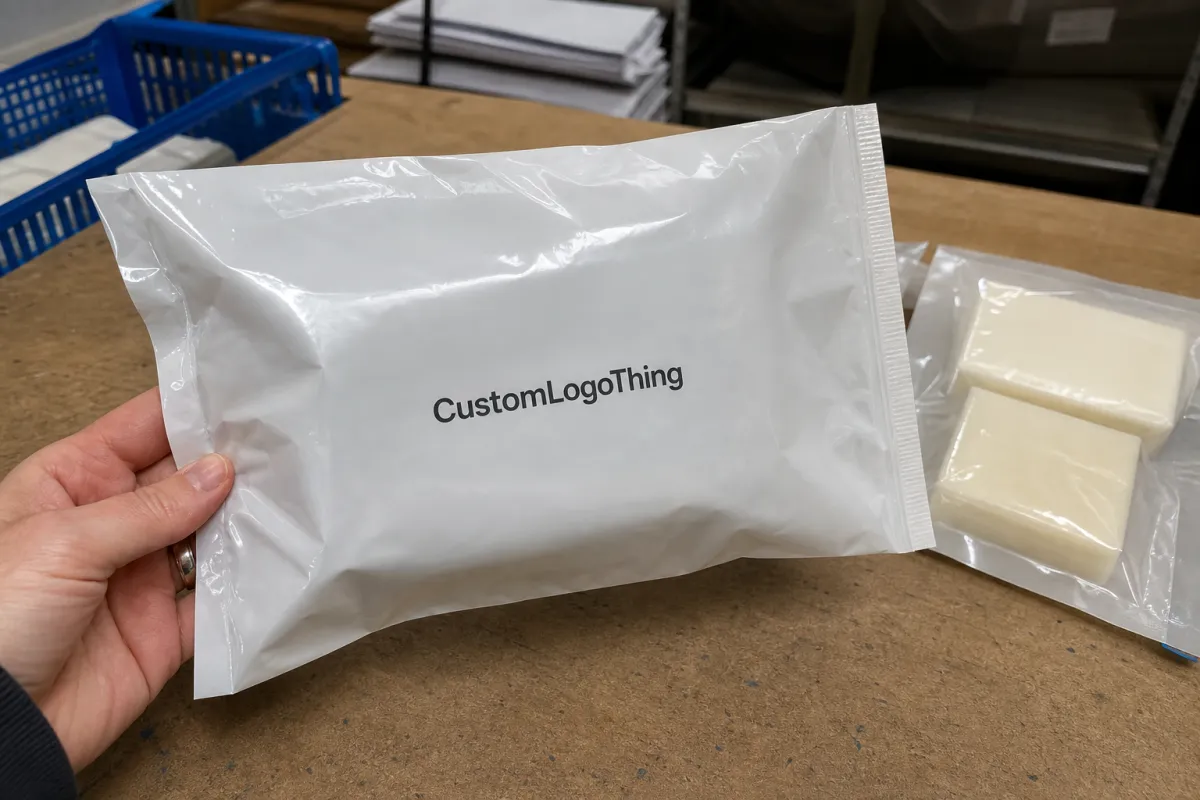
A mailer that is too large does more than waste film. It lets the bar move, which can crease paper sleeves, rub printed labels, and leave the customer with packaging that feels improvised. A bag that is too tight causes a different set of problems: slower loading, split seams at the mouth, and a seal that has little room for error if the product is inserted at an angle. Either way, the packer ends up compensating for a spec that should have been solved before the run started.
There is also a cost side that buyers sometimes underestimate. Oversized mailers use more resin, occupy more carton space, and usually cost more to ship by the case. On a small order that difference may look minor. Across several thousand units, the extra film and freight become easy to see. A correctly sized mailer can reduce filler, cut down on line adjustments, and make the finished product look more deliberate. That matters for soap, which already relies on texture, scent, and color for much of its appeal.
Bars with rounded edges or slightly uneven corners need a little more allowance than flat commercial soap. So do products wrapped in paper sleeves that trap air. The best spec aims for a snug fit without forcing the seal area to do the work of a second box. A bag that closes easily and still leaves the bar sitting flat usually wins over one that looks cheaper but turns into a bottleneck on the packing table.
A bag that fits the bar keeps the order looking deliberate, not improvised.
That is why a soap makers Poly Mailers Custom Size Quote usually begins with the wrapped dimensions, the desired fit, and the actual loading method. If the soap line also uses boxes for gift sets or bundles, it helps to keep the mailer spec aligned with the broader packaging system so one format does not fight another. The same logic applies whether the product is being sold online, tucked into a retail display, or packed as a subscription refill.
Film thickness, closures, and finish options for soap
Most soap mailers are made from LDPE or co-extruded poly film, and thickness is doing more work than it first appears. A 1.5 to 2.0 mil film can be fine for a compact bar with light handling, but many soap brands move into the 2.0 to 3.0 mil range because it holds shape better and resists corner punctures. That said, thicker is not automatically better. If the bag becomes too stiff, small bars can rattle in transit or feel bulky at the shelf.
Closure style matters just as much. A permanent self-seal is fast on the packing line and usually delivers the cleanest tamper-resistant finish. Peel-and-seal is more forgiving if the bag may be reused or returned. A wider flap can help with heavier bars or multi-piece sets, but an oversized flap can slow the operator down and create extra material that never improves the package. The closure should match the sales channel, not just the product weight.
Finish changes the mood of the package. Gloss reads bright and a little more retail-forward. Matte softens the look and hides minor scuffs. Clear film works well when the soap color is part of the selling point, especially for seasonal scents or marbled bars. Opaque film gives a cleaner brand block and hides the uneven look that often comes with handmade batches. For fragrance-heavy soap, opaque or tinted film can also reduce the chance that visual staining or surface haze becomes part of the customer’s first impression.
One practical caution: some soaps carry a slightly oily surface from fragrance oils or from the curing process. That can affect slip, print adhesion on labels, and seal performance if the mouth of the bag is contaminated. It is a small issue until production starts, then it becomes the reason operators slow down and inspect every few pieces. A supplier should be able to talk through film grade, seal strength, and whether a matte surface will mark more easily than gloss under a packing light.
Sizing and artwork specs to confirm before you order
Before asking for pricing, measure the finished wrapped bar. Not the raw soap. Not a sample that has not been sleeved yet. The supplier needs the actual packed length, width, and thickness, because each extra layer changes the fit. A paper wrap, label, or shrink band can add enough bulk to push the item into the next size tier. Handmade soap complicates that further because the dimensions often vary slightly from bar to bar, and the bag needs to tolerate that spread without looking sloppy.
It helps to think in terms of usable interior space rather than printed bag size alone. The flap, seal overlap, and any gusset reduce the room available for loading. A bag that lists as 6 x 9 inches on a spec sheet may not offer 6 x 9 inches of practical packing space. Ask the supplier how much allowance they build into the mouth and whether the stated size reflects the outer dimension or the usable interior. That detail changes the quote comparison more than many buyers expect.
Artwork needs the same level of specificity. Confirm logo placement, print colors, and whether the design is on one side or wraps the full face. If the design uses a spot color, ask for the closest PMS reference and whether the printer can match it consistently across reorders. File quality matters too. Clean vector art moves faster than a low-resolution logo exported from a web page, and a proof based on the wrong file can waste a round of revisions before production has even started.
- Measure: finished wrapped length, width, and thickness.
- Confirm: sleeve, label, shrink wrap, box, or naked soap.
- Define: snug retail fit or easy-load shipping fit.
- Attach: logo file, print count, and placement notes.
- Ask: for the accepted bleed, proof format, and size tolerance.
Packaging buyers often use ISTA test methods as a practical reference point for transit stress, even if the mailer itself does not go through formal lab certification. That is useful because soap can fail in boring ways: corners compress, seals pop during vibration, or print rubs off when stacked against a carton wall. A quote is only as good as the assumptions behind it, and transit assumptions matter.
Soap Makers Poly Mailers Custom Size Quote: what drives price
A soap Makers Poly Mailers custom size quote is built from a small number of variables, and size is the first one that moves the needle. More width and length mean more film. A thicker gauge means more resin. If the product requires a wider seal area or a special closure, the job may need a different production setup altogether. Print coverage adds another layer. One-color branding is straightforward; full-surface printing is a different cost profile.
Quantity shapes the economics as much as material choice. Short runs carry more setup cost per piece because proofing, plate work, and machine changeover are spread over fewer bags. Larger orders usually lower the unit price, but only if the spec stays constant. If one supplier quotes a 7 x 10 bag and another quotes a 6 x 9 bag, the cheaper line item may still be the more expensive landed cost once freight, fit, and waste are included. The bag that looks least expensive on the quote sheet is not always the least expensive in operation.
There are also hidden variables that deserve a line on the comparison sheet. MOQ thresholds can change the economics quickly. So can rush production, additional ink colors, special finishes, and proof revisions. If the soap line changes artwork every season, there may be recurring setup charges that a first quote hides unless you ask directly. Buyers who separate the quote into bag price, setup, freight, and any run-specific charges usually get a clearer picture of the real cost.
| Option | Typical spec | Best for | Typical unit range at 5,000 pcs |
|---|---|---|---|
| Plain translucent LDPE | 1.5-2.0 mil, self-seal | Low-cost shipping and simple inner packs | $0.11-$0.18 |
| Printed co-ex poly | 2.0-2.5 mil, one-color branding | Retail presentation and repeatable packing | $0.18-$0.30 |
| Opaque matte mailer | 2.5-3.0 mil, full-surface print | Premium product packaging and color blocking | $0.24-$0.42 |
| Heavy-duty return mailer | 3.0 mil+, peel-and-seal closure | Higher abuse routes and customer returns | $0.30-$0.55 |
Those price bands are broad because the quote changes with resin market conditions, print coverage, and order size. A 5,000-piece run is not remotely the same as a 25,000-piece run, and neither one behaves like a prototype order. Freight can also distort the comparison. A low unit price with high shipping often loses to a slightly higher quoted price with better carton efficiency and a cleaner packout. That is why landed cost beats headline cost every time.
If the goal is to match the soap package to a broader assortment, keep the mailer spec in the same file as any other branded formats used across the line. A printed shipping pouch for soap should sit comfortably beside other custom packaging products instead of looking like an afterthought purchased from a different program.
Process and timeline from sample approval to shipment
The order flow is usually simple on paper. First comes the spec review. Then the quote. Then the proof. If the bag is new, odd-sized, or carrying a print layout that has not been run before, a sample or mockup is worth the time because it catches obvious fit mistakes before production starts. Once the artwork and size are approved, the job moves into manufacturing, finishing, packing, and shipment.
Most delays are self-inflicted. A buyer sends rough dimensions instead of the finished wrapped size. A logo arrives in the wrong format. Feedback comes back in fragments over several days, which means the proof gets revised more than once. A cleaner request usually moves faster because the supplier can build the quote and proof around one complete spec. Seasonal soap lines feel this more than most categories because the ship date is tied to launch calendars, holiday sales, or subscription cycles that do not wait for extra revision rounds.
Lead time should be broken into three parts: approval time, production time, and transit time. A straightforward job with clean artwork may move into production quickly, while a complex print or a special finish can extend the schedule. For many Custom Poly Mailer orders, production is often around 12 to 15 business days after proof approval, but that depends on factory load, print method, quantity, and shipping lane. If a ship-by date is fixed, it should be stated early, not after the proof has already been approved.
What a first sample should prove before production starts
A sample is not just a smaller version of the final order. It is a check on the assumptions behind the quote. The most useful samples confirm fit, seal behavior, and whether the mailer loads cleanly when the soap is wrapped exactly the way it will be in production. That sounds simple. It rarely is. A sample that looks fine on a screen can still reveal a flap that is too short, a mouth that closes poorly, or a film that feels slick enough to slow the operator’s hands.
There are a few checks worth doing before releasing the full run. Run the wrapped soap through the bag several times. Look for corner drag, label scuffing, and any tendency for the seal to wrinkle. If the package will be shipped through parcel networks, do a small drop check from counter height and a short vibration test in a carton with other packs. If the product sits in warm storage, confirm that the adhesive does not soften and that the seal does not creep.
Print should be checked under real light, not just on a proof screen. Matte film can mute color. Gloss can make small registration shifts more visible. Dark inks on tinted film may look stronger on proof than on the actual bag. These are not dramatic failures, just the ordinary friction that comes with converting a design into a usable package. A solid supplier will point out those risks before production, not after the order has already been printed.
How to compare suppliers on consistency, support, and reorders
Soap brands tend to stay loyal to suppliers that keep dimensions consistent from lot to lot. A mailer that varies too much in width, seal placement, or film gauge can slow the line and create a different customer experience from one order to the next. Consistency matters because the soap itself is often handmade and already has natural variation; the package should reduce that uncertainty, not add to it.
Support matters as well. A practical supplier will discuss fit rather than pushing a generic size. If the soap has a soft paper wrap, a rounded edge, or a label that catches on the flap, the quote should reflect that conversation. Good order support also includes keeping the artwork and die-line records on file so a reorder does not become a restart. That is especially useful for seasonal packaging, where the same base format may be reused with only a color or scent change.
Another detail worth checking is how the supplier handles tolerances. Some variation is normal in custom film, but the buyer should know what that variation looks like in writing. Ask how they document film type, print method, and whether they can repeat the same dimensions on the next run without a new round of guesswork. If the answer is vague, the relationship may still work for a one-off order, but it is weaker as a long-term packaging program.
Compare the quote sheet, yes, but also compare the way the supplier explains the spec. The best partners are usually the ones who can tell you where a bag will fail before it fails, whether that means a seal margin that is too narrow or a print layout that will run too close to the edge. That kind of detail is more useful than polished sales language.
Common mistakes that increase cost, slow approvals, or cause reprints
The most expensive mistake is ordering before the wrapped product is measured correctly. A small error in thickness can turn a smooth pack into a fight at every shift change. Soap that looked compact in a prototype may swell after labeling or wrapping, and once the run begins there is no clean way to recover lost fit.
Artwork problems are almost as common. Low-resolution logos, missing bleed, and unconfirmed colors lead to proof revisions and sometimes reprints. A design that looked crisp on a monitor can lose clarity on matte film or dark stock. Small type is usually the first thing to suffer. If the packaging needs to read at retail distance, it is better to simplify than to cram too much into a small printable area.
Seal style gets ignored too often. Permanent seal works well for shipping-only packs. Peel-and-seal may be better if the order needs customer-friendly opening or occasional reuse. If the seal is not matched to the use case, the mailer may still function, but it will not feel right. That small mismatch becomes visible the first time the packing team has to slow down to compensate.
- Do not compare different sizes as if they were equal.
- Do not skip freight when you compare quotes.
- Do not wait to ask about MOQ until the last step.
- Do not approve a proof without confirming size, finish, and seal type.
- Do not assume a clear bag is better if the soap bleeds color or fragrance residue.
A low quote can still cost more if it hides the wrong size, an extra setup fee, or a material choice that slows the line. That is especially true in custom packaging, where the unit price is only one piece of the total. The more the supplier explains up front, the less likely the order is to turn into rework later.
Next steps to request measurements, samples, and pricing
The shortest path to a usable quote is a clean spec sheet. Gather the finished wrapped dimensions, target quantity, print needs, closure type, and any constraints on thickness or finish. If the soap is unusual in shape or if the order needs to match an existing retail presentation, ask for a plain sample or proof before the full run is released. That is not overcautious. It is the cheapest way to catch a packaging mismatch before resin, print, and freight are all committed.
For a new program, confirm four things before production starts: final bag size, material thickness, closure style, and delivery window. Those are the details that usually decide whether the first run feels smooth or constantly adjusted. A good quote should also show the price break clearly enough to compare unit cost, setup, and freight without guesswork. When those figures are separated, the buyer can see the real landed cost instead of a polished headline number.
The larger point is simple. Soap packaging works best when the spec is built from the product as it will actually ship, not from a rough estimate of what the product is supposed to be. A thoughtful soap makers poly mailers custom size quote does not just lower waste. It improves packing speed, protects the bar, and keeps reorder decisions less chaotic than they need to be.
Frequently Asked Questions
How do I request a soap makers poly mailers custom size quote?
Send the wrapped soap dimensions, target quantity, and whether you need printed or plain bags. Include the closure type, film thickness preference, and any artwork files so the quote reflects the real production cost. Ask the supplier to separate bag price, setup charges, and freight so you can compare the landed total accurately.
What measurements do you need for custom-size soap mailers?
Provide the finished wrapped bar length, width, and thickness, not just the bare soap size. Note whether the soap ships in a box, sleeve, shrink wrap, or with a label because that changes the needed allowance. Confirm the desired fit, since a snug retail look and an easy-pack shipping look are often different sizes.
What affects pricing on custom poly mailers for soap brands?
Price is driven most by size, film thickness, print colors, and total order quantity. Setup, proofing, and freight can change the final landed cost, especially on smaller runs. A lower unit price may still cost more overall if the supplier uses a larger bag or adds extra fees.
Can I get samples before placing a full order?
Yes, and it is smart to request a plain sample or proof when the product shape is new. Samples help confirm fit, seal behavior, and whether the bag loads cleanly on the packing line. For printed orders, ask for artwork proof approval before production starts to avoid rework.
What is a typical lead time after the quote is approved?
Lead time depends on artwork approval, production schedule, order size, and shipping method. Fast approvals usually shorten the timeline because the order can move into production without delay. If you have a ship-by date, share it early so the supplier can confirm a realistic schedule.

