A bag can look polished on a rendering and still miss the mark in production. That is why a custom coffee Paper Bags Material and Sizing guide is useful before artwork is approved or pricing is compared. The wrong liner, the wrong gusset, or a bag that is slightly too small can hurt freshness, filling speed, and shelf presentation at the same time.
The practical job is not to buy “a coffee bag.” It is to match the coffee, the roast profile, the sales channel, and the shipping path to a structure that actually holds up. That means thinking about barrier performance, valve placement, zipper style, carton count, and how the pack will sit beside other retail packaging on shelf. If those pieces are left vague, the cost usually shows up later in reorders, waste, or packaging that never quite fits the product.
For brands comparing branded packaging options, the decision order tends to be the same: protection first, fit second, graphics third, and freight efficiency after that. People often reverse that order because the print proof is the most visible part of the process. Then the bags arrive and the coffee moves through the supply chain exactly as the structure allows, not as the mockup promised.
Custom Coffee Paper Bags Material and Sizing Basics
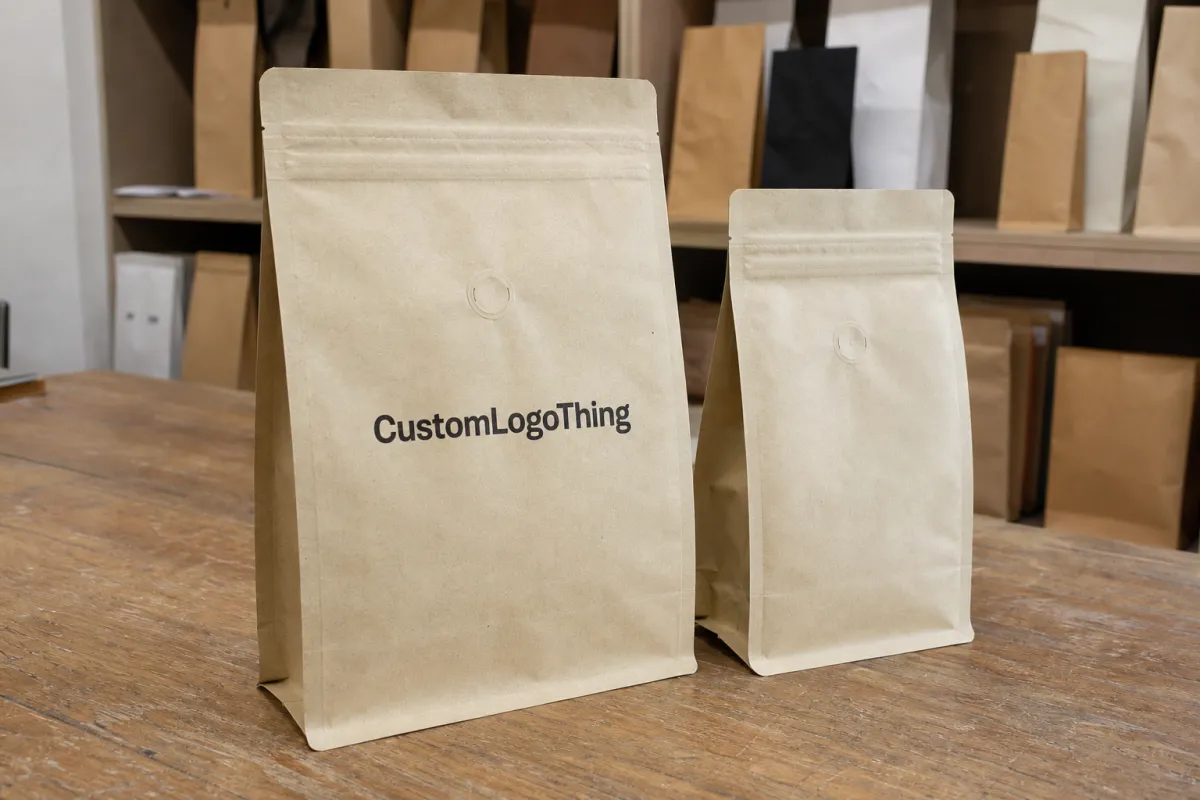
The outer paper is the part buyers see, but it is not the part that keeps coffee fresh. In most builds, the paper layer provides print surface, hand feel, and a more natural look. The inner liner does the protection work. A good custom coffee Paper Bags Material and Sizing guide separates those two decisions, because they are related but not identical.
Natural kraft paper has a warm, familiar appearance and a poor oxygen barrier on its own. White kraft gives a cleaner print field and can make colors pop, but it does not change the freshness story by itself. On its own, paper is best for display, samples, or short-life applications. For retail coffee, it usually needs help from a liner or laminate. The common combinations are paper plus PE, paper plus PLA, or paper plus foil. Each one has tradeoffs in barrier, cost, seal behavior, and end-of-life claims.
Paper weight matters too. Thicker outer paper can improve stiffness and print quality, but it may not solve a weak barrier or a sloppy seal. Buyers sometimes focus on paper thickness because it sounds substantial. In reality, the inside build matters more. A 70-90 gsm kraft outer with a suitable barrier liner will often outperform a heavier-looking bag with the wrong film or a poor heat seal.
Size is not guessed from the front-panel name. It starts with fill weight, then bean density, then whether the coffee is whole bean or ground. Whole beans leave more void space between particles, so the same net weight can sit differently than a fine grind. Dark roasts expand more during roasting, which means they occupy a little more volume for the same weight. That is one reason a 12 oz whole-bean bag may feel comfortable while 12 oz of finely ground coffee can look crowded.
Closures also affect the structure. One-way valves help freshly roasted coffee release gas without ballooning the bag. Zippers improve resealability, which matters for subscription packs and slower-moving retail SKUs. Tear notches, tin ties, and hang holes sound minor, but they affect filling, display, and how the finished pack feels in hand. Packaging is usually judged on the shelf long before anyone reads the tasting notes.
For most buyers, the best order of operations is simple: freshness, then fit, then graphics, then carton efficiency. When those four line up, the bag is much easier to approve. If they do not, the artwork can be perfect and the pack can still be wrong.
How the Bag Structure Protects Freshness
Coffee loses quality through oxygen exposure, moisture pickup, and aroma loss. That sounds technical, but the failure is ordinary. Aromatics escape slowly, oxygen moves in slowly, and flavor dulls before the bag looks visibly damaged. Buyers often blame the roast when the real problem is the barrier.
Most paper coffee bags use one of four common structures: paper plus PE, paper plus PLA, foil laminate, or a recyclable barrier film. Paper plus PE is common and economical. Paper plus PLA is often chosen for a more sustainability-forward story, but PLA is not automatically home compostable, and performance still depends on the full structure, seal quality, and actual storage conditions. Foil laminate gives the strongest barrier and the best protection for longer shelf life. Recyclable barrier films are improving, but they need to be checked against the brand’s real recovery stream, not just the claim on the spec sheet.
One-way valves matter most with freshly roasted coffee that is still degassing. Without a valve, pressure can build and weaken the pack. With a valve, gas exits while oxygen is slowed on the way back in. For specialty coffee, that is usually standard. For grocery or wholesale packs that move more slowly, the valve still helps, especially if the roast date is clearly printed and inventory may sit for several weeks.
Channel changes the answer. Subscription packs need a reseal that actually closes cleanly after repeated use. Grocery shelf packs need display stability and a seal that survives handling. Private label programs often need a structure that balances cost and shelf life instead of maxing out on barrier. If the bags will travel through distribution centers and outer cartons, transit testing matters as much as the material itself. Good references include Packaging and Processing technologies resources for material guidance and ISTA for shipping and distribution testing methods.
Quality control is where a decent-looking bag either proves itself or fails. Ask whether the supplier checks seal strength, valve adhesion, ink rub, laminate bond, and odor transfer. A bag that smells like adhesive or lets the seal lift under light pressure is not a premium pack. It is a claim waiting to fail.
“The bag should match the roast, not the mood board. Freshness failures are expensive decoration.”
Cost, Pricing, and MOQ Drivers
Price comes from a handful of details that buyers sometimes ignore until the quote arrives. Material thickness, barrier type, print coverage, finishing, hardware, and bag size all change the number. A simple kraft look with limited ink coverage can cost far less than a full-coverage matte pack with foil inside, a zipper, and a valve. That is normal. The bag is not one item; it is a stack of materials and machine steps.
MOQ changes the math quickly. The first quantity break is usually the most expensive because setup, plates, and line time get spread across fewer units. After that, unit cost often drops sharply. On many custom printed bags, moving from 5,000 to 10,000 pieces can lower the per-unit price in a noticeable way, while 20,000 pieces can improve it again if the spec stays the same. The savings depend on print colors, finishing, and whether the supplier is converting stock material or sourcing something more specialized.
Hidden costs matter more than most first-time buyers expect. Tooling, cylinders or plates, freight, sample rounds, and rush fees can outweigh a low unit price on a small order. If a quote only lists the bag price and leaves out the rest, it is incomplete, not cheap. A buyer should ask for landed cost, not a headline number that disappears once the freight line shows up.
Broadly, before freight and duties, buyers tend to see three pricing bands. Simple stock-style builds at higher volumes can sit in the low cents per unit. Mid-spec retail bags with a valve and zipper usually land higher. Low-MOQ premium builds, especially with specialty finishes or complex structures, can move well above that because setup is spread over fewer pieces. A useful shorthand is this: a basic kraft/PE bag may be economical at scale, a valve-and-zipper retail pack usually sits in the middle, and a heavy-barrier premium build can become expensive very quickly if the run is small.
| Structure | Typical Use | Relative Unit Cost | Shelf Life Potential |
|---|---|---|---|
| Kraft paper + PE liner | Entry retail, short-to-medium rotation | Low to mid | Moderate |
| Kraft paper + PLA liner | Sustainability-led retail and specialty lines | Mid | Moderate |
| Foil laminate with valve | Premium shelf packs, longer storage, export | Mid to high | High |
| Recyclable barrier structure | Brands balancing recovery claims and protection | Mid to high | Varies by film and seal quality |
For many coffee programs, the biggest cost mistake is paying for barrier you do not need or saving a few cents on a structure that will flatten the product. That is especially true for premium retail packaging, where the coffee has to hold up in transit and still look right on shelf.
Size by Fill Weight, Roast, and Bag Shape
Bag size should start with the actual fill weight, not the marketing name on the front panel. Common coffee capacities usually land around 4 oz samples, 8 oz retail packs, 12 oz standard retail, 2 lb club packs, and 5 lb wholesale bags. Those are not universal, but they are a practical starting point for most buyers. The shape and fill behavior do the rest.
Roast level changes density. Darker roasts are lighter by volume because the beans expand more during roasting. Ground coffee also packs differently from whole bean coffee. That means a 12 oz whole-bean bag may need a different gusset depth or a little more headspace than 12 oz of ground coffee. If the top is crowded, seals get messy. If the bag is too roomy, the pack looks underfilled and weak.
Shape matters just as much. Flat-bottom bags give the cleanest shelf presence and the most stable display. Side-gusset bags usually pack efficiently in cartons and still feel familiar in wholesale settings. Stand-up pouches are practical and often easier for retail, though the visible print area is smaller than many brands want. For coffee sold through shops and subscription channels, flat-bottom and stand-up formats usually win because they balance branding, shelf fit, and filling speed.
One practical rule: if the bag needs a valve, zipper, or heavy seal allowance, choose a slightly larger format than the bare fill weight suggests. A little extra space keeps the top from looking pinched and makes machine filling easier. It also reduces the chance that the bag deforms during top sealing.
Here is a rough fit logic buyers can use before requesting samples:
- 4 oz - good for tasting kits, origin samplers, and promotional sets.
- 8 oz - common for specialty retail and small-batch launches.
- 12 oz - standard consumer pack size in many coffee programs.
- 2 lb - better for clubs, repeat buyers, and lower-frequency replenishment.
- 5 lb - usually wholesale or food service, where carton efficiency matters more than shelf appearance.
Small dimensional changes matter more than most briefs admit. A few millimeters in gusset width or bag height can alter how the pack fills, folds, and ships. If a product line is expected to grow, it is better to test two adjacent sizes than force one size to do everything.
Process, Timeline, and Production Steps
The production path is straightforward, but there are a few places where schedules slip. It usually starts with the dieline and artwork, then proofing, sample approval, printing, converting, and final packing. If the supplier is also sourcing barrier material, the schedule can stretch a little because paper and film availability become part of the calendar.
Artwork revisions are the easiest way to lose time. Every change can force another proof, another color check, or a new plate adjustment. Custom barrier materials add more lead time because they are not always stocked in every region. If the run is short and the spec is unusual, expect more back-and-forth. That is not a failure. It is production reality.
For a simple print on a standard format, a realistic lead time may run 12-18 business days after proof approval. A fully custom structure with valve, zipper, special finish, and a new dieline can stretch to 20-30 business days or more. Sample rounds usually add another 5-10 business days depending on whether the supplier is making a plain mockup or a finished prototype. If the order also needs ocean freight or customs clearance, build extra time into the calendar. Launch dates should be worked backward from ship date, not forward from design approval.
One helpful rule is to approve the practical spec before the decorative details. Lock fill weight, bag style, closure, and barrier first. Then finalize print finish, foil accents, or soft-touch lamination. If the order goes in the other direction, the artwork may be signed off before the structure is usable. That creates avoidable rework.
For shipping durability, case testing matters. Ask whether the packed cartons have been checked against a reasonable drop or compression standard, especially if the coffee will move through multiple distribution points. If you are building a broader product packaging program, it is usually smarter to align outer cases and inner bags together instead of treating them as separate projects.
Good suppliers also inspect practical details that are easy to overlook on a screen: barcode placement, roast-date coding space, zipper alignment, seal width, and top fold consistency. A bag can print beautifully and still fail because the date code lands across a seam. That kind of mistake is avoidable, but only if the production layout is reviewed with the filling line in mind.
Common Mistakes That Waste Money or Freshness
Undersizing is the classic mistake. It makes the bag look overstuffed, weakens seals, and creates awkward carton counts. You also get crooked top folds and visible panel tension, which is not a good look for premium product packaging. If the product barely fits, the filling line becomes a daily annoyance.
Overspecifying is the opposite problem. Some brands choose the heaviest barrier and the most expensive finish even when the coffee moves fast enough that a simpler structure would work fine. Paying for longer shelf life than you need is wasteful. So is paying for a velvet finish on a high-volume SKU that is mostly sold through ecommerce in two weeks. The prettier option is not always the better one.
Forgetting the hardware is another common miss. If a bag should have a zipper or valve and the quote leaves it out, the line item may look attractive while the actual user experience falls apart. Seal performance also matters for shelf-life claims. Buyers should ask whether the closure is heat-sealed, press-to-close, or both. Those small decisions have real consequences.
Artwork errors are less glamorous but just as expensive. Wrong bleed, barcode placement too close to a fold, or no room for roast-date coding can stop a run. If variable data is required, reserve that space early. A supplier can work with a lot of good artwork. They cannot rescue a design that forgot the production panel.
Sustainability claims need care too. Not every recyclable-looking structure is accepted in local recycling, and not every compostable claim applies outside a controlled facility. If the claim is on the bag, it should match the actual material and the actual disposal path. Vague language creates more problems than it solves.
Use this checklist to avoid the usual mess:
- Confirm fill weight, roast style, and grind type.
- Lock barrier type before approving print finishes.
- Reserve space for valve, zipper, barcode, and date code.
- Ask for carton count and packed dimensions early.
- Review samples under real shelf and packing conditions.
Expert Tips for Better Quotes and Fewer Delays
If you want quotes that can actually be compared, ask suppliers to price the same spec in at least two sizes. That shows the unit cost swing and the shipping efficiency difference. A 12 oz bag may look economical until you compare it with an 8 oz or 2 lb format and see how the overall landed cost changes.
Request samples or a pre-production mockup before print is locked, especially if the bag must stand upright on shelf. Photos are not enough. A physical sample tells you whether the bottom sits cleanly, whether the panel proportions feel right, and whether the branding reads from normal viewing distance. It also shows if the zipper feels cheap, the seal line wanders, or the material has an odor you do not want in a coffee bag.
Send a short but complete spec sheet. Include product weight, bean type, grind type, target shelf life, bag style, print colors, finish, valve, zipper, and monthly volume. If the order is for a private label line, note whether the packaging needs to match another SKU family. If recycled content, FSC-certified paper, or a specific barrier requirement matters, say that early. Details hidden in email threads tend to become expensive later.
For quality control, ask what gets checked before shipment. A practical list includes seal strength, laminate adhesion, valve retention, zip function, ink rub, carton count, and pack-out consistency. If the supplier cannot explain how they check those points, the quote is not as complete as it looks. Price alone does not tell you whether the bags will run smoothly.
Keeping one decision framework across SKUs helps too. That makes it easier to scale from one roast to a whole family of coffee pouches, boxes, and accessory packs without reinventing the spec every time. Consistency lowers purchasing friction, but it also makes the shelf read like a real brand instead of a group of separate experiments.
Next Steps: Build a Spec Sheet That Gets Usable Quotes
The fastest way to get better pricing is to send better input. Start with the minimum information that affects structure: roast type, fill weight, target shelf life, bag style, print colors, and expected order quantities. If you already know whether the coffee is whole bean or ground, include that too. That one detail changes sizing more often than people expect.
Then compare two or three size options against carton count, shelf fit, and machine compatibility. Do not choose a bag size from a catalog photo and hope for the best. That is how brands end up with overfilled tops, wasteful freight, and awkward merchandising. A useful quote should describe what the supplier is actually building, not force them to guess.
Send the same brief to every supplier so the quotes are comparable instead of apples to mystery fruit. Ask them to show unit price, setup costs, freight assumptions, and sample charges separately. If one quote looks much cheaper than the others, something is probably missing. Usually a liner, sometimes a closure, occasionally the truth.
A strong coffee bag spec is not complicated. It is disciplined. Know the weight, match the barrier, choose the right bag shape, leave room for production, and make the packaging do the job instead of just looking polished. That is the practical version of a custom coffee paper bags material and sizing guide, and it is the fastest route to packaging that works on shelf, in transit, and in the cup.
How do I choose the right material for custom coffee paper bags?
Match the barrier to shelf life first. Paper on its own is mainly for appearance, not freshness. Use an inner liner or laminate when you need oxygen and moisture protection. Choose recyclable or compostable options only if they still meet the coffee’s freshness needs and your actual disposal path.
What size custom coffee paper bags do I need for 12 oz coffee?
Start with fill weight, then confirm with bean density and grind type because whole bean and ground coffee do not pack the same way. For 12 oz retail packs, a flat-bottom or similar retail-friendly format is common, but the real answer comes from a sample filled with your product. Leave enough room for seals, valves, and zipper hardware so the top does not look stuffed or crooked.
Do I need a valve and zipper in custom coffee paper bags?
A one-way valve helps freshly roasted coffee release gas without swelling the bag. A zipper helps customers reseal the pack, which matters more for slower-moving retail or subscription orders. If the coffee sells quickly, the zipper is still useful, but the valve usually has the bigger effect on freshness.
What drives custom coffee paper bag pricing the most?
Material structure, print coverage, hardware, and bag size usually move price more than the logo itself. MOQ changes the math quickly because the first run is the most expensive one. Freight, sampling, and setup fees can matter as much as the unit price on smaller orders.
What should I send for an accurate quote on custom coffee paper bags material and sizing?
Send fill weight, roast type, grind type, target shelf life, and preferred bag style. Include print colors, finish, valve or zipper needs, and estimated monthly or annual volume. Add your target timeline and any machine or carton constraints so the supplier does not have to guess.

