Buyer Fit Snapshot
| Best fit | stand up pouches for ecommerce packaging for packaging buyers comparing material specs, print proof, MOQ, unit cost, freight, and repeat-order risk where brand print, material, artwork control, and repeat-order consistency matter. |
|---|---|
| Quote inputs | Share finished size, material target, print colors, finish, packing count, annual reorder estimate, and delivery region. |
| Proofing check | Approve dieline scale, logo placement, barcode or warning zones, color tolerance, and any recyclable or compostable wording before bulk production. |
| Main risk | Vague material claims, crowded artwork, or missing packing details can create delays even when the unit price looks attractive. |
Fast answer: Stand Up Pouches for Ecommerce Packaging: Film, Closure, Print, and Fulfillment should be specified like a repeatable production item. The safest quote includes material, print method, finish, artwork proof, carton packing, and reorder notes in one written spec.
What to confirm before approving the packaging proof
Check the product dimensions against the actual filled item, not only the sales mockup. Ask for tolerance on folds, seals, hang holes, label areas, and retail display edges. If the package carries a logo, QR code, warning copy, or legal claim, reserve that space before decorative graphics fill the panel.
How to compare quotes without losing quality
Compare board or film grade, print process, finish, sampling route, tooling charges, carton quantity, and freight assumptions side by side. A lower quote is only useful if the supplier can repeat the same color, closure quality, and packing count on the next order.
Stand up pouches for ecommerce: Packaging That Sells start with a blunt tradeoff: less dead space, less weight, and a package that still looks composed after a warehouse sort, a parcel conveyor, and a doorstep drop. For many brands, stand up pouches for ecommerce replace bulky cartons or oversized tubs with a format that stores more tightly, ships more efficiently, and gives customers something easier to handle once the order is open.
From a packaging buyer’s angle, the real question is never whether the pouch photographs well in a mockup. The real question is whether the structure protects the product, survives handling, and keeps fulfillment costs from creeping up while the packing team is moving fast. That is where the shiny sample meets the messy reality.
Stand up pouches for ecommerce: what they are and why they work
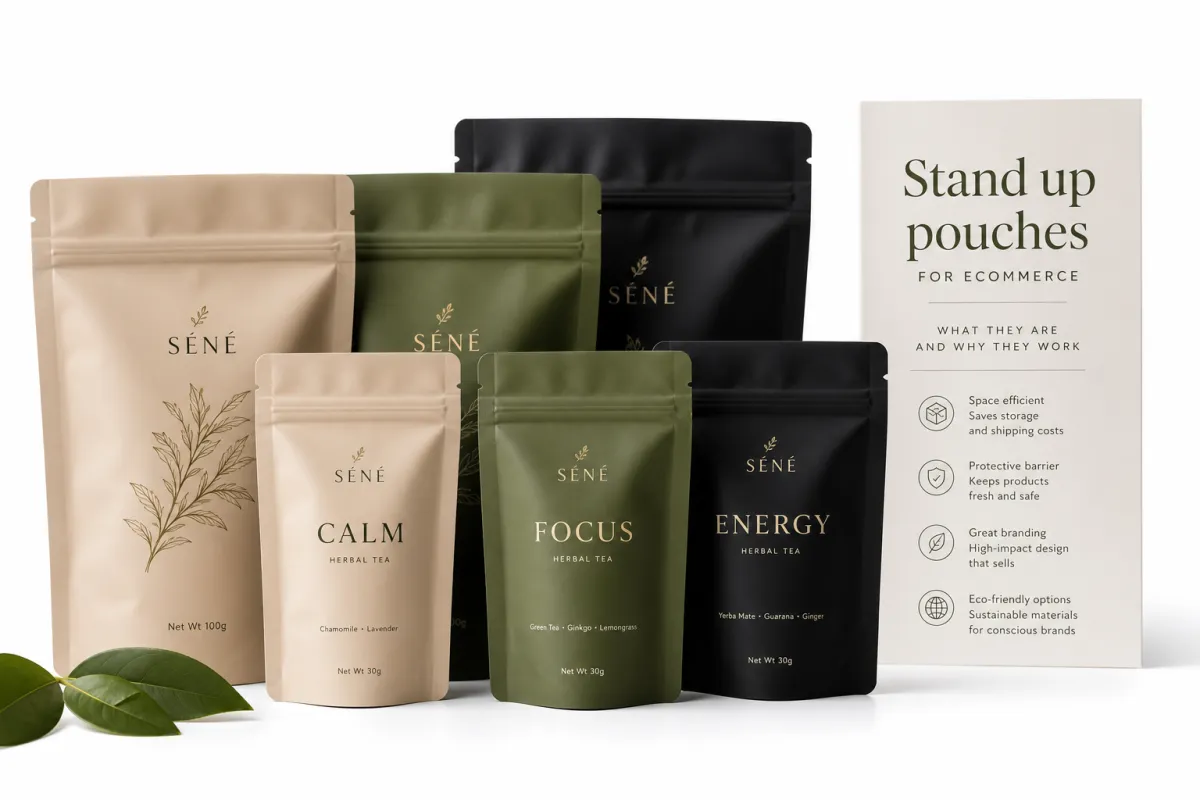
Stand Up Pouches for ecommerce are flexible packages with a gusseted base that opens into a stable bottom, so the pouch can stand upright for filling, display, and storage instead of folding flat once the product goes in. That small structural choice changes a lot. The package can present like a retail-ready unit while still acting like a compact shipping format.
Three pressures usually drive the decision: protection, presentation, and packout efficiency. Dry foods, powders, coffee, tea, snacks, pet treats, bath salts, supplements, and a long list of non-food products all fit this format when the pouch size and barrier layer match the contents. A pouch that fits the product properly tends to look better, travel better, and waste less space. Simple idea, but it matters more than people think.
Fulfillment teams notice the difference immediately. A pouch takes up less inbound storage than a rigid container, stacks more neatly in totes and cartons, and often costs less to move than a heavy jar or a box full of air. Across a catalog with dozens of SKUs, those small savings compound fast. A few cents here and a few cubic inches there can turn into a meaningful monthly difference, which is why operations folks get pretty excited about the format once they run the numbers.
The retail benefit and the ecommerce benefit overlap, but they are not identical. On shelf, the package has to catch a glance and hold form. In ecommerce, stand up pouches for ecommerce also need to tolerate vibration, compression, carton scuffing, and the occasional rough sortation cycle. That means the build has to be chosen for transit reality, not just for a polished photo. I have seen beautiful pouches arrive with the corners crushed because no one pressure-tested the packaging system.
A lot of teams miss that part. The pouch looks clean, modern, and efficient on paper, then the first sample shows a weak seal, a flimsy zipper, or a film that feels too soft for the product. Matched correctly, stand up pouches for ecommerce can improve unboxing, reduce damage claims, and make returns less likely. Matched poorly, they become a new source of complaints. There is no middle ground there, kinda annoyingly.
The branding upside is real too. The front panel gives space for the logo, product name, benefits, usage notes, and regulatory copy, while the back panel can hold ingredients, directions, storage instructions, and legal details in a clean layout. That is one reason stand up pouches for ecommerce do more than contain a product; they can help sell it. Good packaging is not decoration. It is part of the product story.
A pouch can look beautiful in a mockup and still fail in the mailer. Structure has to survive shipping first, then earn its place on the screen and the shelf.
How stand up pouches for ecommerce perform in shipping and fulfillment
Before filling, stand up pouches for ecommerce ship flat, which matters more than many buyers expect. Flat packaging uses less pallet space, lowers inbound freight pressure, and frees up warehouse room for finished goods instead of empty volume. Once filled, the pouch becomes a compact unit that is easier to cartonize than a rigid jar or canister.
Barrier performance carries the other half of the load. Many products need protection from moisture, oxygen, aroma loss, or light exposure, and the film structure has to provide that protection without inflating the packaging cost so much that the margin gets squeezed. Stand up pouches for ecommerce often use layered films such as PET, PE, BOPP, or metallized structures to balance clarity, stiffness, sealability, and barrier. If the material choice is off, the best graphics in the world will not save the order experience.
For products with freshness concerns, a zipper by itself does not solve the problem. The closure helps the customer after opening, but the barrier layer protects the product before shipping and after arrival. Coffee, powders, snack foods, supplements, and pet treats all depend on that distinction. The pouch is not just an outer wrap; it is part of the product system.
That is why the small hardware choices matter. Tear notches, resealable zipper styles, tamper-evident features, hang holes, and fit inside the shipper all shape the customer experience. Stand up pouches for ecommerce can feel tidy and premium after delivery, but only if the opening feature works cleanly and the pouch is not overfilled to the point that the seals are under strain. If the zipper takes two hands and a little prayer to close, the customer notices.
Warehouse teams care about packout behavior for a very simple reason: speed. A pouch that stands consistently will usually pack better in carton partitions or mailer inserts, and that helps with case counts and dimensional weight. If the shape shifts from one unit to the next, packing slows down and void fill rises. That is real labor, not theory. I have watched pack stations lose seconds per unit that turned into hours by the end of the week.
Shipping validation works best when it is treated as testing, not guessing. The ISTA test framework is a useful reference for drop, vibration, and transit simulation, especially when stand up pouches for ecommerce need to move through parcel networks instead of sitting quietly on a boutique shelf.
Customers also make no distinction between the pouch and the order experience. If the product arrives intact, opens cleanly, and reseals without drama, the packaging did its job. If it leaks powder, tears badly, or arrives scuffed because the outer carton was too loose, the package stops being an asset and starts becoming a complaint.
Key factors that shape performance, protection, and price
Material selection shapes almost everything about stand up pouches for ecommerce. A clear PET/PE structure gives strong printability and dependable sealing, matte films create a softer premium look, metallized films improve oxygen and light barrier, and clear high-barrier structures let brands show the product while protecting freshness. Each build makes a different promise, and each one carries tradeoffs in cost, appearance, and protection.
Thickness matters too. A 3 mil pouch behaves differently from a 5 mil pouch, and the difference is not just about hand feel. Thickness changes puncture resistance, seal window, shipping durability, and the way the pouch holds shape after filling. For a heavy powder or a product with sharp edges, the jump from a thin film to a stronger structure can be the difference between a clean shipment and a damaged case. That is not a theoretical risk. It shows up in returns, rework, and the occasional embarrassed warehouse call.
Printing method affects setup and unit economics. Digital printing usually fits shorter runs, multiple SKUs, and fast artwork changes, while flexographic printing becomes more attractive at higher volumes. Stand up pouches for ecommerce with complex gradients, frequent design revisions, or multiple language versions can carry higher setup costs if the print strategy is not chosen with care.
Finish options change both cost and response from the customer. Soft-touch coatings, matte varnishes, clear windows, metallic effects, spot gloss, and tactile surfaces can all help a pouch stand out, but each adds material or production steps. The useful question is not whether a finish sounds premium. The useful question is whether the finish helps sell the product in the channel where it will actually be seen. A finish that looks gorgeous under studio lighting may be wasted if the customer mostly sees a thumbnail on a phone.
Pricing should be reviewed as a system, not as a single quote. Order quantity, number of SKUs, pouch size, zippers, tear notches, spouts, custom shapes, and special finishes all move the number. A higher unit price can still be the better buy if it reduces damage, speeds packing, or improves shelf and screen appeal enough to support better conversion.
For rough planning, stand up pouches for ecommerce can often land around $0.18 to $0.48 per unit at 5,000 pieces, depending on size, structure, and print coverage. A simple pouch with modest print may sit near the low end, while a high-barrier printed pouch with zipper, matte finish, and more complex branding can rise toward the top. That range is not universal, but it is far more useful than a vague label like “affordable” or “premium.”
A second cost layer gets missed too often: landed value. Freight efficiency, lower breakage, fewer cartons, less void fill, and reduced storage cost can change the real economics more than the printed unit price alone. Stand up pouches for ecommerce should be measured against the full packaging system, not against one invoice line.
| Pouch structure | Best fit | Protection level | Typical unit cost at 5,000 pcs |
|---|---|---|---|
| Clear PET/PE with zipper | Dry goods, simple snacks, low-moisture products | Moderate moisture barrier | $0.18-$0.26 |
| Matte BOPP/PE with zipper | Premium snacks, pet treats, lifestyle products | Moderate barrier with strong shelf appeal | $0.22-$0.35 |
| Metallized PET/PE with tear notch | Coffee, powders, aroma-sensitive products | High oxygen and light barrier | $0.24-$0.38 |
| High-barrier clear structure | Products that need visibility and freshness control | High barrier with product display | $0.28-$0.48 |
| Paper-feel laminate with inner barrier layer | Brands chasing a tactile, natural look | Varies by liner and film build | $0.30-$0.50 |
No universal build wins every time. The right structure depends on the product, the shipping lane, the customer expectation, and the budget. That is why stand up pouches for ecommerce need a spec conversation before a price conversation, not the reverse. Start with what the product needs, then let the quote follow the job.
Process and timeline for stand up pouches for ecommerce
The process usually begins with the product itself. What is inside the pouch, how much does it weigh, is it sharp or abrasive, does it clump, does it shed dust, does it absorb moisture, and how long does it need to stay stable on the way to the customer? Those answers determine whether stand up pouches for ecommerce need a basic seal, a high-barrier film, a stronger zipper, or a more protective secondary shipper.
Next comes specification. The buyer should define pouch dimensions, fill weight, closure type, material structure, print method, finish, and any regulatory copy that has to appear on the pack. When the spec is clear, stand up pouches for ecommerce are easier to quote, easier to sample, and easier to approve without last-minute changes that slow launch timing. That alone can save a lot of headaches.
Sampling is where a lot of problems show up early, which is exactly the point. Check the pouch size against the actual fill, not just the theoretical fill weight. Confirm seal quality, zipper function, print legibility, panel alignment, and whether the pouch fits cleanly into the cartons or mailers the fulfillment team actually uses. An attractive sample that fights the packing line is not a success.
Real conditions matter more than clean assumptions. Fill the pouch with the actual product, not a substitute. Some powders flow differently than expected. Some snacks settle more than anticipated. Some pet treats have corners that create puncture pressure on the film. Stand up pouches for ecommerce should be sampled with the real material because weight and texture can change the way the package behaves.
Timeline is usually driven by artwork, sampling, and material availability. A project with approved art, available film, and limited revisions can move faster than a rollout across many SKUs. A more typical path includes discovery, prepress, proofing, sample approval, production, and transit. If a buyer keeps artwork moving and makes quick decisions on structure, the calendar tends to stay under control.
Delays usually come from three places: artwork changes, barrier material sourcing, and sizing revisions after sample review. If the pouch is too tight, fill efficiency suffers. If it is too large, shipping consistency and presentation suffer. If the print proof gets revised three times, the project drifts. Stand up pouches for ecommerce reward teams that lock the spec before production starts.
Planning windows vary by supplier and order complexity, but many teams build in several weeks from first spec discussion to finished delivery, with extra time for complicated print jobs or uncommon film structures. The most reliable timeline is the one built with cushion for approval cycles, not the one built on optimism.
For buyers who want a sourcing signal beyond the factory quote, look for proof that the supplier understands seal performance, artwork registration, and distribution reality. That mix matters more than a polished sales pitch, because stand up pouches for ecommerce have to work in the warehouse long after the proof is approved.
Step-by-step guide to choosing the right pouch for your product
Start with the product itself. Texture, flowability, moisture sensitivity, odor, sharp edges, and fill weight all influence the right pouch build. A fine powder behaves differently from a granola mix, and a fragile item behaves differently from a dense snack. Stand up pouches for ecommerce should be selected around that physical reality, not around a generic template.
Then match the pouch to the channel. A subscription box order may need a stronger unboxing moment, while a warehouse-fulfilled order may need tougher seals and better packout efficiency. A hybrid Brand That Sells both retail and direct to consumer often needs a pouch that can do both jobs without becoming overpriced or overdesigned.
Closure choice matters more than many buyers expect. Tear notches help first open, zippers support repeat use, hang holes help merchandising, and spouts can work for certain liquid or semi-liquid products. If the customer will open and close the package often, stand up pouches for ecommerce should make that motion feel easy rather than awkward. Nobody wants to wrestle with packaging before they even taste the product.
Artwork should support conversion, not sit there as decoration. The logo has to be visible, the product name has to be legible, and the hierarchy of claims has to make sense in a few seconds on a phone screen. A pouch with ten competing messages can feel busy fast, while a pouch with a clean front panel and a well-organized back panel tends to communicate more confidently.
Ask for a spec sheet and use it as a decision tool. It should list dimensions, film structure, closure type, fill weight, print method, finish, and target launch date. When a team documents those items, stand up pouches for ecommerce become easier to compare across vendors and easier to reorder later without accidental drift in format.
Here is a simple way to think through the decision path:
- Define the product and its protection needs.
- Choose a structure that matches barrier and appearance goals.
- Pick a closure that fits the customer’s use pattern.
- Review artwork with print limits in mind.
- Test the sample in the real packing workflow.
That sequence may look basic, yet it catches a lot of expensive mistakes. A pouch that fits the product and the fulfillment workflow will usually outperform a prettier package that was chosen too quickly. In practice, stand up pouches for ecommerce reward teams that think like operators as much as designers.
Common mistakes when ordering stand up pouches for ecommerce
The first mistake is choosing by appearance alone. A pretty pouch mockup does not tell you whether the film has enough barrier, whether the seal area is strong enough, or whether the product will settle in a way that breaks the visual balance. Stand up pouches for ecommerce should never be approved on looks alone, because transit and filling expose weaknesses quickly.
The second mistake is size mismatch. An undersized pouch can stress the seal and make filling slow. An oversized pouch can make the product look sparse, increase the amount of air in the package, and reduce case density. Both problems cost money, and both can be avoided with a proper sample review.
Artwork planning creates another common failure point. Crowded labels, tiny copy, low contrast, and designs that ignore finish changes can all create print problems or readability issues. If a brand wants stand up pouches for ecommerce to help conversion, the design has to communicate clearly on a phone screen, in a warehouse photo, and in a customer’s hand after delivery.
The customer-experience mistake is just as costly. Some packaging looks elegant in a picture but is frustrating to open, messy to reseal, or noisy in a way that feels cheap. I have seen plenty of cases where the product itself was excellent, yet the package made the first use feel harder than it needed to be. That problem is avoidable, and frankly, it is one of the easiest things to catch if you open samples the way customers do.
Cost comparisons create another trap. Comparing only the unit price can hide freight, damage, labor, and rework. A slightly higher-cost pouch might save enough on shipping efficiency and product loss to justify itself within a single launch cycle. Stand up pouches for ecommerce need to be judged on total cost of ownership, not on the cheapest quote in the inbox.
For teams trying to keep sourcing honest, ask for sample packs, ask for data on seal performance, and ask how the pouch has been tested for transit and storage. If a supplier cannot speak clearly about the tradeoffs, that is a signal to slow down. A strong pouch program is built on details, not assumptions.
One practical safeguard is to test the pouch against the exact packout method the customer order will see. Same carton size, same mailer, same filler, same taping pattern, same warehouse workflow. That kind of test exposes realities that artwork proofs never will, and it is one of the simplest ways to make stand up pouches for ecommerce more dependable.
Packaging materials can also affect sustainability claims, so buyers should avoid overstating recyclability or environmental benefit without checking the actual structure and local recovery options. The FSC system is useful if paper components are part of the pack, but a film pouch still needs an honest conversation about material choices and end-of-life realities. Better to be plain about that than to promise more than the package can deliver.
Expert tips and next steps for a smarter pouch rollout
My first recommendation is simple: start with a pilot run. Stand up pouches for ecommerce can look perfect on paper and still reveal small issues in the first fulfillment batch, so a limited pilot helps verify fit, print quality, seal performance, and packing speed before the whole SKU family changes over.
Build a spec sheet that lives with the product, not only in someone’s email inbox. Include dimensions, material structure, closure type, fill weight, artwork requirements, finish, carton count, and target launch date. Once that spec exists, stand up pouches for ecommerce become easier to reorder, easier to compare, and easier to improve later.
Ask for samples with the real product inside them. A blank pouch can prove dimensions, but it cannot fully prove fill behavior, weight distribution, panel bulge, or seal stress. The closer the sample is to the final packed product, the more useful the approval process becomes. I would always rather approve a slightly messy real sample than a perfect empty one.
Test the pouch in the same carton, mailer, and packing workflow the customer order will actually use. That includes void fill, inserts, tape patterns, and any kitting steps that happen on the line. Stand up pouches for ecommerce are not just a product format; they are part of a fulfillment system, and that system has to work as one piece.
It also helps to compare two or three structures before locking in volume. A matte structure may feel more premium, a clear high-barrier build may show the product better, and a metallized film may protect freshness more effectively. The best choice usually comes from comparing samples side by side with the real item, not from guessing from a catalog description.
For launches with more than one SKU, keep the design system tight. Use consistent placement for the logo, product name, and key claims so the line looks like one brand family rather than a stack of unrelated packages. That kind of consistency helps stand up pouches for ecommerce feel more intentional and easier to shop.
Before you place a larger order, make sure the quote includes everything that affects the final landed cost: print method, closure, finish, shipping method, and any setup charges. A quote that looks low can turn expensive after revisions or freight, while a quote that seems higher can be the better buy if it reduces waste and damage.
If the rollout needs a practical order of operations, use this:
- Request two or three structure options.
- Review samples with the actual product.
- Test the filled pouch in shipping cartons.
- Approve artwork only after the panel layout is confirmed.
- Schedule production with buffer time for revisions and transit.
That approach keeps the project grounded. Stand up pouches for ecommerce work best when the packaging team thinks about product behavior, packing flow, shipping stress, and customer handling at the same time. If those pieces line up, the pouch can become a quiet advantage: lighter freight, better protection, cleaner presentation, and a smoother first use for the customer.
For brands that want packaging to earn its keep, the smartest move is to compare structures, request realistic pricing on a few size options, approve samples under real conditions, and set the production timeline before launch pressure starts to build. Done well, stand up pouches for ecommerce are not just a container; they are a practical sales tool that supports the product from warehouse to doorstep.
Are stand up pouches for ecommerce right for your product?
Yes, if your product benefits from lower shipping weight, better shelf presence, and barrier protection without rigid packaging. Stand up pouches for ecommerce are strongest when the item is dry, semi-dry, or otherwise stable inside a flexible format, and when the brand can use the front and back panels to explain the product quickly.
If the product is fragile, highly reactive, or requires a very specific dispensing experience, a pouch may still work, but the spec has to be tighter. That is why stand up pouches for ecommerce deserve sample testing with the real fill, the real carton, and the real fulfillment workflow. Otherwise you are basically guessing, and packaging guesswork gets expensive in a hurry.
The right call is usually the one that balances protection, presentation, and packing efficiency without forcing the customer or the warehouse to do extra work.
FAQ
Are stand up pouches for ecommerce good for shipping fragile products?
Yes, if the pouch structure and the secondary packaging are chosen for the product’s weight, shape, and fragility. Stand up pouches for ecommerce work best for fragile items when they are paired with a strong film, reliable seals, and a mailer or carton that prevents crushing during transit.
How do stand up pouches for ecommerce compare on pricing with rigid packaging?
They often lower freight and storage cost because they are lighter and pack more efficiently than rigid containers. Unit price still depends on the film build, print method, order quantity, and added features like zippers or spouts, so the cheaper-looking option is not always the lower-cost option overall.
What products fit best in stand up pouches for ecommerce?
Dry foods, powders, supplements, pet treats, coffee, tea, snacks, and many non-food items are strong candidates. The best fit is a product that benefits from barrier protection, compact shipping, and strong shelf or on-screen presentation.
How long does it take to produce stand up pouches for ecommerce?
Timing depends on artwork approval, sample review, material availability, and order size. A clear spec and fast approvals usually shorten the path from concept to production, while artwork revisions and special film sourcing can extend the schedule.
What should I check before approving a pouch sample?
Check size, fill behavior, seal strength, print quality, closure function, and how the pouch fits into your packing workflow. Also confirm that the finished pouch protects the product through shipping and customer handling, because stand up pouches for ecommerce need to work beyond the sample bench.


