Stationery Embroidered Baseball Caps unit cost review sounds narrow until the first quote arrives. Then the problem gets broader fast. The low number usually belongs to a lighter spec, a looser proof, or a supplier who has not yet added digitizing, sampling, packaging, and freight. By the time all of those are visible, the bargain can look ordinary.
For stationery brands, office supply launches, event kits, and internal merch programs, embroidered caps are attractive because they sit between useful and branded. They wear well, they photograph cleanly, and they usually feel more deliberate than a printed giveaway cap. The catch is that the cap only looks polished when the body, embroidery, and packing are aligned. Miss one, and the whole job feels less finished than the invoice suggests.
The cheapest quote is rarely the cheapest order once setup, sampling, and freight are counted together.
This review focuses on the parts buyers can actually control: cap spec, embroidery complexity, minimum order quantity, and the repeatability of the finished product. A good quote should answer those questions plainly. If it does not, the number on the page is mostly decoration.
Stationery embroidered baseball caps unit cost review: what buyers miss first
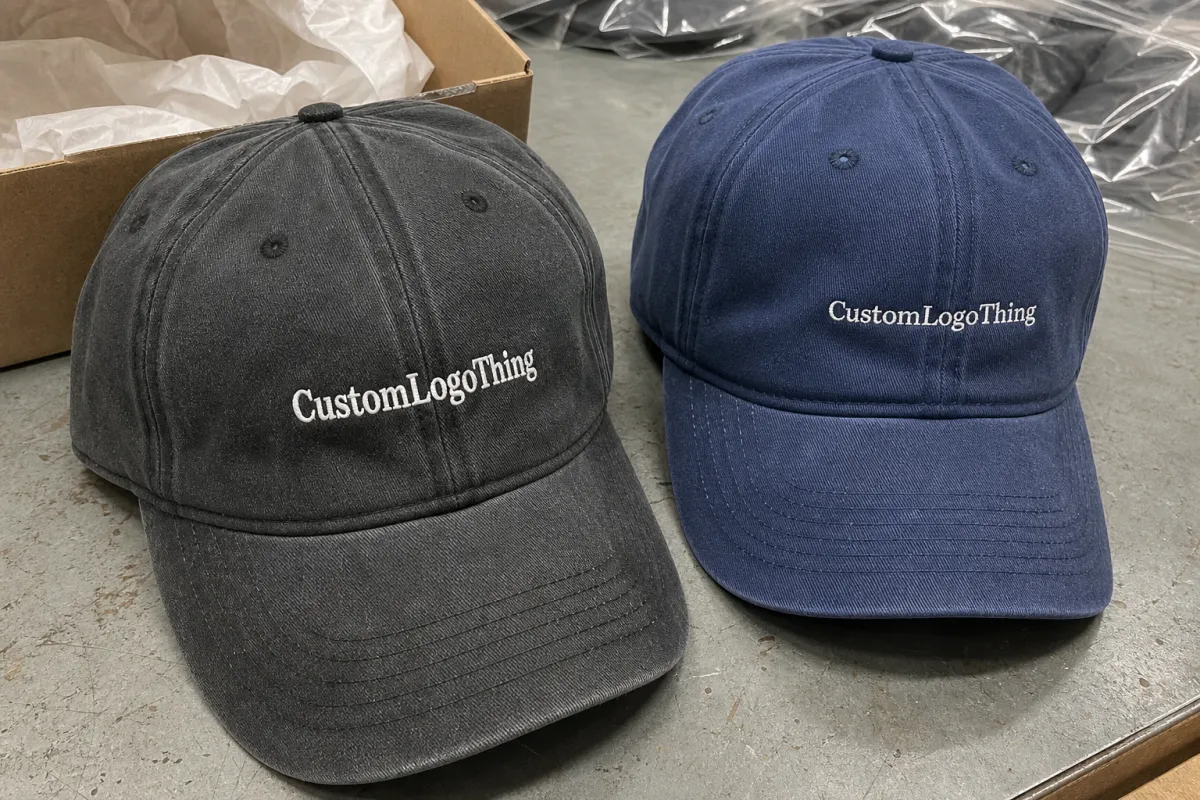
The first trap is assuming all embroidered caps are priced from the same base. They are not. One supplier may include a structured cap, one front logo, thread matching, and a production sample. Another may quote a blank cap and leave everything else to be decided later. That second quote can look lower by a meaningful margin, then climb once the hidden items appear.
Buyers also underestimate how quickly a simple logo becomes a more expensive decoration. A clean wordmark is one thing. A mark with tiny type, thin outlines, or a second placement on the back panel is another. Embroidery is not priced like flat print. It is machine time, thread path planning, and operator judgment all at once.
For stationery programs, the cap is often part of a larger branded package, which makes consistency more important than novelty. The product needs to match the rest of the kit, not fight it. That means the same color target, the same logo size, and the same cap shape across the run. If the cap shifts from sample to bulk, the whole set looks uneven.
Three numbers matter more than the headline quote:
- Unit cost shows the real per-piece spend at a specific quantity.
- MOQ shows how much cash is locked up before the first shipment lands.
- Repeatability shows whether reorder two will match reorder one.
That is why the review should start with a written spec, not a mood board. Cap body, closure type, embroidery placement, stitch count target, and packaging details should be fixed before the first price comparison. Otherwise, two vendors are not quoting the same product. They are quoting two different ideas that happen to share a name.
There is also a quality difference between a logo that fits the cap and a logo that merely fits the file. A supplier who understands cap embroidery will push back on artwork that is too small, too dense, or too close to the seam. That pushback protects the job. Agreement on everything, by contrast, can be expensive.
Cap body choices that change feel, shape, and wear life
Cap body selection affects more than appearance. It changes handfeel, structure, stitch behavior, and how well the cap holds up after packing and shipping. A cotton twill cap is the safest baseline for most buyers. It usually takes embroidery cleanly, has a familiar matte finish, and keeps its shape without feeling stiff.
Brushed cotton can feel softer and slightly more premium, but the surface nap can soften the edge of very fine embroidery. That is not always a problem. It becomes a problem when the logo relies on small text or tight borders. On the wrong artwork, brushed cotton makes the thread look a little less crisp than it should.
Poly-cotton often offers better color consistency across production runs and can behave more predictably in bulk. For repeat orders, that matters. The second order is where weak fabric control becomes visible. If the cap body shifts in shade or texture, the brand gets blamed, not the mill.
Structure matters just as much. A structured front panel gives the embroidery a firmer foundation, so dense logos and sharper type usually sit better. Unstructured caps feel softer and more casual, but they are less forgiving when the design carries too much stitch weight. Heavy embroidery on a weak front panel can create puckering or a shallow collapse near the center seam. Once that happens, the cap may still be wearable, but it no longer reads as a clean retail piece.
Closure choice also moves the cost and the perceived quality. Snapback closures are usually the most economical and the easiest to stock. A strapback with a metal buckle looks more finished and often adds a little to the price. Fitted caps can feel more premium, yet they complicate sizing and make inventory planning harder. For broad distribution, adjustable closures remain the practical default.
Small construction details carry more weight than many buyers expect. Sweatband quality, brim consistency, and panel symmetry all affect how the cap presents on arrival. If the cap is packed flat with no internal support, the front panel can crease before anyone opens the box. That is not an embroidery issue, but it still damages the product.
Color choice changes how quality is perceived. Dark caps hide small stitch imperfections better. Light caps reveal everything. If the logo is delicate or contains narrow letters, the cap color should be chosen with the embroidery in mind, not just the brand palette.
Placement, stitch count, and artwork prep
Embroidery placement is one of the easiest ways for a quote to drift. Front placement is usually the base case. Add a side mark, a back wordmark, or embroidery on the strap and the machine time rises, the setup gets more involved, and the cost per piece moves with it. A design that crosses a seam or sits on a curved crown needs more care as well. The machine can do it, but not without more attention and more risk.
Stitch count matters because embroidery is not priced by square inch in the same way as print. A simple front logo may sit around 4,000 to 7,000 stitches. Once fills, borders, and extra text appear, 9,000 to 15,000 stitches is not unusual. That extra density can look richer, but it also adds stiffness. On a cap, stiffness is a mixed blessing. Some structure is good. Too much turns the front panel into a small wall.
Artwork prep should be disciplined. The cleaner the file, the cleaner the result.
- Send vector art in AI, EPS, or a clean PDF.
- Convert fonts to outlines.
- Keep tiny text above about 4 mm if legibility matters.
- Use Pantone references if color matching is part of the brief.
- Leave clear space around the logo so it does not crowd seams or the brim.
Digitizing is often described too casually. It is not just file conversion. It is the stitch map that tells the machine where to enter, where to pull, where to layer, and where to stop. A good digitized file reduces thread breaks and keeps the shape clean. A poor one can make a neat logo look fuzzy or overly dense.
That is why digitizing should be separated in the quote whenever possible. Some suppliers call it a setup fee, some call it tooling, and some fold it into the cap price to keep the headline number low. Separate line items make comparison easier. Bundled numbers make comparison pleasant and unreliable.
If you are requesting multiple quotes, keep the variables locked. Same cap body. Same placement. Same stitch count target. Same backing method. Even small changes can make one quote appear 15 percent cheaper while actually being a lighter spec. That is not real savings. It is a different product wearing the same label.
Pricing, MOQ, and unit cost ranges that hold up
The cleanest way to read a quote is to split it into five parts: blank cap, embroidery setup, sample cost, packaging, and freight. Once those are separated, the price stops hiding behind shorthand. A supplier quoting $3.90 per unit may still be more expensive than one quoting $4.40 if the first number leaves out digitizing, sample revisions, or special packing.
For standard Embroidered Baseball Caps, these ranges usually hold up when the spec is clear and the artwork is not unusually dense.
| Order size | Simple front embroidery | Denser or multi-location embroidery | Typical cost drivers |
|---|---|---|---|
| 100 pcs | $4.80-$7.50 per piece | $6.50-$11.00 per piece | Setup charges, low-run labor, proofing time |
| 300 pcs | $3.40-$5.60 per piece | $5.20-$8.50 per piece | Better line efficiency, setup spread across more units |
| 500 pcs | $2.90-$4.80 per piece | $4.50-$7.20 per piece | Bulk pricing, fewer changeovers, lower handling per unit |
Sample fees often land around $35-$90, depending on complexity, while digitizing commonly sits in the $25-$75 range for standard logos. Very small text, unusual placements, or heavy fill work can push those numbers up. Packaging is the quiet add-on that gets overlooked. A plain polybag may add almost nothing. A custom printed box, insert card, or branded wrap can add $0.20-$0.80 per unit, sometimes more if the packaging specification is strict.
MOQ changes the economics quickly. A 100-piece order carries a large share of setup cost. A 500-piece order spreads that same burden across more units. That is why the unit price falls as quantity rises. The supplier is not suddenly becoming generous. The math is simply less punishing.
There are also cases where the higher unit cost is the smarter buy. If the cap needs a premium structure, a very tight color match, or a repeat-order program where the second run must mirror the first, paying a little more often makes sense. A cheaper cap that varies in shade or stitch quality can become expensive once a reorder is needed and the old sample no longer matches the new batch.
Freight should stay separate from product pricing. So should any duties or local delivery fees. Folding logistics into the unit price may make the quote look tidy, but it hides useful information. A buyer comparing two sources needs to know whether the product is cheap or just easier to move.
If your packaging or insert cards need paper stock with a sustainability claim, ask for proof of the paper component only. FSC applies to the paper, not to the cap body itself. Keeping that boundary clear avoids sloppy claims later.
Production flow and turnaround from proof to shipment
A good production process should feel predictable. Quote confirmation comes first, followed by artwork review, digitizing, sample approval, bulk embroidery, quality control, packing, and dispatch. If a supplier cannot walk through those steps without changing the subject, they are probably not controlling the run very well.
Typical turnaround depends on quantity, revisions, and seasonality. For a standard order with approved art, 10-15 business days after proof approval is a realistic planning window. Larger orders, denser embroidery, special closures, or custom packaging can stretch the lead time to three or four weeks. During peak periods, add more room. Capacity is finite, and machines do not care about launch dates.
Most delays happen in the same places. The first is weak artwork. The second is repeated changes after sample approval. The third is slow buyer feedback on thread color or packaging details. A straightforward logo should not require half a dozen decision cycles. If it does, the schedule slips before production even starts.
Build in a buffer. If the caps are tied to a retail drop, event handout, or client deadline, one extra week is the minimum safe margin. Two weeks is better. That cushion protects you from rushed freight and gives room for a correction if the embroidery looks too heavy or too shallow on the sample.
Packing deserves more attention than it usually gets. The cap can be well made and still arrive flattened if carton strength, inner support, or pallet stacking is sloppy. For long transit routes, ask how the supplier packs the brims and whether they test carton compression. Even a simple photo check before shipment can catch problems early. It is a small step with real savings attached.
QC on cap orders should include more than a quick visual scan. Good checks usually cover thread shade, stitch tension, logo placement, panel symmetry, closure function, and carton count. For embroidered goods, a sample approved on screen is not enough. The physical sample is the reference that keeps the run honest.
Supplier standards that make repeat orders easier
The strongest suppliers are not the ones with the lowest starting quote. They are the ones who can repeat the same cap body, the same thread shade, and the same embroidery placement without turning every reorder into a new project. That is where the long-term savings live.
Documentation matters more than sales language. A supplier should be able to confirm the cap code, color reference, embroidery file version, and sample photo used for approval. If they save that information, a reorder is far less likely to wander off spec. If they do not, the next order may come back slightly different in shade, crown height, or placement. Small differences become visible once a customer compares batches side by side.
Low quotes without written specs are risky because the differences tend to show up later. Maybe the front panel is softer than the sample. Maybe the thread shifts a shade. Maybe the packaging changes and the caps arrive compressed. Then the buyer pays in replacements, discounted stock, or a second round of approvals. The first invoice looked great. The full-cost picture did not.
A reliable supplier should be willing to provide:
- A pre-production proof or sample photo.
- A written note on cap body, closure, and embroidery placement.
- Retained sample reference for the next order.
- QC photos from bulk production.
- Packaging standards for cartons, inserts, and outer protection.
If the order includes paper inserts, hang tags, or outer packaging with environmental claims, ask for documentation on those components. That keeps the claim accurate and the paperwork usable. Buyers, distributors, and retail partners tend to ask later, not earlier.
Repeat orders reward discipline. A cap program that arrives the same way every time is worth more than a one-off bargain that needs explanations. Finance teams understand that quickly. So do operations teams that have to fix the mistake.
What to send for a cleaner quote
A faster quote starts with a better brief. Send the logo file, cap color, embroidery location, quantity split, deadline, and any packaging requirement in one message. That alone cuts down the back-and-forth that usually turns a simple order into a long chain of clarification emails.
Ask for tiered pricing at 100, 300, and 500 pieces. Those numbers reveal where the supplier’s pricing actually bends. If the unit cost barely changes across tiers, setup is probably heavy or the quote has too much padding. If the price drops sharply, you may have room to scale without major strain on the budget.
Request a sample photo or pre-production proof before approval, especially when the logo includes small text, precise colors, or a placement that must read cleanly from a distance. A proof catches a problem while it is still inexpensive. A finished carton full of caps catches the same problem after the money has already been spent.
The simplest buying rule still holds: compare like for like, keep setup charges visible, and judge each supplier against the same cap body and embroidery plan. That is what turns a stationery Embroidered Baseball Caps Unit Cost review into a usable procurement tool instead of another round of vague numbers. Clear specs lead to cleaner quotes. Clean quotes lead to fewer surprises.
What drives stationery embroidered baseball caps unit cost the most?
Cap body quality, stitch count, placement, and quantity drive most of the price. Digitizing and sampling add setup cost, especially if the logo has fine detail or the proof needs revision. Packaging and freight can matter just as much if the order needs custom cartons or a tight delivery window.
How does MOQ change the price per embroidered cap?
Lower MOQ usually means a higher unit price because setup costs are spread across fewer caps. Once the order reaches a more efficient run size, the per-cap cost usually drops. Tiered pricing at 100, 300, and 500 pieces makes the break point easier to see.
Do I need a sample before placing a bulk order?
Yes, if the logo has small text, exact color requirements, or a placement that must look clean from a distance. A sample confirms stitch density, crown shape, and overall fit before full production begins. Skipping it may save time now, but it can cost more if the first run needs correction.
What is a realistic turnaround for embroidered baseball caps?
For a standard order with approved artwork, 10-15 business days after proof approval is a practical baseline. Larger orders, custom packaging, or multiple revisions can extend that to three or four weeks. Peak season usually adds more time, so a buffer is wise.
What should I include in a quote request for the best pricing?
Include the logo file, quantity, cap color, embroidery location, deadline, and packaging needs. Ask for sample cost, unit cost at multiple quantities, and lead time in the same reply. The clearer the brief, the less back-and-forth and the fewer price surprises later.


