Stationery Slider Lock Bags Packaging Insert Checklist
The stationery Slider Lock Bags Packaging Insert checklist exists for one reason: a pack can look polished on screen and still fail the moment someone loads pens, stickers, cards, or a ruler into the real bag. The insert shifts, the closure drags, or the front panel bows, and the approval sample becomes a reprint problem or a returns problem.
That failure mode shows up often because packaging is usually reviewed as artwork first and structure second. Buyers who treat it as a fit-and-function job usually avoid costly back-and-forth, especially when the pack needs to protect the product, survive shipping, and still look neat on shelf or in a listing image.
Stationery is deceptively tricky. Pens are long and rigid, sticker sheets slide, cards curl, and rulers leave very little tolerance for error. A checklist forces those variables into view before the quote is locked.
Why this checklist catches bad specs early
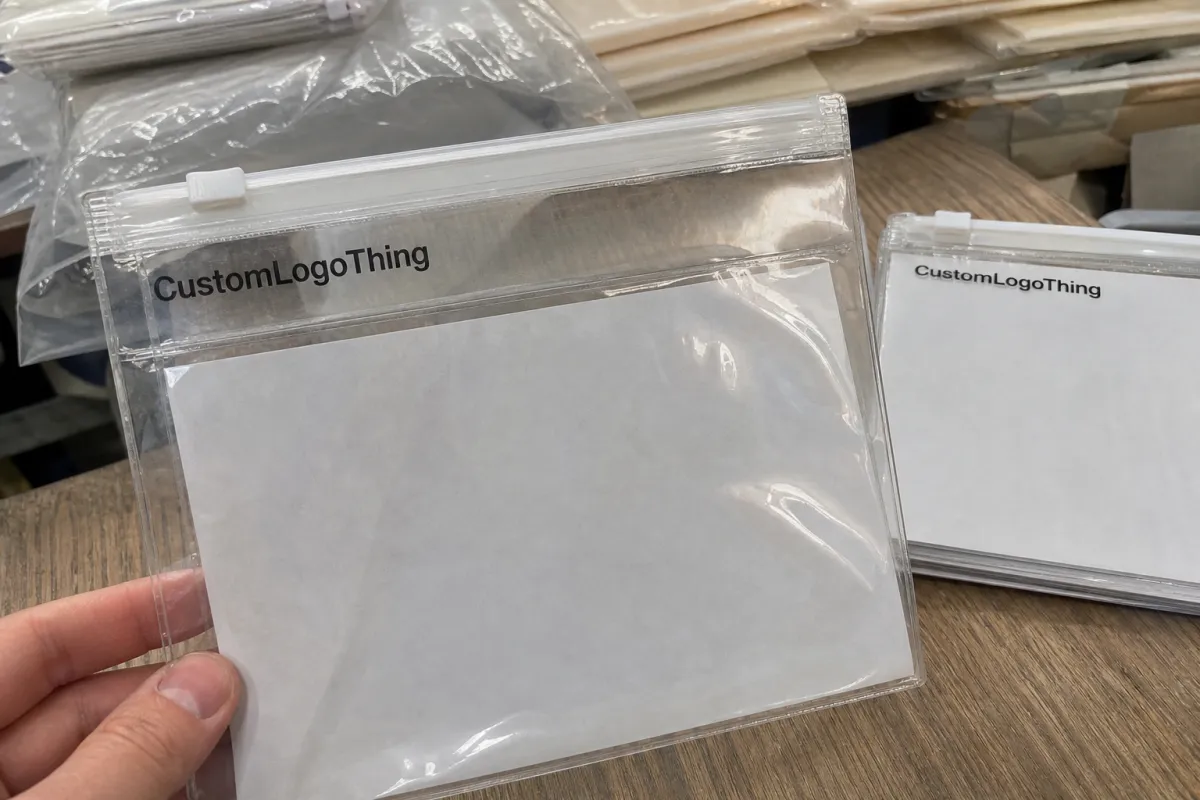
A good checklist is not about more paperwork. It is about finding the specs that look harmless in a PDF and become expensive in production. A card that sits too low, a stiff insert that bows the film, or a closure that works empty and fails when loaded are all common enough to deserve a line item.
The best buyers think in terms of the finished pack, not the individual parts. That means asking whether the bag will protect the product, survive shipping, and stay easy to assemble without slowing the line. It also means accepting that a clean mockup is not proof of function. Mockups do not reveal friction, spring-back, glare, or how a packed set behaves after carton compression.
- Fit: enough room for the packed stack, not just the flat item.
- Closure clearance: the slider must move without catching the insert.
- Assembly speed: one person should be able to pack it without wrestling the parts.
- Presentation: the front face should stay upright and readable.
- Shipping durability: the pack should stay neat after transit vibration and stacking pressure.
Screen proofs are polite. Plastic, paperboard, and human hands are not. That is why a real checklist matters more than a pretty mockup.
How the bag, insert, and slider lock work together
The outer bag does the enclosure job. The insert does the support job. The product creates the real load. If one of those three parts is off, the whole pack looks wrong. That becomes obvious when a team approves the insert before the bag structure is final and the closure lands where the insert wants to live.
Slider Lock Bags need clean top clearance because the track is not just decoration. The seal area, the slider body, and the insert height all compete for the same space. If the insert sits too high, the closure becomes hard to operate. If it sits too low, the front panel looks loose and the presentation loses authority.
In branded packaging, the insert is also part of the visual story. It can keep writing tools aligned, hold a card upright, and create a centered window for a logo or product description. That matters because shoppers usually scan the front in a couple of seconds.
If the closure needs force, the insert is wrong. People do not buy packaging that feels like it needs a seatbelt.
There is also friction to think about. Glossy cards, coated inserts, and soft film move around unless the shape controls them. Fold points, corner notches, pockets, or tabs can stop that movement. A flat insert with no retention features may pass a mockup and fail after a few rounds of handling.
There are usually two use cases. A retail-ready insert prioritizes appearance, alignment, and shelf impact. A shipping-only insert prioritizes protection and packing efficiency. The same bag size might work for both, but the insert structure rarely should be identical.
Critical specs that decide fit, feel, and protection
Start with dimensions. Confirm bag width, height, and depth; insert width and height; the full thickness of the packed stationery set; and the clearance needed for the slider mechanism. For flat paper goods, a few millimeters can be the difference between a clean close and a bulged top edge. For thicker sets, ask for a physical sample once the packed stack is within 2-3 mm of target.
Then choose materials based on the job. Clear film is better for display. Thicker film is better for protection and repeated opening. Inserts are usually paperboard or coated stock when shape control matters most. A common range is 300-400 gsm for printed inserts, or 14-24 pt board if you need more stiffness. If the brief calls for a premium feel, soft-touch lamination or a matte aqueous finish can work, but only if the budget can support it and the coating does not create scuff risk during packing.
Do not ignore the surface details. Opacity affects how much artwork shows through the bag. Glare affects how clean the front face reads under retail lighting. Rounded corners matter if the pack will be handled often. Punch holes, tear notches, and hang-hole placement matter if the item goes on a peg display. That is function, not decoration.
For teams working with chain-of-custody materials, FSC-certified stock is a straightforward way to document responsible sourcing: FSC standards and certified material guidance. If the pack will move through parcel channels, use ISTA test methods and transit packaging guidance so the pack is tested like a shipment, not a desk sample.
- Closure clearance: keep the insert clear of the slider track and top seal.
- Barcode visibility: confirm the code is scannable without opening the pack.
- Hang-hole placement: align it with the shelf planogram, not only the artwork centerline.
- Open-close cycles: test repeated use if the pack is meant for retail handling or sampling.
- Regulatory checks: confirm export or customer-specific requirements before approval.
- Moisture and scuff tolerance: check whether coated artwork or exposed board survives humidity and carton rub.
Small tolerance mistakes create big packaging problems. A half-millimeter shift in the insert can change how the closure feels. A thin film choice can turn a sharp-looking pack into one that wrinkles under load.
Cost and pricing drivers for custom insert packs
Pricing moves fastest when the structure gets more complicated. Bag size, film thickness, insert shape, print colors, finish, and hand assembly all push the quote. A simple clear slider bag with a basic insert may land around $0.09-$0.16 per unit at 5,000 pieces, depending on size and print coverage. A more tailored presentation pack with multiple print areas, a shaped insert, and tighter finishing can move into the $0.18-$0.32 range. If the job needs heavy kitting or multiple parts assembled before shipment, plan higher.
MOQ matters too. Setup cost does not shrink just because the order is small. At 500 or 1,000 units, the unit price usually looks steep. At 3,000 to 10,000 units, the spread starts to settle because print setup, material waste, and die cutting are distributed across more packs.
Compare the real finished cost, not only the base print quote. Freight, sample revisions, die charges, coatings, and hand insertion can change the picture quickly. A supplier with a lower unit print price can still end up more expensive once assembly and packing are added.
| Option | Typical unit cost at 5,000 | Best for | Main tradeoff |
|---|---|---|---|
| Clear slider bag + flat insert | $0.09-$0.16 | Simple stationery bundles, lean launches | Less visual control, fewer premium cues |
| Printed bag + shaped insert | $0.18-$0.32 | Retail packaging, stronger shelf presence | Higher setup and closer tolerance control |
| Kitted multi-part pack | $0.30-$0.55 | Gift sets, promo sets, premium branded packaging | More labor, more chances for assembly errors |
One more cost factor is assembly time. A tidy insert that loads in one motion is worth money. A fussy insert that needs rotating, folding, and re-centering at the pack line slows production and raises labor.
Process and timeline from quote to packed cartons
Good production is boring in the right way. The path should be brief, dieline, artwork, sample, approval, mass production, inspection, packing, and freight. If any step is vague, the schedule starts leaking.
- Brief: confirm SKU, contents, target quantity, and shelf or shipping use.
- Dieline: lock the bag size and insert shape before artwork starts.
- Artwork: place logos, barcode, warnings, and fold-safe content.
- Sample: approve a real assembled unit, not only loose components.
- Production: run the approved spec without late changes.
- Inspection and packing: verify count, fit, and carton strength before freight.
For timing, a simple proof correction can take a few days. A sample is often 7-14 business days once the spec is locked. Mass production for a standard run is commonly 12-20 business days after approval, though more complex structures take longer. If tooling changes or new die lines are needed, add time.
What slows things down most? Missing measurements, late artwork changes, insert size revisions, and unclear carton counts. You can save a lot of time by approving one fully assembled sample, not a pile of separate parts on a table.
If the pack needs to survive parcel handling, use shipment testing rather than relying on a clean desk sample. ISTA programs simulate vibration, compression, and drop stress far better than a polite handoff in the office.
Quality control checks before approval
Before signoff, inspect the pack like someone who has to pay for the mistakes. Confirm dimensions, material, closure clearance, print layout, barcode scanability, carton count, and assembly method. Check the hand motion too. If the pack is awkward to load, the warehouse will find a way to dislike it.
Ask for one fully assembled sample, not a bag in one carton and an insert in another. You need to see the finished fit, the front presentation, and the way the slider closes after the product is inside. A nice loose sample means very little.
Then test the scenario that matters most. Retail hanging, shelf stacking, mail shipment, or repeated open-close cycles each expose different weaknesses. Pick the use case first, then tune the structure to that use case rather than pretending one setup solves everything.
- Load test: confirm the product goes in without forcing the closure or scuffing the artwork.
- Closure test: cycle the slider several times with the product inside.
- Alignment test: check that the insert stays centered after packing and light shaking.
- Carton test: verify the packed units do not press the insert out of position.
- Scan test: check barcode readability through the final film or window.
For multi-SKU programs, version control matters more than most teams expect. Keep a dated spec sheet, a labeled sample, and a single source for measurements. Otherwise, someone will revise the artwork or insert by email, the quote will drift, and the final pack will no longer match the approved sample.
Common mistakes that trigger reprints and damage claims
The classic mistake is measuring the product, not the packaged stack. People measure the pens, stickers, or cards alone, then forget the insert, folds, tabs, and closure clearance. The result is a bag that is technically large enough in theory and clearly wrong in reality.
Another common miss is designing the insert before the bag structure is final. A clean insert can still block the slider, create bulging corners, or push the artwork out of view. The two parts need to be drawn together.
Artwork errors are more annoying because they are preventable. Hidden logos, unreadable barcodes, low-contrast text, and graphics sitting under a seal line are not production surprises. They are approval misses.
- Wrong measurement basis: flat item size instead of packed stack size.
- Ignored closure zone: the slider or seal area gets crowded.
- Weak outer carton: the insert shifts during transit and creases the bag face.
- Overfilled packs: the pack looks bloated and opens poorly.
- No sample test: the flat proof hid stiffness, glare, and hand-feel problems.
- Unclear finish choice: a glossy surface may show scuffs faster than expected.
A flat proof cannot show how a pack behaves when someone opens it, closes it, stacks it, and ships it. That is why real samples beat confidence every single time.
Damage claims often start with packaging that looks fine but is too loose inside the carton. Once the inserts move, edges rub, corners crease, and the print scuffs. Then someone tries to fix the issue with extra tape or filler, which usually turns a simple stationery run into an expensive second pass.
Expert checks before you sign off
Before approval, run one last inspection with the full pack in hand. Confirm the dimensions against the packed stack, check the material thickness, test the closure, scan the barcode, and compare the carton count to the purchase order. If the insert shifts by hand, it will shift in transit.
Also check the visual balance. The logo should not sit too close to a fold line. The product description should not vanish under glare. The insert should frame the contents, not compete with them.
My practical recommendation is simple: compare one standard option, one upgraded option, and one cost-saving option, then choose the version that meets the launch goal without pretending the budget is endless. The useful part of the checklist is not perfection; it is control.
Done well, this checklist protects the basics: fit, closure movement, print visibility, and shipping strength. Done poorly, it becomes a polite formality that hides risk until the order is already on the line.
What should be on a stationery bag insert checklist?
Start with bag dimensions, insert size, product thickness, and closure clearance. Then confirm print placement, barcode visibility, material thickness, and the assembly method so the pack can be built the same way every time.
How do I know if my slider lock bag insert is the right size?
Measure the packed stack, not just the flat item, because the finished bundle is what must fit. Leave room for the insert, folds, tabs, and slider track so the bag closes without bulging or dragging.
What affects pricing most for stationery insert packaging?
Bag size, film thickness, print complexity, insert shape, and hand assembly are the biggest drivers. MOQ, sample cost, freight, and kitting fees can also change the real landed unit cost a lot.
How long does production usually take for custom slider lock bags?
Artwork corrections can move quickly if the measurements are already locked. Full production usually runs in a couple of weeks after approval, but complex structures, new tooling, or late changes will stretch that timeline.
What is the biggest mistake people make with stationery packaging inserts?
They approve a flat layout without testing the assembled pack in real life. That is how blocked closures, loose fit, scuffed print, and avoidable reprints sneak into the order.


