For wedding favors, thickness is the part people underestimate. Color gets the applause. Structure decides whether the beanie looks premium, wears comfortably, and survives the photo session without slouching into something forgettable. A cuffed knit beanie can read polished on a gift table or cheap in one glance. The difference is usually not the logo. It is the material spec.
The wedding cuffed knit Beanies Material Thickness guide matters before you approve a sample because knit density changes three things at once: how the beanie feels, how it photographs, and how it takes decoration. A soft sample may feel nice in the hand but collapse under embroidery. A denser sample may look cleaner, yet run too warm for an indoor reception. That tradeoff is the whole job.
Buyers often focus on the box first. Fair enough. Packaging matters, especially if the order is going into kraft paper sleeves, FSC certified inserts, or recycled mailers. But the beanie still has to carry its own visual weight once the box opens. If the knit is too thin, the whole set feels lighter than the price tag suggests. If it is too heavy, it can overwhelm the rest of the presentation.
Thickness is not one number. It is a mix of yarn weight, stitch density, ply count, cuff depth, and finishing quality. A supplier calling something “thick” or “premium” is not enough. Ask for the actual structure behind the label. That is where the real difference lives.
A beanie can look expensive in a flat lay and still fail on a forehead. The spec has to work in both places.
Why Thickness Matters Before You Approve a Sample
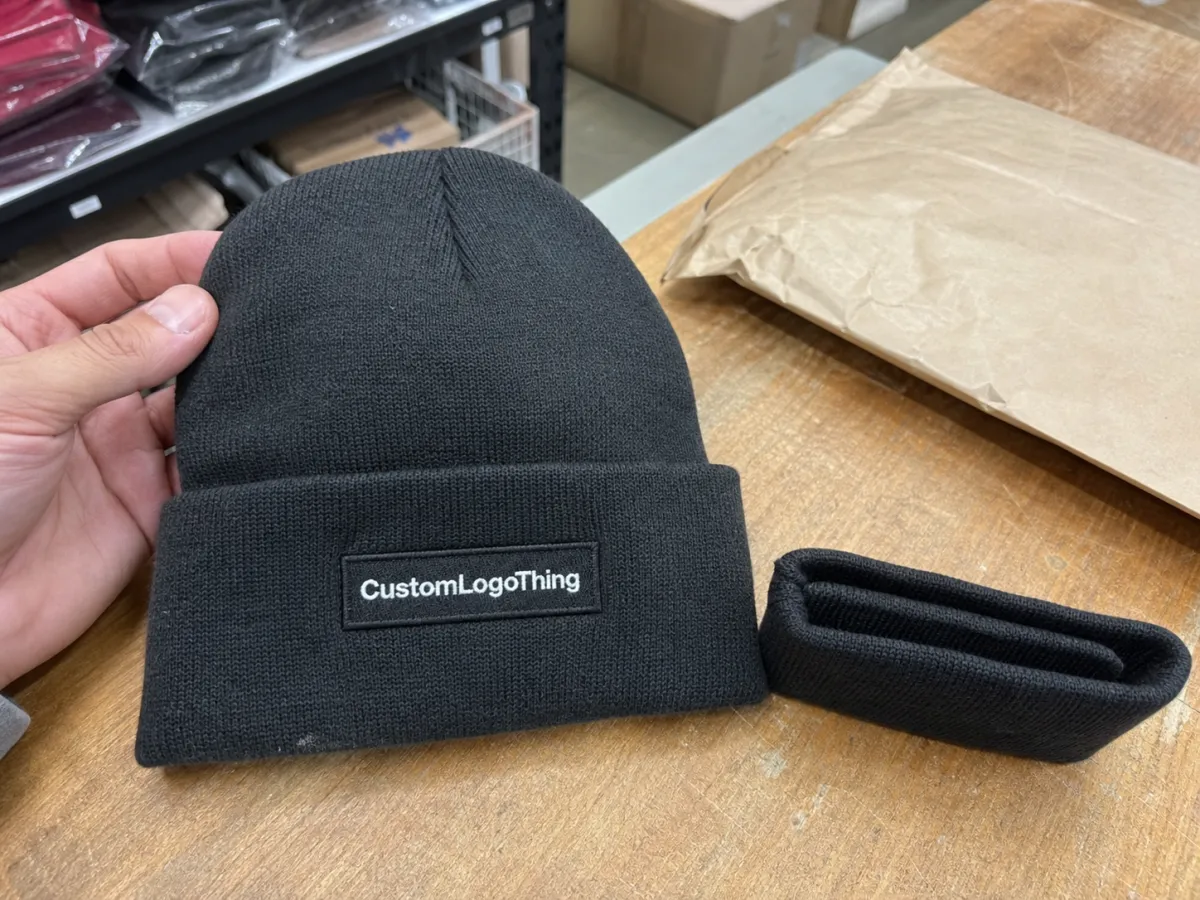
The most common mistake is treating beanie thickness like a style preference. It is not. It is a performance spec with visual consequences. Knit density can change perceived quality more than the yarn color or even the embroidery thread. A tighter cuff reads deliberate. A loose cuff can look unfinished, even if the stitching is perfect.
Wedding settings make this more obvious because the beanie is handled, worn, removed, packed, and photographed in a short window. Guests rarely treat favors gently. They try them on, toss them onto chairs, stuff them into bags, then pull them back out for photos. A flimsy knit shows wear fast. A stiff one may hold shape but feel less inviting.
That is why a sample should be judged in context, not on a desk under office light. Compare it in the room where it will be used. Outdoor ceremonies need more warmth and better wind resistance. Indoor receptions need more comfort and less bulk. Lighting matters too. A knit that looks rich under daylight can look flat under warm event lighting if the surface texture is too loose.
The cuff deserves special attention because it is the main decoration zone. If the cuff is too soft, embroidery can ripple or sink into the knit. If the cuff is too dense, the logo can sit high and feel heavy on the front of the hat. A balanced cuff gives the decoration a stable landing surface without turning the beanie into a brick.
There is also the packaging reality. Dense knits stack better in rigid boxes and fold with less collapse in tissue or sleeves. That matters if the favors are arranged with cards, ribbon, or other gift items. The hat should still look intentional after transit, not like it lost a fight with the shipping carton.
If you want a usable benchmark, standard adult Cuffed Knit Beanies often land around 80-120 g finished weight, depending on yarn and size. Below that, they can start to feel light for a premium wedding favor. Above that, they can feel substantial, even luxurious, but the added bulk is not free. It changes cost, comfort, and how the hat sits on the head.
How Knit Density Affects Warmth, Stretch, and Shape
Denser knits trap more air. That usually means more warmth and better wind resistance. It also usually means better shape retention. A beanie with enough body stands up on a gift table, holds a cuff line, and looks cleaner in flat lay photography. That is useful when the hat has to sit next to stationery, florals, or other high-polish details.
Loose knits feel softer right away. They stretch easily and can fit a wider range of head sizes without pressure. The downside is recovery. If the yarn relaxes too much after a few hours, the cuff starts to spread and the crown can sag. For wedding favors, that kind of droop tends to show up after the event, which is exactly when nobody wants to deal with it.
Recovery is one of the checks buyers skip, then regret. Stretch the cuff hard, fold the beanie, leave it compressed, and see what happens. If it comes back with a tired shape or visible distortion, do not assume production will magically fix it. Knitwear usually behaves in production the way it behaves in sampling. That is the whole point of the sample.
Warmth is only part of the story. Breathability matters too. A thick beanie in a cold outdoor venue feels right. The same beanie inside a heated ballroom can become uncomfortable fast. Guests rarely complain immediately. They just stop wearing it. That is not a great sign for a favor item.
For most wedding projects, medium density is the safest starting point. It gives enough body for embroidery, enough stretch for practical wear, and enough structure to photograph cleanly. Heavy density makes sense for winter weddings, mountain venues, or a gift meant to feel more utilitarian. Light density can work for mild weather or indoor events, but it needs careful decoration planning.
| Thickness band | Hand feel | Warmth | Decoration stability | Best use |
|---|---|---|---|---|
| Light | Soft, flexible | Low to moderate | Fair | Indoor receptions, mild climates |
| Medium | Balanced, smooth | Moderate | Good | Most wedding favors and bridal party gifts |
| Heavy | Structured, dense | High | Very good | Outdoor ceremonies, cold-weather events |
The table is a starting point, not a law. Different yarns can shift the result. A lighter acrylic blend may feel warmer than expected. A wool blend may look richer but shed more at first or require a more careful finish. The same category can produce very different results depending on gauge and construction.
Yarn Blend, Gauge, and Cuff Construction
Material thickness starts with yarn, but it does not end there. Acrylic is still the most common choice because it gives consistent color, predictable supply, and a price point that works for larger wedding runs. It also handles embroidery well enough when the knit density is right. Wool adds warmth and a more natural hand feel. Blends sit between the two and often make the most sense for custom orders that need both comfort and structure.
Gauge matters just as much. Tighter gauge means more stitches per inch. That usually creates a smoother surface, better opacity, and cleaner logo edges. Looser gauge creates more texture and a softer drape, but it can expose the knit pattern in a way that makes small text harder to read. If the design has fine lines or a small monogram, tighter gauge usually wins.
Ply count changes the feel again. Single-ply yarn often looks lighter and can feel softer, but it may show more unevenness in the knit. Two-ply or multi-ply constructions usually hold shape better and give the beanie a fuller look. That does not automatically mean better. A bulky yarn can look rich and still be the wrong choice if the decoration method needs a steadier surface.
Cuff construction deserves its own line in the spec sheet. A double-layer cuff gives embroidery more stability and keeps the decoration zone from collapsing. Reinforced ribbing helps the cuff rebound after stretching. If the cuff is too shallow, the logo can feel cramped. If it is too deep, the hat can look heavy and dominate the face in photos. Buyers often notice this only after the sample arrives. By then, it is late in the game.
There is also the finishing detail nobody talks about until the order is in motion: the edge quality. A clean bind-off, even rib tension, and consistent seam placement matter more than people expect. A knit that is technically the right thickness can still look cheap if the crown finish is sloppy or the cuff seam twists.
Production teams usually check three things before moving beyond sample approval: stitch consistency across the cuff, recovery after stretching, and whether the decoration area stays flat. Those checks sound basic. They are also the reason some beanies look polished and others look like a rush job.
For packaging teams, substrate strength follows the same logic. If an insert is too thin, ink behavior gets messy. If the board is too heavy, it adds cost without improving the result. Knitwear behaves the same way. Structure supports the finish.
If you need a reference point for materials and packaging standards, the U.S. EPA’s recycling resources are a useful starting place for thinking about recycled materials and recovery streams: EPA recycling resources. For shipment durability, the ISTA testing standards are a reasonable benchmark for pack-out and transport stress.
- Yarn blend: acrylic for consistency, wool for warmth, blends for balance
- Gauge: tighter for crisp logos, looser for softer drape
- Ply: single for lighter hand feel, double for more body
- Cuff depth: enough room for embroidery without crowding
- Recovery: cuff should return after stretching and folding
Cost, Pricing, MOQ, and Quote Variables
Thicker beanies usually cost more, but not only because they use more yarn. They also take longer to knit, may need more careful finishing, and can increase decoration time if the cuff is dense or heavily ribbed. A quote that looks like a material jump is often a mix of yarn cost, machine time, and labor at the finishing table.
For custom wedding orders, a practical pricing range for simple Cuffed Knit Beanies often lands around $3.50-$6.50 per unit at moderate volume. Heavier constructions, wool blends, specialty labels, or more complex embroidery can push that into the $6.50-$10+ range. Smaller quantities usually raise the unit price because the setup cost does not shrink much. That is normal. It is also why tiny runs can feel oddly expensive.
MOQ tends to move with complexity. A stock acrylic yarn and standard cuff are easier to source and produce in smaller quantities. Add custom yarn colors, woven labels, special rib construction, or a patch finish, and the minimum order usually climbs. Factories do not increase MOQ out of spite. They do it because setup time and machine scheduling become less efficient.
Ask for line-item pricing, always. Base beanie, sample development, decoration, label application, individual packaging, and shipping should be separated. If a supplier gives one clean number with no breakdown, the quote is hiding something. Sometimes it is harmless. Sometimes it is not. Either way, you cannot compare options fairly without the split.
Pricing should also reflect how the order is packed. Individual tissue, kraft paper sleeves, inserts, and outer cartons all change the final cost. If the beanies are being bundled with printed cards or other small gifts in corrugated cardboard mailers, the pack-out choice can matter as much as the knit itself. A slightly more expensive hat can still be the better value if it lowers rework or protects the presentation on arrival.
If sustainability is part of the brief, ask about FSC certified paper, recycled materials, or biodegradable packaging. Those details do not change the knit, but they do change the impression of the gift set. For wedding favors, the unboxing is part of the product. Ignoring it is a fast way to waste good merchandise.
Useful quote comparison buckets:
- Base beanie cost
- Sample or setup fee
- Decoration charge
- Packaging and labeling
- Freight, duties, and delivery timing
Process and Timeline: Sampling to Delivery
Good orders start with a clear spec sheet. List the yarn blend, target thickness, cuff depth, decoration method, quantity, and deadline. If the supplier is guessing at any of those, the sample stage will drift. A photo alone is not enough. It cannot show cuff rebound, seam behavior, or how the knit feels after wearing for a few hours.
Sampling usually takes the most time when the brief is vague. If the first sample comes back too thin, too hot, or too loose, expect at least one revision. Even a small change in stitch density can alter the look enough to require a new approval. That is not a failure. It is normal production reality. The mistake is not leaving room for it.
A realistic timeline for many custom orders looks like this: 5-8 business days for initial sampling if the yarn is stocked, 12-18 business days for production after approval, and another 5-10 business days for shipping depending on route and method. Add time for custom labels, split shipments, or gift-ready packing. Weddings do not care about anyone’s optimistic calendar.
Decoration method can add its own delays. Embroidery is usually straightforward, but dense stitching, oversized logos, or patch placement may need extra review. If the cuff is thick, the backing must be chosen carefully so the front does not pucker. If the knit is soft, the design may need a stabilizer or a lighter stitch density. Either way, the decoration has to match the fabric. Otherwise, the decoration is doing a job the fabric cannot support.
Shipping is where many good-looking orders get annoyed into mediocrity. Knitwear compresses better than fragile hard goods, but it still needs a sensible pack-out. Corrugated cartons should protect the stack from crushing. Tissue or sleeves should keep the hats from arriving wrinkled or dirty. Moisture protection matters on longer routes. None of that is glamorous. All of it is useful.
Build three approval gates into the process:
- Gate 1: approve yarn and thickness after the first sample
- Gate 2: approve decoration placement and cuff behavior
- Gate 3: approve pack-out and shipping timeline before production
That structure keeps a custom run from drifting. It also gives everyone a paper trail when a correction is needed. Production teams like clarity because it reduces guesswork. Buyers should like it for the same reason.
Common Thickness Mistakes That Lead to Rework
The first mistake is ordering a beanie that is too bulky for the event environment. Outdoor winter weddings can handle dense knits. Heated ballrooms usually cannot. Guests get warm quickly, especially if they are only wearing the beanie for photos. If the product feels uncomfortable, it gets abandoned. A favor that lives in a bag is not exactly a win.
The second mistake is assuming thicker automatically means better decoration results. It does not. Thick knits can swallow fine embroidery if the backing is too light or the stitch plan is too aggressive. Soft loose knits can also blur detail because the surface shifts too much. The right thickness depends on the decoration method, not just the look on a sample card.
The third mistake is skipping recovery tests. Stretch the cuff. Fold the beanie. Leave it compressed. Then check the shape after a day. If the cuff stays baggy or the crown looks tired, that is not a minor flaw. It means the product may disappoint after the first wear. A lot of rework starts with a buyer saying, “It looked better in the sample.” That sentence usually means the sample was not tested hard enough.
The fourth mistake is forgetting the full gift experience. A beanie does not sit alone in a vacuum. It sits beside paper stock, ribbons, inserts, and whatever else is in the package. If the favor includes kraft paper, recycled inserts, or a rigid gift box, the knit texture has to work with the rest of it. Too smooth can feel plain. Too heavy can overpower the set. The product and the packaging need to agree.
Another easy-to-miss issue is pilling. Some soft yarns hold up well; some do not. Repeated friction from outerwear, travel bags, or storage can fuzz the surface faster than expected. Ask for wear feedback before approving a large run, especially if the beanies are meant to live beyond the event. There is nothing romantic about a favor that pills after one outing.
If the sample looks right but fails a stretch-and-return test, keep going. That one check saves more orders than most buyers expect.
Expert Next Steps for Ordering the Right Fit
Start with the event conditions, not the decoration. Outdoor winter ceremony? Prioritize density and recovery. Indoor reception? Prioritize comfort and a smoother hand feel. Bridal party gift? You can usually go a little richer on yarn quality and finish, as long as the cuff still supports the logo cleanly.
Then compare physical samples under the same decoration method. Touch alone does not tell the whole story. Lay them flat. Stretch them. Fold them. Photograph them. The winner is often not the thickest one. It is the one that looks composed from every angle and survives a basic QC check without drama.
Ask for one production timeline with clear approval checkpoints and revision allowances. If the supplier cannot explain how a thickness change affects price, lead time, or decoration choice, the quote is unfinished. Good sourcing is not about finding the lowest number. It is about finding the right structure for the order so the final result does not need excuses.
Think through the whole unboxing. The beanie may travel in corrugated cardboard, but the guest-facing layer can still feel refined with kraft paper, recycled materials, or FSC certified inserts. That is not overkill. It is the difference between a gift that feels considered and a gift that feels packed in a hurry.
Use this wedding cuffed knit Beanies Material Thickness guide as the last checkpoint before approval. If the knit density, cuff structure, decoration method, and packaging all line up, the beanies will look intentional in photos, feel comfortable in real use, and hold up long after the wedding ends.
How do I choose the right wedding cuffed knit beanie thickness?
Match the thickness to the setting. Lighter knit works better for indoor receptions and mild weather. Denser knit makes more sense for outdoor ceremonies and colder climates. Then check stretch recovery, cuff depth, and how the decoration sits on the fabric. Those details matter more than a generic “medium” label.
What thickness works best for embroidery on cuffed knit beanies?
A medium to medium-dense cuff usually gives embroidery the most stable surface. Very loose knits can blur fine text, while overly rigid cuffs can push the stitch line up and make the logo feel heavy. Ask for a sample with the exact stitch count and backing before approval.
Are thicker wedding cuffed knit beanies always better?
No. Thicker can mean warmer and more structured, but it can also feel hot indoors or too stiff for a gift meant to be worn casually. The best choice balances comfort, decoration clarity, and the look you want in photos and on the gift table.
How much does material thickness change unit cost?
Thicker knits usually increase cost because they use more yarn and machine time. Custom yarns, deeper cuffs, special labels, and more complex decoration can push pricing higher again. Ask for itemized pricing so you can compare quotes without guessing where the money went.
What lead time should I expect for custom wedding beanies?
Lead time depends on yarn availability, sample revisions, decoration method, and shipping route. Many custom runs need several business days for sampling, then a couple of weeks for production, plus transit time. Build in a cushion. Wedding dates are not known for patience.


