Buyer Fit Snapshot
| Best fit | Sustainable Display Boxes for Retail projects where brand print, material claims, artwork control, MOQ, and repeat-order consistency need to be specified before quoting. |
|---|---|
| Quote inputs | Share finished size, material target, print colors, finish, packing count, annual reorder estimate, ship-to region, and any compliance wording. |
| Proofing check | Approve dieline scale, logo placement, barcode or warning zones, color tolerance, closure strength, and carton packing before bulk production. |
| Main risk | Vague material claims, crowded artwork, missing packing details, or unclear freight terms can make a low unit price expensive after revisions. |
Fast answer: Sustainable Display Boxes for Retail: Board, Finish, Dieline, and Unit Cost should be specified like a repeatable production item. The safest quote records material, print method, finish, artwork proof, packing count, and reorder notes in one written spec.
Production checks before approval
Compare the actual filled-product size with the drawing, then confirm tolerance on folds, seals, hang holes, label areas, and retail display edges. Reserve space for logos, QR codes, warning copy, and material claims before decorative graphics fill the panel.
Quote comparison points
Review material grade, print process, finish, sampling route, tooling charges, carton quantity, and freight assumptions side by side. A quote is only useful when the supplier can repeat the same color, closure quality, and packing count on the next order.
Sustainable Display Boxes for Retail: Smart Buying Tips
Sustainable display Boxes for Retail sound great until the shipment lands, the glue gives up, and the whole thing starts leaning like it had a rough night. That is the part nobody puts in the mockup. A retail display has to hold product, sell product, survive handling, and still make sense when it is retired. That is the actual job of sustainable display boxes for retail.
Sustainability is not a sticker. It is a stack of decisions: recycled fiber, responsibly sourced board, less material, smarter shipping, and a design that does not turn disposal into a headache. If a display uses less board and still protects the product, good. If it looks virtuous and falls apart in transit, the waste problem just got worse. Buyers need sustainable display Boxes for Retail that work on the floor, not only in a presentation deck.
And yes, I have seen the difference firsthand. A display can look perfect in a sample room and still behave badly in a store. Warehouse handling is rougher than people think. Store staff are busy. Customers tug on things. The box has to deal with all of it.
Sustainable Display Boxes for Retail: What They Really Solve
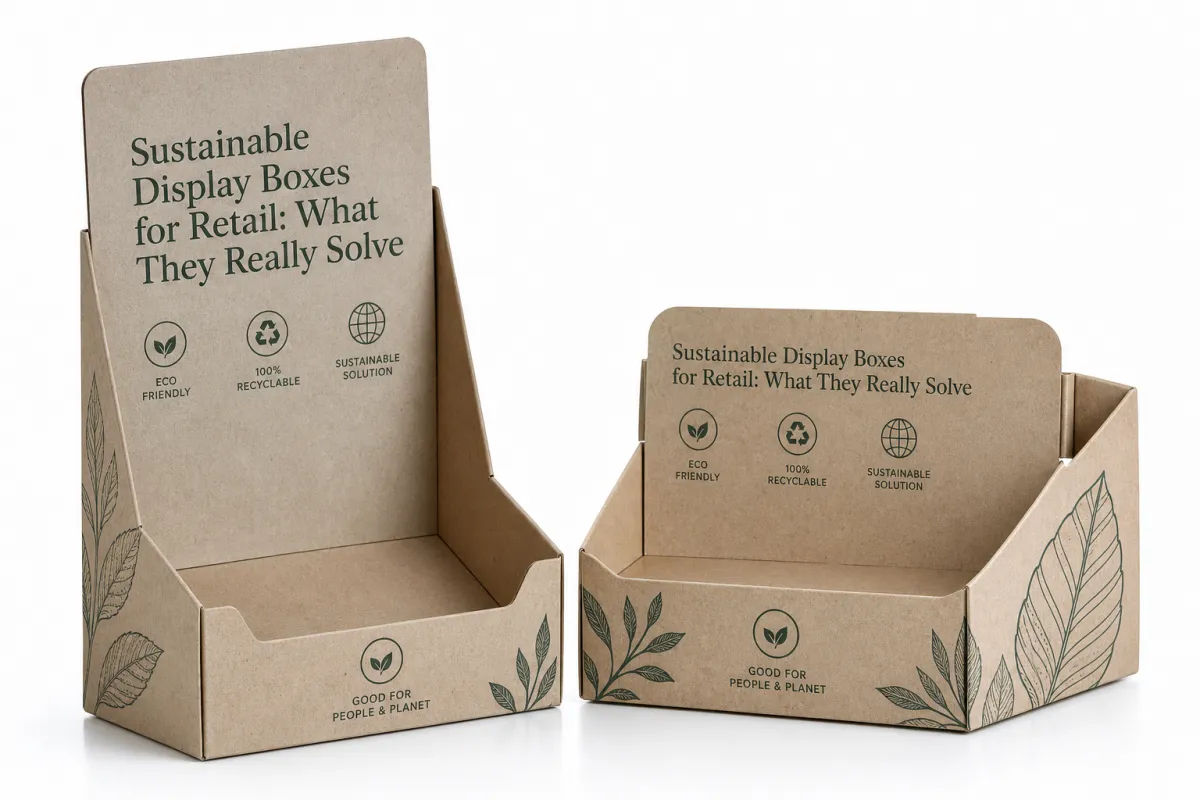
The first job of sustainable display boxes for retail is simple: make the product easier to buy. Visibility matters. Access matters. A tray that holds its shape and keeps the front row clean can move more units than an overbuilt display that eats space and looks tired by lunch. Countertop displays are especially good at impulse sales when the shape is disciplined and the opening is obvious. Floor displays can do the same for seasonal runs and bulk items, as long as they do not collapse into cardboard regret.
The next job is cutting waste in a way that shows up in the numbers. Brands love the phrase “less plastic,” but the better question is whether the full pack uses less material per unit sold. A single corrugated structure can replace a printed shell, a plastic tray, and a separate shipper. That is a real reduction. It also makes sustainable display boxes for retail easier to quote, easier to assemble, and usually easier to freight.
There is a brand side to this too, because shoppers notice more than companies think. Not always in a warm, fuzzy way. Sometimes they just notice that a display looks clean, restrained, and easy to recycle. Kraft board with a focused print approach can look more premium than a glossy box trying too hard. The point is not to wave a green flag around. It is to make sustainable display boxes for retail feel considered, not preachy.
"The best display is the one that arrives flat, sets up fast, and does not need a rescue mission on the store floor."
From a business standpoint, the payoff usually shows up in four places:
- Better merchandising - the product is easier to see and easier to reach.
- Lower material use - fewer components, less board, less waste.
- Cleaner brand presentation - the display supports the sustainability story without shouting over it.
- Fewer damaged units - stronger corners, better stackability, and less fallout in store.
That last one gets ignored a lot. A display that loses product to damage is not sustainable. It is just a more polite version of waste. Buyers comparing sustainable display boxes for retail should treat durability as part of the sustainability equation, not a separate box to tick. If the structure protects more product through the full supply chain, the waste savings usually beat a token material swap.
There is a hard line between marketing language and actual performance. The language is easy: recycled board, FSC-certified fiber, water-based inks, and a few tidy claims on the side panel. Performance takes work: does the display survive palletizing, warehouse handling, shelf stocking, and customer reach? If yes, then sustainable display boxes for retail are pulling their weight. If not, the packaging is wearing a green costume and asking for applause.
Brands that get this right start with the store problem first. How heavy is the product? How much space is available? How long will the display live in market? What level of customer interaction is expected? Once those answers are clear, the sustainability choices become easier to judge. The best sustainable display boxes for retail are not the flashiest. They are the ones that solve the retail problem with the fewest bad tradeoffs.
One more thing: sustainability claims should be specific. “Recyclable” only means something if the local recycling stream can actually handle the material. “Recycled content” should be backed by supplier specs. Otherwise the claim is just decorative, and we do not need more decorative nonsense.
How Sustainable Display Boxes for Retail Work
A display box is a small structure, not just a printed carton with ambition. Most sustainable display boxes for retail use a base or tray, side walls, a front lip or open face, and sometimes a header card, dividers, or inserts. Each piece changes the way the display behaves. A taller front panel gives more branding space but can hide product. A deeper tray improves stability but takes footprint. A divider keeps SKUs neat but adds material. The structure should follow the product, not the other way around.
Material choice affects the life cycle more than almost anything else. Corrugated board is common for stronger floor displays and ship-ready trays because it resists crushing better than thin paperboard. Folding carton or paperboard works well for lighter countertop displays and sharp print detail. Kraft board brings a natural look with fewer coatings, while recycled paperboard can reduce virgin fiber use. In most sustainable display boxes for retail programs, the best substrate is the one that meets the strength target with the least material. Not the one that simply sounds responsible.
The supply chain matters too. Displays are usually shipped flat, which saves freight and warehouse space. Assembly then happens at the warehouse, fulfillment center, or sometimes right in store. That flat-pack advantage is one reason sustainable display boxes for retail are so useful. A display that nests efficiently can cut cubic volume hard compared with a pre-built fixture. Less air in the truck helps cost and emissions. Hard to argue with that.
For validation, I prefer standards over vibes. If a display will be stacked, shipped long distance, or handled by a lot of store staff, it should be checked against practical test methods. The ISTA test methods are useful for shipping and distribution thinking, while fiber sourcing can be checked against FSC certification if the brand wants documented responsible forest management. Those are not magic stamps. They are just better than a pretty render pretending to be evidence.
Performance tradeoffs are unavoidable. More strength usually means more board. Better print quality can nudge a brand toward coated paperboard instead of raw kraft. Moisture resistance may call for a light barrier coating, which can complicate recycling if it is overdone. The smartest sustainable display boxes for retail balance those tradeoffs by use case:
- Short promo runs - lighter board, simple graphics, fewer inserts.
- Mid-length retail programs - stronger corrugated or thicker paperboard, reinforced edges, moderate print coverage.
- Heavy or high-touch displays - engineered corrugated, tested load paths, and fewer decorative extras.
That is the part many buyers miss. Sustainable does not mean fragile. A strong, efficient structure can be the greener choice because it reduces replacements, spoilage, and waste in the field. If one option lasts twice as long, it often wins on total material use even if the board grade looks heavier on paper. That matters even more for sustainable display boxes for retail in busy places like convenience stores, pharmacy counters, and club store aisles.
Another practical detail: assembly should be boring. Boring is good. If the display needs a ten-step ritual or a fight with hidden tabs, store teams will improvise, and the result usually looks kinda awful. A simple lock, clear fold sequence, and obvious product path are worth more than fancy geometry.
Key Factors That Shape Sustainable Display Boxes for Retail
Material choice is the first decision, and it deserves more than a checkbox. Recycled content can range from partial post-consumer fiber to high-recycled substrates, but availability matters just as much as percentage. A buyer can ask for 100 percent recycled board and then find out the grade is inconsistent, expensive, or hard to source at scale. For sustainable display boxes for retail, I would rather see a stable substrate that prints well and holds up than a theoretical eco score that dies in production.
Construction is the next lever. Use fewer parts where possible. Skip unnecessary plastic windows, laminated wraps, and mixed-material extras that make recycling awkward. If a window is truly needed to show the product, keep it small and be honest about disposal. Many sustainable display boxes for retail can do without windows entirely if the die-cut opening and print are handled properly. That saves material and keeps the pack cleaner.
Print and finish should support the structure, not bully it. Water-based inks are a sensible starting point for many programs, and low-impact coatings are often enough if the display is not facing heavy moisture or greasy hands. Soft-touch lamination, spot UV, foil, and heavy gloss all add cost and can complicate recycling. Premium does not require coating the thing like a sports car. In fact, many sustainable display boxes for retail look better when the design is disciplined and not buried under finish effects.
Retail fit is where good intentions get crushed. Literally. The display should match the product weight, the shelf or floor footprint, shopper reach, and the amount of handling it will take. A countertop box for lip balm does not need the same board thickness as a floor stand for glass bottles. One-size-fits-all tends to create overbuilt displays or flimsy ones. Either way, the customer pays. Good sustainable display boxes for retail are sized to the SKU count, the fill weight, and the actual store environment.
Here is a practical spec checklist that keeps the discussion grounded:
- Product weight per pack and per filled display.
- Board grade or substrate, including recycled content and FSC status.
- Print method and total ink coverage.
- Finish level, including whether any coating or lamination is truly necessary.
- Assembly method and target setup time per unit.
- Retail environment, including shelf, countertop, club, or floor placement.
- Target life span, whether it is a 2-week promo or a longer program.
One practical benchmark helps a lot: if the display supports light products, a well-designed paperboard or E-flute structure may be enough. If the unit holds heavier items, like bottles or boxed sets, stronger corrugated with a clean load path usually beats adding decoration. For many sustainable display boxes for retail, the best structural move is not adding more stuff. It is removing the wrong stuff.
Some buyers worry that sustainable choices will make the box look plain. Sometimes they do. Plain is not cheap, though. Kraft, recycled board, and minimal print can look sharp if the logo placement, typography, and die lines are clean. The finishing mistake is usually not “too sustainable.” It is “too busy.” A calm, confident structure often sells better than a display trying to do four jobs with one tired headline. That is where sustainable display boxes for retail can outwork louder packaging.
If you need to compare structural options, a good starting point is to review a broader range of Custom Packaging Products and then narrow the build to the retail setting. Not every display needs a trick. Some just need the right board, the right glue pattern, and a sane layout.
Cost and Pricing for Sustainable Display Boxes for Retail
Price is where buyers get serious, as they should. The cost of sustainable display boxes for retail is shaped by board grade, print complexity, size, insert count, special finishing, and order quantity. A small run with a custom dieline will almost always cost more per unit than a larger standardized build. That is not a supplier trick. It is setup, tooling, and make-ready doing their thing.
The cheapest display is often the one with the fewest complications. A simple countertop tray with one-color print and no special coating may land at a much lower unit cost than a glossy, multi-part structure that looks premium but is overbuilt. For sustainable display boxes for retail, that is where brands can save money without hurting the result: simplify the structure, keep the print disciplined, and leave out needless inserts.
Where cost jumps fast is custom shape, high ink coverage, extra finishing, and low quantity. If a brand wants a shaped header, reinforced base, and full-color graphics on both inside and outside panels, the unit price will rise. That does not mean the project is wrong. It means the buyer should understand the tradeoff. A display that is easier to assemble and less likely to damage product can save money elsewhere, especially when it reduces labor or shrink. Those savings matter in sustainable display boxes for retail programs because the display cost is only one line in the total retail rollout.
Here is a rough pricing frame that keeps the math honest. Real quotes will vary by size, tooling, print area, and shipping region, but these ranges help buyers avoid fantasy pricing:
| Display Type | Common Build | Typical Volume | Approx. Unit Cost | Best Fit |
|---|---|---|---|---|
| Countertop tray | Paperboard or light corrugate, simple print | 2,000 to 10,000 units | $0.18 to $0.55 | Impulse items, samples, small boxed goods |
| Counter display with header | E-flute or reinforced paperboard | 1,000 to 5,000 units | $0.45 to $1.20 | Beauty, snacks, accessories, wellness items |
| Floor display | Corrugated base, printed wrap, header card | 500 to 2,000 units | $3.25 to $8.50 | Seasonal launches, bulk retail, heavier SKUs |
| Premium branded stand | Reinforced corrugated, custom inserts, higher coverage print | 500 to 1,500 units | $6.00 to $12.00 | Longer programs, high-touch retail environments |
Those numbers are not a promise. They are a useful range. A 1,000-unit run with a custom structural shape and full coverage print will sit toward the upper end, while a larger, standardized order can come down quickly. For many sustainable display boxes for retail projects, the real cost win comes from design efficiency, not from squeezing the supplier until the sample looks suspicious. A box that is underbuilt can cost more in damaged goods than it saves in production.
There is also a volume strategy that brands overlook. If a structure can be standardized across several SKUs or seasonal campaigns, the per-unit price usually improves and the launch gets easier. Instead of redrawing the display every time, keep the footprint and load capacity stable, then swap the graphics. That is one of the cleaner ways to scale sustainable display boxes for retail without turning each program into a fresh engineering exercise.
Smaller runs are the toughest corner. They usually carry higher setup cost, and the economics only work if the display has a strong retail purpose. That is why I tell buyers to ask two questions before chasing a fancy build: will this structure move more product, and will it reduce damage or labor enough to justify the cost? If the answer is no, simplify the project. If the answer is yes, the higher unit cost may still be fine. In other words, sustainable display boxes for retail should be measured against retail return, not just pack price.
A quick note on savings: cheaper board is not always cheaper in the long run. A board that fails under load can increase returns, replacements, and restocking labor. That is not a nice surprise. That is a cost leak with a SKU label on it. Good buyers price the full system, not just the carton.
Process and Timeline: From Concept to Store Floor
The process starts with the brief. If the brief is weak, everything after that gets expensive. A good brief for sustainable display boxes for retail should include product dimensions, fill weight, quantity per display, target retail environment, shipping method, and the brand goals for sustainability and appearance. If the packaging team also knows the launch date, store count, and any recycling or compliance requirements, that saves a lot of back-and-forth later.
After the brief comes the structural concept and dieline. This is where the display gets translated from an idea into a buildable shape. The dieline should show load-bearing areas, lock points, perforations, inserts, and print-safe zones. If the structure is complicated, ask for a prototype early. It is cheaper to change paper than to change a production run. That sentence has been true for as long as I have watched display programs miss their deadlines. For sustainable display boxes for retail, the prototype phase is usually where the project gets saved or stalled.
Artwork approval is another common bottleneck. Brands often spend weeks debating copy and graphics, then rush the proof. That is backwards. The technical parts should be reviewed first: dimensions, board grade, folding method, and pack-out. If the art is approved before the structure is locked, the job can slip by several days or even several weeks. A simple countertop program may move from proof approval to shipment in about 12 to 15 business days. More complex sustainable display boxes for retail jobs, especially floor displays with inserts or special finishes, often need 20 to 30 business days after approval.
Delays usually happen in the same few places:
- Design changes after proofing - the dieline shifts and the schedule slips.
- Unclear sustainability claims - the buyer asks for fiber or recycling verification late in the process.
- Sample revisions - the first prototype is close, but not close enough.
- Artwork not print-ready - missing bleeds, bad image resolution, or incorrect color spaces.
Buyers should prepare a few things early if they want the timeline to behave. Product samples help. So do filled weights, shipping carton sizes, and any display assembly instructions already used by the brand. If the store staff will assemble the unit, the setup must be simple enough for a few minutes of labor, not a half-hour engineering lesson. That is especially true for sustainable display boxes for retail used in fast-moving channels like convenience, club, or drugstore retail.
Here is a realistic launch sequence:
- Week 1 - brief, measurements, and structural planning.
- Week 2 - dieline, prototype request, and initial artwork.
- Week 3 - sample review and revisions.
- Weeks 4 to 6 - production, packing, and freight booking for larger orders.
That timeline can move faster if the structure is simple and the artwork is ready on day one. It can move slower if the buyer keeps changing claims, materials, or print coverage. No surprise there. Every revision costs time. If the goal is to launch sustainable display boxes for retail on schedule, the best move is to lock the structure early and leave art tweaks for the areas that do not affect tooling.
One more practical point: shipping and storage matter. A display that ships flat is not only cheaper to move, it is easier to stage in a warehouse and less likely to get damaged before it reaches the store. That is one reason flat-pack sustainable display boxes for retail are so common. They fit the reality of retail operations, which is usually less glamorous than the mockup suggests.
Common Mistakes With Sustainable Display Boxes for Retail
The biggest mistake is picking the greenest-looking material instead of the material that actually does the job. A raw kraft finish can feel responsible, but if the board is too weak for the load, the display will fail in the field. A display that collapses after two days creates more waste than a sturdier one with a slightly heavier substrate. That is why sustainable display boxes for retail should be judged on use, not on aesthetics alone.
The second mistake is mixing too many materials. Plastic windows, laminated wraps, metal clips, and extra inserts can make a display harder to recycle and more expensive to produce. None of those components are automatically wrong, but they should earn their place. If a brand can remove a mixed-material element without hurting visibility or durability, it usually should. Cleaner construction is one of the simplest ways to improve sustainable display boxes for retail.
The third mistake is designing for the render instead of the shelf. A beautiful concept can fail if it blocks product access, tips under weight, or hides the best SKU behind a decorative panel. Shelf visibility is not optional. It is the point. The most effective sustainable display boxes for retail are often the ones with a clean, obvious product path and a structure that makes restocking easy. If the store associate hates the display, the display will probably not stay neat for long.
The fourth mistake is ignoring labor and freight. Assembly time matters. So does pallet efficiency. A display that takes two people ten minutes to build can erase savings that looked fine on a quote sheet. The same goes for oversized packaging that wastes cube in transit. If the display ships in a footprint that triggers unnecessary freight charges, sustainability and cost both take a hit. Smart sustainable display boxes for retail cut waste in the box, in the truck, and at setup.
A practical rule: if a feature does not improve product protection, brand visibility, or setup speed, question it. That sounds blunt because it is. The retail floor is not the place for decorative baggage.
- Do not over-finish the box unless the finish supports the brand or the environment.
- Do not over-spec the board if the product is light and the run is short.
- Do not under-test the structure if the product is heavy, fragile, or high-turn.
- Do not ignore the cost of assembly, storage, and replacement.
Most bad outcomes come from trying to optimize one piece of the puzzle and pretending the rest will behave. A buyer may focus on print savings and miss structural loss. Another may focus on sustainability language and forget freight volume. The best sustainable display boxes for retail avoid those traps by treating the display as a system, not a box with a logo slapped on it.
And because honesty matters, there is no magic material that solves every retail problem. If someone sells you that story, they are probably selling something else too.
Expert Tips and Next Steps for Sustainable Display Boxes for Retail
Start with the retail environment, not the artwork. That sounds obvious, yet plenty of projects begin with graphics and end with structural regret. If the display is going on a wet sales floor, near a checkout lane, or in a high-touch aisle, the board choice and load path matter more than a fancy finish. For sustainable display boxes for retail, the structure should do the heavy lifting and the print should do the selling.
Ask for a prototype before you commit to a full run, especially if the product is heavy, fragile, or likely to be handled a lot. A prototype can expose weak glue lines, awkward product access, or a bad footprint long before production starts. That step often saves far more than it costs. In fact, most of the best sustainable display boxes for retail projects I see are the ones that got tested once and revised once before launch, instead of being pushed straight from concept to quantity.
Use a simple spec checklist so the conversation stays practical:
- Product dimensions and filled weight.
- Board type or substrate, with recycled content target.
- Print method and finish level.
- Quantity and target price per unit.
- Delivery date and store launch date.
- Recycling goals and any certification needs.
If the brand wants to compare options, keep the discussion focused on tradeoffs, not adjectives. One version might use lower-cost corrugated and simple graphics. Another might use slightly heavier board, better print fidelity, and a cleaner retail presentation. Both can qualify as sustainable display boxes for retail. The better choice depends on product value, program length, and how much abuse the display will take before it is retired.
I also like to ask buyers to compare two material paths instead of one. For example, compare recycled corrugated against FSC-certified paperboard, then compare a matte water-based finish against a raw kraft presentation. The point is not to force a particular answer. It is to make the differences visible. That makes it easier to choose a structure that fits the budget and the shelf. A package team can then browse Custom Packaging Products and filter toward the structure that actually fits the retail brief instead of guessing from a catalog thumbnail.
For brands that need a fast rollout, keep the first version simple. A clean tray, a sensible header, and one strong callout can outperform a more elaborate structure that delays the launch. Once the program proves itself in store, the team can add sophistication in the next run. That approach is often better than trying to build the perfect display on day one. With sustainable display boxes for retail, the first job is to get the structure into stores and make it behave.
Finally, do not treat sustainability as a decorative layer. Use recycled or responsibly sourced fiber where it makes sense. Reduce parts. Keep mixed materials low. Design for flat shipping. Test the display against real handling. If the result is sturdy, attractive, and easier to recycle, you are doing it right. That is the standard for sustainable display boxes for retail, and it is a better standard than green language alone.
The cleanest next move is usually this: define the retail environment, choose the lightest board that still survives it, prototype early, and lock the structure before art gets fancy. Do that, and sustainable display boxes for retail stop being a talking point and start doing useful work.
What makes sustainable display boxes for retail actually sustainable?
They use recyclable or recycled fiber, reduce unnecessary material, and avoid mixed components that complicate disposal. They also need to perform in store, so durability and efficient shipping matter just as much as the material claim. A weak display is not a sustainable win. It is just a short-lived box with better marketing.
Are sustainable display boxes for retail more expensive than standard ones?
Sometimes, but not always. The biggest price jump usually comes from custom sizing, premium printing, finish choices, and low order quantities. A simpler structure with the right board selection can cost less than an overbuilt standard box with extra decoration. That is why quotes for sustainable display boxes for retail should be compared by structure, not just by headline price.
What materials work best for eco-friendly retail display boxes?
Corrugated board, recycled paperboard, kraft board, and FSC-certified fibers are common starting points. The best choice depends on product weight, shelf life, and whether the display needs to stand up to customer handling. For many sustainable display boxes for retail, the right answer is the lightest substrate that still protects the product and survives the environment.
How long do sustainable display boxes for retail take to produce?
Simple projects can move fairly quickly, but custom structural work, sampling, and print approval usually add time. A basic countertop display may be ready in about 12 to 15 business days after proof approval, while more complex floor displays can take 20 to 30 business days or more. Build in extra time if you need prototypes, special coatings, or multiple artwork revisions for sustainable display boxes for retail.
Can sustainable display boxes still look premium in a retail setting?
Yes. If the structure is clean, the print is sharp, and the materials are chosen with intention instead of gimmicks, the result can look very premium. Premium does not require heavy plastic or glossy overload; it usually comes from good structure and disciplined design. The best sustainable display boxes for retail look confident because they are designed well, not because they are dressed up.
What is the fastest way to avoid a bad display program?
Do not skip the prototype. If the display has to survive freight, store setup, and customer handling, a sample will usually expose the weak point before you spend real money. That is the cheap lesson. The expensive lesson is finding out after launch.