Buyer Fit Snapshot
| Best fit | Sustainable Folding Cartons Supplier projects where brand print, material claims, artwork control, MOQ, and repeat-order consistency need to be specified before quoting. |
|---|---|
| Quote inputs | Share finished size, material target, print colors, finish, packing count, annual reorder estimate, ship-to region, and any compliance wording. |
| Proofing check | Approve dieline scale, logo placement, barcode or warning zones, color tolerance, closure strength, and carton packing before bulk production. |
| Main risk | Vague material claims, crowded artwork, missing packing details, or unclear freight terms can make a low unit price expensive after revisions. |
Fast answer: Sustainable Folding Cartons Supplier: Board, Finish, Dieline, and Unit Cost should be specified like a repeatable production item. The safest quote records material, print method, finish, artwork proof, packing count, and reorder notes in one written spec.
Production checks before approval
Compare the actual filled-product size with the drawing, then confirm tolerance on folds, seals, hang holes, label areas, and retail display edges. Reserve space for logos, QR codes, warning copy, and material claims before decorative graphics fill the panel.
Quote comparison points
Review material grade, print process, finish, sampling route, tooling charges, carton quantity, and freight assumptions side by side. A quote is only useful when the supplier can repeat the same color, closure quality, and packing count on the next order.
Sustainable Folding Cartons Supplier: Smart Buyer Guide
A sustainable Folding Cartons Supplier gets called in for one reason and then blamed for another. The request is usually simple: cut waste, keep the box looking sharp, and don’t blow the budget. Then the brief grows. Bigger carton. Heavier finish. Extra insert. Maybe a window because someone thinks it “feels premium.” I’ve watched teams chase recycled content while quietly adding board, freight, and scrap. That’s not sustainability. That’s just packaging wearing a green tie.
Folding cartons are paperboard packages used for cosmetics, supplements, food, electronics, and retail goods. Sustainable packaging is not just “paper instead of plastic.” It is a carton built with the right fiber, the right structure, and the right finishing choices so the package does its job without dragging extra material through the supply chain. A real sustainable folding cartons supplier can explain recycled content, FSC-certified fiber, water-based inks, recyclable structures, and the stuff that sounds nice in a sales deck but creates recycling headaches later.
That distinction matters because green claims are cheap. Proof is not. If you are comparing a sustainable folding cartons supplier with a general carton printer, look past the adjectives. Ask what the carton does in the real world. Does it protect the product? Does it run well on the packing line? Can it be recycled in the market you actually sell into? Can the supplier document the claim? Those questions are boring. They also save money.
What a Sustainable Folding Cartons Supplier Actually Delivers
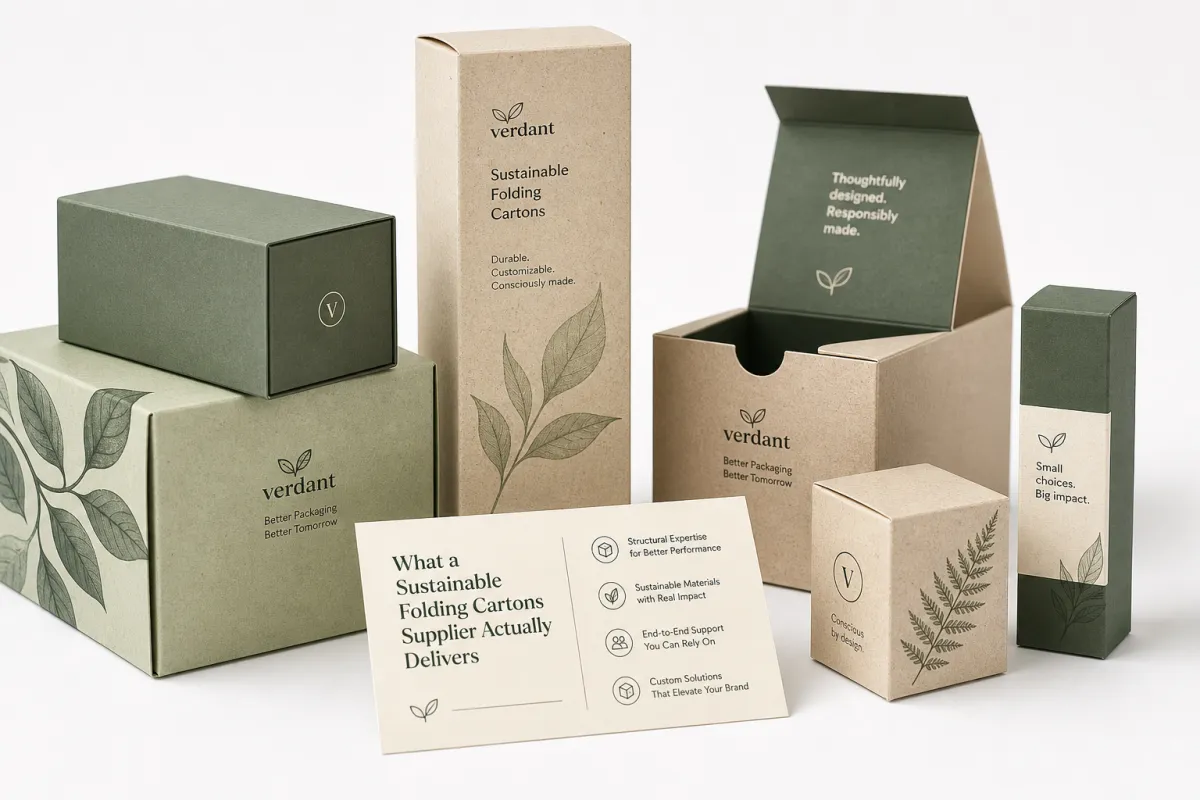
A good sustainable folding cartons supplier delivers more than a printed box. They deliver a package that fits the product, survives handling, folds cleanly, and avoids unnecessary material use. That sounds obvious until you see how many cartons are oversized by a few millimeters in every direction just “to be safe.” Tiny gap. Big waste. Carton sizing is one of the easiest places to trim board without changing the product at all.
In practice, folding cartons are paperboard sleeves, tuck-end boxes, or specialty structures used for retail packaging. The sustainable version usually rests on three things: responsible materials, lower-impact production, and efficient design. A strong sustainable folding cartons supplier should be able to talk about recycled fiber percentages, FSC or PEFC-certified sourcing, water-based or low-VOC inks, and structures that stay recyclable without plastic windows, heavy lamination, or mixed-material inserts pretending to be harmless.
“Sustainable” is not a sticker. It is a system. A carton with certified fiber can still be a poor choice if it uses too much board, rejects badly in production, or forces a second package because the first one was underdesigned. I’ve seen that happen more than once. A sustainable folding cartons supplier should be able to explain the tradeoffs between appearance, protection, recyclability, and cost without hiding behind fluffy claims.
Here is the clean way to think about it:
- Material source: recycled paperboard, FSC- or PEFC-certified virgin fiber, or a blend that meets strength and print needs.
- Construction: the lightest structure that still protects the product and runs well on the line.
- Finish: coatings and treatments that support the product without turning the carton into recycling drama.
- Production waste: sheet optimization, make-ready control, and scrap handling that keep excess down.
A real sustainable folding cartons supplier also sets expectations. They should tell you whether the carton is recyclable in many curbside programs or only in some, whether the finish changes that answer, and whether chain-of-custody paperwork is available. If they stay vague, that usually means the answer is messy or they haven’t bothered to check. Either way, that is not a great sign.
For buyers who want a useful reference on paperboard packaging structure and construction, the Paperboard Packaging Council is worth a look. For certified fiber claims, the paperwork should line up with FSC requirements, not just the wording on a quote sheet.
A practical test is this: if you removed the marketing language, would the carton still make sense? A sustainable folding cartons supplier should make the answer yes. The package should be logical, measurable, and defensible. If it needs a paragraph of green adjectives to justify itself, the structure is probably doing too much or too little.
How a Sustainable Folding Cartons Supplier Works
A solid sustainable folding cartons supplier works like a packaging partner, not a file dump. The process usually starts with a product brief: what the item weighs, how it ships, where it is sold, what shelf impact matters, and whether the customer wants a fully recyclable structure or a premium finish with some compromises. Better brief, better carton. A vague brief gives you vague packaging, which is how reprints happen.
From there, the supplier should move into structural review. That means checking the dieline, board caliper, tuck style, glue flaps, and how the carton will load on a packing line. A sustainable folding cartons supplier should be able to recommend a thinner board if the product is light, or a stronger caliper if the carton needs more compression resistance. That balance matters. Overbuilt cartons waste fiber. Underbuilt cartons create damage and returns. Neither one is green, no matter how hard the sales deck squints.
Material selection comes next. The supplier may recommend recycled paperboard for simpler retail items, or FSC-certified virgin fiber for sharper print and better stiffness. Coated board can help color consistency, but it has to earn its place. A water-based coating often makes more sense than heavy plastic lamination if the goal is to keep the carton recyclable. A competent sustainable folding cartons supplier will explain why one board grade prints beautifully while another saves money but gives up some detail or stiffness. That’s the trade, plain and simple.
Then comes print and finish. This is where buyers get fancy and start adding things nobody asked for. Foil, embossing, soft-touch coatings, UV spot effects, and plastic windows all have a cost. Not just a price tag. They can affect recyclability, lead time, and reject rates too. A good sustainable folding cartons supplier should be able to tell you which finish is functional, which one is decorative, and which one is just expensive noise.
Production is a chain of small checks: prepress, proofing, plate or digital setup, printing, die-cutting, stripping, folding, gluing, and final inspection. This is where real suppliers separate themselves from brokers. A true sustainable folding cartons supplier watches tolerances, color drift, board yield, and glue performance. That is what keeps a carton from looking good in a mockup and miserable in a warehouse.
Documentation should be part of the workflow, not a polite afterthought. Ask for:
- Board specs with caliper, basis weight, and fiber source.
- Certification details for FSC or PEFC where applicable.
- Proof approval records and dieline sign-off.
- Testing notes for compression, drop performance, or transit handling.
- Recyclability guidance tied to the actual structure and finish.
If the product is fragile or travels far, ask whether the carton has been checked against ISTA-style transit thinking, even if the carton is not carrying the whole load by itself. A sustainable folding cartons supplier that understands packout, shipping stress, and shelf abuse is worth more than a cheap print quote that falls apart after the first distribution run.
One more thing: supplier quality often shows up in how they handle exceptions. If board stock shifts, if a color runs hot, or if artwork needs a late correction, do they flag the issue early or quietly hope nobody notices? The second version costs money. Fast communication is part of sustainability too, because it reduces scrap, rush freight, and emergency rework.
Key Factors When Choosing a Sustainable Folding Cartons Supplier
Start with transparency. A trustworthy sustainable folding cartons supplier can tell you where the fiber comes from, what percentage is recycled, which certifications apply, and what the limits are. If the answer is a fog machine of “eco-friendly” language with no specs behind it, you are buying a mood, not a carton.
Next, look at finish choices. Heavy lamination, plastic windows, and mixed-material add-ons can crush recyclability fast. That does not mean every finish is bad. It means the finish needs a reason. A sustainable folding cartons supplier should be able to say, “This aqueous coating protects the graphics and still keeps the carton recyclable,” or “This window patch is a bad fit if your retail channel cares about curbside recovery.” Clear answer. No theater.
Production capability matters too. Some suppliers are fine with easy artwork and wide tolerances. Others can hold tighter registration, manage short runs, and keep color stable across larger quantities. If your brand has picky color expectations, ask how they control it. A sustainable folding cartons supplier should describe proofing, press checks, and reorders without hand-waving. If they say “we’ll make it work,” that is not a process. That is hope in a collared shirt.
Service quality is another filter. You want quick quoting, structural feedback, and someone who spots design problems before they show up in production. A good supplier catches issues like too-small glue flaps, weak tuck retention, or a panel that will crush once the cartons are nested. A sustainable folding cartons supplier that saves you from one bad run has already earned its keep.
End-use reality gets ignored far too often. A carton for a shelf-stable cosmetic item has different needs than a carton that ships with a heavier product, or one that survives repeated handling in retail. A sustainable folding cartons supplier should ask about shipping stress, stacking, retail display, and assembly speed. If they do not ask, they are guessing. Guessing is not a packaging strategy.
Here is a practical buyer checklist:
- Material proof: ask for source, grade, and certification documents.
- Structure proof: request the dieline, board thickness, and carton style explanation.
- Finish proof: confirm whether the finish affects recycling or food-contact compliance.
- Production proof: ask about tolerances, color control, and reject handling.
- Supply proof: check whether they can maintain stock or need long lead board procurement.
One useful rule: compare the supplier’s answers, not just their samples. A sample can look excellent and still hide weak documentation or sloppy production habits. A sustainable folding cartons supplier that can explain the package in plain language is usually the one that can make it repeatedly.
Sustainable Folding Cartons Supplier Pricing: What Drives Cost
Pricing is where buyers either get smart or get sentimental. A sustainable folding cartons supplier is not automatically expensive, but sustainable materials and cleaner production usually have real costs. Recycled board, certified fiber, tighter waste control, and lower-impact inks can raise the unit price. Better design can cut board usage, shipping volume, and reject rates. That is where the actual savings live.
The biggest cost drivers are predictable: board type, board caliper, carton size, print colors, finishing, die-cut complexity, quantity, and tooling. A flat tuck box with two colors and no special finish is a very different animal from a six-panel carton with foil, embossing, and a custom insert. A sustainable folding cartons supplier will usually price the second one much higher because every extra step adds setup time and waste.
MOQ matters too. Small runs often carry a higher unit cost because setup is spread over fewer cartons. Larger runs lower the per-piece price, but they also raise storage risk if demand is unstable. From a buyer’s point of view, the cheapest unit price is not the same thing as the smartest buy. A sustainable folding cartons supplier should help you think about total landed cost: carton price, freight, duties if applicable, storage, and the cost of potential reprints.
Here is a useful comparison for common carton approaches. These are ballpark numbers for moderate complexity and can swing based on region, size, artwork, and order volume. Still, they give buyers a saner starting point than the usual “contact us for a quote” routine.
| Carton Option | Typical Unit Price at 5,000 pcs | Sustainability Profile | Best Use | Main Tradeoff |
|---|---|---|---|---|
| Recycled paperboard with aqueous coating | $0.18-$0.32 | Good fiber efficiency, recyclable in many curbside systems depending on local rules | Beauty, wellness, light retail goods | Print contrast may be softer than premium coated stock |
| FSC-certified virgin fiber board | $0.22-$0.38 | Strong chain-of-custody option, clean print surface | Premium retail, sharp graphics, heavier items | Usually costs more than standard recycled board |
| High-graphics carton with foil or embossing | $0.35-$0.70 | Can still be responsible, but finishing adds complexity | Premium gifting or display-driven products | More waste, higher setup cost, harder recyclability story |
| Short-run digital carton | $0.30-$0.55 | Lower make-ready waste, good for test launches | Trial SKUs, seasonal runs, fast changes | Unit cost climbs fast as volume grows |
That table should not be treated like gospel. It is a practical range, not a quote. A sustainable folding cartons supplier with better board access, local production, or simpler finishing may land lower. Another supplier may quote low and then charge extra for proofs, plates, tooling, freight, or color matching. Ask for a full breakdown before you compare anything.
Cheap carton, expensive lesson. If the quote looks suspiciously low, ask what got removed from the spec, because usually something did.
One sneaky cost driver is design complexity. A carton with fewer folds, fewer colors, and standard dimensions is usually cheaper to produce and easier to recycle. Oversized cartons and novelty shapes often create more scrap in converting, more freight volume, and more downstream waste. A smart sustainable folding cartons supplier will push back on unnecessary complexity because it hurts both cost and sustainability.
Another cost issue is compatibility with the packing line. If the carton runs slowly or jams during folding, your production cost rises even if the quote looked fine. That is why a sustainable folding cartons supplier should ask whether the carton will be machine-packed or hand-packed, and whether gluing tolerances matter. A carton that saves two cents on paperboard but adds ten minutes of labor per case is not saving anything.
If you want a more precise quote, give the supplier a clean brief: product dimensions, target board grade, print count, finish, quantity, packing method, ship-to location, and any certification requirement. A sustainable folding cartons supplier can price a job far more accurately when they are not guessing at the basics.
Folding Carton Process Timeline: From Brief to Delivery
A realistic schedule starts with the brief. The first round usually covers structure, materials, print method, and budget range. If the brief is complete, a sustainable folding cartons supplier can often turn around a useful quote and structural recommendation quickly. If not, the project stalls while everyone argues about whether the carton should feel “cleaner” or “more premium,” which is packaging code for “nobody has made a decision yet.”
Proofing is the next bottleneck. Artwork needs to fit the dieline, bleeds need to be correct, barcodes need to scan, and the finishing plan needs to match the material. A sustainable folding cartons supplier will usually send a digital proof or sample for approval. That can take a few days, and it can take longer if the brand changes copy, moves logos, or adds sustainability claims at the last second. Late changes are where timelines go to die.
Once approved, production typically moves through prepress, printing, die-cutting, finishing, folding, gluing, inspection, and packing. The actual press run may be the fastest part. A sustainable folding cartons supplier spends real time on setup and quality control because that is where costly waste is either prevented or created. If the stock is in hand and the design is locked, the process can move smoothly. If the board still needs sourcing or the artwork keeps drifting, expect delays.
Here is a practical planning range for Custom Folding Cartons:
- Simple short run: about 7-12 business days after proof approval, if stock is available.
- Typical custom run: about 12-18 business days after approval, including finishing and inspection.
- More complex builds: 18-30 business days or more, especially with specialty coatings or custom structures.
Those ranges are not fantasy numbers. They reflect how long it takes when people make decisions on time. A sustainable folding cartons supplier can hit a schedule if the board is selected early, the dieline is frozen, and the proof comes back without a surprise rewrite.
There are a few common delay points worth watching. Board shortages happen. Color adjustments happen. Final sustainability changes happen, especially when a buyer decides a plastic window should disappear after artwork is already approved. A good sustainable folding cartons supplier will tell you that some changes are cheap early and painful late. That warning is free. The correction is not.
If your carton must meet transport durability expectations, ask about ISTA-style testing or at least a practical packout review. Even a beautiful carton fails if it crushes in transit or opens too easily on the shelf. A sustainable folding cartons supplier should know the difference between a display carton and a shipping problem dressed up as packaging.
Common Mistakes When Hiring a Sustainable Folding Cartons Supplier
The first mistake is chasing green labels without checking whether the carton is actually recyclable in the target market. A carton can be paper-based and still include finishes or inserts that complicate recovery. A sustainable folding cartons supplier should explain the real recycling path, not just wave a recycled-content number in your face and call it strategy.
The second mistake is overdesigning the box. Extra coatings, oversized panels, and decorative inserts all use more material and usually increase freight cost too. A sustainable folding cartons supplier can often redesign the carton to use less board without losing shelf presence. That is the kind of adjustment that saves money and looks smarter in a sustainability report.
The third mistake is approving artwork before confirming the board and finish. Some print designs look sharp on one surface and muddy on another. If the supplier changes the stock after approval, the colors can shift. A reliable sustainable folding cartons supplier locks the material first, then prints to that surface, not the other way around.
The fourth mistake is ignoring the packing line. A carton that looks perfect in a mockup may fold badly, pop open, or jam during machine insertion. A sustainable folding cartons supplier should ask how the carton will be assembled and whether glue performance matters. If they do not ask, they are not really designing for production.
The fifth mistake is assuming the quote includes everything. It often does not. Proofs, tooling, color matching, freight, and special inspections can appear as add-ons. A sustainable folding cartons supplier should itemize the quote clearly. If the pricing page reads like a vending machine with secret buttons, keep looking.
Here is the fix for each one:
- Green label confusion: ask for documentation, not adjectives.
- Overdesign: compare a revised dieline with reduced board usage.
- Artwork-first mistake: lock board and finish before final approval.
- Packing line miss: test fit, fold, and glue before volume.
- Hidden charges: request a line-item quote with tooling and freight called out.
One more thing buyers learn the hard way: not every supplier who says “eco-friendly” is willing to prove it. A serious sustainable folding cartons supplier will not get defensive when you ask about FSC chain-of-custody, board source, or recycling compatibility. They expect the question. If the sales response gets prickly, that tells you plenty.
Next Steps With a Sustainable Folding Cartons Supplier
Start with a packaging audit. Look at your current carton and ask what it is doing well, what it is doing badly, and what it is doing wastefully. A sustainable folding cartons supplier can help if you know whether your main goal is lower cost, less material, better recyclability, or a stronger shelf presentation. Trying to solve all four at once without a priority usually ends in a compromise that nobody loves.
Then request three things from every supplier you are considering: a material spec sheet, a realistic timeline, and a quote that separates tooling, printing, finishing, and freight. A sustainable folding cartons supplier that can provide those details quickly is usually easier to work with later too. The ones that cannot tend to stay mysterious right through delivery.
Order samples or mockups before you commit to volume. Test the structure, check shelf fit, and look at the print in real light, not just under a perfect sales rep camera angle. A sustainable folding cartons supplier should welcome that step. Samples reveal the awkward stuff, like weak lock tabs, oversized panels, or a finish that photographs well but looks flat in person.
Use one checklist across every supplier so you can compare them fairly. Judge them on the same criteria:
- Material proof: what board are they actually offering?
- Design support: do they improve the carton or just print it?
- Lead time: what is the real timeline after approval?
- Cost clarity: are there hidden extras?
- Performance: does the carton protect the product and run cleanly?
After that, shortlist two suppliers and ask direct questions. What recycled content can they document? What finish options preserve recyclability? What happens if the board is backordered? How do they handle reprint risk? A sustainable folding cartons supplier worth hiring will answer clearly, because clear answers are easier to act on and much harder to fake.
If you are buying cartons for a brand that cares about image and environmental claims, do not choose on price alone. Compare proof, performance, and total cost. The best sustainable folding cartons supplier is the one that gives you a carton that looks good, behaves well, and avoids waste without turning the project into a sustainability lecture nobody asked for.
How do I verify a sustainable folding cartons supplier is legit?
Ask for certification details, material specs, and chain-of-custody documents instead of taking a green claim at face value. A real sustainable folding cartons supplier should also provide samples and explain the carton structure in plain language. If they cannot show documentation for the board, inks, or finish, keep pushing.
What materials should I ask a sustainable folding cartons supplier to use?
Start with recycled paperboard, FSC- or PEFC-certified fiber, or a board grade that matches your strength and print needs. A good sustainable folding cartons supplier will recommend the simplest finish that still protects the product. Match the material to the product weight, shipping conditions, and retail display requirements rather than guessing.
How much does a sustainable folding cartons supplier usually charge?
Pricing depends on board type, size, print colors, finishing, quantity, and tooling, so there is no honest one-line answer. Small runs cost more per unit; larger runs lower unit cost but can raise inventory risk. Ask every sustainable folding cartons supplier for a full landed-cost quote so you can compare total spend, not just the sticker price.
What is the typical lead time for sustainable folding cartons?
Simple orders can move quickly once artwork and specs are approved, but custom structural work adds time. Proofing and sample approval are usually the delay points, not the press run itself. If a sustainable folding cartons supplier is waiting on board stock or final artwork, expect the schedule to slip.
Can a sustainable folding cartons supplier help reduce packaging waste?
Yes, a strong sustainable folding cartons supplier can right-size the carton, reduce board usage, and suggest structures that ship more efficiently. They can also help remove unnecessary inserts, over-inking, and nonrecyclable finishes. The best savings come from smarter design, not just swapping to a different paperboard.
If you want a better carton, start with the structure, not the slogan. A sustainable folding cartons supplier should help you cut waste, hold the line on cost, and protect the product without fake green drama. Before you ask for quotes, lock the carton size, finish, recycling target, and proof requirements. That one step keeps the whole project from wandering off into expensive nonsense.