Buyer Fit Snapshot
| Best fit | Sustainable Retail Display Boxes Supplier projects where brand print, material claims, artwork control, MOQ, and repeat-order consistency need to be specified before quoting. |
|---|---|
| Quote inputs | Share finished size, material target, print colors, finish, packing count, annual reorder estimate, ship-to region, and any compliance wording. |
| Proofing check | Approve dieline scale, logo placement, barcode or warning zones, color tolerance, closure strength, and carton packing before bulk production. |
| Main risk | Vague material claims, crowded artwork, missing packing details, or unclear freight terms can make a low unit price expensive after revisions. |
Fast answer: Sustainable Retail Display Boxes Supplier: Board, Finish, Dieline, and Unit Cost should be specified like a repeatable production item. The safest quote records material, print method, finish, artwork proof, packing count, and reorder notes in one written spec.
Production checks before approval
Compare the actual filled-product size with the drawing, then confirm tolerance on folds, seals, hang holes, label areas, and retail display edges. Reserve space for logos, QR codes, warning copy, and material claims before decorative graphics fill the panel.
Quote comparison points
Review material grade, print process, finish, sampling route, tooling charges, carton quantity, and freight assumptions side by side. A quote is only useful when the supplier can repeat the same color, closure quality, and packing count on the next order.
Sustainable Retail Display Boxes Supplier: What to Know
A sustainable retail Display Boxes Supplier can make a display look spotless in a rendering and still blow the rollout if the board swells in a humid stockroom, the corners get battered during pallet handling, or the unit takes too long to assemble on a busy sales floor. That gap between a polished mockup and a store-ready display is exactly where material choice, structure, print method, and packout discipline either hold together or fall apart. Retail does not care how pretty the concept deck looked. It cares whether the thing survives shipping and still looks decent after a week on shelf.
From a packaging buyer’s point of view, the job is bigger than printing a nice box. A good sustainable retail display boxes supplier balances shelf presence, product support, transport durability, and end-of-life impact without making the display harder to use. That means the board grade, fold pattern, coating, and shipper count all need to work as one system. If one piece is off, the rest starts dragging. Usually in expensive ways.
Custom Logo Things works with the same practical reality most brands face: displays need to sell product, but they also need to arrive flat, build quickly, and make sense once the retailer asks, “What happens after this is empty?” The best sustainable retail display boxes supplier understands that sustainability is not a slogan printed on a flap. It is a set of decisions about recycled content, FSC-certified sourcing, water-based inks, low-VOC coatings, efficient logistics, and designs that are easier to recycle or recover after use. That is the unglamorous version. It’s also the one that matters.
That is why the conversation should start with performance, not just eco language. A display that is technically recyclable but fails in shipping creates waste anyway. A display that uses fewer mixed materials, ships flat, and holds up through merchandising often delivers better total value. I’ve watched brands save a little on paper and then lose the whole margin because the display collapsed mid-promo. Fun? No. Common? Absolutely.
If you are comparing a sustainable retail display boxes supplier against a traditional box vendor, the useful questions are simple: what is it made from, how will it be printed, how will it travel, and how will store teams handle it?
What a Sustainable Retail Display Boxes Supplier Actually Delivers
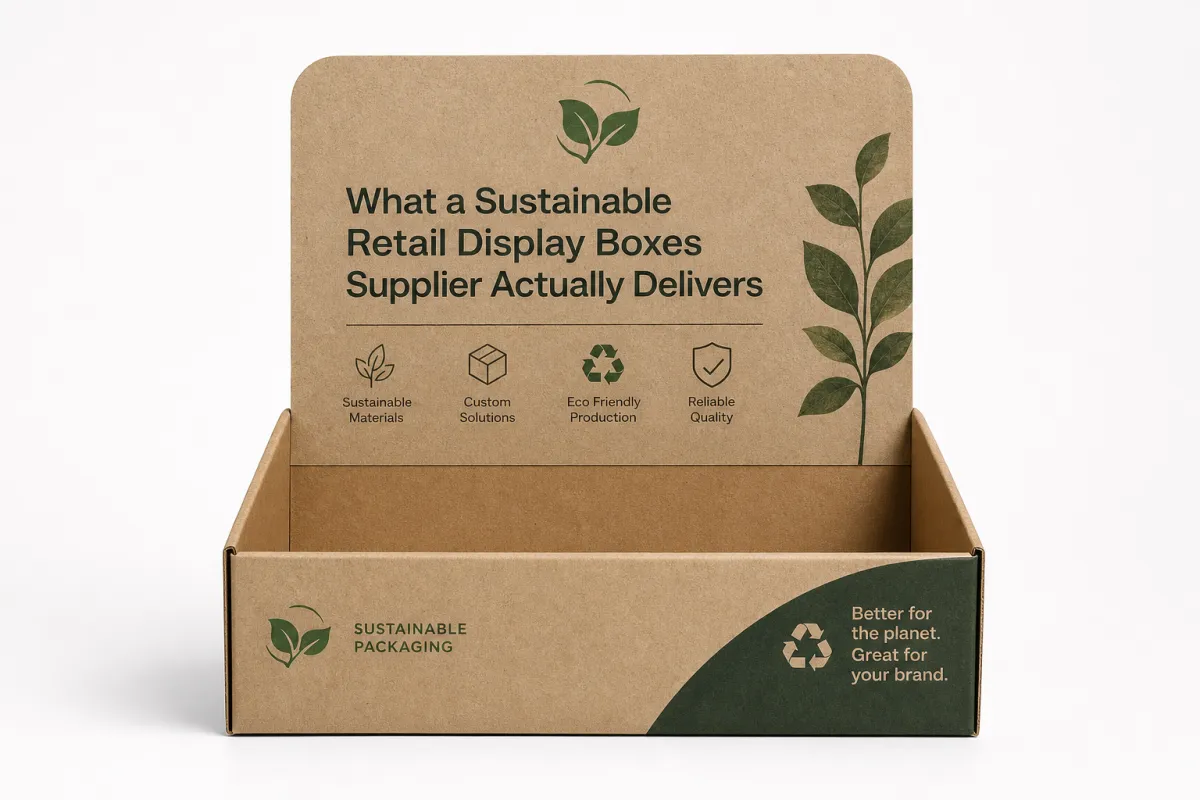
The real value of a sustainable retail display boxes supplier shows up long before the box reaches a store. It begins with the structural thinking behind the display, because a counter display, floor display, or shelf-ready unit has to carry product weight while still looking sharp under retail lighting. If the mockup only solves the visual side, the box may fail the practical side: it might buckle under stacked units, open too loosely during replenishment, or deform when a pallet gets wrapped too tightly. Retail packaging is rude like that. It exposes bad decisions fast.
A sustainable retail display boxes supplier should deliver more than print files and finished cartons. The role usually includes substrate guidance, dieline development, structural recommendations, proofing, and advice on packout and shipping. In practice, the best supplier helps a brand choose a board that fits the product load instead of forcing a one-size-fits-all spec. That is especially useful for beauty, snack, beverage, electronics accessories, and seasonal promos, where the display may need to look refined while still standing up to everyday handling. A display that feels flimsy in the hand is already losing the sale.
Sustainability in this space usually means one or more of the following: recycled content, responsibly sourced fiber, efficient use of material, design choices that avoid unnecessary laminates or plastic add-ons, and print systems that keep recycling compatibility in mind. A strong sustainable retail display boxes supplier does not promise that every display is compostable or universally recyclable, because that depends on the structure, inks, coatings, and local recovery systems. Honest guidance is better than vague green language dressed up as expertise.
From a retail operations angle, the display also has to support shelf organization and speed. If a store team can open, fold, and load the unit in a few minutes, that matters. If the display arrives with clearly labeled parts, readable fold lines, and a stable footprint, that matters too. A skilled sustainable retail display boxes supplier thinks about the people who will assemble the display, not only the marketing team approving the artwork. One side gets the applause. The other side actually has to make the thing work.
"The display that wins the most shelf time is usually the one that survives shipping, opens cleanly, and does not create extra work for the store team."
I once reviewed a pilot run where the graphics were gorgeous and the board choice was supposed to be “more sustainable.” The sample looked fine on a desk. Then we put product in it, stacked it, and sent it through a hot warehouse. The corners softened, the shelf lip bowed, and the whole thing started looking tired before it even hit stores. That was the lesson, and it was kinda annoying: sustainability only counts if the display still performs.
That is the part many buyers miss. A sustainable retail display boxes supplier is not just a print shop with greener paper. It is a production partner that connects branding, retail durability, and environmental responsibility into one piece of packaging hardware. If that balance is right, the display supports the product story instead of fighting it.
How a Sustainable Retail Display Boxes Supplier Builds the Box
Most display projects start with a dieline, but the better sustainable retail display boxes supplier does not treat the dieline as a paperwork step. It is the blueprint for load distribution, print placement, folding behavior, and shipping efficiency. A clean structural plan reduces waste later because the final unit needs fewer revisions, less hand correction, and fewer surprise failures during assembly. That matters when a brand is ordering thousands of pieces for a national retail launch. Guesswork is expensive. Rework is worse.
The production flow usually moves through a sequence like this: brief, structural concept, artwork setup, proof review, prototype, production approval, die cutting, printing, folding, gluing, bundling, and shipment. A dependable sustainable retail display boxes supplier keeps each stage tied to the next one. If the artwork has heavy solids on a critical fold, the supplier should flag it early. If the product weight suggests a stronger base, that should be built into the first prototype, not discovered after cartons are already on a truck. By then, the budget has already started sulking.
Substrate selection is where sustainability and performance come together. Common choices include kraft corrugate, recycled paperboard, FSC-certified board, and lightweight display-grade corrugated material. Kraft-based structures often give a natural, lower-ink look and work well when the brand wants a clean, earthy presentation. Recycled paperboard can be excellent for lighter products or tray-style displays. FSC-certified boards help buyers document responsible fiber sourcing, which is useful for brands with procurement policies tied to forest stewardship. You can read more about fiber sourcing standards at FSC.
Printing choices matter just as much. A thoughtful sustainable retail display boxes supplier will often recommend water-based inks, low-VOC coatings, and finish options that do not interfere with recyclability more than necessary. Heavy plastic lamination can improve abrasion resistance, but it also changes how the display is recovered. Sometimes a light aqueous coating is the better tradeoff. Other times a matte varnish with stronger fiber can give the needed protection without overbuilding the finish. There is no prize for overengineering a box into a sad little armor plate.
For retail displays, physical testing is where confidence gets earned. Compression checks, load testing, and assembly trials help reveal whether the display can handle the real world. Many teams use transit and distribution concepts aligned with ISTA methods, especially when the display needs to survive pallet vibration, warehouse stacking, or repeated handling. An experienced sustainable retail display boxes supplier will also look at moisture exposure, because even a well-made board can lose integrity in a humid backroom.
One practical detail is often overlooked: packout. A display may be eco-friendly in theory, but if it ships in oversized cartons or requires too much protective material, the overall system becomes less efficient. That is why a strong sustainable retail display boxes supplier considers flat-pack shipping, bundle counts, and how the finished units will be staged in distribution centers. Good design saves fiber, lowers freight waste, and reduces the chance of damage. It also gives the warehouse team one less reason to curse your name.
If you are building a larger packaging program, it helps to compare display options alongside other branded packaging needs. Custom Logo Things keeps related production categories organized through Custom Packaging Products, which makes it easier to coordinate visual identity, board choice, and shipping requirements across multiple formats. For a brand buyer, that kind of consistency usually matters more than chasing the lowest printed price on one line item.
At the prototype stage, a sustainable retail display boxes supplier should be willing to answer specific questions: Will the unit hold product at the front lip without bowing? Will the sidewalls remain square after folding? Can the display be replenished without tearing the locking tabs? Those are not abstract concerns. They decide whether a display looks premium for three weeks or collapses halfway through the promotion.
How to Compare a Sustainable Retail Display Boxes Supplier
Choosing the Right sustainable retail display boxes supplier is rarely about one feature. It is about the combination of sourcing, structure, communication, sampling, and repeatability. A supplier can sound eco-conscious and still struggle with basic production control. Another may offer fewer marketing claims but give you stable board, clear proofs, and predictable reorders. In packaging, consistency is a form of sustainability because it avoids waste and rework.
Start with material sourcing. Ask what portion of the structure is recycled content, whether the board is FSC-certified, and whether the supplier can document the claim instead of simply stating it. A trustworthy sustainable retail display boxes supplier should be able to explain what is recyclable, what is recycled content, and what local recycling systems are likely to accept. Those are not the same thing. A display can be made from renewable fiber and still be difficult to recycle if it carries too many mixed materials.
Then look at structural capability. Retail displays are not flat cartons with a print job on top; they are load-bearing promotional tools. A capable sustainable retail display boxes supplier should show experience with counter units, floor stands, shelf-ready trays, and PDQ-style packaging. If the product is heavy, fragile, or top-heavy, the supplier should be able to adjust the board grade, add hidden reinforcements, or recommend a different footprint instead of simply printing the same shape in a new color. Pretty drawings do not hold product up.
Brand fit is another major filter. The display has to support the product story, not interrupt it. A clean natural kraft board may suit a wellness brand. A crisp white board with controlled print coverage may fit electronics accessories. A good sustainable retail display boxes supplier knows when to preserve a minimalist look and when to add stronger graphics for retail visibility. Either way, the display should be easy for store teams to handle, because difficult setup hurts compliance. Merchandising teams remember pain. Brands usually remember the invoice.
Communication quality is often the hidden difference between an average project and a smooth one. If the supplier sends a proof with realistic folds, clear panel labeling, and direct notes about tolerances, that saves time later. If they respond quickly to artwork questions and explain why a certain finish might cause recycling issues, that is a strong sign. A dependable sustainable retail display boxes supplier makes the process feel managed instead of reactive. That alone can save a launch from becoming a panic spiral.
Here is a simple comparison that helps buyers sort options without getting lost in the sales pitch:
| Supplier Type | Typical Strengths | Typical Risks | Best Fit |
|---|---|---|---|
| Basic print vendor | Low entry price, fast artwork turnaround | Weak structural advice, limited sustainability documentation | Light promotional pieces with low load |
| Experienced sustainable retail display boxes supplier | Material guidance, prototype support, better retail planning | May cost more upfront than simple print-only quoting | Brand launches, repeated retail programs, regulated sourcing needs |
| Premium display partner | Advanced engineering, testing, more finish options, stronger QA | Higher unit cost and longer approval cycles | High-visibility programs, heavier products, national rollouts |
That table is not about ranking suppliers by prestige. It is about matching the project to the right level of support. A sustainable retail display boxes supplier with strong sampling and documentation can save time, reduce store complaints, and cut waste from avoidable remake cycles. That is real value, even when the invoice is not the lowest number on the page.
Pricing a Sustainable Retail Display Boxes Supplier Project
Pricing from a sustainable retail display boxes supplier usually depends on more variables than buyers expect. The obvious ones are size and quantity, but the board grade, print coverage, finishing, special cutting, and packing method all move the number. A display that looks simple on screen can become expensive if it needs nested parts, reinforced corners, or multiple print hits to achieve the brand look. Clean design does not always mean cheap production. That would be too easy.
For rough planning, many custom retail display projects at medium volume can land in a range like $0.22 to $0.38 per unit for simpler recycled corrugate structures, $0.34 to $0.55 per unit for FSC-certified board with stronger branding, and $0.52 to $0.90 per unit for more complex units with specialty finishes, heavy print coverage, or extra reinforcement. Those are not fixed rates. A smaller run, thicker board, or full-coverage graphics can push pricing higher, while a larger order can lower the unit cost. A reliable sustainable retail display boxes supplier will explain the drivers instead of hiding them behind a vague “custom quote” label.
What matters more than unit price is total landed value. That includes freight, warehouse handling, assembly time, damage risk, and the cost of replacements if the display fails in store. A box that saves a few cents on paper stock can end up costing more if it takes twice as long to assemble or arrives crushed from poor pallet packing. A smart sustainable retail display boxes supplier looks at the whole chain, not just the press sheet. That is the difference between buying a display and buying a problem with a logo on it.
There is also a hidden cost in overpackaging. If a display needs plastic wraps, extra inserts, or oversized shipper cartons to survive transit, the project may become less attractive from both a sustainability and labor standpoint. A stronger board grade or a better locking tab can sometimes remove the need for that extra protection. That is one reason experienced buyers ask the sustainable retail display boxes supplier to quote multiple structural options rather than a single locked spec. Options expose the tradeoffs instead of hiding them.
One useful way to compare quotes is to request good, better, best tiers. That format makes tradeoffs visible. For example, “good” might be recycled corrugate with one-color print and water-based coating. “Better” could be FSC board with higher print coverage and improved load support. “Best” might add a premium finish, tighter color control, or structural reinforcement for heavier merchandise. A thoughtful sustainable retail display boxes supplier can build those tiers without losing the sustainability story.
Below is a practical way to think about cost drivers:
- Board grade: thicker or higher-performance substrates cost more, but may reduce damage and reprints.
- Print coverage: full-bleed graphics and multiple spot colors usually raise cost versus simpler layouts.
- Finishes: aqueous coating, varnish, and specialty effects add cost, while heavy lamination can affect recyclability.
- Structure: locking tabs, pop-up elements, and reinforced bases require more engineering and die time.
- Quantity: larger volumes often lower the per-unit number, especially once plates and dies are spread across the run.
- Packing method: flat pack, bundle count, and carton design all affect freight efficiency and receiving labor.
The buyer’s job is not to hunt for the cheapest piece of board. The job is to buy a display that supports the merchandising plan, survives handling, and reflects the brand properly. A good sustainable retail display boxes supplier can usually show where money is being spent and where it is being saved, which makes the decision much easier to defend internally.
If you are comparing vendors, ask each sustainable retail display boxes supplier to price the same brief, the same dimensions, and the same print spec. Otherwise the quotes are not truly comparable. One supplier may include prototype work, another may not. One may quote freight separately, while another hides it in the unit number. Clear apples-to-apples quoting is part of good packaging buying. So is refusing to pretend every quote means the same thing.
Step-by-Step Timeline With a Sustainable Retail Display Boxes Supplier
A realistic schedule starts with the brief. The best sustainable retail display boxes supplier will want product dimensions, unit weight, display location, target store date, artwork files, and a sense of how the retailer wants the unit merchandised. That first call matters because it tells the supplier whether the display is standing on a floor, sitting on a counter, or hanging off a shelf edge. Each format has different load and footprint demands. Pretending they are all interchangeable is how projects get weird.
After the brief comes structural concepting. This stage may take only a few days for a straightforward format or longer if the display needs multiple product zones, cutouts, or locking features. A good sustainable retail display boxes supplier will probably send one or two options rather than dozens, because the goal is to choose a structure that behaves well, not just to generate more drawings. If the team is debating board weight or print coverage, that should happen here, before the artwork is fully finalized.
Artwork handoff usually follows once the structure is approved. That is where the supplier checks bleed, fold lines, safety margins, barcodes, and any retailer compliance marks. A dependable sustainable retail display boxes supplier will flag artwork issues early, especially if a logo sits too close to a structural score or if dark ink coverage may crack on a fold. That kind of review prevents costly reproofing later. It also prevents the usual “Why does this look perfect on screen and awful in person?” conversation.
Prototypes are one of the most useful steps in the process. Even a simple sample can reveal whether the display folds cleanly, whether the tabs are too stiff, and whether product weight causes a lip to sag. On more involved programs, testing may include compression checks, rough handling simulation, or transit validation aligned with EPA sustainable materials guidance and standard shipping assumptions. A careful sustainable retail display boxes supplier uses the prototype to answer practical questions, not just visual ones.
Once the sample is approved, production begins. Depending on complexity and volume, a typical custom display run may take 12 to 18 business days after final proof approval, with simple jobs sometimes faster and highly detailed jobs taking longer. If special coatings, structural changes, or retailer approval loops are involved, the timeline can stretch. A dependable sustainable retail display boxes supplier will say that upfront instead of promising a date that ignores approvals. Shipping dates should be real, not wishful.
Launch planning is where many good projects are won or lost. If displays arrive before the product is ready, they can sit in storage and pick up damage. If they arrive late, merchandising teams rush. The best sustainable retail display boxes supplier helps coordinate delivery windows, pallet labeling, and store staging so the unit lands when the product is available and the field team is ready. No one wants a beautiful display parked in the corner for two weeks because the campaign schedule was guessed instead of planned.
Here is a practical project flow that keeps the schedule honest:
- Discovery call and product review
- Structural concept and substrate recommendation
- Artwork preparation and file check
- Proofing and revisions
- Prototype approval and performance check
- Production, packing, and freight booking
- Warehouse receipt and store rollout
A sustainable retail display boxes supplier that manages these steps well usually saves more time than a cheaper vendor that leaves the brand to coordinate every detail alone. Predictability is part of sustainability too, because missed launches often create waste in the form of reprints, emergency freight, and avoidable backroom clutter.
Common Mistakes When Choosing a Sustainable Retail Display Boxes Supplier
The first mistake is treating sustainability like a label instead of a build decision. A display can be called eco-friendly and still combine too many materials for easy recovery. Gloss film, plastic windows, foil accents, and heavy adhesive coverage all affect how the display is handled at end of use. A serious sustainable retail display boxes supplier will tell you which elements help, which ones complicate recycling, and where a simpler structure might do the same job. That answer is usually less glamorous than the sales brochure.
The second mistake is approving the display by appearance alone. A unit can look excellent in a rendering and still fail under real conditions. Humidity, shelf load, transit vibration, and repeated handling all matter. That is why a good sustainable retail display boxes supplier pushes for prototypes and real product samples. If the display is for a grocery environment or a warehouse club, environmental stress matters even more because the unit may be handled frequently and stored in less-controlled conditions. Retail is not a museum.
The third mistake is giving vague artwork or vague dimensions. If the supplier has to guess panel sizes or print placement, rework is almost guaranteed. That creates more waste, more cost, and more delay. A reliable sustainable retail display boxes supplier should ask for exact measurements, product weight, SKU count, and retailer requirements. If that information is not available, the buyer should expect more back-and-forth before the order can be released. Guessing is not strategy.
The fourth mistake is ignoring schedule risk. Many teams want a display yesterday, then discover that approval cycles, sustainability documentation, and prototype changes all take time. A capable sustainable retail display boxes supplier can work quickly, but not if the brief keeps changing. Fast jobs are possible when the artwork is ready, the structure is simple, and the print finish is straightforward. Once the request includes special coatings or multiple internal approvals, the schedule needs more breathing room. That’s not the supplier being difficult. That’s physics plus paperwork.
The fifth mistake is buying on price alone. A low number can be tempting, especially when a campaign has many moving parts. But a weak display can collapse, confuse the store team, or look tired after a few days. Then the brand spends more replacing it. A practical sustainable retail display boxes supplier may not be the absolute cheapest quote, but it can lower the risk of damage, labor friction, and disappointing shelf presentation.
There is also a softer mistake that matters a lot: assuming the supplier will read the brand’s mind. Good communication is part of good packaging. If the brand wants a natural look, say so. If the display must be easy to flatten after the promotion, say so. If the retailer has strict recycling rules, say so early. A responsive sustainable retail display boxes supplier can only solve the right problem if the problem is described clearly.
"The least expensive display is not always the least expensive program. If it fails on shelf, the savings disappear very quickly."
Expert Tips for Working With a Sustainable Retail Display Boxes Supplier
The strongest advice I can give is simple: ask for a prototype early. Screens do not show how a fold behaves, how stiff the base feels, or how fast a store associate can assemble the unit. A prototype from a sustainable retail display boxes supplier shows all of that in one piece. It can also reveal whether the print looks too dark on kraft, whether the flap locks cleanly, or whether the display needs a slightly wider footprint for stability. A decent mockup saves a lot of wishful thinking.
Design for flat shipping whenever possible. Flat packs reduce freight inefficiency, simplify warehouse handling, and lower the chance of crushed corners. A smart sustainable retail display boxes supplier will often recommend a structure that assembles quickly from a flat state rather than one that ships half-built. That approach is usually better for both labor and waste reduction, especially when the rollout covers many stores. Flat is not glamorous, but it works.
Keep material separation in mind. If a display uses one main fiber substrate and minimal mixed-material add-ons, it is often easier to sort after use. That does not mean every decorative element has to disappear, but it does mean the brand should be intentional. A practical sustainable retail display boxes supplier can help choose coatings, adhesives, and finishes that support the intended disposal path. If your recycling goals matter, say that directly in the brief. Nobody should have to decode the mission like it’s a puzzle box.
It also helps to prepare a short spec sheet before you request quotes. Include dimensions, product weight, quantity, print colors, finish preferences, load requirements, shipping assumptions, and any sustainability certifications that matter to your brand. That one page makes it much easier for a sustainable retail display boxes supplier to quote accurately and avoid guesswork. The fewer assumptions, the fewer surprises. Strange concept, but it works.
When comparing options, do not just ask which one is greener. Ask which one is greener and better for the launch. A display that uses less material but arrives with weak color control may not serve the brand well. A display that uses recycled board, holds its shape, and gives retailers an easy assembly process is usually the stronger choice. That is the point where a sustainable retail display boxes supplier becomes a true partner instead of a transaction.
Here is a compact buyer checklist that usually keeps projects on track:
- Confirm product weight, dimensions, and fill count before quoting.
- Ask for proof of recycled content or FSC certification when those claims matter.
- Request a prototype or physical sample before final approval.
- Verify finish choices against recyclability and retail durability.
- Compare at least two or three quotes using the same brief.
- Build in time for artwork review, sampling, and launch logistics.
If you follow that checklist, the conversation with a sustainable retail display boxes supplier becomes much more useful. You spend less time untangling vague claims and more time deciding which structural and material choices support your merchandising goals. That is where the real savings live.
For brands that want a broader packaging strategy, it often makes sense to coordinate display development with the rest of the custom packaging line. A retailer sees the shelf unit, the shippers, the inner packs, and the branded cartons as one story. When those pieces feel aligned, the presentation looks intentional, and the operational side usually runs better too. That is why many buyers prefer a sustainable retail display boxes supplier who can also think beyond a single box format and connect the display to the larger packaging system.
At Custom Logo Things, that broader view is usually the most practical one. A well-chosen sustainable retail display boxes supplier improves cost control by reducing damage and rework, improves timeline reliability by limiting surprises, and improves shelf impact by making the display easier to merchandise. The best sustainability story is not the loudest one. It is the one that still makes sense after shipping, storage, setup, and sell-through.
If you are choosing a supplier this week, keep the decision tight: ask for a sample, ask for the material spec in writing, and ask how the display is meant to move through the warehouse and store. If those three answers line up, you are probably dealing with a real partner, not just a prettier quote.
FAQ
How do I choose the right sustainable retail display boxes supplier?
Check material options, structural capability, and whether the supplier can prove recycled content or responsible sourcing. Ask for prototypes, retail references, and clear guidance on print, finishing, and recyclability so you can judge the supplier on both performance and documentation. If they get vague fast, that’s usually your answer.
What materials are best for sustainable retail display boxes?
Common choices include recycled corrugate, FSC-certified paperboard, and kraft-based display board. The best material depends on product weight, store conditions, branding needs, and local recycling access, so the right answer is usually project-specific rather than universal. One-size-fits-all sounds neat. It rarely is.
How much do sustainable retail display boxes usually cost?
Cost depends on board grade, size, print coverage, finishing, and order quantity. A lower unit price is not always cheaper overall if the box adds freight, labor, or failure risk, which is why total landed value matters more than the first quote line. Cheap cardboard that collapses is still expensive.
What is the typical timeline for a custom display box project?
Most projects move through brief, proofing, prototype approval, production, and delivery. Simple jobs can move faster, but structural changes, approvals, and special finishes often add time, so a realistic schedule is one of the best ways to keep a launch on track. Rush jobs can happen. Miracle jobs usually cannot.
How can I make sure the box is actually sustainable?
Ask what percentage of recycled content is used, whether inks and coatings are recyclable-friendly, and how the box should be disposed of. Request documentation for certifications or sourcing claims so the sustainability story is specific, not vague. If the answers sound polished but empty, keep digging.