A tea logo on a baseball cap is usually a straightforward bulk order, but the quote only stays clean when the spec is tight. The cap base, embroidery method, closure, packing, freight, and approval process all affect the final landed cost. If any of those pieces are vague, the unit price becomes a guess instead of a comparison.
For buyers, the main question is not whether the cap looks good in a mockup. It is whether the chosen materials, stitch plan, and production path can be repeated without surprises. That is what separates a reliable quote from a number that changes later.
Why a tiny tea logo can change cap economics
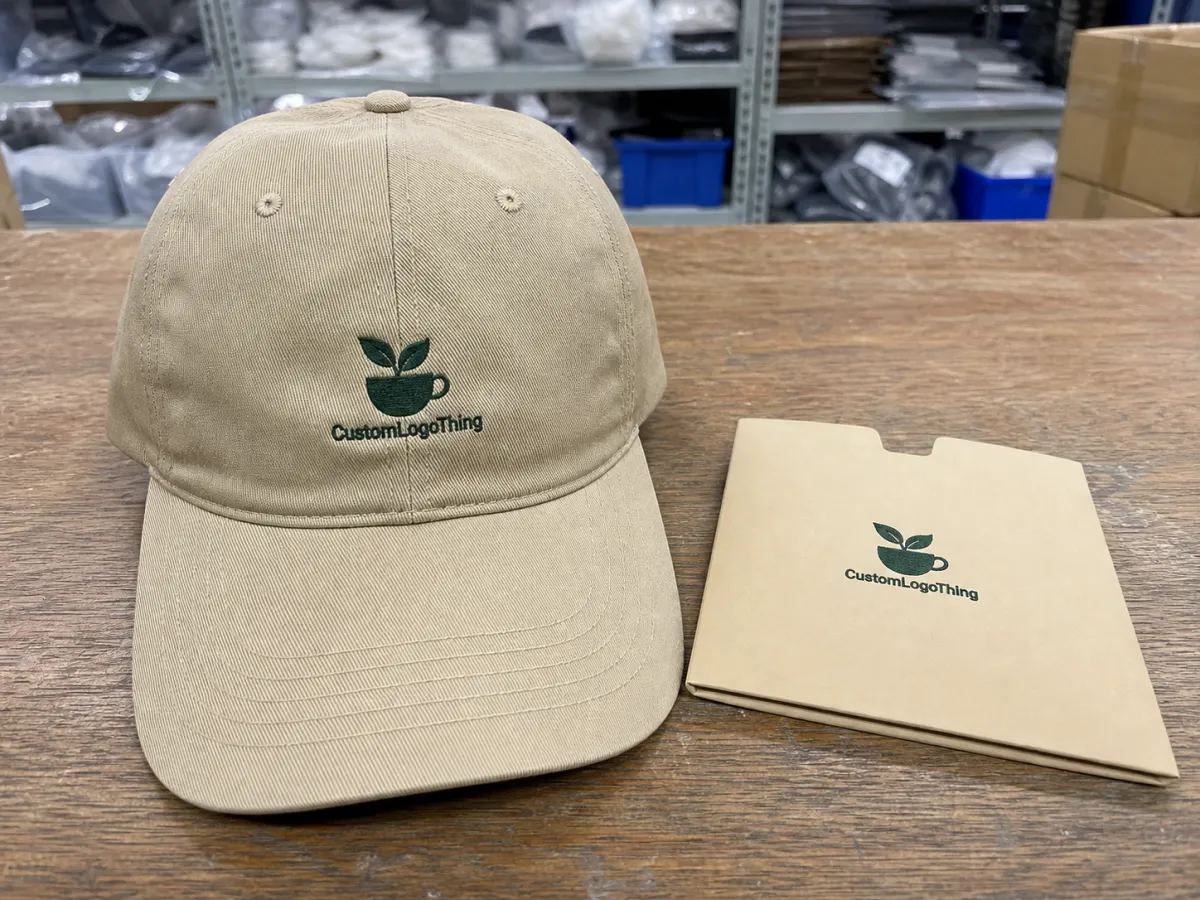
A small logo still carries setup cost. It must be digitized, tested, aligned, and approved, so a modest design is not automatically a cheap one. The fixed work is there whether the artwork is simple or not.
What often moves price more than logo size is the cap itself. Basic cotton twill with a standard closure stays predictable. Add washed fabric, a stiffer front panel, a metal buckle, or custom internal trim, and the unit cost rises even if the logo never changes.
Placement also matters. Front-center embroidery on a stable panel is usually efficient. Designs that cross seams or sit close to curved edges slow production and raise the risk of puckering, so the real cost is not only materials but also machine time and reject rate.
For tea brands, restrained branding usually works best. Clean embroidery, moderate density, and a simple silhouette are easier to wear and easier to reproduce in bulk. If the design can be simplified without losing identity, that is usually the best place to save cost.
A useful quote should show the cap base, embroidery method, setup charges, packing terms, and delivery assumptions. Without those details, the number is incomplete.
What the cap spec sheet should cover before you quote
The spec sheet should define the cap material, crown structure, brim style, closure type, embroidery location, logo size, thread colors, quantity, and destination. Buyers can ask for a rough estimate without all of that, but rough input produces wide price swings.
For tea Embroidered Baseball Caps, cotton twill is usually the most predictable base. Washed cotton gives a softer, more casual look, but it can vary a little more by batch. Structured six-panel caps are safer when the logo has sharp edges or small lettering because the front panel stays stable during stitching.
Artwork should be supplied as vector files whenever possible, with Pantone references if color accuracy matters. Thin lines, tiny text, and delicate leaf details may need to be simplified before digitizing. That is normal embroidery prep, not a design failure.
Do not skip sample approval. A photo proof may be enough for a simple order, but a physical sample is the safer choice when the logo is detailed, the color match is critical, or the caps are going into retail. One approved sample can prevent a whole batch from being wrong in the same way.
Packing details belong on the spec sheet too. If the caps are folded, stacked, or packed with inserts, the carton must protect the crown in transit. If shipping conditions are rough, it is worth checking against a transport standard such as ISTA. Clear packaging instructions help quotes stay comparable.
Specs that affect stitch quality, fit, and repeatability
Stitch quality depends on the artwork and the cap construction. A structured front panel usually gives the machine a steadier surface, so the logo comes out cleaner and more repeatable than it might on a soft unstructured cap.
Stitch density is a major cost and quality lever. Too light, and the logo looks thin. Too dense, and the fabric can pucker or slow production. For small tea marks, a moderate density usually gives the best balance between clarity and efficiency.
Decoration method matters as well. Direct embroidery is often the best value for simple logos. A patch helps when the art has too much detail for the available space. Puff embroidery creates more depth, but it is less forgiving around fine lines and tight curves.
Fit also affects how the product is judged. Crown height, brim curve, and closure style change comfort and appearance. Adjustable closures are the safest option for mixed distribution, while fitted caps may suit retail but are less flexible for large groups.
Thread choice should be practical, not only visual. Polyester thread is generally favored for durability and color stability. If the tea brand uses soft neutrals, test the thread against the cap color in daylight, not just on a screen or under indoor lighting.
Packaging can influence repeatability too. Individual polybags, inserts, and stack height should be checked so they do not distort the crown. If the packaging is only decorative, it should not be adding labor or risk without a clear benefit.
Tea embroidered baseball caps unit cost review: pricing bands and MOQ ranges that make sense
A useful tea embroidered baseball caps Unit Cost Review separates ex-factory price, setup, packing, freight, and taxes. If those pieces are blended together, the quote is hard to compare and easy to misread.
MOQ has a direct effect on the per-piece number. At small quantities, digitizing and sample work sit on a few caps, so the unit cost is high. By 300 pieces, the same setup is spread more efficiently. At 500 pieces and above, pricing usually becomes noticeably more stable for repeatable designs.
| Cap option | Typical MOQ | Ex-factory unit cost range | Best use case |
|---|---|---|---|
| Standard cotton twill, front embroidery, basic strap | 100-300 | $3.80-$6.80 at 100 pcs; $2.40-$4.20 at 300 pcs | Tea merch, event giveaways, short promotional runs |
| Washed cotton, structured crown, one- or two-color logo | 300-500 | $3.10-$5.40 at 500 pcs | Retail-ready brand drops with a softer finish |
| Premium closure, woven label, front and back embroidery | 500+ | $4.50-$7.80 | Higher-margin retail, gifting, and premium tea programs |
| Patch plus embroidery combo, custom hang tag | 500+ | $5.20-$8.50 | Complex branding, specialty presentation, launch collections |
Those ranges assume a straightforward logo and normal production discipline. They do not include air freight surprises, redesign cycles, or artwork that needs to be simplified after sampling. If the logo is detailed, both setup time and stitch efficiency may move against you.
Digitizing commonly costs $20-$60 per logo, while samples often fall in the $30-$120 range depending on whether the supplier provides a photo proof or a stitched sample. Custom labels, swing tags, and special inserts can add cost, but only when they are truly part of the order.
Freight can erase a low factory price quickly. A cap that looks cheap at the factory may not be cheap landed if the route changes or the order misses a shipping window. For budget decisions, landed cost is the number that matters.
Compare like with like: same cap style, same embroidery area, same closure, same packing method, same delivery term. If those variables differ, the quotes are not direct competitors.
Process, lead time, and production steps from sample to ship date
Cap production is predictable when the approvals are tight. The usual sequence is artwork review, digitizing, sample approval, bulk production, inspection, packing, and shipment. Most delays come from changes made after the file is already in motion.
For a standard order, digitizing often takes 1 to 2 days after final artwork is received. A photo proof may follow quickly. A physical sample can take 3 to 7 days, and bulk production is often 15 to 25 business days for a straightforward run.
The biggest schedule risks are artwork revisions, color changes, and slow approvals. Holiday backlogs matter, but those are visible. The harder problem is starting bulk production before the sample has truly been signed off.
Inspection should happen before cartons are sealed. Check stitch alignment, panel symmetry, crown height, thread tension, closure consistency, and color match. Tea branding often uses muted tones, so even a small dye lot shift can be noticeable across a batch.
Packaging should be tested if the caps are going to retail shelves, mailers, or long shipping routes. If recycled cartons or claims are involved, confirm whether any FSC labeling actually applies before the print run is approved. Small packaging mistakes are slow to fix and easy to miss until the end.
How repeat tea cap orders stay predictable on cost and quality
Repeat orders stay predictable when the variables stay fixed. The same cap base gets reused, the logo file does not change, and the stitch plan remains approved unless there is a clear reason to revise it.
Quality checks should be practical: stitch alignment, seam registration, crown symmetry, brim curvature, and closure consistency. Small errors in any of those areas are visible once the cap is worn or stacked, even if they looked acceptable in a mockup.
Reorders are cheaper mainly because the supplier is not rebuilding the order from scratch. The digitizing file already exists, the cap spec is stable, and the packing method is known. Less uncertainty means less sample churn and fewer price surprises.
That matters for tea brands because subtle designs leave less room for error. A quiet logo with a leaf or wordmark can look refined only if the embroidery is consistent. Restraint is usually what makes the cap feel premium, not extra decoration.
For that reason, the best savings usually come from simplification: fewer colors, fewer extras, fewer packaging parts, and fewer approval loops. A restrained order is easier to repeat and easier to price correctly.
That is the main value of a tea embroidered baseball caps Unit Cost Review: it shows which choices change the landed cost and which choices only add noise. The best order is the one that can be repeated without surprises.
What to prepare before you request a quote and place the order
To get a usable quote, send the logo file, cap style, target quantity, delivery destination, and timeline. Thread color references and a note about retail, staff, or promotional use help the supplier price the order more accurately.
If the logo allows it, ask for two embroidery versions: one with the simplest stitch path and one with a slightly cleaner edge treatment. In some cases the upgrade is worth it; in others it adds cost without improving the result enough to matter.
When the logo has small text or delicate details, a physical sample is safer than a photo proof. Fabric exposes problems that screens hide, including needle spacing, thread pull, and edge density. The sample is the right place to catch those issues.
Keep product cost and logistics cost separate. That makes supplier comparison easier and prevents a low factory price from hiding expensive freight. A slightly higher ex-factory number can still be the better landed-cost choice.
If sustainability requirements matter, state them early. Recycled content, paper inserts, recyclable cartons, and FSC-related claims all need to be verified before print and packing. Late changes are where paperwork and physical stock collide.
In short, the best quote is the one with the fewest assumptions. Clear spec, clear logo, clear delivery term, and clear packing. That is the cleanest way to buy without paying for noise.
Final take: the cap stays affordable when the design is simple, the base is standard, and the supplier is pricing the same product you think you are buying. Confirm stitch count, verify packing, and compare landed cost rather than headline price.
FAQ
What drives tea embroidered baseball caps unit cost the most?
The main drivers are cap construction, embroidery complexity, order quantity, and freight. Small orders carry more setup cost per cap, while extra finishes like woven labels, premium closures, and custom inserts increase the total quickly. If the logo is detailed, digitizing and sampling can also add time and cost.
Is direct embroidery cheaper than a patch for tea logo caps?
Direct embroidery is usually cheaper for a simple tea logo with clean edges and limited color changes. A patch helps when the design has too much detail for the available stitch area, but it adds another production step. For small, readable logos, direct embroidery is usually the better value.
What MOQ should I expect for tea embroidered cap orders?
Many factories start around 100 pieces for a basic run. Pricing improves around 300 pieces and becomes more efficient again at 500 pieces or more. MOQ can rise if you ask for special fabric, custom packing, or more complex decoration.
How long does production take after sample approval?
Digitizing usually takes 1 to 2 days, sample work can take 3 to 7 days, and bulk production often takes 15 to 25 business days. Bigger runs and more complex embroidery can extend that window. Shipping time is separate and depends on the transport method and destination.
What files do I need for an accurate tea cap quote?
Send a vector logo file such as AI, EPS, or PDF whenever possible. Add Pantone colors, embroidery placement, cap style, target quantity, and the delivery address. The more precise the file and spec, the fewer quote corrections you will need later.

