Tea Woven Label Beanies material sample guide sounds narrow until the first sample lands on a knit cuff and the whole decision changes. A logo that looked crisp on screen can soften once it is woven. A border that seemed neat on a flat proof can feel bulky against skin. And a label that looked centered in artwork may sit slightly off once it is stitched to a beanie that stretches, twists, and folds with wear.
That is why physical samples matter so much in this category. Beanies are not stable, flat products. They move under tension, they recover after stretching, and they sit close to the body. A sample shows how the label behaves in the real setting: the cuff, the seam, the fold line, the hand feel, the way light hits the threads, and whether the design still reads from a few feet away. Those details decide whether the branding looks considered or merely attached.
Buyers often start with artwork, but the final approval usually turns on material behavior. One label may feel soft but blur at the edges. Another may hold tiny text but feel too stiff for a winter accessory worn against the forehead. A good sample process reduces that tradeoff to something visible and measurable. It is less about ceremony than avoiding a batch of product that looks acceptable on paper and disappointing in a box.
A sample is not a decoration; it is a test of how weave, stretch, and placement work together on a real beanie.
If you need to compare woven labels with other trims in one place, our Custom Labels & Tags page helps organize labels, tags, and sewn-in branding before the order is locked.
Why tea woven label beanies material samples can change the whole sale
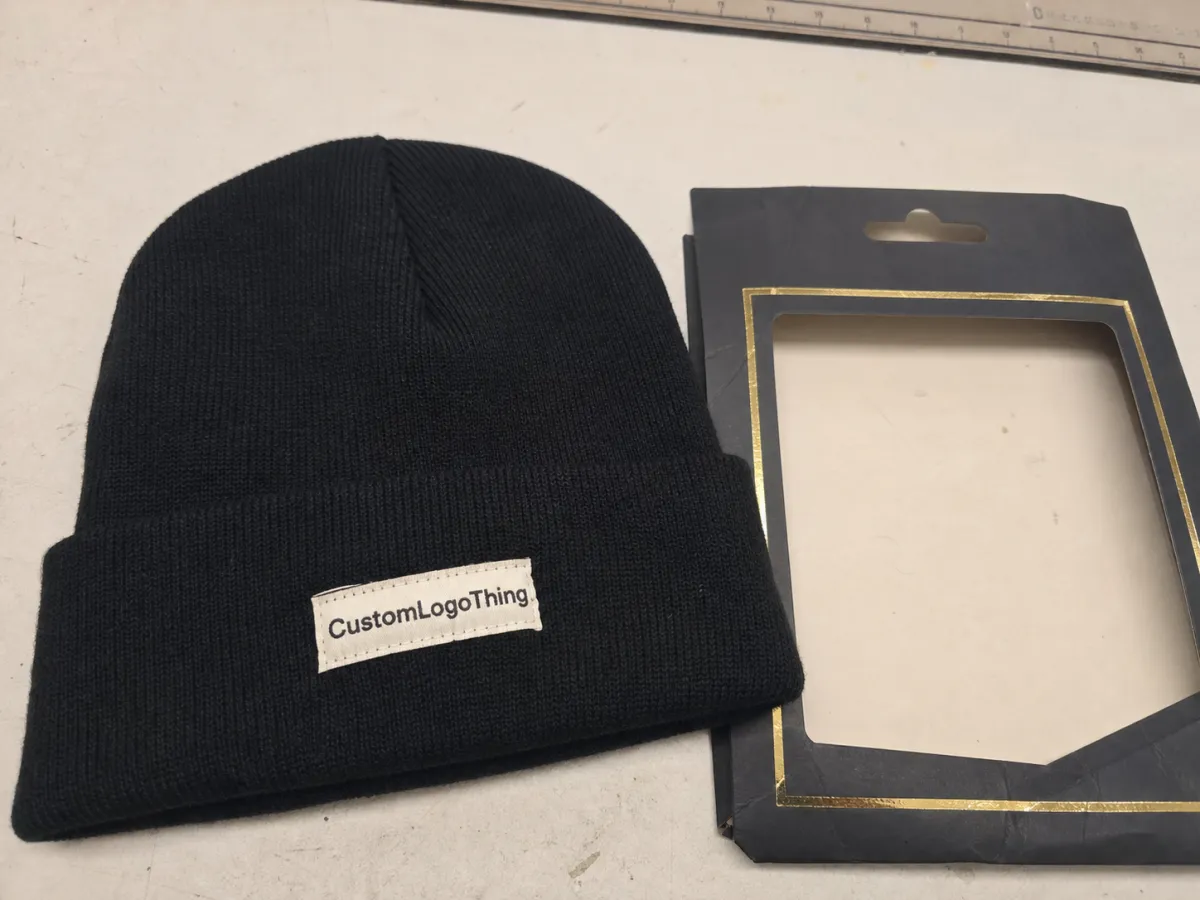
A woven label can look precise in a mockup and still fail in production because the knit body changes the rules. A ribbed cuff pulls on the label. A seam adds thickness. A dark beanie body changes contrast. Store lighting can make a glossy thread look brighter than it really is, while daylight may show that the same label is actually too dull to stand out. A sample reveals those shifts before they become expensive.
There is also a scale problem that catches people off guard. On screen, a line of type can look perfectly readable at 6 mm. On a woven label, that same line may break apart if the thread count is too low or the weave is too coarse. A border that looks balanced in a layout file may crowd the logo once the label is trimmed and sewn down. The sample turns those abstract questions into a real object you can hold up to the beanie body.
That matters because the final buyer usually cares about three things at once: appearance, comfort, and durability. If the label is visually strong but scratchy, it becomes a return risk. If it is soft but indistinct, it may not carry the brand the way the buyer expected. If it is durable but too thick, the cuff can lose its clean shape. A sample gives you the chance to choose the tradeoff deliberately instead of discovering it after production starts.
There is another practical reason to sample early: production corrections cost far more than sample revisions. Changing a border width or simplifying artwork after approval is manageable. Discovering after a full run that the weave is too loose for the logo is a much larger problem. A small sample fee is cheap insurance compared with remaking a label batch that no longer fits the product line.
For beanies, the label is not just an identifier. It is part of the silhouette. Some brands want it to disappear into the knit and feel understated. Others want a visible mark that reads like a badge. A sample tells you which path the spec is actually taking. That may sound obvious, but in practice many orders fail because the buyer and supplier were picturing two different outcomes from the same PDF.
How the tea woven label beanies material sample guide applies to knit beanies
Beanies are a special case because the fabric keeps moving after the label is attached. The cuff stretches when worn, then relaxes. The seam can push one edge upward. The fold line can hide part of the design. Even the type of knit changes the result. A dense acrylic rib holds a label differently than a softer merino blend, and a loose gauge body can make the same label feel larger simply because the fabric frame around it looks calmer.
That is why the sample should be reviewed on the exact beanie style, not just on a loose label card. A label can be technically correct and still wrong for the garment. Placement matters just as much as weave. A label set too close to the fold may buckle. One placed too low may get lost in the cuff. The best review compares the sample against the real garment, with the cuff stretched, folded, and then allowed to recover.
Build choices affect the read in small but important ways. Weave density determines how much detail survives. Border finish changes both comfort and visual framing. Backing can alter stiffness. Attachment method influences whether the label sits flat or wrinkles after sewing. Even thread direction can matter if the design has strong diagonals or narrow lettering. If the sample is meant to answer more than one question, list those questions before the first round goes out. Otherwise the revision notes tend to drift.
There is a useful comparison here. A label designed for a flat woven shirt tag may carry fine detail differently than one destined for a beanie cuff, because the shirt tag is usually more stable and less exposed to stretch. The beanie label has to survive movement, handling, and repeated wear. That is a different job, and the sample should be judged as such.
For buyers comparing options, the smartest approach is usually to test only a few controlled variables at a time. Change weave density, or change border finish, but not both in the same revision. If the sample comes back better, you will know which adjustment actually fixed the problem. If everything changes at once, the result may look improved without telling you why.
Buyers who want a tighter comparison often review several woven label options before requesting a physical sample, then narrow the field to two or three versions that differ by one spec only.
Material, weave, and finish factors that affect the sample
There is no universal best material for every woven label beanie sample. Polyester remains common because it holds shape well, accepts color reliably, and stays cost-effective across small and medium runs. Some programs ask for a softer hand or a more muted surface, which can shift the thread choice or the backing. If the label sits near skin, comfort belongs in the spec sheet, not in the afterthought column.
Thread count and weave density are the main drivers of sharpness. Higher-density weaves support smaller text, tighter curves, and cleaner logo edges. They also raise the cost and can slow sample turnaround a little because the build is more exacting. Lower-density weaves are lighter and often softer, but they may break up fine details. That tradeoff is not theoretical. It shows up immediately on small type, thin borders, and delicate icon marks.
Finish changes the reading too. A satin-like face can make colors appear brighter and more premium. A matte face usually feels quieter and more subdued. Heat-cut edges can stay slim, but if the cut is not clean the edge may fray. Merrowed borders frame the artwork and can give a classic label look, though they add bulk and can feel heavier on a cuff. Backing can change the whole hand feel; a soft backing may help comfort, while a firmer one can improve structure.
Color matching deserves more attention than it usually gets. Dark yarn can swallow detail. Cool lighting can make a blue-black label appear flat. A high-contrast logo on screen may need thicker strokes in thread form. If the beanie itself is dark, the label needs enough separation to stay readable at a glance. I would check the sample in daylight and under indoor lighting, then view it from three distances: close up, arm’s length, and a quick retail glance. That catches more problems than a single photo ever will.
Material behavior also matters after handling. Stretch the label across the cuff, release it, and repeat. Look for curling edges, warping, or a border that turns up after tension. A sample that still looks composed after bending and folding is telling you something useful. One that only looks good while lying flat is not ready for approval.
Packaging can affect the sample review too, especially when the order is tied to a retail launch. A sample that arrives in recycled materials or an FSC certified paper sleeve may match the brand story better, but protection still comes first. A simple kraft paper wrap inside a corrugated cardboard mailer usually does the job well. If the supplier uses biodegradable packaging, that can be a plus, provided the edges are protected and the label does not arrive crushed.
| Sample option | Typical use | What it tells you | Common sample cost |
|---|---|---|---|
| Standard woven label | Everyday retail beanies | Baseline legibility, edge feel, and color balance | $18-$35 per sample set |
| High-density weave | Small logos or fine text | How much detail survives at small scale | $25-$45 per sample set |
| Satin-faced or soft-hand finish | Premium or comfort-first programs | Surface sheen, hand feel, and comfort against skin | $25-$50 per sample set |
| Merrowed or framed edge | Classic branded look | Bulk at the border and how the label sits on the cuff | $28-$55 per sample set |
Those numbers are not fixed, but they are useful as a working range. A simple sample with a standard weave and limited color count often lands at the lower end. Add fine detail, special finish, or multiple revision rounds and the quote climbs. Buyers should also ask whether the sample fee is credited back against production. Some suppliers apply it later. Some do not. The difference changes the real cost more than the headline number does.
Cost, MOQ, and quote variables for sample orders
Sample pricing usually comes from four parts: setup, weaving, shipping, and revisions. Setup can cover artwork conversion or loom preparation. Weaving covers the actual sample production. Shipping is straightforward. Revisions are where budgets often drift, because a first sample that misses the target can lead to a second or third round. Buyers who keep the spec narrow generally spend less than buyers who ask the supplier to solve several design problems at once.
The quote changes with complexity. More colors mean more thread changes. Smaller labels require more precision. A denser weave may cost more because it takes longer to produce and is less forgiving during setup. Border choice also matters. A heat-cut label usually costs less than a heavily framed edge, while a soft backing can add to both material and handling expense. If the label carries a tiny logo, the supplier may need to slow the machine or adjust the weave structure, and that time shows up in the price.
Moqs can be confusing because sample orders and production orders behave differently. For development, one to three sample versions is often enough. For a pilot run, 50 to 200 pieces may be smarter because it shows how the label holds up in sewing, packing, and real inventory flow. That is not overkill. It is a practical way to catch issues that only appear once the product is handled at scale, especially if the beanie line includes multiple colors or sizes.
If you are comparing quotes, ask for a line-by-line breakdown:
- Exact label spec - size, fold, weave density, color count, border finish, and backing.
- Included sample cost - whether setup, weaving, and one revision are covered.
- Production credit - whether the sample fee applies to the final order.
- Shipping method - transit time and packaging protection should be spelled out.
A clean quote should let you compare two suppliers without guessing what is hidden inside the number. If one estimate looks much lower, it may simply be using fewer colors, a lighter weave, or a smaller finished size. That is not necessarily bad. It just means the quotes are not the same product.
For broader packaging or transit expectations, external standards can help with basic checks. ISTA offers guidance on transport testing, and FSC explains certification details for paper-based materials. Neither replaces a supplier’s own spec sheet, but both give useful reference points when packaging claims or handling performance matter.
Process and lead time from request to approved sample
The fastest sample process starts with a complete request. Send the artwork file, the finished label dimensions, the beanie style, the cuff placement, the color references, the target deadline, and the approval criteria in one message. If the supplier has to ask for basic information in several rounds, the schedule expands immediately. Even a small delay at the start can ripple through the whole timeline.
Once the request is clear, the workflow is usually predictable. The supplier confirms the build, converts the artwork if needed, produces the sample, sends photos or a digital reference if requested, and then ships the physical piece. If a revision is required, one concentrated response from the buyer is better than scattered comments over several days. A sample room can move quickly, but it cannot read half-finished feedback.
Lead times vary by queue position, material availability, and complexity. A straightforward woven label sample often takes about 5 to 10 business days before shipping. Revisions may add a few more days. Special thread colors, denser weaves, or unusual finish requests can extend the schedule further. International shipping typically adds another 3 to 7 business days, depending on route and customs handling. If a launch date matters, build a cushion rather than planning to the edge.
Good approval also depends on clear standards. Decide what success means before the sample arrives. Does the label need to be discreet or prominent? Should the feel be soft enough for direct skin contact, or is a firmer label acceptable because the cuff stays outside the wear zone? Is the priority color accuracy, stitching durability, or a premium surface? A sample is easier to judge when the scorecard is already written.
Many teams keep the approval process simple:
- Confirm the spec in writing.
- Review the sample on the actual beanie blank.
- Approve only after comfort, color, legibility, and placement all pass.
That same decision should then live in the production file, not just in email. The final label spec belongs beside the order number, the packing note, and the artwork version. If the order also includes hang tags or other trims, keep the approved label spec next to the rest of the branding package so nothing gets rebuilt from memory later.
Common sample mistakes and expert checks before approval
The biggest mistake is approving from a render alone. Screens distort color, flatten texture, and hide the way a woven label behaves under tension. Another frequent error is forgetting that the cuff changes the label’s proportions. A design that looks balanced on a flat proof may appear smaller once it is wrapped around knit fabric. Buyers also miss edge feel more often than they should. A label can look perfect and still feel irritating after ten minutes of wear.
There are a few checks that catch most problems early. View the sample in daylight if possible, then under indoor lighting. Stretch the beanie cuff and release it several times. Check the label after trimming and stitching, not only before attachment. Photograph it from a distance, because that is closer to the way customers will see it in a shop or online. If the sample still looks clean after those checks, the spec is probably solid.
A short pre-approval list keeps the review honest:
- Does the logo read clearly at arm’s length?
- Does the edge feel comfortable against skin?
- Does the color hold up in cool and warm light?
- Does the size stay balanced on the actual cuff?
- Does the sample match the written spec exactly?
One more test is worth the small effort: move the beanie around as if it were being packed, worn, and repacked. A label that looks tidy while stationary may wrinkle, curl, or catch once it is handled. That movement test is especially useful for retail programs, because customers rarely encounter the product in a perfect, motionless state.
For wearability, edge finish matters more than many buyers expect. A slightly rough border may not matter on a tote tag, but it can be a problem on a winter accessory worn against the forehead or near the ear. If the sample feels abrasive, do not assume it will soften enough in production. Rework the spec instead.
If a label only looks good in a flat photo, it is not ready for a stretch knit beanie.
The best part of a tea Woven Label Beanies Material Sample guide is that it keeps approval tied to repeatable checks instead of a quick visual impression. That is how you avoid a label that looks fine in isolation and weak in the product.
Next steps: lock the spec and move to production
Once the strongest sample is clear, freeze the key specs before production begins. Record the finished size, weave density, thread colors, fold style, border finish, backing, placement, and packing method. If the sample passed because the logo needed a slightly thicker stroke or a wider border, write that down now. Small adjustments are easy to forget once the pace of the order picks up.
It also helps to keep the final notes close to the production order. That way the approved sample does not disappear into a folder of old proofs. The buyer, the merch team, and the production side should all be looking at the same version. That sounds basic, but it is one of the most common reasons a good sample still turns into a bad production run.
If the beanies are part of a retail launch or a gift set, the label spec and the packaging spec should stay linked. A simple corrugated cardboard shipper with kraft paper inserts may be enough for some lines. Others may need a more polished outer presentation. If the packaging story includes recycled materials, post-consumer waste content, or FSC certified paper, document that clearly so the claims remain accurate. Packaging detail may feel secondary, yet it often shapes how the finished product is perceived long before the label is examined.
Used well, the tea woven label Beanies Material Sample guide is not a formality. It is the point where artwork, material, and garment behavior meet. That is the moment to decide whether the label should blend in, stand out, or split the difference. Get that decision right, and the rest of production becomes much more predictable.
What should I check in a tea woven label beanies sample before approval?
Check legibility, edge comfort, color accuracy, and how the label sits on the actual beanie cuff. Review it in daylight and indoor light, then stretch the cuff and let it recover to see whether the label stays flat. Confirm that the finished size and placement match the production spec, not just the artwork file.
How many sample versions should I request for beanies with woven labels?
Two or three versions are usually enough if the goal is to compare one variable at a time. Keep one baseline and adjust only one major detail, such as weave density or border finish. That makes the final decision easier to trace and reduces the chance of approving a sample for the wrong reason.
Do woven label materials change the unit cost on beanie orders?
Yes. Thread count, color count, size, finish, and backing all affect cost. More complex builds usually cost more, and very small orders tend to carry a higher per-piece price because setup is spread across fewer units. A clean spec sheet keeps quotes comparable.
How long does the sample and approval process usually take?
A simple sample often takes about 5 to 10 business days before shipping, with a few more days for transit. Revisions can add time, especially if the artwork needs rework or the supplier has to source a special thread color. If timing matters, build a buffer for both sample production and shipping.
What are the most common mistakes when ordering woven label beanies samples?
Approving from a digital mockup only is the biggest one. Buyers also overlook stretch, seam bulk, edge feel, and the way the label reads at a distance. Another common miss is failing to write the final spec down after the sample is approved, which makes later production more vulnerable to memory drift.