Pricing branded winter headwear is rarely about the beanie body alone. A small woven label can change how the entire product is read: casual or retail-ready, generic or intentional, forgettable or something a buyer would actually pay for. That shift is easy to miss if you only look at the headline item price.
For that reason, a ceramic woven label Beanies Unit Cost Review should examine the whole build, not just the knit. Beanie style, label size, fold type, stitch method, artwork complexity, packing, and quantity break all affect the final number. In practice, those details decide whether the order fits a promo budget, an ecommerce margin target, or a more premium gift program.
The best buyers treat the label as part of the product architecture. A beanie with the right cuff shape, the right label placement, and a clean stitch line can look like a planned retail item. The same body knit with sloppy branding looks like leftover stock. The difference is small on paper and obvious on shelf.
Why a small woven label can change beanie resale math
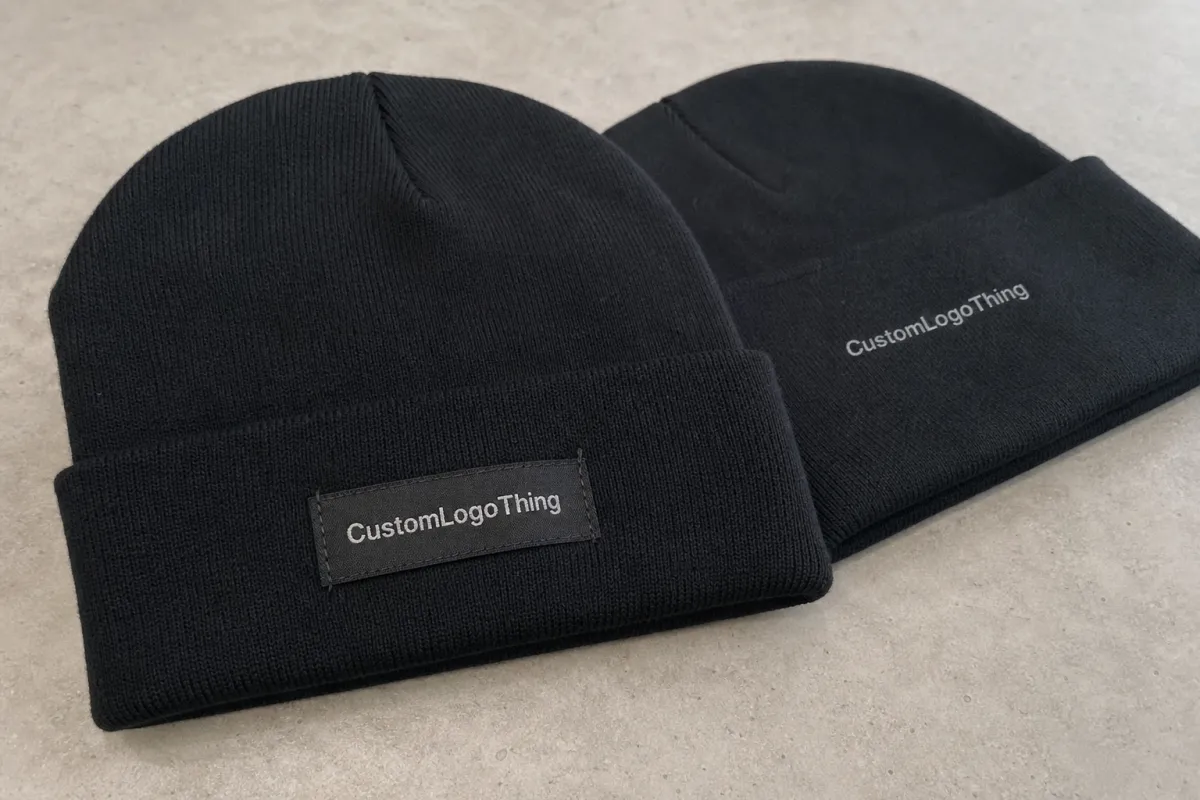
Most buyers start with the fabric weight and the knit type, because those are the obvious variables. Fair enough. But once the beanie is photographed, hung on a display, or placed in a mailer, the woven label becomes one of the first things the shopper notices. It does more than decorate. It signals whether the brand understood the product or simply added branding at the last minute.
That matters because perceived value often moves faster than material cost. A 20 x 50 mm label on a front cuff can raise the product's visual credibility without making it look busy. If the stitching is straight and the contrast is readable, the label works like a small anchor point for the whole brand. If it is crooked, oversized, or too thin to read, the product looks cheaper than it is.
There is also a resale argument. Buyers often focus on shaving a few cents off the beanie body, then overlook the decoration package that actually shapes shopper confidence. A more polished label can support a higher retail price, better conversion in product photos, and fewer doubts at first glance. That is not a theoretical claim; it is how many buyers end up justifying the added labor.
A useful way to think about the order is simple: the body carries warmth, but the label carries intent. When the branding feels planned, the product feels closer to finished merchandise and farther from generic inventory. That is usually where the margin comes from.
In a ceramic woven label beanies Unit Cost Review, the price swings are usually driven by practical choices rather than one dramatic expense. A one-location sew-on label is easier than a two-position build with a front logo label and a side size marker. A simple fold is cheaper than a specialty finish. One extra color in the weave may be minor on a spreadsheet, but it can affect loom time, proofing, and the tolerance for fine detail.
Beanie build choices that affect label appearance and wear
Beanie construction changes how a woven label sits, stretches, and ages. Cuffed rib-knit styles usually give the cleanest branding surface because the cuff creates a flatter zone with enough structure for the label to lie straight. That is one reason they dominate retail and promo programs. The placement is visible, predictable, and generally easier to sew consistently.
Slouchy beanies can still work, but the knit moves more. If the label sits on a softer section, it can tilt when the beanie is worn or pulled into shape. Double-layer bodies feel more substantial and often hold a label better after repeated handling. Rib-knit construction, by contrast, gives stretch and comfort but demands more care if the label artwork uses small lettering or fine borders.
Placement affects both appearance and comfort. Front cuff placement gives the strongest brand read and is usually the cheapest to execute cleanly. Side seam placement can feel more restrained and premium. Hem-edge placement is subtle, though it has to be handled carefully so the edge does not scratch or rub. Back branding can work, but it is less effective for ecommerce images, where the front view carries most of the selling load.
There is a practical comfort question too. Flat labels are low profile and work well on casual beanies. End-fold and center-fold labels tend to finish the edge neatly and usually feel better against the skin. Loop-fold labels give a more dimensional look, though they can stand away from the knit more than some brands want. Patch-style woven labels are another option entirely: more presence, more sewing time, and sometimes more cost.
Durability should be checked before bulk. Ask how the label holds up after stretching, folding, and handling in a carton. Edges should not fray. Threads should not snag. The weave should not blur when the fabric is pulled. If the product is headed into ecommerce fulfillment or gift sets, those small failures matter because the item has to arrive looking crisp, not repaired by the shopper.
Artwork, label specs, and approval details that prevent rework
Clean artwork is the easiest way to avoid a slow sample cycle. Woven construction is unforgiving with tiny text, hairline strokes, and overly detailed crests. A logo that looks polished on screen can turn muddy in thread if the detail level is too ambitious. The safest move is usually to simplify the design before sampling rather than after the first proof fails.
Good quoting starts with complete specs. Suppliers need the label size, fold style, thread color count, placement, attachment method, and quantity. They also need the target due date. If those basics are vague, the quote may look low at first and then drift upward once the real work is defined. That is how pricing confusion starts.
- Label size in millimeters or inches
- Fold style such as flat, end-fold, center-fold, or loop-fold
- Thread color count and background color
- Attachment method such as sewn edge, tacked ends, or side-seam stitch
- Placement on cuff, body, side seam, or back area
- Quantity and target delivery date
That list may look basic, but it is where many quote errors begin. If the supplier has to guess the fold or the placement, the unit cost may be meaningless. A proper ceramic woven label Beanies Unit Cost Review only works if two suppliers can price the same build and arrive at comparable numbers without a long chain of clarifying emails.
Proof review should be more than a glance. Check spelling, logo proportions, border thickness, contrast, and whether the label still reads at normal viewing distance. A proof can technically match the file and still fail in the hand if the text is too thin or the contrast is weak. A physical sample or pre-production proof is the best check on scale, weave density, and how the label sits on the actual beanie body.
If you are comparing label formats across more than one program, the cleanest starting point is often Custom Labels & Tags, because it keeps weave style, fold, and attachment aligned before the order is placed. That same discipline applies to woven label options for beanies and to other branded trims that need to stay consistent across a product line.
A quote is only useful if it separates the beanie body, the label, the sewing, and the freight. If those items are blended together, you cannot tell where the cost is really coming from.
Pricing, MOQ, and ceramic woven label beanies unit cost review
This is the part buyers usually care about first. The trick is separating real cost drivers from quote noise. For a ceramic woven label Beanies Unit Cost Review, the biggest levers are total quantity, label complexity, thread count, attachment labor, and whether the order is a stock blank or a fully custom knit run with branding built in.
MOQ has a direct effect on cost per piece. Lower quantities almost always carry higher unit pricing because setup, proofing, and machine time are spread across fewer units. Once an order crosses a volume break, the price can fall faster than first-time buyers expect. A quote for 300 pieces and a quote for 1,000 pieces may look like different products even if the artwork is identical.
Setup charges and tooling fees need to be visible. Some suppliers use those terms loosely. Others separate sample development, loom preparation, digital proofing, and sewing setup. If those items are hidden inside the unit price, the comparison becomes muddy. You may think you found the lowest offer when you really found the most compressed quote format.
| Order format | Typical MOQ | Typical cost per piece | What drives the price |
|---|---|---|---|
| Stock acrylic beanie + one woven label | 300-500 pcs | $1.75-$2.95 | Label size, one- or two-color weave, sewing labor, basic packing |
| Stock beanie + woven label + hang tag | 500-1,000 pcs | $2.05-$3.40 | Extra finishing, tag application, packaging line time, setup charges |
| Higher-volume beanie with more detailed woven label | 1,000-3,000 pcs | $1.45-$2.35 | Better spreading of tooling fees, lower decoration cost per piece |
| Fully custom knit beanie with woven label branding | 500-2,000 pcs | $2.70-$5.00 | Custom knit labor, yarn count, decoration, and longer production time |
Those numbers are buying ranges, not promises. A simple one-color woven label sewn to a stock beanie can sit near the lower end. A multi-color label, special fold, or retail-ready packout pushes the price upward. Add individual polybags, custom hang tags, carton labeling, or rush freight and the landed cost rises again.
The unit price should never be compared without context. One supplier may quote a low product cost but charge more for setup. Another may appear expensive at first and include the decoration work in a cleaner line structure. The only honest comparison is the full landed cost: product, setup, sample, packaging, and shipping.
One more practical split matters. Ask whether the label is sewn onto a stock beanie or built into a fully custom run. The production path changes both lead time and cost. Stock blanks usually ship faster and let buyers forecast more easily. Custom knit bodies give a stronger branded look, but they require more planning, more approvals, and more budget room.
Production steps and lead time from proof to packed cartons
A realistic production schedule starts with the artwork intake. The supplier confirms the spec, builds a digital proof, and checks whether the label size and placement fit the actual beanie body. After approval comes weaving or stock sourcing, then sewing or attachment, quality checking, and final packing.
Delays usually show up in the same places. Artwork revisions are a common slowdown, especially if the logo needs simplification. Color corrections can add time because thread shades never behave exactly like ink or screen color. Sample approval is another bottleneck, and peak-season workload can stretch a normal lead time without warning.
Buyers can control part of that timeline. Send vector artwork. Confirm quantity early. Approve proofs quickly. Lock the shipping destination before production starts. Those steps do not shorten manufacturing itself, but they cut avoidable back-and-forth. In apparel sourcing, that often matters as much as the production clock.
Lead time should be discussed in two parts: production days and transit days. A quote that says 12 business days is not the full story if the shipment still needs another week in transit. It also matters whether the goods are shipping from stock, from a decorated facility, or from a fully custom knit line. Those paths do not move at the same speed, and they should not be priced as if they do.
If cartons are going into distribution centers or direct-to-consumer fulfillment, ask whether the packaging plan has been considered against ISTA transit test methods. The label can be perfect and the product can still disappoint if the carton crushes in transit. For paper hang tags, FSC-certified stock is a sensible option when the buying team wants the printed component to align with a cleaner sourcing policy.
How to judge supplier consistency on repeat beanie runs
Repeat orders are where suppliers prove whether they can hold a spec. The best partners keep label size, stitch density, placement, and color matching stable from one run to the next, even if the reorder happens months later. That matters because seasonal apparel is easy to distort over time. A small drift in placement or thread tone can make a later batch look like a different product line.
Ask for approved sample references and spec records. If the first run was accepted, the reorder should not begin from scratch. A capable supplier can pull the previous artwork file, reference the same label construction, and confirm whether the same thread shade is still available. That shortens the process and reduces the odds of a surprise during production.
Good operations show up in the small things. Proofs arrive on time. Exceptions are explained clearly. Quality checks are documented. If a supplier sees that a label width will not sit flat on a cuffed rib-knit beanie, they should say so before bulk starts. Early warning is worth more than a slightly lower quote.
Consistency is part of the economics. Reorders that match the original shipment avoid rework, cut rejection risk, and protect the retail look of the line. If you are comparing a new vendor against an existing one, keep the conversation focused on the same specification, the same label construction, and the same shipping standard so the numbers remain comparable.
A clean reorder process also helps when the rest of the branded trim package expands. Once the label spec is locked, it is easier to coordinate matching hang tags, inserts, and related matching garment labels without losing track of which version was approved. That becomes especially useful once a winter item turns into a recurring assortment.
Next steps to request a clean quote and move to purchase order
If you want an accurate quote quickly, send the basics in one clean package: logo files, preferred beanie style, target label size, estimated quantity, color preferences, and the delivery deadline. A complete brief gives the supplier less room to pad the number for uncertainty and less reason to send back a vague estimate.
Ask for a quote that separates unit cost, setup, sampling, and freight. That makes comparison possible. If the artwork is new, request one proof or sample round first, then approve only after checking readability, placement, and fit on the actual beanie body. A nice-looking proof is not enough if the final item sits crooked on the cuff.
Be direct about priorities. If margin is tight, ask where savings are real: simpler weave, one fewer thread color, a standard placement. If presentation matters more than the last few cents, say that too. Honest constraints usually produce better quotes than broad requests for "best price."
That is the most useful way to handle a ceramic woven label beanies Unit Cost Review: define the spec, compare landed cost, confirm the lead time, and approve the sample only after the branding looks right in the hand. Once those pieces line up, the order is easier to buy, easier to sell, and easier to reorder with confidence.
What does a ceramic woven label beanies unit cost usually include?
It usually covers the woven label itself, the attachment labor, and the base beanie item if the quote is for a finished product. Setup, sampling, and freight may be listed separately, so ask for a line-by-line quote before comparing vendors. If the design uses multiple thread colors or special folds, those details can raise the unit cost even when the quantity stays the same.
How does MOQ change woven label beanie pricing?
Lower quantities usually have a higher unit price because weaving setup and labor are spread across fewer pieces. Once the order crosses a volume break, the cost per piece often falls faster than first-time buyers expect. If you only need a small run, ask whether a stock beanie plus sewn label is cheaper than a fully custom decorated body.
Which beanie styles give the cleanest woven label placement?
Cuffed rib-knit beanies usually offer the cleanest front placement because the cuff gives a flat, visible area for branding. Double-layer styles work well when you want a label that feels secure and sits flat after repeated wear. Slouchy beanies can work too, but the label position needs to be chosen carefully so it does not distort when the hat stretches.
How long does woven label beanie production take after approval?
After artwork approval, the schedule depends on whether the beanies are stocked blanks or fully custom made-to-order units. Sampling, bulk decoration, and final packing are the main checkpoints, and each one can add time if revisions are needed. Transit time should be added on top of production time so the buyer can judge the real delivery date.
What should I send to get an accurate beanie quote fastest?
Send a vector logo, target quantity, beanie style, preferred label placement, and any color requirements up front. Include your delivery window and ship-to location so the quote reflects the real landed cost, not just the unit price. If you already have a sample reference or competitor image, include it to reduce back-and-forth on expectations.


