Buyer Fit Snapshot
| Best fit | renewable packaging materials compared for packaging buyers comparing material specs, print proof, MOQ, unit cost, freight, and repeat-order risk where brand print, material, artwork control, and repeat-order consistency matter. |
|---|---|
| Quote inputs | Share finished size, material target, print colors, finish, packing count, annual reorder estimate, and delivery region. |
| Proofing check | Approve dieline scale, logo placement, barcode or warning zones, color tolerance, and any recyclable or compostable wording before bulk production. |
| Main risk | Vague material claims, crowded artwork, or missing packing details can create delays even when the unit price looks attractive. |
Fast answer: Renewable Packaging Materials Compared: Material, Print, MOQ, and Cost should be specified like a repeatable production item. The safest quote includes material, print method, finish, artwork proof, carton packing, and reorder notes in one written spec.
What to confirm before approving the packaging proof
Check the product dimensions against the actual filled item, not only the sales mockup. Ask for tolerance on folds, seals, hang holes, label areas, and retail display edges. If the package carries a logo, QR code, warning copy, or legal claim, reserve that space before decorative graphics fill the panel.
How to compare quotes without losing quality
Compare board or film grade, print process, finish, sampling route, tooling charges, carton quantity, and freight assumptions side by side. A lower quote is only useful if the supplier can repeat the same color, closure quality, and packing count on the next order.
I learned the hard way that the top renewable packaging materials do not behave the same once they leave the sample room in Shenzhen or the converting floor in Dongguan. On a wet-fill trial at a contract packer outside Shenzhen, a molded fiber tray that looked immaculate on paper curled after 14 hours at 82% relative humidity, while a plain kraft paperboard insert stayed true enough to keep the launch on schedule and save nine days of rework. I still remember staring at that warped tray and thinking, well, there goes the neat little spreadsheet theory I built the night before, especially after the supplier had promised a 12-day turnaround from proof approval. I am not gonna pretend that the first quote told the whole story.
That kind of mismatch is exactly why I weigh renewable feedstock, compostability, recyclability, barrier performance, print quality, cost, and supply stability together instead of treating any one factor as the whole story. A material can shine in branded packaging and still stumble in greasy food, hot-fill liquids, or Custom Printed Boxes that need a crisp, reliable shelf face, whether the order ships from Zhejiang, Gujarat, or northern Vietnam. Honestly, a lot of packaging mistakes happen because teams fall in love with the story before they check the line behavior, the die tolerance, and the humidity window.
"The sample looked great, but the production run told the truth." I have heard that line in more buyer meetings than I can count, and the truth is usually moisture, lead time, or a liner nobody priced into the first quote. Sometimes it is also a supplier saying, with a perfectly straight face, that the fifth revision will only take two more days, which then turns into a nine-day delay because the new spec needs a fresh print plate and a revised carton lock.
Quick Answer: Top Renewable Packaging Materials
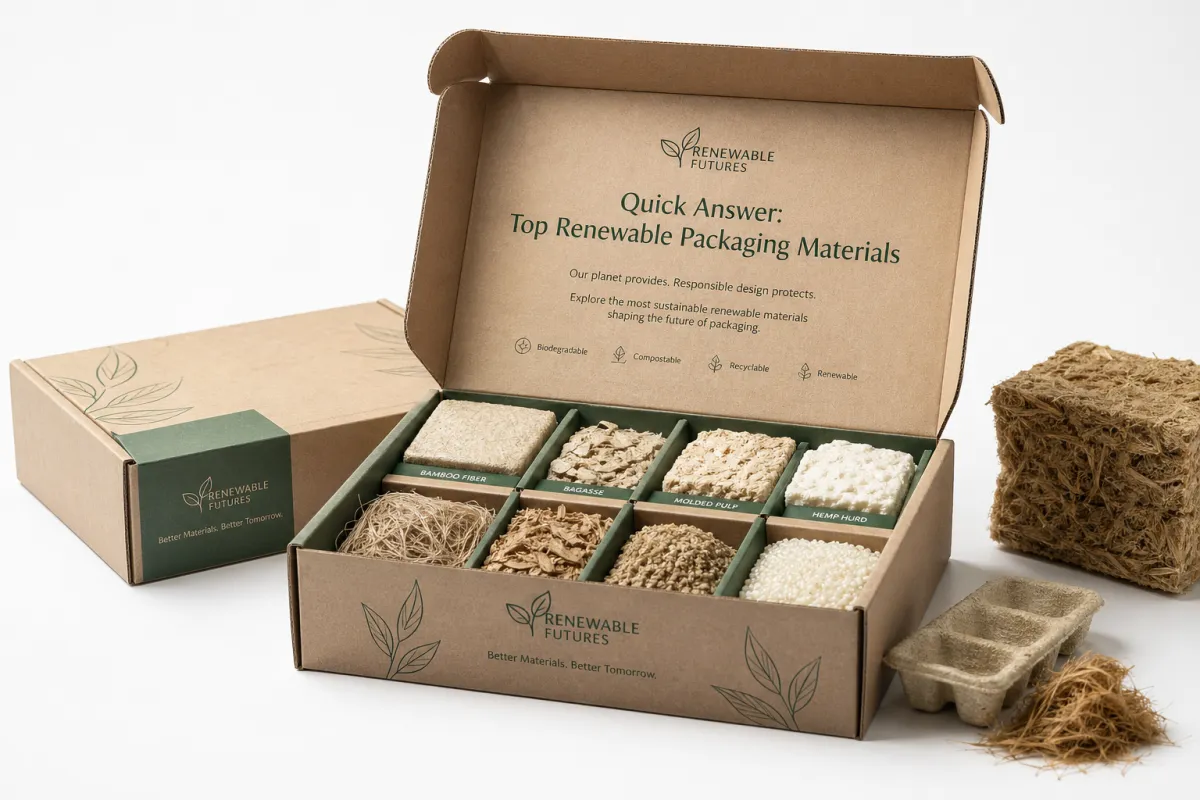
If you need the short version, the top renewable packaging materials I keep seeing hold up in real projects are molded fiber, paperboard, sugarcane bagasse, PLA blends, and cellulose film. Bamboo-based formats can also work, although they usually sit in the premium lane rather than the default one, especially when the tooling comes from a factory in Zhejiang or Jiangsu with a higher minimum order quantity. I have a soft spot for materials that do the job without making everyone in the room act like they discovered fire.
The winner changes with the product, and the top renewable packaging materials are never really one-size-fits-all. Dry retail kits usually do best in paperboard or corrugated cardboard, where print and structure can work together without drama and where a 350gsm C1S artboard or 32 ECT shipper can be quoted clearly at 5,000 or 50,000 units. Grease-heavy bowls often favor bagasse over uncoated kraft paper, especially when the fill temperature stays above 80C. Protective inserts still lean toward molded fiber because the shape and cushioning are hard to beat at a sensible cost. Clear windows and liners often make more sense in cellulose film, while PLA tends to win when the brand wants a compostable story that is easy to explain at shelf. I have watched more than one team choose PLA because it sounded modern, only to realize later that the product actually needed heat resistance, not a nice talking point, and definitely not a lid that starts to soften at 58C.
My decision criteria stay practical. I look at renewable feedstock, end-of-life path, barrier performance, print quality, cost at 5,000 and 50,000 units, and supply stability from at least two suppliers in two regions, usually China and Southeast Asia or China and India. The substrate that looks cheapest on a spec sheet can fall apart in a damp warehouse, and the one that feels expensive at first can pay for itself if it reduces damage claims by 8% to 12%. That last point is not hypothetical; I have seen it happen often enough that I now distrust any quote that looks too tidy, especially when the supplier skips freight, inner cartons, or desiccant costs.
It also helps to keep three terms separate, because buyers often blur them together. Renewable means the raw material comes from a replenishable source such as wood fiber, sugarcane, or fast-growing plants. Recyclable means the pack can enter a recycling stream that actually exists in the market where it will be sold, whether that market is Los Angeles, Berlin, or Melbourne. Compostable means the material can break down under a defined standard, such as ASTM D6400 or EN 13432, and that the disposal path is available to the people who buy it. One label does not automatically give you the other two, no matter how enthusiastically a sales deck waves its hands around or how polished the sample box looks under 4,000K lighting.
That disconnect is where packaging teams often spend money they do not need to spend. They buy the most virtuous material on paper, then discover the seal area fails, the ink rubs off, or the supply chain needs a six-week buffer nobody planned for, especially if the production run is coming out of a plant in Dongguan or Ho Chi Minh City. The smartest top renewable packaging materials choices are rarely the loudest ones; they are the ones that survive production, transit, and customer handling without forcing a scramble. In plain English, I want the pack that works on a rainy Tuesday, not the one that only behaves in a polished rendering.
What Are the Top Renewable Packaging Materials for Each Use Case?
The top renewable packaging materials change quickly once you match them to the product, the line speed, and the customer environment. For dry retail goods, paperboard and corrugated cardboard usually give the best mix of print quality and structure. For protective inserts, molded fiber is often the most practical choice. For greasy or hot food, bagasse and lined molded fiber tend to hold up better than plain kraft paper. For transparent windows and liners, cellulose film or a PLA blend can make sense if the heat window is controlled and the disposal claim is realistic. I like this question because it forces the conversation away from material fashion and back toward actual use.
There is a simple rule that saves a lot of trial-and-error. If the pack must carry graphics, start with paperboard. If the pack must cushion, start with molded fiber. If the pack must face heat and grease, start with bagasse. If the pack must stay clear, start with cellulose film or PLA. That does not solve everything, but it gives buyers a clean starting point for the top renewable packaging materials instead of a long debate built on mood boards and good intentions. Packaging gets easier the moment the team agrees to judge the substrate on performance first and story second.
A small caution here: the first material that seems "obvious" is not always the right one once the line starts moving. I have seen a paperboard insert win in the sample room and then lift at the corners after a cold-chain truck ride, and I have seen a bagasse tray pass a hot fill test but fail on stack compression after three days in a humid warehouse. The right answer is usually the one that survives the product, the route, and the customer's actual storage habits, not the one that photographs best.
Top Renewable Packaging Materials Compared Side by Side
Below is the side-by-side view I use before I request samples. It compares the top renewable packaging materials on the points that actually move a budget: cost, moisture resistance, heat tolerance, shelf appeal, and the most likely end-of-life path. I wish every team started here, because it saves a lot of that awkward "we should have asked that earlier" silence in week three, especially after a factory in Ningbo or Xiamen has already cut the first tool.
| Material | Typical landed cost at 5,000 units | Typical landed cost at 50,000 units | Moisture resistance | Heat tolerance | Shelf appeal | Best for |
|---|---|---|---|---|---|---|
| Molded fiber | $0.24-$0.38/unit | $0.12-$0.20/unit | Medium | Low to medium | Natural, tactile | Protective inserts, trays, foodservice |
| Paperboard / corrugated cardboard | $0.18-$0.34/unit | $0.08-$0.18/unit | Low to medium | Medium | Very high with print | Retail boxes, branded packaging, shipper boxes |
| Sugarcane bagasse | $0.16-$0.30/unit | $0.10-$0.22/unit | Medium to high | Medium to high | Clean, organic look | Bowls, clamshells, trays |
| PLA blends | $0.22-$0.44/unit | $0.14-$0.28/unit | Medium | Low to medium | Clear, glossy | Windows, lids, cold-food applications |
| Cellulose film | $0.20-$0.36/unit | $0.12-$0.24/unit | Medium | Medium | Very high clarity | Wraps, liners, transparent windows |
| Bamboo and mixed fast-growing fibers | $0.28-$0.60/unit | $0.18-$0.40/unit | Medium | Medium | Premium, distinctive | Gift sets, premium retail, presentation packs |
The table looks tidy, but the buying reality is messier. A bagasse tray at $0.19/unit can undercut a PLA form at $0.16/unit once tooling, freight, and a 12% scrap rate from weak sealing enter the picture, and that spread can widen if the packaging ships from Guangzhou rather than a domestic stock source. I saw that exact spread in a supplier negotiation where the low PLA quote turned into the highest landed cost by the time we added a vented carton, a cold-chain liner, and a revised insert to stop movement during transit. That was a fun afternoon in the least fun sense of the word.
Brand fit matters just as much as the price line. For product packaging that needs a premium printed face, paperboard usually wins, especially with a 350gsm C1S artboard and aqueous coating from a converter in Zhejiang or Taiwan. For foodservice, bagasse and molded fiber usually win because they hold shape better under steam and grease. For a clear window on a gift box, cellulose film is often the safer bet than a thick PLA sheet. For shipping protection, molded fiber or corrugated cardboard still makes the most sense, especially if drop performance matters to the final customer. I have seen beautiful packaging fail because the wrong material was asked to do the wrong job, and honestly, the material was not the problem.
Detailed Reviews of the Top Renewable Packaging Materials
Once the short list is set, I test each of the top renewable packaging materials the same way I would test a launch candidate for a client with a real budget and a real deadline in Chicago, Rotterdam, or Kuala Lumpur. That means wet handling, corner crush, seal integrity, ink rub, and a 48-hour hold in conditions that are not studio-perfect, often at 75% to 85% relative humidity. If the sample only survives when everyone is standing politely around it, I do not trust it. Packaging has a habit of behaving like a diva the moment the lights go up.
Molded Fiber
Molded fiber is still one of my favorite practical materials for inserts and protective trays. In one factory floor test in Dongguan, a 1.8 mm pulp tray survived a 1.2-meter edge drop with only a small corner dent, while a lighter paper pulp version cracked along the rib after the second drop. That difference matters when the product includes glass, ceramics, or a heavy cosmetic jar that can turn a small failure into a costly return. I remember one beauty launch where we all pretended the first cracked insert was a one-off until the third one cracked in exactly the same spot, at which point the supplier in Foshan quietly revised the mold and the lead time jumped by four business days. That is not a fluke; that is the material telling you no.
The trade-off is surface finish. Molded fiber is not the best choice for fine-detail printing, rich photographic color, or razor-sharp logo edges. I have seen brands force a luxury look onto a rough pulp surface, and the result felt accidental rather than deliberate, especially after a 6-color print proof looked cleaner than the actual run from the Guangzhou plant. If premium shelf appeal is the goal, use molded fiber where the customer cannot see the raw face, or pair it with a printed outer carton that carries the visual story. Honestly, that is usually the smarter move anyway, because it lets the structure do structure things and the graphics do graphics things.
Best for: inserts, trays, and foodservice items that need protection first. For a setup with Custom Printed Boxes and a molded insert, I usually ask for a sample box, a transit test, and one moisture exposure test at 75% relative humidity before I approve the run. If the tray puckers during that test, I would rather learn it in the sample room than from a furious customer with a cracked product. On a typical run, I expect a 15 to 25 business day window from proof approval to first molded samples, depending on whether the tool is cut in Dongguan or Ningbo.
Paperboard and Corrugated Cardboard
Paperboard and corrugated cardboard are the workhorses of the category, and I mean that as praise. A 350 gsm C1S artboard can hold a crisp print face for retail packaging, while 32 ECT corrugated cardboard still gives enough compression resistance for e-commerce. For branded packaging, this is usually the easiest place to balance print quality, structure, and cost without wandering into unnecessary complexity, whether the cartons are printed in Suzhou or assembled near Los Angeles. There is a reason so many smart teams keep coming back to it: it simply behaves.
The catch is coating. Aqueous coating, lamination, foil, and heavy plastic windows can complicate recyclability, and buyers often discover that after the design is already approved. I sat in a client meeting in Singapore where a cosmetic carton looked gorgeous under studio lights, but the added gloss film changed the recycler guidance in two regions and forced a relabeling budget of $1,800 for the first 8,000 pieces. The box was beautiful. The disposal claim was not. That is the kind of moment that makes everyone suddenly fascinated by the small print in the spec sheet.
For a lot of projects, kraft paperboard is the smartest starting point because it prints well, runs on standard converting lines, and gives enough flexibility to build custom printed boxes without forcing a special tool. If you need a sturdy outer shipper and a polished retail face in one system, paperboard plus corrugate is still one of the least risky combinations. A standard folding carton in 18 pt board can often be quoted around $0.15 per unit at 5,000 pieces and delivered in 12 to 15 business days from proof approval if the printer already has the die on file. I would call it boring only if boring meant reliable, which in packaging is usually a compliment.
Best for: retail boxes, folded cartons, display packs, and shippers where package branding matters as much as structure. If I had to build a launch around one flexible substrate, paperboard would still sit near the top of the list among the top renewable packaging materials, especially for projects that need a fast turnaround from Guangzhou, Ningbo, or a domestic converter.
Sugarcane Bagasse
Sugarcane bagasse is one of the top renewable packaging materials I reach for on food trays, bowls, and clamshells because it has a clean, natural look and a decent resistance to grease. I tested a 24-ounce bagasse bowl with hot soup at 92C in a kitchen line outside Ho Chi Minh City, and the rim held well for the first 25 minutes before softening slightly at the seam. That is more than enough for many foodservice settings, though not every use case will be so forgiving. I have seen it perform beautifully in a lunch service and then sulk a little when asked to sit under steam for too long. It is packaging, not a superhero.
The quality spread between suppliers is real. I once compared two bagasse lots that both claimed the same thickness, and one lot showed 4% more warp after stack storage because the pulp blend was tighter and the dry cycle was shorter. The buyer had assumed all bagasse was interchangeable. It is not. A lot that looks the same on a sample sheet can behave differently on a filling line, especially when temperature and dwell time are not controlled. That is the point where I get a little impatient, because suppliers love to say "same spec" as if that closes the conversation, even when one plant in Gujarat is running a different press schedule than another in Foshan.
Sugarcane bagasse is also a strong Choice for Brands that want an earthy, low-plastic look without going fully uncoated paper. Still, the print surface is limited, so I would not use it for highly detailed graphics or a Premium Retail Box that needs glossy color. Use it where the texture strengthens the story, not where it fights the design. If the material is doing the aesthetic work, let it do that work honestly. A plain natural finish often looks better than a forced premium look, especially on trays sold in 4-pack or 6-pack foodservice sleeves at around $0.21 per unit.
Best for: bowls, plates, trays, and clamshells, especially in foodservice and takeaway. Among the top renewable packaging materials, it is often the easiest way to communicate a natural look without giving up basic functionality, and it usually ships from factories in southern China or western India with a 3 to 5 week production window.
PLA Blends and Cellulose Film
PLA and cellulose film solve different problems, and buyers often lump them together because both can be called bio-based or compostable in the right context. PLA is useful for clear lids, cold cups, and windows where gloss and visibility matter, especially when the converter can supply a 20 to 30 micron sheet with a predictable seal bar response. Cellulose film is better for clarity in wraps and liners, and it tends to feel like a real film rather than a plastic substitute trying too hard to imitate one. I like that cellulose film usually knows what it is, which is more than I can say for some packaging I have seen pushed through approval.
Heat is the dividing line. Commodity PLA can soften around 55C to 60C, which makes it a poor fit for hot-fill, steam, or a warehouse in Shenzhen that turns into an oven by late afternoon. I have seen PLA lids deform on a product that was fine in January and failed in late July after the same 30-minute truck route. Cellulose film handles temperature in a different way, but it still depends on the exact coating, humidity, and seal format. The first time that happens, you blame the line. The second time, you blame the spec. By the third time, someone in procurement is asking for a different supplier in Malaysia or Japan.
The bigger issue is disposal reality. A compostable label only helps if the local collection stream exists and the customer can access it. If not, the material can still be the right choice for a narrow use case, but the claim needs careful wording. That makes this a poor fit for broad retail packaging unless the end-of-life story is already clear and easy to understand. I would rather have a modest claim that is true than a shining claim that collapses under the slightest question from procurement or a retailer compliance team in London or Toronto.
Best for: clear windows, liners, and cold applications where visual appeal matters. Among the top renewable packaging materials, PLA and cellulose are strong specialists, not universal replacements, and their success depends on a precise spec rather than a general promise.
Bamboo and Other Fast-Growing Fibers
Bamboo has a strong marketing halo, and I understand why. It sounds fast-growing, renewable, and premium. I have seen bamboo-fiber sample sets impress a buyer in under 30 seconds because the tactile finish felt more upscale than plain kraft paper, especially on a 2-piece gift set with a matte outer sleeve. That reaction is real, and it can help in gift packaging or limited-edition product packaging where the first touch matters. I still remember a client running their hand across a bamboo sample and saying, "Well, this one actually feels expensive," which is not a technical term, but it is a useful one.
The economics often push back. A bamboo clamshell I priced at $0.31/unit came with a tooling quote of $14,000 and a seven-week lead time because the mold geometry was not standard. For a 3,000-unit launch, that made no sense. For a 60,000-unit premium set, it might. The difference is scale, not sentiment. I have learned to stop romanticizing a material the moment the tooling quote arrives, which is usually where the romance ends, right around line item three and the freight line from the factory in Hangzhou or Xiamen.
If you are buying bamboo-based formats, I would ask for exact fiber content, mold weight, finish variation across lots, and compression data. Some mixed-fiber products are excellent. Others rely more on branding language than measurable performance. That is why I keep bamboo in the conversation but not at the top of every list of the top renewable packaging materials. A premium surface means little if the wall thickness varies by 0.4 mm from one shipment to the next.
Best for: premium retail, gift sets, and high-touch presentation where texture and story justify the added cost. It works best when the order is large enough to absorb a $10,000-plus tool and when the brand is prepared for a 25 to 40 business day sample-and-approval cycle.
My overall view stays simple. Paperboard and corrugated cardboard win on versatility. Molded fiber wins on protection. Bagasse wins on foodservice. PLA and cellulose film win on transparent specialty use cases. Bamboo wins when a premium feel matters more than budget discipline. None of them is perfect, and none of them should be treated like a universal answer. Each one earns its place by solving a different problem in the same supply chain. That is the part people forget when they try to turn packaging into a purity contest, especially after a first quote from a factory in Dongguan makes the choice look easier than it really is.
Price Comparison for Top Renewable Packaging Materials
Price is where a lot of sustainability conversations get fuzzy, so I prefer to break the numbers into four buckets: material cost, tooling, print setup, and failure rate. That is the only way to compare the top renewable packaging materials without hiding the real economics behind a single unit quote, whether the production site is in Zhejiang, Tamil Nadu, or northern Vietnam. I have sat through too many meetings where someone waved around a low unit price like it settled the matter. It does not.
At 5,000 pieces, I often see paperboard cartons land at $0.18 to $0.34/unit, molded fiber at $0.24 to $0.38/unit, and bagasse foodware at $0.16 to $0.30/unit. At 50,000 pieces, the ranking can shift quickly: paperboard may drop to $0.08 to $0.18/unit, molded fiber to $0.12 to $0.20/unit, and bagasse to $0.10 to $0.22/unit. PLA and cellulose film usually sit above basic paperboard because the resin or coating adds cost, and bamboo formats often sit at the top of the range. The funny thing is that the "cheap" option is often only cheap until someone asks about shipping, waste, or an extra finishing step nobody tracked, like a window patch or a cold-chain carton insert.
Tooling is the hidden line item that surprises first-time buyers. A custom molded fiber tool can run $3,500 to $18,000 depending on cavity count and detail. A custom die for a folded carton may only be a few hundred dollars, but the print setup, plates, and finishing can still add $250 to $1,200 before you make a single sellable unit. One client saved $0.03/unit on board cost and then spent $2,600 extra on a special window patch because the original design needed more shelf visibility. I wanted to tell them gently that "saving" money by adding five special steps is not really saving, but I have learned to bite my tongue more often than I used to.
One detail people miss is that a more expensive renewable pack can still save money. I have seen a bagasse tray reduce product damage by 11% on a courier route because it handled heat better than a flimsy paper insert. I have also seen molded fiber cut assembly time by 22 seconds per pack because the insert indexed the product better than a loose corrugate cradle. Savings like that do not show up in the first quote, but they do show up in margin. They also show up in fewer angry emails, which is its own kind of financial analysis.
If you are comparing the top renewable packaging materials for branded packaging or retail packaging, ask every supplier for the full landed cost. That means unit price, freight, tooling, print setup, minimum order quantity, and the cost of rejected pieces. A cheap quote that ignores a 9% scrap rate is not cheap. It is just a quotation with a costume on, usually delivered before 3 p.m. from a sales office in Guangzhou or Shanghai.
Process and Timeline: Sampling, Converting, and Lead Times
Timeline planning matters almost as much as price, especially for the top renewable packaging materials that require tooling or a custom converting step. Paperboard can move quickly. Molded fiber and specialty films usually need more patience, more testing, and a more disciplined sign-off process. I have seen a project go from "we just need a carton" to "why are we still waiting on a mold correction" in the space of one meeting, particularly when the tool is cut in Dongguan and the artwork team is sitting in New York.
My usual sequence is simple: brief, sample, revise, approve, produce. A clean paperboard carton may move from brief to first sample in 5 to 8 business days, then into production 12 to 15 business days after artwork approval. A molded fiber project can take 20 to 35 business days once tooling is locked. Specialty film work can stretch to 25 to 40 business days if the sealing window or barrier spec needs a second round. In my experience, the most optimistic schedule is the one that dies first, usually after the first revision comes back from the factory in Ningbo with a note about a 1.5 mm tolerance shift.
Delays tend to come from the same four places. Artwork approval takes longer than expected because the team wants one more logo revision. Barrier validation takes longer because a grease test or cold-chain trial exposes a weakness. Certifications take longer because the supplier has to gather proof. The factory queue takes longer because your slot sits behind a larger order that already paid the deposit. I have also seen the surprisingly common delay called "someone forgot to send the dieline," which is not exactly a technical term, but it should be, especially after a missed file adds three days in a plant that already had a 48-hour proof window.
I still tell buyers to ask for dates, not promises. Ask for sample ship date, revision turnaround, production slot, and freight window. If a supplier cannot give those four milestones, they are guessing, and guessing is expensive. In one client meeting, a launch slipped by 11 days because the artwork was signed off before the die lines were checked. The cartons themselves were fine. The schedule was not. Nothing humbles a room faster than discovering the pack is perfect and the calendar is wrecked, especially when the freight vessel has already been booked out of Shenzhen.
For transit validation, I like to reference the logic used in ISTA test methods so a box is not approved only because it survived a hand carry across the office. For fiber sourcing, I want chain-of-custody documents from a credible source such as FSC before I treat a sustainability claim as real. Those two checks have saved me from more than one costly restart. They also save time later, which is the kind of logic that looks boring until a freight pallet arrives with crushed corners or a customs team asks for proof on a Monday morning.
Here is a practical milestone list I use before any launch locks:
- Sample request confirmed in 1 business day, with one written spec sheet and one dieline.
- First physical sample in 5 to 12 business days for paperboard, or 15 to 25 business days for molded fiber.
- At least 2 revision rounds allowed before final approval, with 3 to 5 business days per round.
- Transit, seal, or fill tests completed before the production slot is paid in full.
Those milestones sound basic, but they keep the top renewable packaging materials from becoming a schedule risk. A good material choice that arrives two weeks late is still a bad procurement decision. I would rather have the slightly less glamorous pack that lands on time than the prettier one that forces everyone to work weekends. A launch in Seoul or Chicago does not care how elegant the sample looked if the delivery truck is still in transit on release day.
How to Choose the Right Top Renewable Packaging Materials
The best way to choose among the top renewable packaging materials is to start with the product, not the trend. Dry goods, greasy foods, cosmetics, shipping protection, and premium gift sets all reward different structures. A material that works for a candle box may fail for a soup bowl, and a film that looks elegant on a retail window may be useless in a freezer. I know that sounds obvious, but I have watched a lot of smart teams trip over exactly that point because the mood board looked so convincing and the product team did not yet have a temperature spec or a target ship date.
I use a five-point filter: moisture, grease, heat, stiffness, and brand presentation. If moisture is the main threat, I move toward coated paperboard, bagasse, or a lined structure. If heat is the issue, I rule out low-temp PLA very early. If stiffness is the priority, corrugated cardboard or molded fiber usually makes more sense. If the shelf face is doing most of the selling, paperboard still gives the cleanest graphics. The trick is not choosing the material you like best; it is choosing the one that makes the product look like it belongs there, whether the final pack is for a 250 ml serum bottle or a 16-ounce food tray.
One cosmetics brand I worked with wanted a glossy uncoated look but also wanted the box to survive a 36-hour warehouse dwell in summer. We tested three board weights, one aqueous coating, and one cellulose window. The winning pack used 18 pt paperboard with a small cellulose insert window and a 24-hour humidity hold. That choice was not flashy, but it kept the carton from bowing by 3 mm. I remember the design team being slightly disappointed that the elegant problem-solving answer was not also the most dramatic one. Packaging rarely cares about our drama, only about the 3 mm that decides whether the shelf face looks sharp or tired.
Here is the sourcing framework I would use before signing anything. First, confirm regional availability so freight does not erase the benefit. Second, ask whether the fiber or resin has proof of origin, and request FSC documentation where relevant. Third, check whether the material runs on your current machinery or needs a new seal bar, mold, or die. Fourth, ask for food-contact status if the pack touches a consumable. Fifth, verify whether the claim survives the disposal reality in your main market. If your order ships from Xiamen to Dallas, the ocean transit time and humidity exposure matter just as much as the unit cost.
To make the decision easier, I keep a simple matrix in front of every buyer. It is blunt, but it works:
| Product type | Best-fit material | Main reason | Main risk |
|---|---|---|---|
| Dry retail goods | Paperboard or corrugated cardboard | Strong print and easy conversion | Coating can affect recyclability |
| Greasy or hot food | Bagasse or lined molded fiber | Better grease and heat control | Supplier consistency varies |
| Protective inserts | Molded fiber | Fit and shock absorption | Lower print detail |
| Clear windows or liners | Cellulose film or PLA blend | Transparency | Heat and disposal limits |
| Premium gift sets | Bamboo or specialty fiber mix | Texture and visual differentiation | Tooling and cost |
My blunt advice: do not chase the trendiest sustainability label. Pick the top renewable packaging materials that match the product, the line speed, and the disposal path your customer can actually access. That is how you avoid green-looking failure. I have seen too many brands spend months polishing the sustainability story only to discover the pack fails at the first real stress point, often because the actual material spec was never tested outside a sample room in Shenzhen or a retailer mockup in London. Nobody wants that kind of reveal.
Our Recommendation: Best Picks and Next Steps
If you want one practical answer, here it is: the best overall choice depends on the use case, not on a single universal winner. For retail boxes and branded packaging, paperboard is usually my first call. For protective inserts, molded fiber earns the nod. For food bowls and trays, bagasse is often the strongest fit. For clear windows and liners, cellulose film or a PLA blend can be right, but only after a heat and disposal check. That is the part that saves people from buying into a nice-looking mistake, especially if the first quote looks appealing at $0.15 to $0.22 per unit and hides a long freight lane from the factory in Guangdong.
Here is what I would do next on a real project. Order two or three sample materials, then test them on the actual fill line, the actual shipping lane, and the actual customer-facing shelf. A lab test is useful, but a 90-minute aisle test and a courier run tell you far more about surface rub, edge warp, and stack stability. The gap between the sample room and the warehouse is where most failures hide. I have literally watched a carton look polished in a conference room and then come back from shipping with corner scuffs that made it look like it had already been through a minor war, even though it only spent one night on a truck in Dallas.
I also recommend a documentation audit before any purchase order goes out. Ask for compostability certification if the claim will be used, ask for FSC or equivalent fiber proof if fiber origin matters, ask for food-contact paperwork if the product is edible, and ask for a current spec sheet with weight, thickness, and tolerance limits. If a supplier cannot provide those in one email, I would slow down. Not forever, just enough to make sure you are buying a material, not a story, and not a packaging promise that needs three follow-up calls to unpack.
For teams building custom printed boxes, launch kits, or retail packaging, I would start with the product range at Custom Packaging Products and ask for 2 board weights, 2 print finishes, and 1 backup material. That small step often saves a full revision cycle and gives the design team more room to make smart package branding choices. It also gives you a realistic fallback if the first sample comes back with a crease line in exactly the wrong place, which somehow always seems to happen when the print run is already scheduled for the last week of the month.
My final view is straightforward. The top renewable packaging materials are not the ones with the loudest sustainability claim; they are the ones that survive your product, your budget, and your timeline without surprises. Pick one material, request samples, test it against your current pack, and compare the failure rate as carefully as the price. If you are choosing this week, start with paperboard, molded fiber, and bagasse, then run real humidity, transit, and seal tests before you sign off. That is how you choose the top renewable packaging materials with your eyes open, and with a lot fewer headaches, whether the final production run happens in Ningbo, Hyderabad, or Ho Chi Minh City.
What is the cheapest top renewable packaging material for small brands?
Paperboard is often the lowest-cost starting point for small brands because it is widely available, easy to convert, and familiar to most printers. At 3,000 to 5,000 units, I usually see it beat molded fiber and PLA on total landed cost, especially when the design uses standard folds and no special window patch. If you keep the structure simple, paperboard can be surprisingly forgiving on both budget and timeline, and a basic carton can often come in around $0.15 to $0.22 per unit from a converter in Guangdong or Jiangsu.
Are top renewable packaging materials the same as compostable packaging?
No. Renewable refers to the source of the material, while compostable refers to how it breaks down under a defined standard. Some of the top renewable packaging materials are recyclable instead of compostable, and some compostable claims only hold in industrial facilities that your customers may not have access to. This is one of those places where the label sounds neat, but the real-world path is messier, especially across markets like California, Germany, and Australia. If a supplier cannot tell you whether the pack is industrial-compostable, home-compostable, or simply bio-based, I would treat the claim with caution.
Which top renewable packaging materials handle grease or moisture best?
Bagasse, coated paperboard, and some molded fiber structures usually handle grease and moisture better than uncoated paper. The exact coating or liner matters as much as the base substrate, so I always test the full pack with the actual fill and a dwell time of at least 4 hours before I trust the result. If you skip that step, you are basically asking the package to improvise under pressure, and packaging is not known for its improv skills, especially after a 24-hour hold in humid weather.
How long does it take to source top renewable packaging materials?
Stock paperboard can move quickly, sometimes in under 2 weeks, while custom molded fiber or specialty film projects often need 3 to 6 weeks for tooling, sample rounds, and validation. Sampling, artwork approval, and queue time are the usual schedule breakers, so ask for milestone dates instead of assuming the fastest-case estimate will hold. I always tell teams to pad the calendar a little, because the calendar rarely apologizes when it is wrong, and a 12 to 15 business day promise can stretch fast if the proof changes after the first round.
How do I compare top renewable packaging materials without greenwashing?
Request proof for every claim: renewable content, compostability, recyclability, food-contact compliance, and chain-of-custody documents. Then compare the total system cost and failure risk, not just the sustainability headline, because a cheaper material that creates a 7% damage rate is not a cheap choice. That is the cleanest way I know to choose the top renewable packaging materials. It is not flashy, but it is honest, and honesty tends to age better than marketing copy from any factory brochure in Shenzhen or Milan.


