Factories can quote Recycled Poly Mailers quickly. The catch is that they need real information, not a loose request that says “please send pricing.” If the buyer leaves out size, thickness, print coverage, recycled-content target, and delivery timing, the quote will be slow, incomplete, or revised three times before procurement ever sees it.
That is why a Trade Show Giveaway recycled poly mailers factory quote checklist matters. It turns a broad sourcing request into something a production team can price without guessing. The result is not just faster pricing. It is a quote that can actually be compared across suppliers without spending half the week decoding different assumptions.
Recycled Poly Mailers also happen to fit the trade show environment unusually well. They are light, stack flat behind a booth, and survive the sort of handling that ruins softer promo packaging. Attendees can carry literature, samples, or a follow-up purchase in them without feeling like they have been handed junk. That simple utility is often worth more than another object designed to look clever on a render.
Why Recycled Poly Mailers Win At Busy Trade Shows
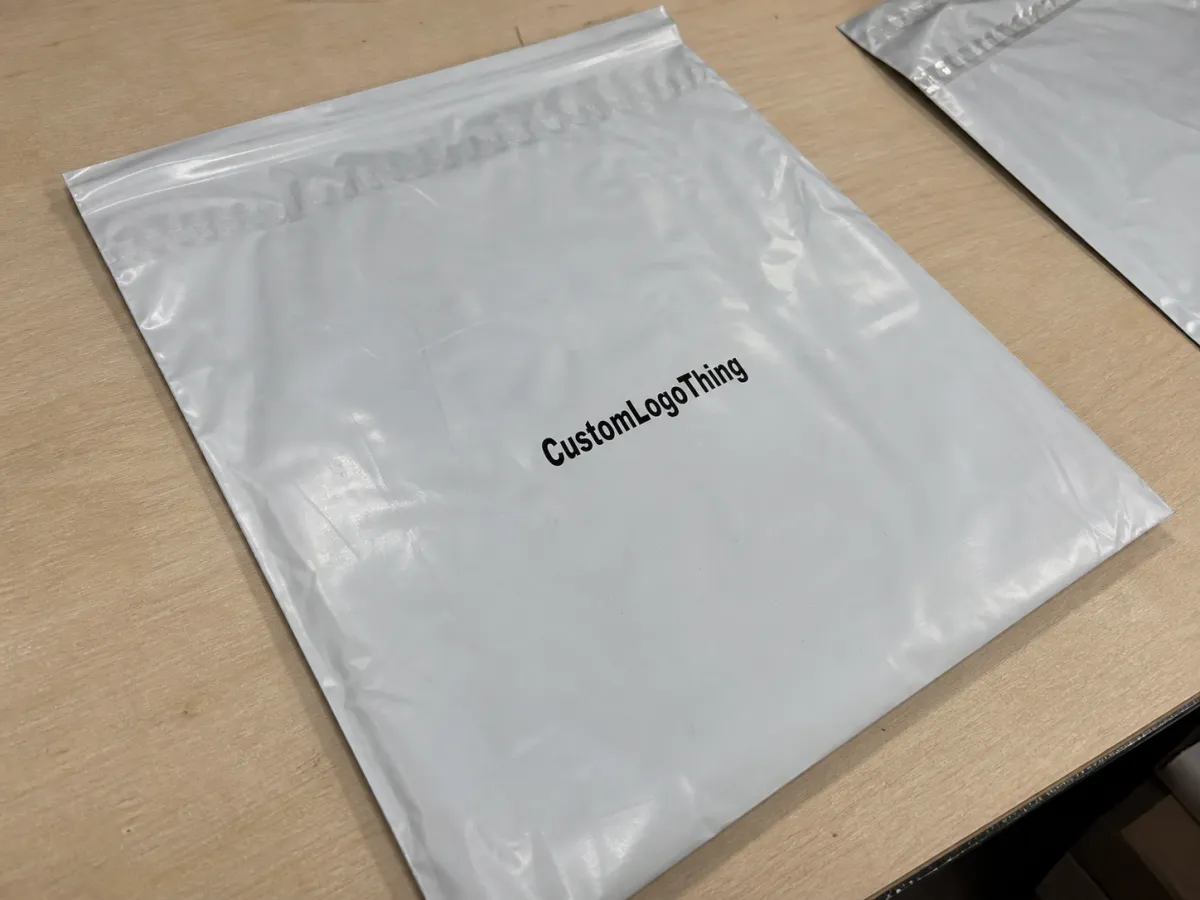
Trade show giveaways have to pass a few tests at once. They need to be easy to display, easy to hand out, and useful enough that people keep them long enough to matter. Recycled Poly Mailers score well on all three. A box of them takes far less booth space than rigid promo items, and the stack does not collapse into visual clutter the way assorted sample kits and premium gift boxes often do.
There is also a logistics angle that buyers sometimes overlook. Mailers are cheap to move relative to their utility, especially when the event team needs extra stock or when the giveaway doubles as a return-shipping envelope. That flexibility matters at crowded shows where booth storage is limited and every carton competes with display materials, inventory, and the inevitable pile of literature nobody planned to receive.
The sustainability story is stronger too, but only if the claim is handled carefully. Buyers should ask what “recycled” actually means: post-consumer content, post-industrial content, or a blend. Those details affect the environmental message, the look of the film, and sometimes the strength of the material. A recycled-content mailer is not automatically better than a standard one if it fails in use. Good intentions do not hold seams together.
For event teams comparing packaging formats, the main question is fit. A mailer should survive the event, not merely photograph well in a pitch deck. If the contents are brochures, stickers, or light samples, a recycled poly mailer can outperform heavier alternatives because it does the job without creating dead weight. If the load includes hard-edged items or multiple products, the spec needs to reflect that reality instead of optimism.
“A giveaway works best when the attendee can carry it without resenting the weight.”
Some buyers also use the same mailer after the show for outbound sample fulfillment or replacement shipments. That second life improves the cost story. It also tends to improve acceptance inside the company, because packaging that serves two functions is easier to justify than packaging that exists only for one weekend and one badge scan.
Specs Buyers Should Lock Before Requesting Samples
Start with the build, not the sample. Sampling before the spec is fixed usually produces confusion, not insight. The factory may send a material that looks right but is too thin, too glossy, or too small once the actual contents go in. By the time that is discovered, the production clock has already started moving.
Four decisions should be locked first: recycled-content target, film thickness, finished size, and closure type. After that, print method and packing instructions matter more than most people expect. If those basics are vague, the quote will be vague too. That is not a factory problem. It is a briefing problem.
Recycled content deserves a real discussion. Some buyers only need a recycled-content claim that supports a campaign message. Others need documentation for internal sustainability reporting or customer-facing compliance language. If recycled content is part of the story, ask for the supporting paperwork early. The same rule applies to any environmental claim. A brochure line is not a substitute for material proof.
Thickness affects both price and performance. For trade show use, many buyers land between 2.0 mil and 3.5 mil. Light literature packs can work at the low end. Sample kits, catalog bundles, or items with harder edges usually need more film. Once the build moves above 4.0 mil, the cost climbs, but so does the chance that the mailer survives a full day of repeated handling without splitting at the seam.
Use one measurement system and stick to it. Mixing mils and microns in the same RFQ creates avoidable mistakes. So does writing “standard size” instead of dimensions. The factory should not have to infer whether the intended finish is a 9 x 12 mailer, a larger sample pouch, or a custom size built around the product rather than the logo.
Closure style changes the whole user experience. A peel-and-seal strip is the default for most promotional mailers because it is cheap, familiar, and fast. Tear strips help if the item is meant to be reused. Zip closures are more convenient, but they add cost and can complicate production. For a pure giveaway, simpler is often better. Fancy does not always translate into useful.
Printing also needs a decision. One-color logos are the least expensive and often the cleanest. Two-color artwork adds clarity without pushing the job into the higher-cost range too quickly. Full-bleed branding looks strong, but it increases setup pressure and can raise waste if the art is tight. Matte finishes usually read as more premium; gloss tends to look brighter and more promotional.
If the mailer has to support hand-carry, check puncture resistance and seal strength, not just appearance. If the contents include hard corners, ask for a little more room around the load. A design that fits perfectly in CAD can fail once actual products, inserts, and human hands get involved. Packaging rarely fails in theory. It fails in the hallway, after someone has already walked away from the booth.
Trade Show Giveaway Recycled Poly Mailers Factory Quote Checklist
A strong RFQ is specific enough that three different suppliers can quote the same job without rewriting it. That is the whole point. If a request forces the factory to interpret the size, guess the print method, or assume the delivery terms, the quote is already compromised before pricing begins.
- Finished size: Give exact outer dimensions and, if needed, the usable interior space.
- Material spec: State the recycled-content target and whether the film is single-layer or co-extruded.
- Thickness: Specify mil or microns clearly and consistently.
- Closure: Note peel-and-seal, tear strip, zip, or another closing method.
- Print details: Include logo placement, number of colors, Pantone references, and whether full bleed is required.
- Artwork files: Send vector art when possible; low-resolution files slow proofing and can distort line work.
- Quantity breaks: Ask for pricing at multiple volumes, such as 1,000, 3,000, and 5,000 units.
- Packing: Confirm bulk packed, carton count, palletization, and any labeling rules for receiving.
- Shipping terms: Provide the full delivery address and clarify whether the quote should include freight.
- Deadline: Give the actual event date and the receiving deadline, not the preferred date.
- Proofing: Ask for digital mockups and state whether a physical pre-production sample is required.
That list sounds simple, but it prevents most of the back-and-forth that slows this category down. The most common omission is print detail. The second is shipping. A factory can usually price a mailer faster than it can untangle an unclear destination or an artwork file that was exported as a screenshot.
Ask for the quote to show landed cost if possible. Factory price alone can be misleading, especially when the shipment is large but light. Air freight on bulky cartons can erase the savings from a low unit price. Ocean freight is cheaper, but only if the timeline can absorb the transit. A quote that ignores shipping is not finished; it is just optimistic.
One practical test helps here: if the RFQ cannot be forwarded to another supplier without edits, it is not ready. Clean input gives cleaner comparisons. It also reduces the chance that procurement ends up comparing one supplier’s real quote against another supplier’s assumption.
If a broader packaging buy is happening at the same time, keep the same level of detail across cartons, inserts, and event supplies. A fragmented brief creates mismatched pricing and makes the sourcing team spend time reconciling versions instead of evaluating numbers. The paperwork should be boring. Boring is efficient.
For buyers looking beyond mailers, a wider packaging catalog can help keep spec standards aligned across related items. See Custom Packaging Products for adjacent formats that can be quoted with the same discipline.
Pricing, MOQ, and Unit Cost Drivers You Can Actually Control
Recycled poly mailer pricing is driven by a small set of variables, and most of them are under the buyer’s control. Size, thickness, print complexity, recycled-content target, and special features such as zip closures or extra-heavy film all affect cost. So does quantity. That part is unavoidable.
Typical pricing moves in a predictable way. A simple 2.0 to 2.5 mil mailer with one-color print may quote in the low range at 1,000 units, then drop noticeably by 5,000 units. As a rough buying benchmark, small runs often land around $0.45 to $0.90 per piece before freight, while larger standard runs can fall roughly into the $0.18 to $0.38 range depending on spec and print. Custom sizes, extra thickness, or specialty closures can push the price higher quickly.
MOQ behaves the same way. Factories have setup costs for film, printing, inspection, and packing. Spreading those costs across fewer units raises the per-piece price. Buying more can lower unit cost, but only if the stock will actually move. Excess promo inventory is not a savings account. It is a storage problem with a label on it.
Freight deserves the same scrutiny as the unit price. Mailers are light, but they occupy space. That makes them awkward for air freight and sometimes not as cheap to move as buyers expect. If the event is near enough for ground delivery, the landed cost may be much better than a rushed air shipment. If the show is overseas, shipping time and customs clearance become part of the pricing story whether procurement likes it or not.
| Spec Choice | Typical Cost Impact | Best Use Case |
|---|---|---|
| 2.0-2.5 mil, one-color print | Lowest | Light brochures, short-run events, simple branding |
| 3.0-3.5 mil, two-color print | Moderate | Standard giveaways with better durability and presentation |
| 4.0 mil+, custom size, full-bleed print | Highest | Heavy samples, premium branding, reuse as a shipping mailer |
| Standard size, bulk packed | Best logistics value | Warehouse receiving, fast handling, lower labor cost |
Upgrades should earn their place. A thicker film is worth paying for if the contents are sharp-edged or heavy. Pantone matching matters if the mailer is part of a multi-event campaign and the brand color has to hold up across every touchpoint. A fancy finish is harder to justify if the mailer is only meant to move from booth to tote bag and disappear for the rest of the day.
The useful question is not “What looks premium?” It is “What changes use?” A stronger seal changes use. Better opacity can change use if the contents need to stay private. A decorative effect rarely does. That distinction keeps the quote grounded in function instead of presentation theater.
Production Steps, Proofing, and Lead Time for Event Deadlines
The production flow is straightforward: quote, artwork review, proof approval, material preparation, printing, curing, inspection, packing, and dispatch. Each step sounds harmless until one gets delayed. Then the event calendar starts looking smaller than it did last week.
For simple orders, production can often move in roughly 10 to 15 business days after proof approval. Custom sizes, multiple print colors, heavy film, or specialty packing can stretch that to 15 to 25 business days or more. Add pre-production samples, holiday shutdowns, or sea freight, and the timeline changes fast. Buyers who wait until the booth graphics are already on the truck usually learn this the hard way.
Most delays are predictable. The artwork file is wrong. The bleed is missing. The logo has been flattened into a low-resolution image. Someone asks for a color tweak after the proof has already been signed off. None of these are dramatic failures. They are routine, which is exactly why they are so expensive.
QC should be specific, not vague. Ask the factory what will be checked before shipment: print registration, seal integrity, film gauge, bag dimensions, carton count, and visual defects such as smudges or misprints. If the mailer has a small logo, a slight registration error can look fine on screen and obvious in person. Small branded items have a way of magnifying small mistakes.
Build in extra time for trade show freight. Even if production finishes on schedule, carrier delays, receiving appointments, and dock restrictions can still compress the margin. A safe plan usually includes at least one buffer week for domestic deliveries and more if the shipment crosses borders. A quote that arrives on time is not the same thing as inventory that arrives on time.
One more detail matters more than buyers expect: packing format. Bulk packed cartons are easier to receive and cheaper to move. Retail-style bagging adds labor. Pallet labels, carton marks, and warehouse instructions can change receiving speed too. If those details are missing from the RFQ, the paperwork may look clean while the shipment causes trouble at the dock.
For teams managing multiple event items, the best control point is consistency. Keep the same approval sequence for every product: spec confirmation, artwork sign-off, proof review, packing check, delivery confirmation. That reduces surprises. It also makes it easier to see where the timeline is slipping before the deadline turns into a panic.
How to Order Cleanly and Keep the Giveaway From Falling Flat
The cleanest purchase starts with the load, not the logo. Choose the mailer size around the actual contents. Confirm the recycled-content target. Decide whether the mailer only needs to be handed out or whether it also needs to function as a shipping envelope later. Then request quotes from multiple suppliers using the exact same spec sheet. That is the only fair comparison.
Before approving production, request a digital proof and, if the artwork is tight or the mailer is a key branded item, a physical sample. Confirm carton count, ship-to address, and the receiving window in writing. If the event team needs spare inventory, say so now. Extras are much easier to add before production than after the first hundred pieces disappear from the booth.
The most common mistakes are repetitive because they are so easy to make. The logo is too small to read from a few feet away. The color match is acceptable in a PDF but off under venue lighting. The mailer was sized for the artwork instead of the product. Or the buyer skipped the reorder buffer and then discovered that “just in case” quantities were never included.
Procurement tends to prefer one thing above all: a quote that already answers the questions everyone else would have asked later. Size, thickness, print method, MOQ, packing, lead time, and delivery terms should be visible in one place. If the supplier has to clarify all of that later, the quote was not complete. It was a draft.
A good final brief is short but detailed. One file, one approved spec sheet, one delivery destination list, and one date that matters. That is enough to produce usable pricing and, more importantly, enough to keep the giveaway from becoming a late-stage scramble dressed up as sourcing.
What should I include in a recycled poly mailers factory quote request for trade shows?
Include finished size, recycled-content target, thickness, closure style, print colors, quantity breaks, artwork files, packing format, shipping destination, and the event deadline. If the quote also needs freight, say so clearly. The fewer assumptions the factory has to make, the cleaner the pricing will be.
How do I choose the right size for trade show giveaway recycled poly mailers?
Choose the size based on the actual giveaway load, not the artboard or the logo placement. Test the mailer with brochures, inserts, or sample kits before locking the spec. Oversized mailers increase cost and freight without solving the real problem.
What affects MOQ and unit cost the most on custom recycled poly mailers?
Quantity, film thickness, print complexity, custom sizing, and closure features have the largest impact. Higher recycled-content targets can also affect cost if the material blend is harder to source. Larger runs usually lower unit price, but only if the inventory will be used.
How long is the usual production lead time after proof approval?
Simple orders can move in roughly 10 to 15 business days after approval, while more complex specs usually take longer. Add time for samples, freight, customs, and receiving appointments. A delay of just a few days in proofing can affect the entire event schedule.
Can recycled poly mailers be used as both a giveaway bag and shipping mailer?
Yes, if the film strength, seal quality, opacity, and size are chosen with both uses in mind. Ask for puncture resistance and load expectations if the mailer will carry samples or return shipments. If it only needs to function as a booth giveaway, the spec can usually be simpler and less expensive.


