Trade Show Buyers make packaging decisions fast. A recycled poly mailer can look polished in a mockup and still feel too soft, seal poorly, or print darker than expected once it arrives in hand. That gap between screen and reality is exactly why the Trade Show Giveaway Recycled Poly mailers Sample Approval Checklist matters: it keeps a good idea from becoming a weak handout on the show floor.
From a buyer’s point of view, the sample has three jobs. It has to carry the brand, survive handling, and fit the giveaway item without looking improvised. Miss one of those, and the whole booth story gets thinner. People notice when a giveaway bag feels cheap, even if nobody says it out loud.
“If the sample feels wrong in your hand, bulk production will not fix it later.”
Why recycled mailer samples get rejected on the booth floor
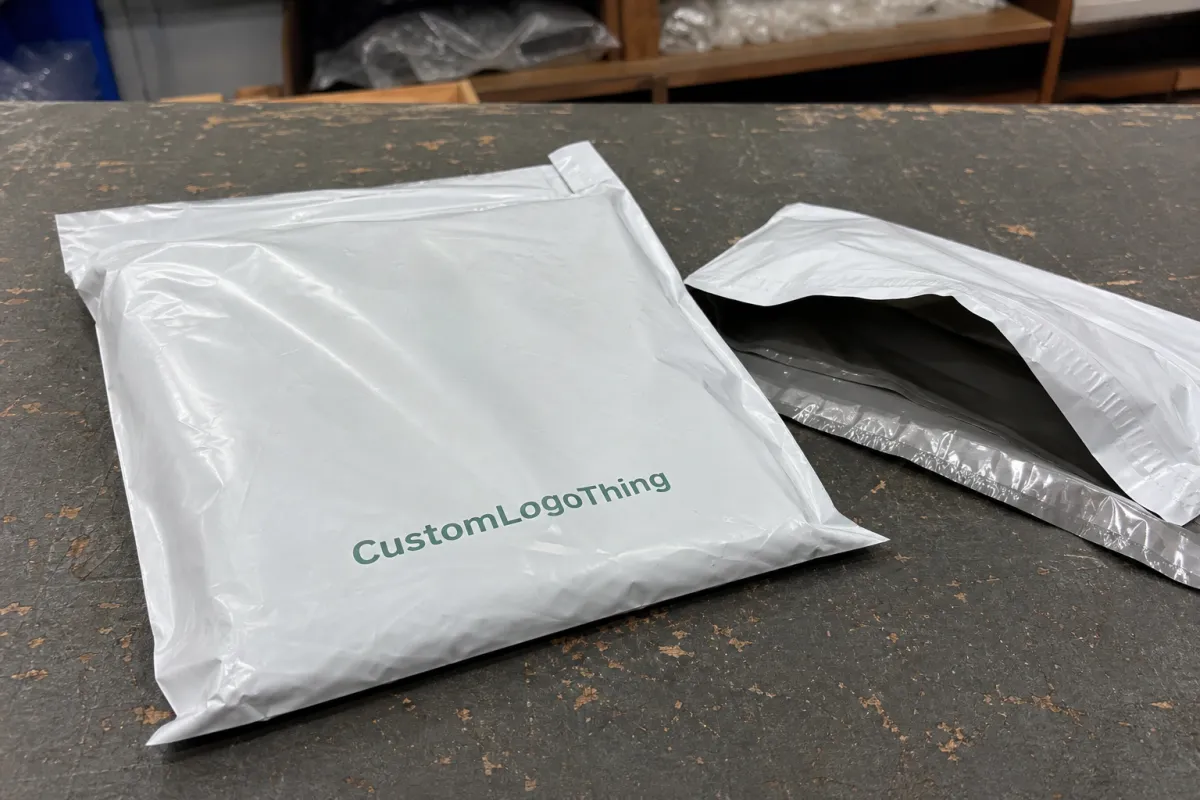
The first rejection trigger is often texture. A recycled poly mailer may look crisp online, then arrive with a softer hand, an odd slickness, or a stiffer feel than expected. Booth staff touch these bags all day, and attendees usually notice the packaging before they notice the fine print. A visual proof alone misses the details that matter in real use.
Color is another common problem. Bright exhibit lighting can push a logo darker, flatter, or more washed out than the proof suggested. Dark ink on translucent film can lose edge definition. Light ink on frosted material can disappear at a glance. If the logo is meant to anchor the giveaway, the sample needs to prove it can hold up under glare, shadows, and fluorescent lighting.
Function is where many approvals fail. A mailer that seals weakly or splits at the seam might be acceptable on a mockup board, but it becomes a liability when staff are stuffing, stacking, and handing out hundreds of pieces. A good trade show bag opens cleanly, closes securely, and carries the item without buckling at the top edge or tearing at the corners.
Consistency matters too. If the first carton looks one shade off from the next, or if the print drifts from bag to bag, the booth display starts to look careless. Buyers usually read that as weak process control, even when the supplier stayed within a loose tolerance. Sample approval exists to catch those shifts before they show up in production.
- Visual check: logo clarity, color accuracy, and print placement.
- Tactile check: thickness, stiffness, and surface feel.
- Functional check: seal strength, seam integrity, and fit with the giveaway item.
- Brand check: does the bag feel appropriate for the booth environment and the audience?
Trade Show Giveaway Recycled Poly Mailers Sample Approval Checklist
The Trade Show Giveaway Recycled Poly mailers sample approval checklist should cover the finished dimensions, recycled content claim, thickness, closure style, print placement, and behavior when the bag is filled. If a supplier cannot state those details clearly, that is already useful information. Samples are for confirming specifics, not for admiring vague promises.
Approval should not live with one department alone. Marketing needs to confirm the visual story and brand fit. Procurement needs to review price, minimum order quantity, and freight. The booth or operations team needs to verify that the bag works with the item it will hold. One person should own the final decision, though. If “everyone gets a say,” the sample often stalls forever.
- Measure the finished size and compare it to the actual giveaway item, not a rough estimate.
- Confirm recycled content claims and make sure the spec sheet or quote describes the material consistently.
- Check print placement, bleed, and edge clearance on the physical sample.
- Test the closure several times to see whether it seals cleanly and stays closed.
- Inspect seams and corners for weak welds, pinholes, or uneven edges.
- Load the real giveaway item and handle the bag the way booth staff will.
- Write revisions directly on the sample or spec sheet so the approved version is obvious later.
A PDF proof is not approval. It never shows seam strength, surface finish, or how the material behaves under real handling. If the supplier sends multiple versions, label them clearly: Rev A, Rev B, Rev C. That sounds basic, but version confusion is how teams approve the wrong bag because someone replied to the wrong thread.
Keep the sample check tied to the broader event kit if the bag is part of a larger package. A useful comparison point is Custom Poly Mailers alongside other Custom Packaging Products, especially when the booth uses inserts, outer cartons, or retail-style handouts.
Material, print, and finish factors that change approval
Recycled content affects more than the claim on the spec sheet. It can change opacity, stiffness, and the overall hand feel. A higher recycled blend may look a little less glossy or feel less crisp, which can be exactly right for an eco-forward brand. It is not right if the buyer expected a premium giveaway and received something too thin or too soft for the booth floor.
Material thickness deserves real attention. Many lightweight mailers sit around 2.5 to 3.0 mil, while heavier promotional runs often move closer to 3.0 to 4.0 mil when durability matters. Those are practical planning ranges, not standards. A thinner film can reduce cost and shipping weight. A heavier film usually improves puncture resistance and reuse value, which matters if attendees are likely to carry the bag around after the event.
Print method matters just as much. Full-color graphics can look rich, but heavy ink coverage on film can scuff during shipping or booth handling. Spot colors can stay cleaner, but only if registration holds tightly. If the logo must remain readable under bright lights, ask for the sample to be viewed from a few feet away, not only at arm’s length. That is closer to how it will actually be seen.
Closure style and seam design are the quiet details that often decide approval. A self-seal strip should close firmly without wrinkling the top edge. Heat seals should hold through stuffing and repeated handling. Side seams and bottom seams need enough strength for the actual contents, not an empty bag on a desk. If the mailer is meant to be reused, it should survive more than one open-and-close cycle.
Finish can shift the decision too. Matte film usually reads as more subdued and often feels premium, but it can mute color slightly. Gloss makes graphics pop, but it can show scuffs faster. Frosted surfaces sit between those two. None of these is automatically better. The right choice depends on the brand story, the contents, and the way the bag will be handed out.
For sustainability claims, ask for documentation where possible. The EPA has practical guidance on recycled materials and environmental claims at EPA recycling resources, and ISTA provides packaging testing context for transit and handling at ISTA. You do not need a lab report for every order, but you do need enough evidence to avoid guessing.
Pricing, MOQ, and unit cost drivers to compare
Price is driven by size, thickness, recycled blend, print count, and extras such as special finishes or heavier closures. Larger bags use more film. Thicker bags use more material. More colors usually add setup cost. There is no mystery there, but the quote can still be misleading if the line items are not read carefully.
MOQ is where a lot of teams get tripped up. A lower quantity can look inexpensive per unit at first glance, then jump once setup, plates, freight, and handling are added. If you only compare unit price, you are not comparing total cost. You are comparing the number that looks best in an email.
| Option | Typical MOQ | Sample Cost | Approx. Unit Cost | Best For |
|---|---|---|---|---|
| Standard recycled poly mailer, one-color print | 1,000-3,000 | $25-$75 | $0.18-$0.32 | Simple booth giveaways with tighter budgets |
| Midweight mailer, two-color print | 3,000-5,000 | $40-$100 | $0.24-$0.42 | Brand-heavy promotions that need cleaner graphics |
| Thicker mailer with premium finish | 5,000+ | $60-$150 | $0.35-$0.65 | Higher-value giveaways and reusable handouts |
Those numbers change with order size, artwork coverage, and freight method, so treat them as planning ranges, not promises. Ask whether sample charges are credited back against the production order. Some suppliers apply them later. Some do not. That detail belongs in the quote before the approval conversation starts.
Land cost matters as much as factory price. Trade show deliveries often need carton labels, direct-to-venue shipping, or a tighter receiving window than standard warehouse freight. A mailer that looks cheaper at the factory can become more expensive once it is packed for the show dock. That is another reason the Trade Show Giveaway recycled poly mailers sample approval checklist should sit beside pricing review, not after it.
Process, turnaround, and lead time checkpoints
The cleanest approval flow is simple: request quote, confirm specs, review the sample, collect revisions, lock approval, and release production. The weak point is usually internal timing. The factory may be ready while three departments are still deciding whether the bag feels more “premium” or more “practical.” That delay can eat the schedule fast.
Sample turnaround and production lead time are not the same thing. A sample may take a few business days to produce and ship, while the full run may take 12 to 20 business days after approval, sometimes longer for large quantities or more complex print setups. If those timelines get blurred together, the event date becomes the problem instead of the packaging.
Most delays come from missing dimensions, artwork edits, or slow feedback. If the giveaway item itself is still changing, finalize that first. A mailer designed around the wrong size is a waste of time and material. It also helps to assign one decision owner and one backup. A long chain of approvals is not the same thing as control.
For planning, build in at least one full review cycle and add buffer before the trade show shipping cutoff. If the order is going direct to the venue, add more time for receiving rules, dock hours, and carton count verification. Trade show logistics tend to punish optimism.
- Sample request: 1-3 business days to confirm specs and artwork.
- Sample production and transit: often 5-10 business days depending on complexity.
- Revision loop: add 2-5 business days if changes are needed.
- Production run: commonly 12-20 business days after approval.
- Shipping buffer: keep extra time for venue delivery or cross-country freight.
If the mailers need to arrive with other booth materials, coordinate them with the rest of the package rather than sending them separately. That avoids carton mismatches and split deliveries that force someone to babysit the dock. Nobody wants that job on a show week.
Common sample approval mistakes to avoid
The biggest mistake is approving from digital mockups alone. Screen color, material feel, and closure performance can all shift once the physical sample arrives. A mockup is useful for direction, but it is not a substitute for the real item. Treat it like a sketch, not the final say.
Another easy miss: testing the mailer empty. A bag may look perfect until it is loaded with the giveaway item and the top edge starts buckling or the seal stops lining up. Always test with the actual contents, then handle it the way booth staff will. Pack it. Carry it. Stack it. That is where flaws show up.
Too many reviewers can also slow the process into a standstill. Marketing wants branding, operations wants fit, procurement wants price, and someone from leadership wants one more change. Pick one final approver, or the sample can drift through a loop of polite opinions. Most packaging failures are not technical. They are decision failures.
Another common issue is weak documentation. Color tolerance, quantity, ship-to address, and revision level should be confirmed before production starts. Memory is a bad control system. Email is imperfect, but it still beats “I thought we agreed on the other shade.”
If the sample needs a second pass, that is not failure. It is cheaper to catch a seam issue or a print shift on a sample than in a bulk order that is already on the truck. That is the point of the trade show giveaway recycled poly mailers sample approval checklist: controlled friction now, fewer expensive surprises later.
A final trap is assuming recycled content alone makes the bag suitable for the booth. Sustainability claims matter, but if the mailer feels flimsy or the print looks dull, attendees will remember the weakness first. Buyers usually want both: a responsible material story and a package that can survive a packed event schedule.
Expert review tips before you sign off
If color coverage or film thickness matters, ask for two sample variants. Compare them under the same lighting and with the same contents. A bag can feel different just because one version uses a slightly heavier gauge or a different recycled blend. Side-by-side is more useful than memory.
Use a pass-or-fail grid. Keep it simple: size, print, seam, closure, and pack-out. Do not let the review drift into vague preference language. “I sort of like this better” sounds helpful and tells the team almost nothing. A checklist works because it forces the conversation back to measurable points.
Photograph the approved sample beside a ruler and the actual giveaway item. Save those images with the spec sheet, revision notes, and quote. The next reorder will move faster if the reference sample is easy to find and nobody has to search through unlabeled boxes. Label it with supplier name, revision level, and approval date.
For buyers who need a stronger sustainability story, ask whether the recycled-content claim can be supported clearly on the paperwork. If the brand is using insert cards or outer packaging as part of the set, check those components too. FSC is more relevant for paper pieces than for the poly mailer itself, but the whole kit still needs one coherent message.
- Compare under one light source so color judgment stays consistent.
- Load the actual giveaway before approving size or seal strength.
- Keep one master sample for future reorders and supplier reference.
- Document the pass/fail result in the same file as the quote and artwork.
One more practical check helps more than people expect: place the filled mailer on a scale if weight matters for shipping or booth handling. The difference between a light handout and a heavier kit can change carton count, freight estimates, and how quickly staff can prep giveaways during setup. Small details turn into real costs when you multiply them by hundreds or thousands of pieces.
Next steps to lock approval and place the order
Once the sample passes, turn it into a locked spec sheet with exact size, material, print setup, carton count, and delivery details. That sheet should be the source of truth for procurement, marketing, and the booth team. If approval lives only in email, someone will eventually remember it wrong.
Send the final spec to everyone who needs it, then get one written sign-off before the PO is released. If the order is going direct to a trade show venue, verify the receiving window, labeling requirements, and ship-to address before production starts. A perfect mailer sent to the wrong dock still fails the job.
After that, schedule the run with a realistic buffer and track artwork and freight status closely. If a revision appears after approval, make sure the change is intentional and documented. Tiny edits have a habit of becoming expensive edits.
For teams buying through a larger packaging program, it helps to connect the mailer order with the rest of the event kit so cartons, inserts, and handouts all arrive together. The trade show giveaway recycled poly mailers sample approval checklist should be the final gate, not a loose reference someone half-remembers two weeks before booth day.
That is usually the difference between a handout that feels considered and one that looks rushed. Good approval discipline does not make the process glamorous. It does make the outcome harder to mess up.
How many recycled poly mailer samples should I approve before ordering a trade show giveaway run?
Approve at least one physical sample, and ask for a second version if print color, thickness, or closure performance is critical. Test it with the actual giveaway item so you can judge fit, seal strength, and handling before production.
What should a trade show giveaway recycled poly mailers sample approval checklist include?
Include finished size, recycled content, thickness, print placement, closure type, seam strength, and carton pack-out. Add ship-to details and a clear sign-off owner so the approval is traceable and not buried in email.
How much does sampling add to the total cost of recycled poly mailers?
Sampling is usually a small part of the full order, but freight, rush review, and revision fees can add up fast. Ask whether sample charges are credited back on the production run before comparing supplier quotes.
How long does the sample approval process usually take?
Plan for one sample review cycle plus a revision window, then separate that from the actual production lead time. The biggest delay is often internal feedback, not the factory, so set one decision deadline and stick to it.
What is the most common mistake buyers make with trade show mailer approvals?
They approve from mockups instead of a physical sample, then discover the color, feel, or seal is not what they expected. They also forget to test the mailer with the real giveaway item, which is how fit problems slip into production.
Buyers do not need more theory. They need a sample that looks right, feels right, and works under trade show pressure. Keep the checklist tight, document every revision, and approve the physical sample before you commit to bulk. That is how you get a clean handout instead of a box of regrets.


