Pricing trade show Woven Label Beanies moq is less about finding the cheapest hat and more about buying an item that can survive the show floor, the shipping carton, and the follow-up photos after everyone gets home. A beanie is one of the few promotional pieces that still feels useful once the booth tear-down starts. That matters. So does the detail level, because a label that reads clearly under convention lighting does more for brand recall than a crowded logo ever will.
The strongest trade show merch usually has a short life in the booth and a long life afterward. A woven label beanie fits that pattern well. It works for staff uniforms, sponsor kits, VIP packs, and attendee giveaways without looking disposable. It also avoids some of the production problems that come with oversized embroidery or full-color printing on stretchy knitwear. The result is a piece that feels deliberate, not improvised.
There is a practical reason buyers keep returning to this format. The item is compact, the branding surface is predictable, and the minimum order is often lower than people expect if the base beanie is stocked. The challenge is not whether the product can be made. The challenge is choosing the right knit, label size, and delivery plan before the deadline starts narrowing.
Why Woven Label Beanies Win at Busy Trade Shows
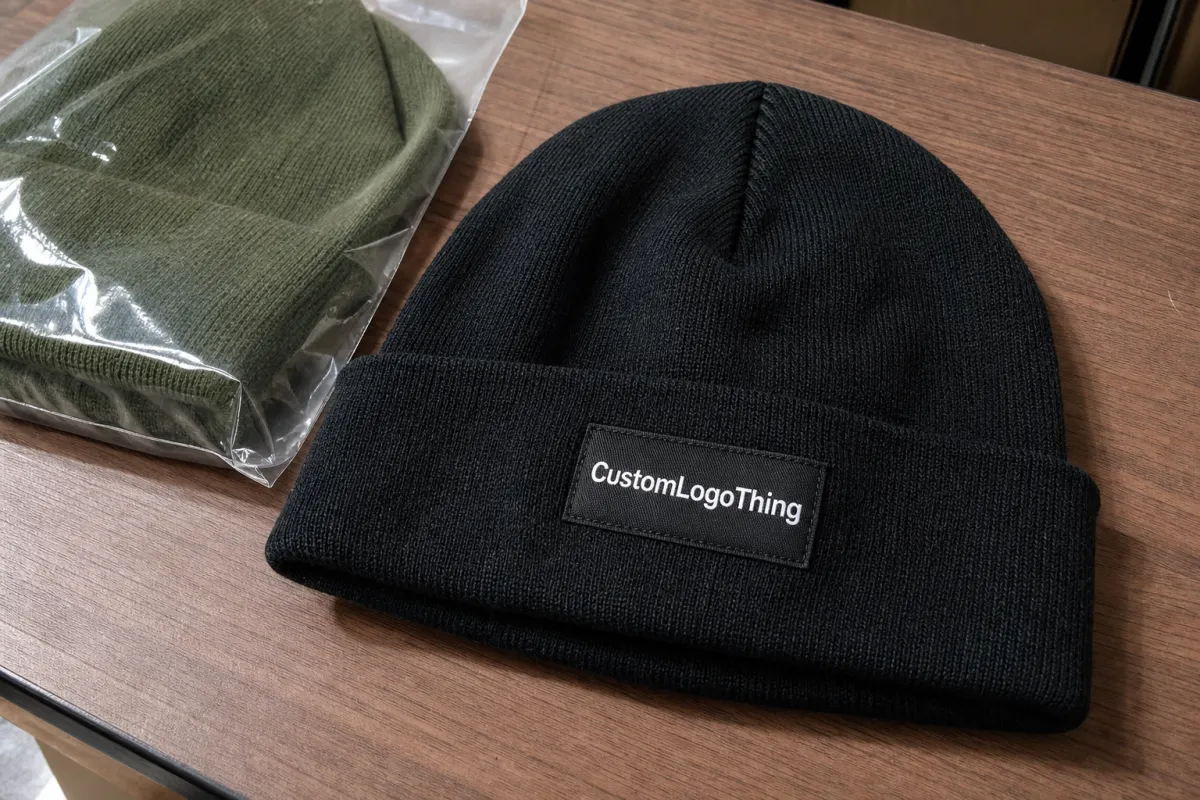
Trade show aisles are noisy visually. Badges swing, banners crowd the sightlines, and people are usually reading from three to eight feet away while moving. That is why woven labels make sense. They give you a clean brand mark on a flat cuff without forcing the logo to do too much work. If the design is legible at a glance, it has already done its job.
Embroidery has its place, but tiny text can fill in and lose edge on knit fabric. Printed patches can look crisp, yet they often lack the tactile finish that makes a giveaway feel worth keeping. A woven label sits in the middle. It holds detail better than chunky stitching, and it looks more intentional than a sticker or heat transfer that belongs on packaging, not apparel.
The real advantage is wearability. A beanie that feels good gets used. It gets carried, worn on travel days, and photographed long after the show is over. That creates more impressions than a branded item that gets left on a hotel desk. For event teams, that is the metric that matters: not how fast the item leaves the booth, but how often it reappears later.
There is another reason the format keeps working. It is easy to scale. A simple stock beanie with a one-color woven label can be tested at a lower quantity, while a larger campaign can move into custom colors and more refined finishing. That flexibility is useful for event marketers who do not want to commit to 1,000 units before seeing the response from the first activation.
A good giveaway does not need to shout. It needs to stay in use after the booth lights are off.
Label Placement, Knit Finish, and Color Choices That Read Fast
Placement decides whether the label looks premium or awkward. Front cuff placement is the standard choice because the fold creates a neat, visible panel. Side placement can work for a quieter brand mark or a smaller event graphic. Back cuff placement is useful for sponsor names, taglines, or a secondary message. Sewn tabs are subtle and useful when the brand wants restraint, but they disappear faster in a crowded hall.
Beanie style changes the read as much as label design does. Cuffed beanies are the easiest to brand because the fold gives the label a clear frame. Slouch beanies feel looser and more casual, which can fit lifestyle brands or younger audiences. Rib-knit constructions tend to hold shape better, which matters if the merch needs to look polished in photos and on staff. Fisherman styles feel heavier and more substantial, but they are not always the best choice for warmer venues.
Texture also affects how the label looks. A tight gauge knit gives a cleaner finish and supports a more precise label edge. Looser knits can stretch the surface and make the label sit less cleanly. That does not mean loose knits are a problem. It means the artwork and placement need to be chosen with the knit structure in mind. Buyers often think only about the logo. The knit is what determines whether the logo lands well.
Color contrast is the quickest way to keep a label readable. Black on white. White on navy. Charcoal on heather gray. Those combinations work because the eye can separate the brand mark from the ground instantly. Tonal branding can look more refined, but it demands cleaner artwork and tighter control over placement. If the audience has only a second or two to notice the item, subtle color matching may be too subtle.
Label size should stay restrained. A common woven label size on a cuff sits around 35 x 25 mm to 50 x 30 mm, depending on the beanie and the amount of detail in the artwork. Smaller than that, and the text can collapse into a blur. Bigger than that, and the label starts to dominate the garment. Most good trade show pieces sit in the middle: enough room for a logo, perhaps a short line of text, and a border that keeps the shape tidy.
The inside finish matters more than many buyers expect. A label can look sharp on the outside and still feel scratchy if the back side, seam allowance, or stitching is rough. Ask how the label is secured, whether the edges are soft enough for bare skin, and whether the construction will cause itch at the forehead after a few hours. People may forgive a plain look. They do not forgive an uncomfortable one.
Specs to Lock Before You Request a Quote
Before anyone can quote trade show Woven Label Beanies moq accurately, the order needs to be defined in plain terms. Not mostly defined. Defined. That starts with the base style, then the yarn blend, label size, label placement, fit, and packing method. If any of those pieces are vague, the quote will wander and the sample approval will slow down.
- Beanie style: cuffed, slouch, rib-knit, fisherman, or fully custom knit.
- Yarn blend: acrylic, acrylic/polyester, recycled polyester, or wool blend if the budget allows it.
- Fit: adult, youth, relaxed, or close-fit.
- Label format: sewn woven label, fold-over label, side tab, or back-cuff placement.
- Packaging: bulk packed, individual polybag, belly band, or hangtagged.
- Shipping plan: one destination, split shipment, warehouse receiving, or direct-to-show.
Artwork quality affects the order more than buyers expect. Woven labels are clean, but they are not a miracle fix for overly detailed files. Thin strokes, tiny text, gradients, and decorative shading usually need cleanup before production. Vector artwork is the safest starting point because it keeps edges sharp and lets the supplier adjust the weave without guessing.
Color references should be handled with discipline. Pantone calls are useful, but only if they are tied to the actual label and yarn options available. A supplier can usually get close, though exact matches depend on fiber, dye lot, and the weave construction. That is one reason proofs matter. A screen mockup is not a production sample, and it should never be treated as one.
Packaging is not an afterthought if the beanies are going to a convention center or a distribution warehouse. Bulk packing reduces cost and is fine for internal teams. Individual polybags or folded bands add cost, but they make the item easier to distribute at registration tables, in sponsor boxes, or in retail-style presentations. If the order needs inserts, request paper stock early so the pack-out does not become a last-minute scramble.
For buyers comparing finish options across apparel and accessories, our Custom Labels & Tags page is a useful reference point before finalizing the beanie spec.
Trade Show Woven Label Beanies MOQ, Pricing, Setup, and Unit Cost
The MOQ question usually comes first, and it should. Minimums are where the economics of the order become clear. A stock beanie with a woven label can sometimes start around 100 pieces, especially if the design is simple and the supplier already stocks compatible colors. As the order becomes more specific, the minimum often rises. That is normal. More customization usually means more handling, more setup, and more material control.
Production pricing is shaped by four things more than anything else: quantity, label complexity, yarn choice, and packaging. Some suppliers call the one-time setup charge a tooling fee. Others call it a sample prep charge. The name changes. The math does not. Buyers should always separate one-time costs from recurring unit cost so they can see the real break-even point.
| Order level | Typical MOQ | Typical cost per piece | One-time charges | Best fit |
|---|---|---|---|---|
| 100 pieces | Often possible with stock beanies | $8.50-$13.00 | $50-$120 setup/tooling | Small booth tests, VIP drops |
| 250 pieces | Common sweet spot | $6.25-$9.25 | $40-$100 setup/tooling | Regional shows, staff gear, sponsor kits |
| 500 pieces | Best bulk pricing leverage | $4.95-$7.25 | Setup spread across more units | Multi-show seasons, larger activations |
Those numbers are realistic for straightforward branded beanies with a woven label. They move upward if the order adds special yarns, extra colors, mixed label placements, or more elaborate packaging. Recycled yarns and wool blends can also shift the price, especially if the finish needs additional control to keep the hand feel comfortable. Low pricing is useful. A low price that creates a rough product is not.
There is a simple rule on unit cost: the cleaner the order, the better the price. One design. One packing method. One ship-to address. Split shipments, rush handling, and mixed versions of the same beanie push the quote up. The buyer who wants a lower per-piece cost should avoid adding complexity after the first price is already in motion.
Presentation can justify some of that cost. A belly band, hangtag, or individual polybag adds a little to the unit number, but those details improve how the item is received at the booth. For press kits and sponsor packs, that added polish often pays for itself in how the item is handled. For staff giveaways, bulk packing is usually the smarter choice. The right answer depends on the use case, not on a blanket rule.
Another piece buyers should watch is label color count. A one- or two-color woven label is usually the easiest path to stable pricing. More color shifts can work, but the weave becomes denser and the setup more particular. The result may still be worth it if the artwork is strong. It is rarely worth it if the extra color is only there because the original logo file was never simplified for fabric.
Process, Proofs, and Production Lead Time for Show Deadlines
The best production process is ordinary. Inquiry. Quote. Artwork check. Digital proof. Revision if needed. Sample approval. Production. Shipping. If a supplier cannot explain that sequence clearly, the order is already carrying unnecessary risk. Event apparel lives on deadlines, so the process needs to be predictable before it is quick.
For a clean order, a quote often comes back within 1 to 2 business days if the quantity and artwork are ready. Proofing usually takes another day or two, depending on how much the label needs to be simplified. Physical samples are worth requesting when the label placement, yarn texture, or color match is sensitive. For simple stock beanies, a digital proof may be enough if the artwork is already clean and the buyer is comfortable with the yarn options.
Typical production runs are often 2 to 4 weeks after proof approval for standard custom runs. Fully custom knit styles take longer because the knitting process itself is more involved and color control has more points of failure. Rush production is possible on some orders, but rush does not erase freight time or receiving schedules. A beanie that arrives after the event is still a finished product. It just missed the reason it was bought.
Convention centers do not care that a factory finished on time. They care whether the cartons arrived during the receiving window.
Lead time problems usually show up in three places. First, the artwork is not vector-ready and the proof cycle drags. Second, the color approval is loose, which leads to extra sampling. Third, the delivery details are incomplete, so the shipment lands at the wrong dock or too early for receiving. The fastest orders are usually the ones with the least ambiguity.
For teams that need a better handle on sample timing, file formats, and packing rules, our FAQ covers the basics without turning the order into a sales conversation.
There is also a packaging detail that gets overlooked more often than it should: inserts. If the beanies need printed cards, keep the paper spec consistent with the rest of the order. FSC-certified stock is a sensible default if the project includes printed material. It keeps the presentation cleaner and avoids a late-stage substitution that makes the pack-out look careless.
Why Event Teams Reorder Through a Specialist Supplier
Repeat orders are where a specialist supplier proves useful. Trade show merch is rarely a one-time event. The same beanie might move through a spring conference, a regional roadshow, and an end-of-year summit. If the first run is documented correctly, the second order becomes a reuse of tested decisions rather than a new round of guesswork.
That consistency matters more than buyers sometimes admit. Stored specs prevent brand drift. Approved proofs keep the logo from changing scale. Notes on yarn, fit, and label position save time when the next event calendar fills up. A supplier with event experience should be able to answer straightforward questions without creating new complications: What is the MOQ? Can the order be split? How does the pricing change if the label color changes? Can one order ship to more than one event location?
The cost savings usually come from fewer mistakes, not from dramatic discounts. A buyer who can point to the last approved file and the last approved packaging plan gets a cleaner reorder and fewer revisions. That is especially helpful for agencies managing several activations at once. It is also useful when a brand wants the same look across different products.
If your team uses woven labels on other items too, keeping a stable source for Custom Labels & Tags helps maintain the same visual language across apparel, bags, and inserts. That consistency is easy to miss until a new batch suddenly looks slightly off. Then it becomes expensive.
Specialist suppliers also tend to be more direct about production limits. They know when a yarn choice will affect stretch, when a finer weave might not survive the label size, and when a rush request is not realistic for the current shipment lane. That honesty matters. A flattering answer is not useful if the carton misses the show floor.
What to Send for a Fast Quote and Clean Production Start
If you want a fast quote, send the information that changes price first. Quantity. Deadline. Destination. Artwork. Beanie style. Label placement. Packaging. Budget range. That is enough for a supplier to build a real estimate instead of a placeholder number that has to be rewritten later.
- Quantity: total units and any split by color, size, or location.
- Deadline: the actual event date or receiving deadline.
- Ship-to: booth, warehouse, office, or fulfillment center.
- Artwork: vector file preferred, with Pantone notes if available.
- Style choice: cuffed, slouch, rib-knit, or custom knit.
- Packaging: bulk pack, polybag, banded, or hangtagged.
- Budget: target spend or acceptable range.
Two questions speed the process more than most buyers expect: do you need a sample, and do you need split shipping? If the answer is yes to either, say so at the start. Those decisions affect timing, freight, and sometimes the whole pack-out plan. Waiting until the third email to mention them usually creates preventable delays.
A good order path is simple. Choose the style first. Then pick the label size. Then decide on color contrast. Then confirm packaging. Then lock the shipping method. Trying to solve all five at once usually creates a muddy quote and a slower approval cycle. Clean inputs create cleaner pricing.
For many event teams, it helps to ask for two versions of the quote: one built for the lowest possible unit cost, and one built for a stronger presentation. That comparison makes the tradeoff visible. A bulk-packed beanie may be cheaper. A banded or polybagged version may be easier to hand out and better suited to VIP kits. Neither is automatically right. The use case decides.
Trade show merch should do three things well: read fast, travel well, and remain useful after the event. Trade show Woven Label Beanies moq can hit all three if the artwork is tight, the label is sized correctly, and the lead time is handled with enough margin. The weak point is usually not the product itself. It is the assumption that a show deadline can absorb last-minute changes.
What is the usual MOQ for trade show woven label beanies?
Most orders land in the 100 to 300 piece range, though the exact minimum depends on whether the beanie is stock, custom knit, or built with special packaging. Simpler artwork and stock yarns usually support lower minimums. More colors, more detail, or custom construction usually move the MOQ higher.
How long do woven label beanies take to produce for a booth deadline?
Quote and proofing can often be completed in 1 to 2 business days if the artwork is ready. Standard production commonly runs 2 to 4 weeks after approval. Rush work is possible on some projects, but freight and receiving windows still have to fit the event schedule.
Can I get a sample before placing a full order?
Yes. A sample is sensible when label placement, texture, or color match matters to the final result. Digital proofs are usually enough for simple orders, but physical samples reduce risk on premium or high-visibility projects. Sample fees may be credited on larger production orders, depending on the supplier and the project size.
What affects unit cost the most on woven label beanies?
Quantity is the biggest driver because larger runs lower the per-piece cost. After that, yarn choice, label complexity, packaging, and shipping method shape the final number. Rush production and split delivery usually add cost.
What artwork works best for woven labels on beanies?
Bold logos, clean lines, and short text work best because woven labels have limited detail compared with print. Vector files are the safest starting point, since they keep edges crisp during proofing and production. Thin strokes, gradients, and tiny type often need simplification before the weave can be approved.


